Anuradha: Difference between revisions
From All Skies Encyclopaedia
Anuradha
No edit summary |
No edit summary |
||
| (3 intermediate revisions by the same user not shown) | |||
| Line 1: | Line 1: | ||
{{DISPLAYTITLE:}} | {{DISPLAYTITLE:Anuradha (अनुराधा)}} | ||
[[File: | [[File:Anuradha nakshatras in Temple draw+lbl 4ase.jpg|thumb|Anuradha nakshatra in Tirupperunthurai (Athmanathaswamy temple) near Aranthangi, India, 10th century CE. (SMH 2025).]] | ||
[[File:17-19 nakshatra stellarium.gif|thumb|The nakshatras 17, 18, 19 mapped to the Stellarium star chart; Anuradha is the westernmost (right) one.]] | [[File:17-19 nakshatra stellarium.gif|thumb|The nakshatras 17, 18, 19 mapped to the Stellarium star chart; Anuradha is the westernmost (right) one.]] | ||
Anuradha (अनुराधा) is an Indian name, used by the Indian Vedic tradition. Most of these names are roughly 3000 years old. They pre-date Hinduism but were taken over by it. | |||
==Etymology and History== | ==Etymology and History== | ||
'''Name Variants''' | |||
* Anuradha | |||
* Maitra | |||
== Mythology == | === Origin of Constellation=== | ||
Anuradha means "following Radha". It is an asterism depicted as consisting of four stars. They are typically identified with β, δ, φ and ρ Scorpii, a rather recognizable configuation that forms almost a straight line. The same line forms the Chinese constellation [[Fang]]. | |||
====Stars within the Constellation Area==== | |||
{| class="wikitable sortable mw-collapsible" | |||
|+ | |||
|- | |||
!id | |||
!Label | |||
!IAU design. | |||
!description | |||
!Vmag | |||
|- | |||
|1 | |||
|Dschubba | |||
|HIP 78401 | |||
|Constellation lines (Vertex) | |||
|2.32 | |||
|- | |||
|2 | |||
|Acrab | |||
|HIP 78820 | |||
| Constellation lines (Vertex) | |||
|2.5 | |||
|- | |||
|3 | |||
|Acrab | |||
|HIP 78820 | |||
| Constellation lines | |||
|2.62 | |||
|- | |||
|4 | |||
|Fang | |||
|HIP 78265 | |||
|Constellation lines | |||
|2.91 | |||
|- | |||
|5 | |||
|Iklil | |||
|HIP 78104 | |||
|Constellation lines (Vertex) | |||
|3.86 | |||
|- | |||
|6 | |||
|ω 1 Scorpii | |||
|HIP 78933 | |||
|Inside the hull | |||
|3.97 | |||
|- | |||
|7 | |||
|Jabbah | |||
|HIP 79374 | |||
| Constellation lines (Vertex) | |||
|4 | |||
|- | |||
|8 | |||
|ω 2 Scorpii | |||
|HIP 78990 | |||
|Inside the hull | |||
|4.33 | |||
|- | |||
|9 | |||
|Jabbah A | |||
| HIP 79374 | |||
|Constellation lines (Vertex) | |||
| 4.349 | |||
|} | |||
===Transfer and Transformation of the Constellation=== | |||
<gallery> | |||
File:Nakshatras in Temple draw+lbl 4ase.jpg|Display of all 28th nakshatra in a door frame in Tirupperunthurai (Athmanathaswamy temple) near Aranthangi, India, 10th century CE. (SMH 2025). | |||
File:Nakshatra temple magDraw lbl.jpg|Display of all 28th nakshatra in silver arch with candles in Tirupperunthurai (Athmanathaswamy temple) near Aranthangi, India, 10th century CE. (SMH 2025). | |||
File:Anuradha nakshatras in Temple draw+lbl 4ase.jpg|Anuradha in Tirupperunthurai (Athmanathaswamy temple) near Aranthangi, India, 10th century CE. (SMH 2025). | |||
File:17 Anuradha draw.png|Anuradha reconstructed by Jones (1720). | |||
</gallery> | |||
==Mythology == | |||
mnemonic tales and cultural significance | mnemonic tales and cultural significance | ||
== Weblinks == | ==Weblinks== | ||
*{{NAMESPACE}} | |||
==References== | |||
*[[References]] (general) | |||
[[Category:Indian]] [[Category:Asterism]] [[Category:Constellation]][[Category:Eurasia]][[Category:South Asian]] | [[Category:Indian]] | ||
[[Category:Asterism]] | |||
[[Category:Constellation]] | |||
[[Category:Eurasia]] | |||
[[Category:South Asian]] | |||
[[Category:Zodiac]] | [[Category:Zodiac]] | ||
Latest revision as of 17:20, 14 December 2025


Anuradha (अनुराधा) is an Indian name, used by the Indian Vedic tradition. Most of these names are roughly 3000 years old. They pre-date Hinduism but were taken over by it.
Etymology and History
Name Variants
- Anuradha
- Maitra
Origin of Constellation
Anuradha means "following Radha". It is an asterism depicted as consisting of four stars. They are typically identified with β, δ, φ and ρ Scorpii, a rather recognizable configuation that forms almost a straight line. The same line forms the Chinese constellation Fang (房宿).
Stars within the Constellation Area
| id | Label | IAU design. | description | Vmag |
|---|---|---|---|---|
| 1 | Dschubba | HIP 78401 | Constellation lines (Vertex) | 2.32 |
| 2 | Acrab | HIP 78820 | Constellation lines (Vertex) | 2.5 |
| 3 | Acrab | HIP 78820 | Constellation lines | 2.62 |
| 4 | Fang | HIP 78265 | Constellation lines | 2.91 |
| 5 | Iklil | HIP 78104 | Constellation lines (Vertex) | 3.86 |
| 6 | ω 1 Scorpii | HIP 78933 | Inside the hull | 3.97 |
| 7 | Jabbah | HIP 79374 | Constellation lines (Vertex) | 4 |
| 8 | ω 2 Scorpii | HIP 78990 | Inside the hull | 4.33 |
| 9 | Jabbah A | HIP 79374 | Constellation lines (Vertex) | 4.349 |
Transfer and Transformation of the Constellation
-
 Display of all 28th nakshatra in a door frame in Tirupperunthurai (Athmanathaswamy temple) near Aranthangi, India, 10th century CE. (SMH 2025).
 -
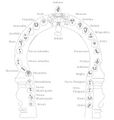 Display of all 28th nakshatra in silver arch with candles in Tirupperunthurai (Athmanathaswamy temple) near Aranthangi, India, 10th century CE. (SMH 2025).
 -
 Anuradha in Tirupperunthurai (Athmanathaswamy temple) near Aranthangi, India, 10th century CE. (SMH 2025).
 -
 Anuradha reconstructed by Jones (1720).


Mythology
mnemonic tales and cultural significance
Weblinks
References
- References (general)





