DU.ŠE.E GU4.UD: Difference between revisions
DavidHilder (talk | contribs) No edit summary |
|||
| (14 intermediate revisions by 3 users not shown) | |||
| Line 1: | Line 1: | ||
< | DU.ŠE.E GU<sub>4</sub>.UD (𒁺𒊺𒂊𒄞𒌓) is perhaps a name for Mercury implying KAŠ<sub>x</sub>.E = GU<sub>4</sub>.UTU | ||
{{DISPLAYTITLE:DU.ŠE.E GU<sub>4</sub>.UD}} | {{DISPLAYTITLE:DU.ŠE.E GU<sub>4</sub>.UD}} | ||
{{Template:Mercury}} | |||
=== | == Concordance, Etymology, History<ref>[[Mesopotamian (All Terms)|Planetarium Babylonicum 2.0]], All Skies Encyclopaedia.</ref> == | ||
This writing occurs once in what is apparently a commentary to a line of Enuma Anu Enlil (ACh Suppl.<ref>''Ch. Virolleaud'', L'astrologie chaldéenne S(in); Shamasz; Isht(ar); Adad; S/Supp. = Supplément; SS / 2.Supp. = Second Supplément (Paris 1905 - 1912)</ref>, 7:44, now K.75+ rev. 16'). The signs DU and ŠE when interposed (DU׊E) have the reading KAŠ<sub>4</sub> = ''lasāmu'', 'to run fast'. Here we have the two signs written consecutively (DU.ŠE) for which we can suppose a reading KAŠ<sub>x</sub> allowing for a rendering KAŠ<sub>x.</sub>.E = ''lāsimu'' ,'fast runner, fleet-footed,' as a name for the planet Mercury 'GU<sub>4</sub>.UTU.' [Gössmann<ref>''Gössmann P.F''. Planetarium Babylonicum, Rom, 1950 (A. Deimel. Šumerisches Lexikon 4/2).</ref> 107*, CAD<ref>''The Assyrian Dictionary of the Oriental Institute of the University of Chicago.'' Chicago - Glückstadt, 1956 -...</ref> L 106; AHw<ref>''Soden von W''. Akkadisches Handwörterbuch. Wiesbaden, 1985.</ref>, 539; Borger 1978<ref>''Borger R''. Assyrish-babylonische Zeichenliste. Kevelaer: Butzon und Bercker; Neukirchen-Vluyn: Neukirchener Verlag, 1978.</ref>, 107, Nr. 202; 2004, 317, Nr. 350]. If so, we have here a precursor to the identification of the planet with the fleet footed Roman messenger deity Mercury, and of the Greek Hermes. | |||
The DU sign can be read KAŠ<sub>5</sub>, and may be used instead of KAŠ<sub>4</sub> in KAŠ<sub>4</sub>.E = ''lāsimu'' "runner, messenger". [AHw<ref>''Soden von W''. Akkadisches Handwörterbuch. Wiesbaden, 1985.</ref>, 539; Borger 1978<ref>''Borger R''. Assyrish-babylonische Zeichenliste. Kevelaer: Butzon und Bercker; Neukirchen-Vluyn: Neukirchener Verlag, 1978.</ref>, 107, Nr. 202; 2004, 317, Nr. 350]. In the Mesopotamian pantheon there was the deity <sup>d</sup>Lāsimu [Tallqvist 1938<ref>''Tallqvist K''. Akkadische Götterepitheta. Helsingforsiae, 1938.</ref>, 346]. If this assumption is correct, the name takes on an astronomical meaning and could mean: "Fast-moving - Mercury"(?). | |||
==Historical Dictionaries== | ==Historical Dictionaries== | ||
{| class="wikitable" | {| class="wikitable" | ||
|- | |- | ||
!Kurtik (2022)!!Gössmann (1950) | !Kurtik (2022, d12)!!Gössmann (1950) | ||
|- | |- | ||
|[G. 107*]; только в [ACh Suppl., 7:44] в неясном контексте. | |[G. 107*]; только в [ACh Suppl., 7:44] в неясном контексте. | ||
| Line 27: | Line 21: | ||
[[Category:Mesopotamian]] | [[Category:Mesopotamian]] | ||
[[Category: | [[Category:Sumerian]] | ||
[[Category:West Asian]] | [[Category:West Asian]] | ||
[[Category:Eurasia]] | [[Category:Eurasia]] | ||
[[Category:Cuneiform]] | [[Category:Cuneiform]] | ||
[[Category:Planet]] | |||
[[Category:Solar System]] | |||
[[Category:Mercury]] | |||
Latest revision as of 17:55, 6 January 2026
DU.ŠE.E GU4.UD (𒁺𒊺𒂊𒄞𒌓) is perhaps a name for Mercury implying KAŠx.E = GU4.UTU
Images of Mercury
-
 Mercury seen at Dawn in Namibia (SMH 2001).
 -
 Mercury at Dawn in Central Europe (SMH 2924).
 -
 Mercury at Dawn in Central Europe with Label (SMH 2024).
 -
 Mercury at Dawn in Central Europe (SMH 2024).
 -
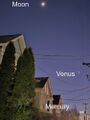 Mercury and Venus in comparison to the young lunar crescent (Providence 2025).
 -
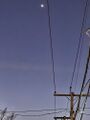 Mercury and Venus at dusk (Providence 2025).


Concordance, Etymology, History[1]
This writing occurs once in what is apparently a commentary to a line of Enuma Anu Enlil (ACh Suppl.[2], 7:44, now K.75+ rev. 16'). The signs DU and ŠE when interposed (DU׊E) have the reading KAŠ4 = lasāmu, 'to run fast'. Here we have the two signs written consecutively (DU.ŠE) for which we can suppose a reading KAŠx allowing for a rendering KAŠx..E = lāsimu ,'fast runner, fleet-footed,' as a name for the planet Mercury 'GU4.UTU.' [Gössmann[3] 107*, CAD[4] L 106; AHw[5], 539; Borger 1978[6], 107, Nr. 202; 2004, 317, Nr. 350]. If so, we have here a precursor to the identification of the planet with the fleet footed Roman messenger deity Mercury, and of the Greek Hermes.
The DU sign can be read KAŠ5, and may be used instead of KAŠ4 in KAŠ4.E = lāsimu "runner, messenger". [AHw[7], 539; Borger 1978[8], 107, Nr. 202; 2004, 317, Nr. 350]. In the Mesopotamian pantheon there was the deity dLāsimu [Tallqvist 1938[9], 346]. If this assumption is correct, the name takes on an astronomical meaning and could mean: "Fast-moving - Mercury"(?).
Historical Dictionaries
| Kurtik (2022, d12) | Gössmann (1950) |
|---|---|
| [G. 107*]; только в [ACh Suppl., 7:44] в неясном контексте.
Знак DU допускает прочтение KAŠ5 и может употребляться вместо KAŠ4 в выражении KAŠ4.E = lāsimu «бегун, курьер» [AHw, 539; Borger 1978, 107, Nr. 202; 2004, 317, Nr. 350]. В месопотамском пантеоне существовало божество dLāsimu [Tallqvist 1938, 346]. Если данное предположение верно, название приобретает астрономический смысл и может означать: «Быстро движущийся — Меркурий»(?). |
Example |
References
- ↑ Planetarium Babylonicum 2.0, All Skies Encyclopaedia.
- ↑ Ch. Virolleaud, L'astrologie chaldéenne S(in); Shamasz; Isht(ar); Adad; S/Supp. = Supplément; SS / 2.Supp. = Second Supplément (Paris 1905 - 1912)
- ↑ Gössmann P.F. Planetarium Babylonicum, Rom, 1950 (A. Deimel. Šumerisches Lexikon 4/2).
- ↑ The Assyrian Dictionary of the Oriental Institute of the University of Chicago. Chicago - Glückstadt, 1956 -...
- ↑ Soden von W. Akkadisches Handwörterbuch. Wiesbaden, 1985.
- ↑ Borger R. Assyrish-babylonische Zeichenliste. Kevelaer: Butzon und Bercker; Neukirchen-Vluyn: Neukirchener Verlag, 1978.
- ↑ Soden von W. Akkadisches Handwörterbuch. Wiesbaden, 1985.
- ↑ Borger R. Assyrish-babylonische Zeichenliste. Kevelaer: Butzon und Bercker; Neukirchen-Vluyn: Neukirchener Verlag, 1978.
- ↑ Tallqvist K. Akkadische Götterepitheta. Helsingforsiae, 1938.





