SIPA.ZI.AN.NA: Difference between revisions
No edit summary |
DavidHilder (talk | contribs) No edit summary |
||
| Line 7: | Line 7: | ||
* = ''šitadallu'' (''šidallu, šitaddaru''); Akkadian parallel (Kurtik sh14 <sup>(mul)</sup>''Šitaddaru''(''m'') (344)) | * = ''šitadallu'' (''šidallu, šitaddaru''); Akkadian parallel (Kurtik sh14 <sup>(mul)</sup>''Šitaddaru''(''m'') (344)) | ||
** 1) constellation in Orion (Orion), | ** 1) constellation in Orion (Orion), | ||
** 2) designation of the zodiac sign Gemini in later texts [CAD Š/3, 128; | ** 2) designation of the zodiac sign Gemini in later texts [CAD<ref name=":0">''The Assyrian Dictionary of the Oriental Institute of the University of Chicago.'' Chicago and Glückstadt, 1956 - 2010</ref> Š/3, 128; Gössmann 1950<ref name=":1">''Gössmann P.F''. Planetarium Babylonicum, Rom, 1950 (A. Deimel. Šumerisches Lexikon 4/2).</ref>, 348; BPO 2<ref name=":2">''Reiner E., Pingree D''. Enuma Anu Enlil, Tablets 50-51. Malibu, Undena Publications, 1981 (Babylonian Planetary Omens: Part Two).</ref>, 14]. See also (Kurtik b01) [[BALUM|<sup>d</sup>BA.LIM]], (Kurtik i01) [[I3-li2-ab-rat|<sup>d</sup>''I''<sub>3</sub>-''li''<sub>2</sub>-''ab-rat'']], (Kurtik p05) [[PAP.SUKKAL|<sup>d</sup>PAP.SUKKAL]], (Kurtik s21) [[SIPA]]. | ||
Hoffmann and Krebernik (2023).<ref>Hoffmann, S. M. and Krebernik, M. (2023). What do deities tell us about the celestial positioning system, in: R. Rollinger, I. Madreiter, M. Lang, C. Pappi (eds.). The Intellectual Heritage of the Ancient Near East, Papers held at the 64th Rencontre Assyriologique International and 12th Melammu Symposium July 16-20 2018, Innsbruck. Austrian Academy of Sciences Press, 539-579</ref> <blockquote>The sumerogram means “true shepherd of heaven”. Its Akk. equivalent has several variants; in the earliest attestations (OB prayer to the Gods of the Night) it appears as ''ši-ta-(ad)-da-ru''. The etymology is opaque. If the equation SIPA.E.NE ‘herdsmen’ = ''ti-ša-at-talu'' in a lexical text from Emar is not a secondary development, it could point to an ancient term for “shepherd”. cf. Selz 1998 [Fs. Römer, AOAT253], 300: “Damit dürfte die Verbindung unserer Berufsbezeichnung [scil. NAMEŠDA] mit der Šita-Waffe, der als Wurfkeule bekannten Hirtenwaffe, außer Zweifel stehen.” Ancient scribes, assuming a Sum. origin *šita-ta-ra(-a), explained the Akk. term as ''ša ina kakki maḫṣu'' “he who was slain with the weapon”. For references see CAD Š/3 128 s.v. ''šitadallu''. <sup>mul</sup>SIPA.ZI.AN.NA (AN 7l). For the twins in front of <sup>mul</sup>SIPA.ZI.AN.NA see ''LatSAA 8''.</blockquote> | Hoffmann and Krebernik (2023).<ref>Hoffmann, S. M. and Krebernik, M. (2023). What do deities tell us about the celestial positioning system, in: R. Rollinger, I. Madreiter, M. Lang, C. Pappi (eds.). The Intellectual Heritage of the Ancient Near East, Papers held at the 64th Rencontre Assyriologique International and 12th Melammu Symposium July 16-20 2018, Innsbruck. Austrian Academy of Sciences Press, 539-579</ref> <blockquote>The sumerogram means “true shepherd of heaven”. Its Akk. equivalent has several variants; in the earliest attestations (OB prayer to the Gods of the Night) it appears as ''ši-ta-(ad)-da-ru''. The etymology is opaque. If the equation SIPA.E.NE ‘herdsmen’ = ''ti-ša-at-talu'' in a lexical text from Emar is not a secondary development, it could point to an ancient term for “shepherd”. cf. Selz 1998 [Fs. Römer, AOAT253], 300: “Damit dürfte die Verbindung unserer Berufsbezeichnung [scil. NAMEŠDA] mit der Šita-Waffe, der als Wurfkeule bekannten Hirtenwaffe, außer Zweifel stehen.” Ancient scribes, assuming a Sum. origin *šita-ta-ra(-a), explained the Akk. term as ''ša ina kakki maḫṣu'' “he who was slain with the weapon”. For references see CAD Š/3 128 s.v. ''šitadallu''. <sup>mul</sup>SIPA.ZI.AN.NA (AN 7l). For the twins in front of <sup>mul</sup>SIPA.ZI.AN.NA see ''LatSAA 8''<ref name=":3">''Hunger H.'' Astrological Reports to Assyrian Kings. Helsinki, 1992 (State Archives of Assyria, VIII).</ref>.</blockquote> | ||
==== Sources and Identification(s) ==== | ==== Sources and Identification(s) ==== | ||
| Line 16: | Line 16: | ||
|- | |- | ||
|'''Lexical texts.''' | |'''Lexical texts.''' | ||
* (1) Unilingual Sumerian lists: <sup>mul</sup>sipa.zi.an.na [MSL XI, 108:395; 133, col. viii 40; 143, col. x 17]. | * (1) Unilingual Sumerian lists: <sup>mul</sup>sipa.zi.an.na [MSL XI<ref>''Materials for the Sumerian Lexicon''. Vol. XI. The Series HAR-ra = ''hubullu.'' Tablets XX-XXIV. Ed. by E.Reiner with the coll. of M.Civil. Roma, 1974.</ref>, 108:395; 133, col. viii 40; 143, col. x 17]. | ||
* (2) Urra XXII series: <sup>mul</sup>sipa.e.ne = ''ti-ša-at-ta-lu'' [Emar VI/4, 151:155], mul <sup>d</sup>sipa.zi.an.na = ''ši-dal-lu'' [MSL XI, 30, 10:4], [<sup>mul</sup>si]pa. zi.an.na = ''ši-t''[''a-d'']''a-rum'' [Cavigneaux 1979, 17:9], <sup>mul</sup>sipa.zi.an.na = ''ši-ta-ad''-[''a-ru''] [Cavigneaux 1981, 79.B.1 /5 iv 2], <sup>mu[l]</sup>sipa.zi.an.na = ''ši-da-al-lu-''[''u''] [SpTU III, 114A v 18; Bloch-Horowitz 2015, 105:274ʹ]. | * (2) Urra XXII series: <sup>mul</sup>sipa.e.ne = ''ti-ša-at-ta-lu'' [Emar VI/4<ref>''D. Arnaud''. Texte de la bibliothèque, transcriptions et traductions, 1987. (= Emar 6/4).</ref>, 151:155], mul <sup>d</sup>sipa.zi.an.na = ''ši-dal-lu'' [MSL XI, 30, 10:4], [<sup>mul</sup>si]pa. zi.an.na = ''ši-t''[''a-d'']''a-rum'' [Cavigneaux 1979<ref>''Cavigneaux A.'' // Baghdader Mitteilungen 10, 132-134.</ref>, 17:9], <sup>mul</sup>sipa.zi.an.na = ''ši-ta-ad''-[''a-ru''] [Cavigneaux 1981<ref>''Cavigneaux A.'' Textes scolaires du temple de Nabû ša Harê. Texts from Babylon I. Baghdad, 1981.</ref>, 79.B.1 /5 iv 2], <sup>mu[l]</sup>sipa.zi.an.na = ''ši-da-al-lu-''[''u''] [SpTU III<ref name=":4">''Špätbabylonische Texte aus Uruk.'' Teil III / Bearb. von Weiher E. von. Berlin, 1988.</ref>, 114A v 18; Bloch-Horowitz 2015<ref>Bloch, Y. and W. Horowitz (2015): “Urra = hubullu XXII: The Standard Recension,” , Journal of Cuneiform Studies 67: 71-125.</ref>, 105:274ʹ]. | ||
* (3) Series Ḫg. B VI: <sup>mul</sup>sipa.zi.an.na = ŠITA<sub>2</sub>.DAR = ''ša''<sub>2</sub> ''ina kak-ki maḫ-ṣi'' [MSL XI, 41:44], <sup>mul</sup>sipa.zi.an.na = (skip) = ŠITA<sub>2</sub>.DA.[AL<sup>?</sup>] [SpTU III, 116 iii 13]. | * (3) Series Ḫg. B VI: <sup>mul</sup>sipa.zi.an.na = ŠITA<sub>2</sub>.DAR = ''ša''<sub>2</sub> ''ina kak-ki maḫ-ṣi'' [MSL XI, 41:44], <sup>mul</sup>sipa.zi.an.na = (skip) = ŠITA<sub>2</sub>.DA.[AL<sup>?</sup>] [SpTU III<ref name=":4" />, 116 iii 13]. | ||
| | | | ||
|- | |- | ||
|'''"Prayers to the Gods of the Night."''' | |'''"Prayers to the Gods of the Night."''' | ||
* (1) Old Babylonian prayer: | * (1) Old Babylonian prayer: | ||
** (a) Erm. 15642: ''ši-ta-ad-da-da-ru-um'' [Horowitz 2000, 196-197:18], and also [Shileiko 1924, 147; Dossin 1935, 180; Von Soden 1936, 306], | ** (a) Erm. 15642: ''ši-ta-ad-da-da-ru-um'' [Horowitz 2000<ref>''Horowitz W.'' Astral Tablets in the Hermitage, Saint Petersburg // ZA. 2000. Bd. 90. S. 194-206.</ref>, 196-197:18], and also [Shileiko 1924<ref>''Шилейко В.К''. Таблетка с молитвой ночным богам в собрании Лихачева //ИРАИМК. 1924, Т. 3, Ленинград, с. 144-152.</ref>, 147; Dossin 1935<ref name=":5">''Dossin G''. Prières aux “Dieux de la nuit” (AO 6769) // RA 32, № 4, 179-190.</ref>, 180; Von Soden 1936<ref>''von Soden W.'' Ein Opferschaugebet bei Nacht // ZA. 1936. Bd. 43 (N.F. 9), S. 305-308.</ref>, 306], | ||
** (b) AO 6769: ''ši-ta-da-da-ru'' [Dossin 1935, 181-182:18]. | ** (b) AO 6769: ''ši-ta-da-da-ru'' [Dossin 1935<ref name=":5" />, 181-182:18]. | ||
* (2) Hittite prayer: <sup>mul</sup>''Ši-pa-zi-a-na'' [KUB IV, 47 r. 44; BPO 2, 2:8; Van der Toorn 1985, 130:44]. | * (2) Hittite prayer: <sup>mul</sup>''Ši-pa-zi-a-na'' [KUB<ref>''Keilschrifturkunden aus Boghazköi'' (''Berlin'').</ref> IV, 47 r. 44; BPO 2<ref name=":2" />, 2:8; Van der Toorn 1985<ref>''K. van der Toorn.'' Sin and Sanction in Israel and Mesopotamia. A Comparative Study. Maastricht, Van Gorcum, 1985.</ref>, 130:44]. | ||
* (3) Neo-Assyrian prayer: [<sup>mul</sup>SI]PA.ZI.AN.NA [Oppenheim 1959, 283:14]. | * (3) Neo-Assyrian prayer: [<sup>mul</sup>SI]PA.ZI.AN.NA [Oppenheim 1959<ref>''Oppenheim A.L.'' A New Prayer to the “Gods of the Night” // Analecta biblica. 1959. Vol. 12. P. 282-301.</ref>, 283:14]. | ||
| | | | ||
|- | |- | ||
|'''EAE.''' | |'''EAE.''' | ||
See. [Rochberg-Halton 1988, 62, 214 EAE 20 XII Rec. C: 7', 215 EAE 20 XII Rec B Source S r. 44, 218 EAE 20 Source Y:14, 285 App. 2.4 r. 26, 289-290; BPO 2, III 3b, 30-30a, IX 4, 14, X 4, XIV 8, XV 33-35, XVI 2, XVII 12, XVIII 1-3, 6-10; BPO 3, 286; Largement 1957, 246:61; NSAM 2, 249; SpTU I, 93:7'; SpTU IV, 162 r. 13]. | See. [Rochberg-Halton 1988<ref name=":6">''Rochberg-Halton F''. Aspect of Babylonian Celestial Divination: The Lunar Eclipse Tablets of Enuma Anu Enlil. Horn, 1988 (AfO, Beiheft 22).</ref>, 62, 214 EAE 20 XII Rec. C: 7', 215 EAE 20 XII Rec B Source S r. 44, 218 EAE 20 Source Y:14, 285 App. 2.4 r. 26, 289-290; BPO 2<ref name=":2" />, III 3b, 30-30a, IX 4, 14, X 4, XIV 8, XV 33-35, XVI 2, XVII 12, XVIII 1-3, 6-10; BPO 3<ref name=":7">''Reiner E., Pingree D''. Babylonian Planetary Omens. Part Three. Groningen, STYX Publications. 1998.</ref>, 286; Largement 1957<ref name=":8">''Largement R.'' Contribution à l’Etude des Astres errants dans l’Astrologie chaldéenne // ZA 18, 235-264.</ref>, 246:61; NSAM 2<ref name=":9">''Verderame L.'' Le Tavole I-VI della serie astrologica Enūma Anu Enlil. Roma, Di.Sc.A.M., 2002 (Nisaba. Studi Assiriologici Messinesi).</ref>, 249; SpTU I<ref name=":10">''Špätbabylonische Texte aus Uruk.'' Teil I / Bearb. von H.Hunger. Berlin, 1976.</ref>, 93:7'; SpTU IV<ref>''URUK. Špätbabylonische Texte aus dem Planquadrat U 18''. Teil IV / Bearb. von Weiher E. von. Mainz am Rhein, 1993.</ref>, 162 r. 13]. | ||
| | | | ||
|- | |- | ||
| Line 38: | Line 38: | ||
|- | |- | ||
|'''"Three Stars Each (Astrolabes)."''' | |'''"Three Stars Each (Astrolabes)."''' | ||
* Astrolabe P. Month of simanu, stars of Ea, 240 [Pinches 1900, 574]. | * Astrolabe P. Month of simanu, stars of Ea, 240 [Pinches 1900<ref>''Pinches T.G.'' Review of R.Brown. Researches into the Origin of the Primitive Constellations of the Greeks, Phoenicians, and Babylonians. Vol. 2. London, 1900 // JRAS. 1900. P. 571-577.</ref>, 574]. | ||
* Astrolabe B. | * Astrolabe B. | ||
** (1) Menology: <sup>iti</sup>šu <sup>mul</sup>sipa.zi.an.na / <sup>d</sup>Nin.šubur sukkal.maḫ An.na <sup>d</sup>Innin.bi.id.da. ke<sub>4</sub>: <sup>iti</sup>šu ''Ši-ta-ad-da-lu'' / <sup>d</sup>''Pap-sukkal'' sukkal ''ṣi-i-ru ša'' <sup>d</sup>''A-nim u'' <sup>d</sup>''Iš''<sub>8</sub>-''tar''<sub>2</sub> "Duuzu, the True Shepherd of Anu, Ninshubur (acc. Papsukal), the noble vizier of Anu and Ishtar" (A i 38-39, 45-47); for a parallel see. [Çağirgan 404:18-19], see also [BPO 2 81; CAD Š/3, 128b; Emelyanov 1999 79]. | ** (1) Menology: <sup>iti</sup>šu <sup>mul</sup>sipa.zi.an.na / <sup>d</sup>Nin.šubur sukkal.maḫ An.na <sup>d</sup>Innin.bi.id.da. ke<sub>4</sub>: <sup>iti</sup>šu ''Ši-ta-ad-da-lu'' / <sup>d</sup>''Pap-sukkal'' sukkal ''ṣi-i-ru ša'' <sup>d</sup>''A-nim u'' <sup>d</sup>''Iš''<sub>8</sub>-''tar''<sub>2</sub> "Duuzu, the True Shepherd of Anu, Ninshubur (acc. Papsukal), the noble vizier of Anu and Ishtar" (A i 38-39, 45-47); for a parallel see. [Çağirgan<ref>''Çağirgan G''. Three More Duplicates to Astrolabe B // Belleten. 1985. Vol. XLVIII, № 191-192, 399-416.</ref> 404:18-19], see also [BPO 2<ref name=":2" /> 81; CAD<ref name=":0" /> Š/3, 128b; Emelyanov 1999<ref>''Емельянов В.В''. Ниппурский календарь и ранняя история Зодиака. СПб: "Петербургское Востоковедение", 1999.</ref> 79]. | ||
** (2) List (12´3): mul ''ša'' egir-''šu''(bi) gub-''zu'' / <sup>mul</sup>sipa.zi.an.na <sup>d</sup>nin.šubur / sukkal <sup>d</sup>''A-nim u''<sub>3</sub> <sup>d</sup>''Iš''<sub>8</sub>-''tar''<sub>,</sub> "The constellation that stands behind it (i.e. behind the Bull's Jaw), the True Shepherd of Anu, Ninshubur, messenger of Anu and Ishtar" (B i 9-11), for a parallel see. [Oelsner-Horowitz, Ea 4]. | ** (2) List (12´3): mul ''ša'' egir-''šu''(bi) gub-''zu'' / <sup>mul</sup>sipa.zi.an.na <sup>d</sup>nin.šubur / sukkal <sup>d</sup>''A-nim u''<sub>3</sub> <sup>d</sup>''Iš''<sub>8</sub>-''tar''<sub>,</sub> "The constellation that stands behind it (i.e. behind the Bull's Jaw), the True Shepherd of Anu, Ninshubur, messenger of Anu and Ishtar" (B i 9-11), for a parallel see. [Oelsner-Horowitz<ref name=":11">''Oelsner J., Horowitz W.'' The 30-Star-Catalogue HS 1897 and The Late Parallel BM 55502 // AfO. 1997-1998. Bd. 44-45. S. 176-185.</ref>, Ea 4]. | ||
** (3) List (3´12): <sup>iti</sup>sig<sub>4</sub> <sup>mul</sup>sipa.zi.an.na šu-ut <sup>d</sup>E<sub>2</sub>-a "Simanu: the True Shepherd of Anu (on the way) Ea (rises)" (C i 3). | ** (3) List (3´12): <sup>iti</sup>sig<sub>4</sub> <sup>mul</sup>sipa.zi.an.na šu-ut <sup>d</sup>E<sub>2</sub>-a "Simanu: the True Shepherd of Anu (on the way) Ea (rises)" (C i 3). | ||
** (4) List (sunrise-sunrise=6m): | ** (4) List (sunrise-sunrise=6m): | ||
*** (a) [<sup>iti</sup>sig<sub>4</sub>] <sup>mul</sup>sipa.zi.an.na <sup>mul</sup>ur.gu.la <sup>mul</sup>muš ˹e<sub>3</sub>˺ "[Siman:] The True Shepherd of Anu, the Lion, the Snake are rising" (C 17), | *** (a) [<sup>iti</sup>sig<sub>4</sub>] <sup>mul</sup>sipa.zi.an.na <sup>mul</sup>ur.gu.la <sup>mul</sup>muš ˹e<sub>3</sub>˺ "[Siman:] The True Shepherd of Anu, the Lion, the Snake are rising" (C 17), | ||
*** (b) <sup>[mu]l</sup>sipa.zi.an.na <sup>mul</sup>ur.gu.la <sup>mul</sup>muš ˹šu<sub>2</sub>˺ "(Kislimu): The True Shepherd of Anu, the Lion, and the Serpent go in." [KAV 218, C 30; Horowitz 2014, 34, 37, 40]. | *** (b) <sup>[mu]l</sup>sipa.zi.an.na <sup>mul</sup>ur.gu.la <sup>mul</sup>muš ˹šu<sub>2</sub>˺ "(Kislimu): The True Shepherd of Anu, the Lion, and the Serpent go in." [KAV<ref>''Schroeder O.'' Keilschrifttexte aus Assur verschiedenen Inhalts. Leipzig, 1920.</ref> 218, C 30; Horowitz 2014<ref name=":12">Horowitz, W. (2014), The three stars each: the Astrolabes and related texts, Archiv für Orientforschung AfO Beiheft, 33.</ref>, 34, 37, 40]. | ||
* BM 82923. Month of Siman, the Ea stars: <sup>mu</sup>[<sup>l</sup>SIPA.ZI.AN.NA // 4,0] // ''su-kal-lum'' "[True Shepherd of Anu // 240] // Messenger" [Walker-Hunger 1977, 30:7]. | * BM 82923. Month of Siman, the Ea stars: <sup>mu</sup>[<sup>l</sup>SIPA.ZI.AN.NA // 4,0] // ''su-kal-lum'' "[True Shepherd of Anu // 240] // Messenger" [Walker-Hunger 1977<ref>''Walker C.B.F., Hunger H.'' Zwölfmaldrei // MDOG. 1977. Bd. 109. S. 27-34.</ref>, 30:7]. | ||
* BM 34713. [<sup>iti</sup>s]ig<sub>4</sub> // 4.0 <sup>múl</sup>sipa.zi.<an>.na // 1.50 <sup>múl</sup>šu.gi // 55 <sup>múl</sup>''A-nu-ni-tu''<sub>2</sub> "[S]iman: 240 True Shepherd of Anu, 110 Old Man, 55 Anunitu" [LBAT, 1499:3]. | * BM 34713. [<sup>iti</sup>s]ig<sub>4</sub> // 4.0 <sup>múl</sup>sipa.zi.<an>.na // 1.50 <sup>múl</sup>šu.gi // 55 <sup>múl</sup>''A-nu-ni-tu''<sub>2</sub> "[S]iman: 240 True Shepherd of Anu, 110 Old Man, 55 Anunitu" [LBAT<ref name=":13">''A. Sachs, T. Pinches, J. Strassmaier,'' Late Babylonian Astronomical and Related Texts, London, 1955.</ref>, 1499:3]. | ||
* The stars of Ea, Anu, and Enlil. | * The stars of Ea, Anu, and Enlil. | ||
** a) List of the 12 stars of Anu (no. 6): <sup>mul</sup>sipa.zi.an.na [CT 33, 9 r. 10; Horowitz 1998, 176]. | ** a) List of the 12 stars of Anu (no. 6): <sup>mul</sup>sipa.zi.an.na [CT<ref name=":14">''Cuneiform Texts from Babylonian Tablets in the British Museum.''</ref> 33, 9 r. 10; Horowitz 1998, 176]. | ||
* Text Nv. 10. <sup>mul</sup>sipa.zi.[an.na] is the asterism AN.TA.GUB.BA in the month of Ab, see (Kurtik g06) [[GAM3|GAM<sub>3</sub>]]. | * Text Nv. 10. <sup>mul</sup>sipa.zi.[an.na] is the asterism AN.TA.GUB.BA in the month of Ab, see (Kurtik g06) [[GAM3|GAM<sub>3</sub>]]. | ||
| | | | ||
| Line 56: | Line 56: | ||
* Ea 4. MUL KI.MIN(=''ša'' EGIR-''šu''<sub>2</sub> GUB-''zu'') <sup>mul</sup>SIPA.ZI.AN.NA <sup>d</sup>''Nin-šubur'' (B: <sup>d</sup>PAP.SUKKAL) ˹SUKKAL˺ AN-''nim'' ''u''<sub>3</sub> ''Iš''<sub>8</sub>-''tar''<sub>2</sub> ''ana'' IM.SAG.GA<sub>2</sub> | * Ea 4. MUL KI.MIN(=''ša'' EGIR-''šu''<sub>2</sub> GUB-''zu'') <sup>mul</sup>SIPA.ZI.AN.NA <sup>d</sup>''Nin-šubur'' (B: <sup>d</sup>PAP.SUKKAL) ˹SUKKAL˺ AN-''nim'' ''u''<sub>3</sub> ''Iš''<sub>8</sub>-''tar''<sub>2</sub> ''ana'' IM.SAG.GA<sub>2</sub> | ||
* "The star that stands after it, the True Shepherd of Anu, Ninshubur (B: Papsukal), the vizier of Anu and Ishtar. (For predicting) the early wind (i.e., 'low price')" | * "The star that stands after it, the True Shepherd of Anu, Ninshubur (B: Papsukal), the vizier of Anu and Ishtar. (For predicting) the early wind (i.e., 'low price')" | ||
* [Oelsner-Horowitz 1997-98, 177, note 30]; for a parallel see. [BPO 2, III 30]. | * [Oelsner-Horowitz 1997-98<ref name=":11" />, 177, note 30]; for a parallel see. [BPO 2<ref name=":2" />, III 30]. | ||
| | | | ||
|- | |- | ||
|'''EAE.''' | |'''EAE.''' | ||
See. [BPO 2; BPO 3; BPO 4]. | See. [BPO 2<ref name=":2" />; BPO 3<ref name=":7" />; BPO 4]. | ||
| | | | ||
|- | |- | ||
|'''Šumma Sîn ina tāmartīšu.''' | |'''Šumma Sîn ina tāmartīšu.''' | ||
See. [Koch-Westenholz 1999, 157:53, 162:126]. | See. [Koch-Westenholz 1999<ref name=":15">''Koch-Westenholz U''. The Astrological Commentary ''Šumma'' ''Sîn ina tāmartīšu'' Tablet 1 // Res Orientales. 1999. Vol. XII, 149-165.</ref>, 157:53, 162:126]. | ||
| | | | ||
|- | |- | ||
| Line 74: | Line 74: | ||
** b) <sup>mul</sup>GABA GIR<sub>2</sub>. TAB ''u'' <sup>mul</sup>UZ<sub>3</sub> KUR<sup>meš</sup>-''ma'' <sup>mul</sup>ŠU.GI ''u'' <sup>mul</sup>SIPA.ZI.AN.NA ŠU<sub>2</sub><sup>meš</sup> "The chest of the Scorpius and the Goat rises, the Old Man and the True Shepherd of Anu sets" (I iii 26). | ** b) <sup>mul</sup>GABA GIR<sub>2</sub>. TAB ''u'' <sup>mul</sup>UZ<sub>3</sub> KUR<sup>meš</sup>-''ma'' <sup>mul</sup>ŠU.GI ''u'' <sup>mul</sup>SIPA.ZI.AN.NA ŠU<sub>2</sub><sup>meš</sup> "The chest of the Scorpius and the Goat rises, the Old Man and the True Shepherd of Anu sets" (I iii 26). | ||
* (4) Intervals between dates of heliacal risings: TA KUR ''ša''<sub>2</sub> <sup>mul</sup>GU<sub>4</sub>.AN.NA 20 UD<sup>meš</sup> ''ana'' KUR ''ša''<sub>2</sub> <sup>mul</sup>SIPA.ZI.AN.NA / TA KUR ''ša''<sub>2</sub> <sup>mul</sup>SIPA.ZI.AN.NA 35 UD<sup>meš</sup> ''ana'' KUR ''ša''<sub>2</sub> <sup>mul</sup>KAK.SI.SA<sub>2</sub> "20 days from the rising of the Heavenly Bull to the rising of the True Shepherd of Anu. 35 days from the rising of the True Shepherd of Anu to the rising of the Arrow" (I iii 46-47). | * (4) Intervals between dates of heliacal risings: TA KUR ''ša''<sub>2</sub> <sup>mul</sup>GU<sub>4</sub>.AN.NA 20 UD<sup>meš</sup> ''ana'' KUR ''ša''<sub>2</sub> <sup>mul</sup>SIPA.ZI.AN.NA / TA KUR ''ša''<sub>2</sub> <sup>mul</sup>SIPA.ZI.AN.NA 35 UD<sup>meš</sup> ''ana'' KUR ''ša''<sub>2</sub> <sup>mul</sup>KAK.SI.SA<sub>2</sub> "20 days from the rising of the Heavenly Bull to the rising of the True Shepherd of Anu. 35 days from the rising of the True Shepherd of Anu to the rising of the Arrow" (I iii 46-47). | ||
* (5) Culminations, simultaneous with heliacal risings: 'On the 10th day of siman, the Demon with the Gaping Mouth culminates, the True Shepherd of Anu rises' (I iv 19-20), see (Kurtik u06) [[UD.KA.DU8.A|UD.KA.DU<sub>8</sub>.A]]. | * (5) Culminations, simultaneous with heliacal risings: 'On the 10th day of siman, the Demon with the Gaping Mouth culminates, the True Shepherd of Anu rises' (I iv 19-20), see (Kurtik u06) [[UD.KA.DU8.A|UD.KA.DU<sub>8</sub>.A]]. | ||
* 6) Stars 'in the path of the Moon': <sup>mul</sup>SIPA.ZI.AN.NA (I iv 33), see (Kurtik s20) ''[[Sîn]]''. [MA, 31, 41, 48, 48, 50, 56, 63, 68]. | * 6) Stars 'in the path of the Moon': <sup>mul</sup>SIPA.ZI.AN.NA (I iv 33), see (Kurtik s20) ''[[Sîn]]''. [MA<ref name=":16">Hunger, H. and J. M. Steele (2019). The Babylonian Astronomical Compendium MUL.APIN, Routledge, NY</ref>, 31, 41, 48, 48, 50, 56, 63, 68]. | ||
|[[File:SIPAZIANNA stellarium.jpg|alt=Stellarium screenshot|thumb|Painting of the True Shepherd of Anu by Jessica Gullberg (2021) on a Stellarium map (Gullberg, Hoffmann, Gullberg 2022)]] | |[[File:SIPAZIANNA stellarium.jpg|alt=Stellarium screenshot|thumb|Painting of the True Shepherd of Anu by Jessica Gullberg (2021) on a Stellarium map (Gullberg, Hoffmann, Gullberg 2022)]] | ||
|- | |- | ||
|'''"Letters" and "Reports."''' | |'''"Letters" and "Reports."''' | ||
See. [SAA 10, 381a; SAA 8, 352b]. | See. [SAA 10<ref name=":13" />, 381a; SAA 8<ref name=":3" />, 352b]. | ||
| | | | ||
|- | |- | ||
| Line 85: | Line 85: | ||
* (1) <sup>mul</sup>sipa.zi.an.na = šita.da.ra / ''ša''<sub>2</sub> ''ina'' <sup>giš</sup>tukul ''maḫ-ṣi'' "True Shepherd of Anu = Shitadara, the one who is struck down by weapons"; | * (1) <sup>mul</sup>sipa.zi.an.na = šita.da.ra / ''ša''<sub>2</sub> ''ina'' <sup>giš</sup>tukul ''maḫ-ṣi'' "True Shepherd of Anu = Shitadara, the one who is struck down by weapons"; | ||
* (2) 12 Akkadian stars; | * (2) 12 Akkadian stars; | ||
* (3) 7 ''lumāšu''-stars [Mesop.Astrol, App. B:163-164, 209, 227]; see also <sup>mul</sup>maš.tab.ba ''ša ina'' igi <sup>d</sup>pap.sukkal / <sup>mul</sup>si[pa.z]i.<an.na> in the list of 7 Celestial Twins and in the list of 7 tikpi-stars [KAR, 142 i 28-29, 36]. | * (3) 7 ''lumāšu''-stars [Mesop.Astrol.<ref name=":17">''Koch-Westenholz U''. Mesopotamian Astrology. Copenhagen, Museum Tusculanum Press. 1995.</ref>, App. B:163-164, 209, 227]; see also <sup>mul</sup>maš.tab.ba ''ša ina'' igi <sup>d</sup>pap.sukkal / <sup>mul</sup>si[pa.z]i.<an.na> in the list of 7 Celestial Twins and in the list of 7 tikpi-stars [KAR<ref name=":18">''Ebeling E.'' Keilschrifttexte aus Assur religiösen Inhalts. Bd. I-II. Leipzig 1919, 1920.</ref>, 142 i 28-29, 36]. | ||
| | | | ||
|- | |- | ||
|'''MLC 1866.''' | |'''MLC 1866.''' | ||
* (a) See III. "Symbol," as well as (Kurtik d04) [[DAR.LUGAL]], (Kurtik m16) [[MAŠ.TAB.BA]]. | * (a) See III. "Symbol," as well as (Kurtik d04) [[DAR.LUGAL]], (Kurtik m16) [[MAŠ.TAB.BA]]. | ||
* (b) <sup>mul</sup>SIPA.ZI.AN.NA / <sup>d</sup>''pap-sukkal'' SUKKAL <sup>d</sup>60 ''u an-tu''<sub>4</sub> "True Shepherd of Anu, Papsukal, messenger of Anu and Antu" (col. iv 19'-20') [Beaulieu et al. 2018, 38, 42]. A list of bird cries (Birdcall texts). ''it-ti-du-u''<sub>2</sub><sup>mušen</sup> ''iṣ-ṣur'' <sup>d</sup>''ka''<sub>3</sub>-''ka''<sub>3</sub> / <sup>mul</sup>sipa.zi.an.na ''uḫ-ta-b''[''il'']... "Francolin — the bird of the deity Kaka. (Her cry): "The True Shepherd of Anu was robb[ed] ..." [Lambert 1970, 114-115:16]. | * (b) <sup>mul</sup>SIPA.ZI.AN.NA / <sup>d</sup>''pap-sukkal'' SUKKAL <sup>d</sup>60 ''u an-tu''<sub>4</sub> "True Shepherd of Anu, Papsukal, messenger of Anu and Antu" (col. iv 19'-20') [Beaulieu et al. 2018<ref name=":19">Beaulieu, P.-A., Frahm, E., Horowitz, W. & Steele, J. (2018), The Cuneiform Uranology Texts: Drawing the Constellations, American Philosophical Society Press, Philadelphia, USA.</ref>, 38, 42]. A list of bird cries (Birdcall texts). ''it-ti-du-u''<sub>2</sub><sup>mušen</sup> ''iṣ-ṣur'' <sup>d</sup>''ka''<sub>3</sub>-''ka''<sub>3</sub> / <sup>mul</sup>sipa.zi.an.na ''uḫ-ta-b''[''il'']... "Francolin — the bird of the deity Kaka. (Her cry): "The True Shepherd of Anu was robb[ed] ..." [Lambert 1970<ref>''Lambert W.G.'' The Sultantepe Tables. IX. The Birthcall Text // Anatolian Studies. 1970. Vol. 20. P. 111-117.</ref>, 114-115:16]. | ||
| | | | ||
|- | |- | ||
| Line 98: | Line 98: | ||
** ''šu imittu''(15) ''u a-si-du / ˹egir˺-u<sub>2</sub> ša<sub>2</sub>'' <sup>mul</sup>sipa.zi.an.na | ** ''šu imittu''(15) ''u a-si-du / ˹egir˺-u<sub>2</sub> ša<sub>2</sub>'' <sup>mul</sup>sipa.zi.an.na | ||
** "the right hand and in the back (i.e., eastward-located) heel of the True Shepherd of Anu (ξ Ori, κ Ori)" | ** "the right hand and in the back (i.e., eastward-located) heel of the True Shepherd of Anu (ξ Ori, κ Ori)" | ||
** [Pingree-Walker 1988, BM 78161:1-3], see (Kurtik d04) [[DAR.LUGAL]]. | ** [Pingree-Walker 1988<ref>''Pingree D., Walker C.'' A Babylonian Star-Catalogue: BM 78161 / Fs. Sachs, 313-322.</ref>, BM 78161:1-3], see (Kurtik d04) [[DAR.LUGAL]]. | ||
| | | | ||
* | * Right hand ξ, ν Ori | ||
* | * Back heel: η Lep | ||
[[File:TrueShepherd.png|alt=Painting of the True Shepherd of Anu by Jessica Gullberg (2021)|thumb|Painting of the True Shepherd of Anu by Jessica Gullberg (2021)]] | [[File:TrueShepherd.png|alt=Painting of the True Shepherd of Anu by Jessica Gullberg (2021)|thumb|Painting of the True Shepherd of Anu by Jessica Gullberg (2021)]] | ||
| Line 107: | Line 107: | ||
|'''Dalbanna-text.''' | |'''Dalbanna-text.''' | ||
* A. mul šu zag sipa.[zi.an.na] "The right hand of the [True] Shepherd of [Anu]" (ν Ori). | * A. mul šu zag sipa.[zi.an.na] "The right hand of the [True] Shepherd of [Anu]" (ν Ori). | ||
* B. ˹aga˺ <sup>mul</sup>sipa.zi.an.na "Crown of the True Shepherd of Anu" (λ1 Ori) [Walker 1995, 29; Koch 1995, 44; Hunger-Pingree 1999, 105]. | * B. ˹aga˺ <sup>mul</sup>sipa.zi.an.na "Crown of the True Shepherd of Anu" (λ1 Ori) [Walker 1995, 29; Koch 1995<ref>''Koch J.'' Der Dalbanna-Sternenkatalog // WO. 1995. Bd. 26. S. 43-85.</ref>, 44; Hunger-Pingree 1999<ref name=":20">Astral Sciences in Mesopotamia. Leiden/Boston/Köln, Brill 1999 (Handbuch der Orientalistik 44)</ref>, 105]. | ||
| | | | ||
|- | |- | ||
|'''Anaphora.''' | |'''Anaphora.''' | ||
* А 3427: ''ina'' <sup>iti</sup>sig<sub>4</sub> ''ina'' ''še-rim'' ud 28 sipa ki.min(=''meš-ḫa im-šuḫ'' ZI) "In the month of siman, on the morning of the 28th day, the True Shepherd of Anu emits mišḫu and rises" [Schaumberger 1955, 238:10]. | * А 3427: ''ina'' <sup>iti</sup>sig<sub>4</sub> ''ina'' ''še-rim'' ud 28 sipa ki.min(=''meš-ḫa im-šuḫ'' ZI) "In the month of siman, on the morning of the 28th day, the True Shepherd of Anu emits mišḫu and rises" [Schaumberger 1955<ref>''Schaumberger J.'' Anaphora und Aufgangskalender in neuen Ziqpu-Texten // ZA 55 (N.F. 17), 237-251.</ref>, 238:10]. | ||
| | | | ||
|- | |- | ||
| '''"Planisphere K 8538."''' | | '''"Planisphere K 8538."''' | ||
* Sector 3: [<sup>d</sup>''Pap-sukkal''] sukkal AN.NA <''u''> <sup>d</sup>''Ištar'' <sup>d</sup>''I''<sub>3</sub>-''li''<sub>2</sub>-''ab-rat'' <sup>mul</sup>Sipa.zi.an.na "Papsukal, messenger of An (and) Ishtar, Ilabrat, True Shepherd of Anu" [Koch 1989, 56, Abb. 2; 59]. | * Sector 3: [<sup>d</sup>''Pap-sukkal''] sukkal AN.NA <''u''> <sup>d</sup>''Ištar'' <sup>d</sup>''I''<sub>3</sub>-''li''<sub>2</sub>-''ab-rat'' <sup>mul</sup>Sipa.zi.an.na "Papsukal, messenger of An (and) Ishtar, Ilabrat, True Shepherd of Anu" [Koch 1989<ref>''Koch J.'' Neue Untersuchungen zur Topographie des babylonischen Fixsternhimmels. Wiesbaden, 1989.</ref>, 56, Abb. 2; 59]. | ||
| [[File:Sipzianna BM K8538 .png|alt=photograph BM K8538|thumb|photograph of BM K8538, SIPA.ZI.AN.NA highlighted in colour (courtesy: the Trustees of the BM)]] | | [[File:Sipzianna BM K8538 .png|alt=photograph BM K8538|thumb|photograph of BM K8538, SIPA.ZI.AN.NA highlighted in colour (courtesy: the Trustees of the BM)]] | ||
|- | |- | ||
| Line 123: | Line 123: | ||
|- | |- | ||
|'''Late astrology, magic, and the calendar.''' | |'''Late astrology, magic, and the calendar.''' | ||
* (1) Predictions of grain prices by the positions of the planets relative to the zodiacal constellations and other phenomena: <sup>múl</sup>SIPA.ZI.AN.NA [SpTU I, 94:39]. | * (1) Predictions of grain prices by the positions of the planets relative to the zodiacal constellations and other phenomena: <sup>múl</sup>SIPA.ZI.AN.NA [SpTU I<ref name=":10" />, 94:39]. | ||
* (2) An extispicy involving correspondences between liver fragments, deities, months, and stars: KA.DU<sub>10</sub>.GA // <sup>d</sup>''Nusku''(PA.TUG<sub>2</sub>) // <sup>iti</sup>SIG<sub>4</sub> // <sup>mul</sup>SIPA.[ZI.AN.NA] "'Sweet Mouth' is Nusku; month of siman; [True] Shepherd of [Anu]" [SpTU IV, 159:6; Reiner 1995, 78]. Here <sup>mul</sup>SIPA.ZI.AN.NA is used apparently as a designation for the zodiac sign Gemini see (Kurtik s21) [[SIPA]]. | * (2) An extispicy involving correspondences between liver fragments, deities, months, and stars: KA.DU<sub>10</sub>.GA // <sup>d</sup>''Nusku''(PA.TUG<sub>2</sub>) // <sup>iti</sup>SIG<sub>4</sub> // <sup>mul</sup>SIPA.[ZI.AN.NA] "'Sweet Mouth' is Nusku; month of siman; [True] Shepherd of [Anu]" [SpTU IV, 159:6; Reiner 1995, 78]. Here <sup>mul</sup>SIPA.ZI.AN.NA is used apparently as a designation for the zodiac sign Gemini see (Kurtik s21) [[SIPA]]. | ||
See also <sup>mul</sup>''Sipa-zi-an-na'' [SpTU II, 42:7, r. 2], <sup>múl</sup>SIPA.ZI.AN.NA [SpTU III, 102:4, 5; 103:19]. | See also <sup>mul</sup>''Sipa-zi-an-na'' [SpTU II<ref>''Špätbabylonische Texte aus Uruk.'' Teil II / Bearb. von Weiher E. von. Berlin, 1983.</ref>, 42:7, r. 2], <sup>múl</sup>SIPA.ZI.AN.NA [SpTU III<ref name=":4" />, 102:4, 5; 103:19]. | ||
| | | | ||
|} | |} | ||
| Line 1,163: | Line 1,163: | ||
==== Deity. ==== | ==== Deity. ==== | ||
Papsukal, see (Kurtik p05) [[PAP.SUKKAL|<sup>d</sup>PAP.SUKKAL]]. For the name, en<sup>(!)</sup> sipa.zi.an.na, as a royal name in the pre-flood era in the “Sumerian King List”, see. [Jacobsen 1939, 74-75:20-21]. In poorly preserved copies of the lists of gods belonging to the AN:<sup>d</sup>''Anum'' series, we also find the identity: [<sup>d mul</sup>si]pa.zi.an.na = <sup>d</sup>min(=<sup>d</sup>dumu.[zi]) "True [Shep]erd of An = Dumu[zi]"(?) [CT 24, 9:9; 25, 7:9a], indicating a connection between Dumuzi and the constellation; for objections see [Foxvog 1993, | Papsukal, see (Kurtik p05) [[PAP.SUKKAL|<sup>d</sup>PAP.SUKKAL]]. For the name, en<sup>(!)</sup> sipa.zi.an.na, as a royal name in the pre-flood era in the “Sumerian King List”, see. [Jacobsen 1939<ref>''Jacobsen, T.'' The Sumerian King List. Assyriological Studies, 11. The University of Chicago Press, Chicago, Illinois, 1939.</ref>, 74-75:20-21]. In poorly preserved copies of the lists of gods belonging to the AN:<sup>d</sup>''Anum'' series, we also find the identity: [<sup>d mul</sup>si]pa.zi.an.na = <sup>d</sup>min(=<sup>d</sup>dumu.[zi]) "True [Shep]erd of An = Dumu[zi]"(?) [CT<ref name=":14" /> 24, 9:9; 25, 7:9a], indicating a connection between Dumuzi and the constellation; for objections see [Foxvog 1993<ref>''Foxvog D.A.'' Astral Dumuzi / Near Eastern Studies in Honor of W.W.Hallo. Bethesda, MD, 1993.</ref>, 106] (see also [Alster 1985]). The Neo-Assyrian description of the temple ritual VAT 10099 tells of Marduk's struggle with various deities, including mulSIPA.ZI.AN.NA, whom Marduk defeats (<sup>d</sup>''bēl'' <sup>mul</sup>''Sipa-zi-an-na ik-mu-ma'') [Livingstone 1986<ref>''Livingstone A.'' Mystical and Mythological Explanatory Works of Assyrian and Babylonian Scholars. Oxford, 1986.</ref>, 116: 6-7]. | ||
===== Prayers and rituals. ===== | ===== Prayers and rituals. ===== | ||
* (1) Prayers to the night gods, see above. | * (1) Prayers to the night gods, see above. | ||
* (2) Šurpu series (II 184): <sup>d</sup>''Ḫendur-sag-ga''<sub>2</sub> <sup>mul</sup>SIPA.ZI.AN.NA ''lip-ṭu-ru'' "May Hendursaga (and) the True Shepherd An, deliver" [Reiner 1970, 18]. | * (2) Šurpu series (II 184): <sup>d</sup>''Ḫendur-sag-ga''<sub>2</sub> <sup>mul</sup>SIPA.ZI.AN.NA ''lip-ṭu-ru'' "May Hendursaga (and) the True Shepherd An, deliver" [Reiner 1970<ref>''Reiner E.'' Šurpu. A Collection of Sumerian and Akkadian Incantations. Osnabrück, 1970 ( AfO, Beiheft 11).</ref>, 18]. | ||
* (3) The hemerologies for the 19th day of Nisan and the 10th day of Tebet: pad-''su ana'' <sup>mul</sup>sipa.zi.an.na ''gar-ma ma-ḫir'' "He brings his sacrifice to the True Shepherd of Anu, and (it) is accepted" [KAR | * (3) The hemerologies for the 19th day of Nisan and the 10th day of Tebet: pad-''su ana'' <sup>mul</sup>sipa.zi.an.na ''gar-ma ma-ḫir'' "He brings his sacrifice to the True Shepherd of Anu, and (it) is accepted" [KAR<ref name=":18" />, 178, ii 57, rev. ii 48; Labat 1939<ref>''Labat R.'' Hemerologies et menologies d'Assur. Paris, 1939.</ref>, 62-63, 134-135]. | ||
* (4) The ritual of "Laying on of hands" (šu.il<sub>2</sub>.la<sub>2</sub>.kam): <sup>mul</sup>sipa.zi.an.na ''ilu ellu bānû'' [x].meš "True Shepherd of Anu, the bright god, protection [...]" [BMS, 50:1; Ebeling 1953, 146-151; Mayer 1976, 431]. | * (4) The ritual of "Laying on of hands" (šu.il<sub>2</sub>.la<sub>2</sub>.kam): <sup>mul</sup>sipa.zi.an.na ''ilu ellu bānû'' [x].meš "True Shepherd of Anu, the bright god, protection [...]" [BMS<ref>''King L.W.'' Babylonian Magic and Sorcery. London, 1896.</ref>, 50:1; Ebeling 1953<ref>''Ebeling E.'' Die akkadische Gebetsserie "Handerhebung". Berlin, 1953.</ref>, 146-151; Mayer 1976<ref>''Mayer W.R.'' Untersuchungen zur Formensprache der babylonischen “Gebetsbeschwörungen / Studia Pohl: Series Maior 5. Rome, Biblical Institute Press, 1976.</ref>, 431]. | ||
* (5) A ritual against an epidemic [TuL 163, 34:13]. | * (5) A ritual against an epidemic [TuL<ref>''Ebeling E.'' Tod und Leben nach den Vorstellungen der Babylonier. Berlin-Leipzig, 1931.</ref> 163, 34:13]. | ||
* (6) In the ''bīt mēseri'' series, cf. [Meier 1942, 142:17; Reiner 1995, 17]. | * (6) In the ''bīt mēseri'' series, cf. [Meier 1942<ref>''Meier G..'' Die zweite Tafel der Serie ''bīt mēseri'' // AfO. 1942. Bd. 14, Heft 3/4. S. 139-142.</ref>, 142:17; Reiner 1995<ref name=":21">''Reiner E.'' Astral Magic in Babylonia. Philadelphia, The Amer. Philos. Soc., 1995.</ref>, 17]. | ||
* (7) For appeals to the True Shepherd of Anu as a deity in medical texts, see. [Reiner 1995, 56]. | * (7) For appeals to the True Shepherd of Anu as a deity in medical texts, see. [Reiner 1995<ref name=":21" />, 56]. | ||
* (8) In astrological geography, the True Shepherd of Anu was associated with Sippar and Larsa, see below (VI 8). | * (8) In astrological geography, the True Shepherd of Anu was associated with Sippar and Larsa, see below (VI 8). | ||
* (9) Wishes for the welfare of the Assyrian king: <sup>[mul]</sup>SIPA.ZI.AN.NA <sup>d</sup>PAP.SUKKAL SUKKAL SUKKAL <sup>d</sup>''A-nim u'' <sup>d</sup>''Iš-tar'' / [...<sup>g</sup>]<sup>iš</sup>PA ''mu-na-ʼi-ir kiš-šat'' UN.MEŠ ''lu-šat-me-eḫ-ka'' [...] "True Shepherd of Anu, Papsukal, the messenger of An and Ishtar, [...] the scepter that kills all men, let him hand you [...]" [Watanabe 1992, 370, K. 6331 r. 4-5]. | * (9) Wishes for the welfare of the Assyrian king: <sup>[mul]</sup>SIPA.ZI.AN.NA <sup>d</sup>PAP.SUKKAL SUKKAL SUKKAL <sup>d</sup>''A-nim u'' <sup>d</sup>''Iš-tar'' / [...<sup>g</sup>]<sup>iš</sup>PA ''mu-na-ʼi-ir kiš-šat'' UN.MEŠ ''lu-šat-me-eḫ-ka'' [...] "True Shepherd of Anu, Papsukal, the messenger of An and Ishtar, [...] the scepter that kills all men, let him hand you [...]" [Watanabe 1992<ref>''Watanabe K.'' Segenswünsche für den assyrischen König in der 2. Person Sg. (II) // ASJ. 1992. Vol. 14. P. 369-373.</ref>, 370, K. 6331 r. 4-5]. | ||
See also [Tallqvist 1938, 441; CAD Š/3, 128b; Beaulieu 1992, 60-63]. | See also [Tallqvist 1938<ref>''Tallqvist K''. Akkadische Götterepitheta. Helsingforsiae, 1938.</ref>, 441; CAD<ref name=":0" /> Š/3, 128b; Beaulieu 1992<ref>''Beaulieu P.-A.'' Antiquarian Theology in Seleucid Uruk // ASJ. 1992. Vol. 14. P. 47-75.</ref>, 60-63]. | ||
==== Symbol. ==== | ==== Symbol. ==== | ||
A bearded male deity wearing a long robe and a horned cap, with a rod in one hand and the other arm extending alongside his body. Safety figures of Papsukal, sometimes with inscriptions, were placed under the platforms of Mesopotamian temples; the earliest well-dated example comes from Ashur (12th century BC) [Ellis 1967]. Description of the constellation figure in MLC 1866 (col. ii 10-12): <sup>mul</sup>SIPA..ZI.AN.NA <sup>d</sup>''pap-sukkal suk-kal-lum'' <sup>d</sup>60 ''u an-tu''<sub>4</sub> / ''ṣa-lam šu-u''<sub>2</sub> ''lu-bu-uš-tu''<sub>4</sub> ''la-biš ziq-nu za-qin ku-ur-ku-ru ša''<sub>2</sub>-''kin'' / MUD ''u nam-za-qa ta-mi-iḫ'' "True Shepherd of Anu, Papsukal, vizier of Anu and Antu. This figure of a man, (who) is clothed, bearded, has a kurkurru, / holds a lock and key."" [Beaulieu et al. 2018, 36, 40]. | A bearded male deity wearing a long robe and a horned cap, with a rod in one hand and the other arm extending alongside his body. Safety figures of Papsukal, sometimes with inscriptions, were placed under the platforms of Mesopotamian temples; the earliest well-dated example comes from Ashur (12th century BC) [Ellis 1967<ref>''Ellis R.S.'' "Papsukkal" Figures beneath the daises of Mesopotamia // RA 61, No. 1, 51-61.</ref>]. Description of the constellation figure in MLC 1866 (col. ii 10-12): <sup>mul</sup>SIPA..ZI.AN.NA <sup>d</sup>''pap-sukkal suk-kal-lum'' <sup>d</sup>60 ''u an-tu''<sub>4</sub> / ''ṣa-lam šu-u''<sub>2</sub> ''lu-bu-uš-tu''<sub>4</sub> ''la-biš ziq-nu za-qin ku-ur-ku-ru ša''<sub>2</sub>-''kin'' / MUD ''u nam-za-qa ta-mi-iḫ'' "True Shepherd of Anu, Papsukal, vizier of Anu and Antu. This figure of a man, (who) is clothed, bearded, has a kurkurru, / holds a lock and key."" [Beaulieu et al. 2018<ref name=":19" />, 36, 40]. | ||
==== Previous Identification. ==== | ==== Previous Identification. ==== | ||
= [[Orion]] [Gössman 1950, 348, I; Waerden 1949, 13; 1952-53, 219; 1974, 73; Weidner 1957-59, 73a, 74; BPO 2, 11, 14; MA, 138; Mesop.Astrol. 208, App. C; Hunger-Pingree 1999, 276; Horowitz 2014, 248, Beaulieu et al. 2018, 75]. | = [[Orion]] [Gössman 1950<ref name=":1" />, 348, I; Waerden 1949<ref>''Waerden B. L. van der''. Babylonian astronomy. II. The thirty Six Stars // JNES. V. 8. P. 6-26.</ref>, 13; 1952-53<ref>''Waerden B.L. van der''. History of the Zodiac // AfO. 1952-1953. Bd. 16. P. 216-230.</ref>, 219; 1974<ref>''Waerden B.L. van der'' (with contributions by P.Huber). Science Awakening. II. The Birth of Astronomy. Leiden-N.Y. 1974 (Russian translation, see [Van der Waerden 1991]).</ref>, 73; Weidner 1957-59<ref>''Weidner E.'' mul gir<sub>2</sub>.tab = ''zuqaqîpi'' // AfO. 1957-1958. Bd. 18. S. 393-394].</ref>, 73a, 74; BPO 2<ref name=":2" />, 11, 14; MA<ref name=":16" />, 138; Mesop.Astrol.<ref name=":17" /> 208, App. C; Hunger-Pingree 1999<ref name=":20" />, 276; Horowitz 2014<ref name=":12" />, 248, Beaulieu et al. 2018<ref name=":19" />, 75]. | ||
= [[Orion|Orio]]<nowiki/>n, constellation figure correlated with stars, see. [Koch 1989, 117, Abb. 17].<gallery> | = [[Orion|Orio]]<nowiki/>n, constellation figure correlated with stars, see. [Koch 1989, 117, Abb. 17].<gallery> | ||
| Line 1,206: | Line 1,206: | ||
(1) = Saturn; see (Kurtik m35) [[MUL.MUL]], V 12. | (1) = Saturn; see (Kurtik m35) [[MUL.MUL]], V 12. | ||
(2) = Venus(?); [''Sipa'']-''zi-an-na'' <sup>d</sup>''Dil-bat'' "True [Shepherd] of An = Venus" [BPO 3, 262, K. 3384 rev. 2]. | (2) = Venus(?); [''Sipa'']-''zi-an-na'' <sup>d</sup>''Dil-bat'' "True [Shepherd] of An = Venus" [BPO 3<ref name=":7" />, 262, K. 3384 rev. 2]. | ||
In [Gössman 1950, 348, III A] the identities: the True Shepherd of Anu = Mars(?), Mercury(?), Jupiter(?) are also assumed, without, in our opinion, conclusive confirmation. | In [Gössman 1950<ref name=":1" />, 348, III A] the identities: the True Shepherd of Anu = Mars(?), Mercury(?), Jupiter(?) are also assumed, without, in our opinion, conclusive confirmation. | ||
===== Predictions: ===== | ===== Predictions: ===== | ||
(3) Visibility of stars in the True Shepherd of Anu; [DIŠ <sup>ul</sup>SIPA.ZI].AN.NA UL.MEŠ-''šu''<sub>2</sub> UL.UL.MEŠ IDIM ''ug-dap-pa-šam-ma'' SAL.ḪUL [DU<sub>3</sub>-''uš''] "[If] the stars of [True Shepherd] Anu twinkle (increase in brilliance): an important person will strengthen and [commit] evil deeds" [BPO 3, XV 33], parallel: DIŠ <sup>mul</sup>SIPA.ZI.AN.NA MUL.MEŠ-''šu''<sub>2</sub> ''it-ta-na-an-bi-ṭu'' / ''kab-tu ug-da-ap-pa-ša''<sub>2</sub>-''am-ma'' / ''le-mut-ti ip-pu-uš'' / <sup>mul</sup>''Dil-bat ina pa-an'' <sup>mul</sup>SIPA.ZI.AN.NA GUB-''ma'' "If the stars of the True Shepherd of Anu increases in its radiation: an important person will become excessively powerful and commit evil, (it means): Venus stands before the True Shepherd of Anu." [SAA 8, 255 r. 6-7]; [DIŠ <sup>ul</sup>SIPA.ZI.A]N.NA UL.MEŠ-''šu''<sub>2</sub> ''un-nu-tu''<sub>4</sub> NUN ''na-ram''<sup>?</sup> [...] "[If] the stars of [the True Shepherd] Anu wan: the crown prince, the favorite [...]" [BPO 2, XV 34]; [DIŠ <sup>mul</sup>SIPA].ZI.AN.N[A ''ina'' KI.GUB-''šu''<sub>2</sub> ...] ''u da-am'' KUR ''ana'' K[I.KAL NIGIN] "[If] the True [Shepherd] of A[n (is) in its correct position...] and it is dark: the country [will gather] into for[tresses]" [BPO 2, XVIII 2]; [DIŠ <sup>mul</sup>]SIPA.ZI.AN.NA ''a-dir'' AN.MI <sup>d</sup>''Sin u'' <sup>d</sup>UTU ''ina'' KUR DU<sub>3</sub>.[A.BI GAL<sub>2</sub>] MAŠ<sub>2</sub>.ANŠE [...] "[If] the True Shepherd of Anu becomes dim: [there will be] an eclipse of the Moon and Sun in a[ll] countries, the cattle [...]" [BPO 2, XVIII 9]; [DIŠ] <sup>mul</sup>SIPA.ZI.AN.NA KI.GUB KUR<sub>2</sub>.KUR<sub>2</sub> [x x] KA´MI BARA<sub>2</sub> ''ina'' K[UR...] "[If] the True Shepherd of Anu, (its) position changes [...] (and) becomes dim: the throne in the country [...] [BPO 2, XVIII 6]; [DIŠ <sup>mul</sup>]SIPA.ZI.AN.NA ''meš-ḫa im-šu-uḫ'' LUGAL EN BALA ''ina šer''<sub>3</sub>''-t''[''i-šu''<sub>2</sub>] ''bu-bu-ʼ-tu''<sub>2</sub> DIRI-''ma'' BA.B[E] "[If] the True Shepherd of Anu emits mišḫu: the king, the ruler of the dynasty, because of his offenses, will be covered with pustules and die." [BPO 2, XVIII 10]; [DIŠ] UD ''ina'' GUB.BA-''šu''<sub>2</sub> MUL.MEŠ ''ma-lu-u''<sub>2</sub> NAM.BAD.MEŠ GAL<sub>2</sub>.MEŠ "[If] in its position it (= the True Shepherd of Anu) is filled with stars: there will be pestilence" [BPO 2, XVIII 12]. | (3) Visibility of stars in the True Shepherd of Anu; [DIŠ <sup>ul</sup>SIPA.ZI].AN.NA UL.MEŠ-''šu''<sub>2</sub> UL.UL.MEŠ IDIM ''ug-dap-pa-šam-ma'' SAL.ḪUL [DU<sub>3</sub>-''uš''] "[If] the stars of [True Shepherd] Anu twinkle (increase in brilliance): an important person will strengthen and [commit] evil deeds" [BPO 3<ref name=":7" />, XV 33], parallel: DIŠ <sup>mul</sup>SIPA.ZI.AN.NA MUL.MEŠ-''šu''<sub>2</sub> ''it-ta-na-an-bi-ṭu'' / ''kab-tu ug-da-ap-pa-ša''<sub>2</sub>-''am-ma'' / ''le-mut-ti ip-pu-uš'' / <sup>mul</sup>''Dil-bat ina pa-an'' <sup>mul</sup>SIPA.ZI.AN.NA GUB-''ma'' "If the stars of the True Shepherd of Anu increases in its radiation: an important person will become excessively powerful and commit evil, (it means): Venus stands before the True Shepherd of Anu." [SAA 8<ref name=":3" />, 255 r. 6-7]; [DIŠ <sup>ul</sup>SIPA.ZI.A]N.NA UL.MEŠ-''šu''<sub>2</sub> ''un-nu-tu''<sub>4</sub> NUN ''na-ram''<sup>?</sup> [...] "[If] the stars of [the True Shepherd] Anu wan: the crown prince, the favorite [...]" [BPO 2<ref name=":2" />, XV 34]; [DIŠ <sup>mul</sup>SIPA].ZI.AN.N[A ''ina'' KI.GUB-''šu''<sub>2</sub> ...] ''u da-am'' KUR ''ana'' K[I.KAL NIGIN] "[If] the True [Shepherd] of A[n (is) in its correct position...] and it is dark: the country [will gather] into for[tresses]" [BPO 2<ref name=":2" />, XVIII 2]; [DIŠ <sup>mul</sup>]SIPA.ZI.AN.NA ''a-dir'' AN.MI <sup>d</sup>''Sin u'' <sup>d</sup>UTU ''ina'' KUR DU<sub>3</sub>.[A.BI GAL<sub>2</sub>] MAŠ<sub>2</sub>.ANŠE [...] "[If] the True Shepherd of Anu becomes dim: [there will be] an eclipse of the Moon and Sun in a[ll] countries, the cattle [...]" [BPO 2<ref name=":2" />, XVIII 9]; [DIŠ] <sup>mul</sup>SIPA.ZI.AN.NA KI.GUB KUR<sub>2</sub>.KUR<sub>2</sub> [x x] KA´MI BARA<sub>2</sub> ''ina'' K[UR...] "[If] the True Shepherd of Anu, (its) position changes [...] (and) becomes dim: the throne in the country [...] [BPO 2<ref name=":2" />, XVIII 6]; [DIŠ <sup>mul</sup>]SIPA.ZI.AN.NA ''meš-ḫa im-šu-uḫ'' LUGAL EN BALA ''ina šer''<sub>3</sub>''-t''[''i-šu''<sub>2</sub>] ''bu-bu-ʼ-tu''<sub>2</sub> DIRI-''ma'' BA.B[E] "[If] the True Shepherd of Anu emits mišḫu: the king, the ruler of the dynasty, because of his offenses, will be covered with pustules and die." [BPO 2<ref name=":2" />, XVIII 10]; [DIŠ] UD ''ina'' GUB.BA-''šu''<sub>2</sub> MUL.MEŠ ''ma-lu-u''<sub>2</sub> NAM.BAD.MEŠ GAL<sub>2</sub>.MEŠ "[If] in its position it (= the True Shepherd of Anu) is filled with stars: there will be pestilence" [BPO 2<ref name=":2" />, XVIII 12]. | ||
(4) The Navel of the True Shepherd of Anu; [DIŠ <sup>ul</sup>SIPA.ZI.]AN.NA LI.DUR-''su'' SA<sub>5</sub> ''ina'' 15-''šu''<sub>2</sub> MI GAL<sub>2</sub>''-ši'' BAL-''tum'' GA[L<sub>2</sub>] ... "[If] the Navel of [the True Shepherd] Anu is red (and) there is a dark spot on the right side of it: there will be an upheaval..., the one who is like the master will fall from weapons" [BPO 2, XV 32] [BPO 2, XV 32]; parallel [ibid., XVII 14]; [DIŠ] <sup>mul</sup>SIPA.ZI.AN.NA LI.DUR-''su'' MI AN.MI UD.16.KAM [...] "[If] the Navel of the True Shepherd of Anu is dark: on the 16th (there will be) an eclipse [...]" [BPO 2, XVI 3; XVIII 5]; [DIŠ] <sup>mul</sup>SIPA.ZI.AN.NA LI.DUR-''su it-ta-na-an-''[''bit'' ...] "[If] the Navel of the True Shepherd of Anu is dark: there will be an eclipse [...]" [BPO 2, XIII 4], see also (Kurtik L06) [[LI.DUR]]. | (4) The Navel of the True Shepherd of Anu; [DIŠ <sup>ul</sup>SIPA.ZI.]AN.NA LI.DUR-''su'' SA<sub>5</sub> ''ina'' 15-''šu''<sub>2</sub> MI GAL<sub>2</sub>''-ši'' BAL-''tum'' GA[L<sub>2</sub>] ... "[If] the Navel of [the True Shepherd] Anu is red (and) there is a dark spot on the right side of it: there will be an upheaval..., the one who is like the master will fall from weapons" [BPO 2<ref name=":2" />, XV 32] [BPO 2<ref name=":2" />, XV 32]; parallel [ibid., XVII 14]; [DIŠ] <sup>mul</sup>SIPA.ZI.AN.NA LI.DUR-''su'' MI AN.MI UD.16.KAM [...] "[If] the Navel of the True Shepherd of Anu is dark: on the 16th (there will be) an eclipse [...]" [BPO 2<ref name=":2" />, XVI 3; XVIII 5]; [DIŠ] <sup>mul</sup>SIPA.ZI.AN.NA LI.DUR-''su it-ta-na-an-''[''bit'' ...] "[If] the Navel of the True Shepherd of Anu is dark: there will be an eclipse [...]" [BPO 2<ref name=":2" />, XIII 4], see also (Kurtik L06) [[LI.DUR]]. | ||
(5) Heliacal rising of the True Shepherd An; DIŠ <sup>mul</sup>SIPA.ZI.AN.NA ''ina E''<sub>3</sub>-''š''[''u''<sub>2</sub> ''ša'']-''qu'' GAB I<sub>3</sub>.GAL<sub>2</sub> "If the True Shepherd of Anu, during [its] appearance (stands) high: there will be ..." [BPO 2, III 3b]; [DIŠ <sup>mul</sup>]SIPA.ZI.AN.NA ''ina'' KI.[GUB-''šu''<sub>2</sub>] / [''ša'']-''qu ina'' SAG ITI-''šu''<sub>2</sub> IGI MU [x x] "[If] the True Shepherd of Anu in [its] position[s] (stands) high, (and) it appears at the beginning of the corresponding month [...]" [BPO 2, XVII 12], see also [ibid., XVIII 3]. | (5) Heliacal rising of the True Shepherd An; DIŠ <sup>mul</sup>SIPA.ZI.AN.NA ''ina E''<sub>3</sub>-''š''[''u''<sub>2</sub> ''ša'']-''qu'' GAB I<sub>3</sub>.GAL<sub>2</sub> "If the True Shepherd of Anu, during [its] appearance (stands) high: there will be ..." [BPO 2<ref name=":2" />, III 3b]; [DIŠ <sup>mul</sup>]SIPA.ZI.AN.NA ''ina'' KI.[GUB-''šu''<sub>2</sub>] / [''ša'']-''qu ina'' SAG ITI-''šu''<sub>2</sub> IGI MU [x x] "[If] the True Shepherd of Anu in [its] position[s] (stands) high, (and) it appears at the beginning of the corresponding month [...]" [BPO 2<ref name=":2" />, XVII 12], see also [ibid., XVIII 3]. | ||
(6) Heliacal risings earlier and later than the set time; DIŠ <sup>mul</sup>SIPA.ZI.AN.NA ''ina'' <sup>iti</sup>SIG<sub>4</sub> IGI-''mar'' BE-''ma'' MUL B[I NIM-''ma'' IGI ...] BE-''ma'' MUL BI ''uḫ-ḫi-ir-ma'' ITI-''šu''<sub>2</sub> DIB-''ma'' IGI LUGAL KUR BI KUR-''s''[''u''...] "The True Shepherd of Anu rises heliacally in the month of simanu; if the star [rises early: ...]; if the star is delayed, and it rises pass the set time in the month: the king of this country, hi[s] country [...]" [BPO 2, IX 4], see also [ibid., IX 14, X 4]. | (6) Heliacal risings earlier and later than the set time; DIŠ <sup>mul</sup>SIPA.ZI.AN.NA ''ina'' <sup>iti</sup>SIG<sub>4</sub> IGI-''mar'' BE-''ma'' MUL B[I NIM-''ma'' IGI ...] BE-''ma'' MUL BI ''uḫ-ḫi-ir-ma'' ITI-''šu''<sub>2</sub> DIB-''ma'' IGI LUGAL KUR BI KUR-''s''[''u''...] "The True Shepherd of Anu rises heliacally in the month of simanu; if the star [rises early: ...]; if the star is delayed, and it rises pass the set time in the month: the king of this country, hi[s] country [...]" [BPO 2<ref name=":2" />, IX 4], see also [ibid.<ref name=":2" />, IX 14, X 4]. | ||
(7) The Moon and the True Shepherd of Anu; DIŠ 30 ''ina'' IGI.LA<sub>2</sub>-''šu''<sub>2</sub> <sup>mul</sup>SIPA.ZI.AN.NA ''ina'' SAG-''šu''<sub>2</sub> GUB ''ina'' MU BI LUGAL KUR GAL ''ana'' KUR TUR SILIM [...] "If the Moon during its appearance, (and) the True Shepherd of Anu stands at its beginning: in this year, the king of a great country will make peace with (the king of) a small country [...]" [NSAM 2, 171, §7]; DIŠ <sup>mul</sup>SIPA.ZI.AN.NA ''ina'' ŠA<sub>3</sub>-''šu''<sub>2</sub> GUB LUGAL ŠU<sub>2</sub>''-tam'' [DU<sub>3</sub>-''uš''] "If (the Moon durings its appearance, and) the True Shepherd of Anu stands in its middle: the king of superiority over all [will achieve]." [NSAM 2, 171, §8]; <sup>d</sup>''Pap-sukkal'' KUR-''ma'' KI <sup>d</sup>UTU GUB <sup>d</sup>30 ''ina'' <sup>mul?</sup>SIPA.ZI.AN.<NA> ''ana''<sup>?</sup> GENNA KUR-''ma'' "Papsukkal has risen and stands in the place(?) of the Sun, the Moon has reached(?) the True Shepherd of Anu Saturn" [SpTU IV, 162 r. 12-13]; DIŠ <sup>mul</sup>SIPA.ZI.AN.NA ''ana'' IGI [30 TE] / [UD].MEŠ BALA MAN GID<sub>2</sub>.DA [x x x x] "If the True Shepherd of Anu (= Saturn) comes close to the front [of the Moon: da]ys and the reign will be long [...]" [SAA 8, 544:4′-5′]; [DIŠ 30 MIN (= ''ina'' IGI.LA<sub>2</sub>-''šu''<sub>2</sub>) <sup>mul</sup>SI]PA.ZI.AN.NA ''ina'' ŠA<sub>3</sub>-''šu''<sub>2</sub> GUB-''iz'' LUGAL SU<sub>3</sub> ŠU<sub>2</sub>-''tam'' DU<sub>3</sub>-''uš'' / [<sup>mul</sup>SIPA.ZI].AN.NA <sup>ul</sup>UDU.IDIM.SAG.UŠ "[If the Moon at its appearance] (and) the True [Shep]herd of Anu stands in the moon: the distant king of might will attain. [True Shepherd] Anu = Saturn" [ACh Suppl., 7:25-26]. | (7) The Moon and the True Shepherd of Anu; DIŠ 30 ''ina'' IGI.LA<sub>2</sub>-''šu''<sub>2</sub> <sup>mul</sup>SIPA.ZI.AN.NA ''ina'' SAG-''šu''<sub>2</sub> GUB ''ina'' MU BI LUGAL KUR GAL ''ana'' KUR TUR SILIM [...] "If the Moon during its appearance, (and) the True Shepherd of Anu stands at its beginning: in this year, the king of a great country will make peace with (the king of) a small country [...]" [NSAM 2<ref name=":9" />, 171, §7]; DIŠ <sup>mul</sup>SIPA.ZI.AN.NA ''ina'' ŠA<sub>3</sub>-''šu''<sub>2</sub> GUB LUGAL ŠU<sub>2</sub>''-tam'' [DU<sub>3</sub>-''uš''] "If (the Moon durings its appearance, and) the True Shepherd of Anu stands in its middle: the king of superiority over all [will achieve]." [NSAM 2, 171, §8]; <sup>d</sup>''Pap-sukkal'' KUR-''ma'' KI <sup>d</sup>UTU GUB <sup>d</sup>30 ''ina'' <sup>mul?</sup>SIPA.ZI.AN.<NA> ''ana''<sup>?</sup> GENNA KUR-''ma'' "Papsukkal has risen and stands in the place(?) of the Sun, the Moon has reached(?) the True Shepherd of Anu Saturn" [SpTU IV, 162 r. 12-13]; DIŠ <sup>mul</sup>SIPA.ZI.AN.NA ''ana'' IGI [30 TE] / [UD].MEŠ BALA MAN GID<sub>2</sub>.DA [x x x x] "If the True Shepherd of Anu (= Saturn) comes close to the front [of the Moon: da]ys and the reign will be long [...]" [SAA 8<ref name=":3" />, 544:4′-5′]; [DIŠ 30 MIN (= ''ina'' IGI.LA<sub>2</sub>-''šu''<sub>2</sub>) <sup>mul</sup>SI]PA.ZI.AN.NA ''ina'' ŠA<sub>3</sub>-''šu''<sub>2</sub> GUB-''iz'' LUGAL SU<sub>3</sub> ŠU<sub>2</sub>-''tam'' DU<sub>3</sub>-''uš'' / [<sup>mul</sup>SIPA.ZI].AN.NA <sup>ul</sup>UDU.IDIM.SAG.UŠ "[If the Moon at its appearance] (and) the True [Shep]herd of Anu stands in the moon: the distant king of might will attain. [True Shepherd] Anu = Saturn" [ACh Suppl.<ref>''Ch. Virolleaud'', L'astrologie chaldéenne S(in); Shamasz; Isht(ar); Adad; S/Supp. = Supplément; SS / 2.Supp. = Second Supplément (Paris 1905 - 1912)</ref>, 7:25-26]. | ||
(8) The eclipse of the Moon in the True Shepherd of Anu; DIŠ ina KI mulSIPA.ZI.AN.NA u2-lu mulzi-ba-ni-tum a-dir EŠ.BAR Si-par u UD.UNUGki "If (the Moon) eclipses in the realm of the True Shepherd of Anu or in Libra: solution for Sippar and Larsa" [Weidner 1963, 118, MNB 1849:40]; DIŠ ina | (8) The eclipse of the Moon in the True Shepherd of Anu; DIŠ ina KI mulSIPA.ZI.AN.NA u2-lu mulzi-ba-ni-tum a-dir EŠ.BAR Si-par u UD.UNUGki "If (the Moon) eclipses in the realm of the True Shepherd of Anu or in Libra: solution for Sippar and Larsa" [Weidner 1963<ref>''Weidner E.'' Astrologische Geographie im Alten Orient // AfO. 1963. Bd. 20. S. 117-121.</ref>, 118, MNB 1849:40]; DIŠ ''ina'' <sup>iti</sup>GAN UD.14.KAM AN.MI GAR-''an'' KA´MI-''su'' TU LUGAL ''ši-si-tu''<sub>4</sub> UGU-''šu''<sub>2</sub> ŠUB-''di'' / ''ina'' KI <sup>mulx</sup>SIPA.ZI.AN.NA ''ša''<sub>2</sub>-''niš ana tar-ṣi'' <sup>mulx</sup>PA.BIL.SAG BE.MEŠ "If on the 14th day of the month of kislim an eclipse (of the moon) occurs and it sits in the eclipse: the king, shoutings will befall upon him. (If the eclipse occurs) in the region of the True Shepherd of Anu, or in the direction of Pabilsag: plague" [Rochberg-Halton 1988<ref name=":6" />, 285, App. 2.4, BM 47447 r. 25-26], see also (Kurtik d04) [[DAR.LUGAL]], VI 1. | ||
(9) The Moon's halo and the True Shepherd of Anu; DIŠ ''Sin'' TUR<sub>3</sub> NIGIN<sub>2</sub>-''ma'' <sup>mul</sup>SIPA.ZI.AN.NA ''ina'' ŠA<sub>3</sub>-''šu''<sub>2</sub> DU NIM.MEŠ KUR SI.SA<sub>2</sub>.MEŠ "If the Moon is surrounded by a halo and the True Shepherd of Anu (= Saturn) stands in it: the high lands of the country will prosper" [BPO 2, III 30a]; [diš 30] ''ina'' <sup>iti</sup>še ''ina'' igi.lal''-šu''<sub>2</sub> tur<sub>3</sub> nigin<sub>2</sub>-''ma'' <sup>mul</sup>sipa.zi.an.na ''ina'' ša<sub>3</sub>-''šu''<sub>2</sub> gub ''ina'' iti.bi an.mi ''gar-an'' "[If the Moon], during its appearance in the month of adar, is surrounded by a halo and the True Shepherd of Anu stands in it: there will be an eclipse in that month" [Koch-Westenholz 1999, 162:126]; DIŠ 30 TUR<sub>3</sub> NIGIN<sub>2</sub>-''ma'' <sup>mul</sup>SIPA.ZI.AN.NA ''ina'' ŠA<sub>3</sub>-''šu''<sub>2</sub> GUB-[''iz''] LUGAL SU.KI ''kiš-šu''<sub>2</sub>-''tu''<sub>2</sub> DU<sub>3</sub>''-uš'' KUR-''su i-na-aḫ-ḫi''-[''iš''] "If the moon is surrounded by a halo and the True Shepherd of Anu stand[s] in it: the king of Subartu will attain world domination, his country will prosper." [SAA 8, 302 r. 3-5], see also [ibid., 451:4-6]. | (9) The Moon's halo and the True Shepherd of Anu; DIŠ ''Sin'' TUR<sub>3</sub> NIGIN<sub>2</sub>-''ma'' <sup>mul</sup>SIPA.ZI.AN.NA ''ina'' ŠA<sub>3</sub>-''šu''<sub>2</sub> DU NIM.MEŠ KUR SI.SA<sub>2</sub>.MEŠ "If the Moon is surrounded by a halo and the True Shepherd of Anu (= Saturn) stands in it: the high lands of the country will prosper" [BPO 2<ref name=":2" />, III 30a]; [diš 30] ''ina'' <sup>iti</sup>še ''ina'' igi.lal''-šu''<sub>2</sub> tur<sub>3</sub> nigin<sub>2</sub>-''ma'' <sup>mul</sup>sipa.zi.an.na ''ina'' ša<sub>3</sub>-''šu''<sub>2</sub> gub ''ina'' iti.bi an.mi ''gar-an'' "[If the Moon], during its appearance in the month of adar, is surrounded by a halo and the True Shepherd of Anu stands in it: there will be an eclipse in that month" [Koch-Westenholz 1999<ref name=":15" />, 162:126]; DIŠ 30 TUR<sub>3</sub> NIGIN<sub>2</sub>-''ma'' <sup>mul</sup>SIPA.ZI.AN.NA ''ina'' ŠA<sub>3</sub>-''šu''<sub>2</sub> GUB-[''iz''] LUGAL SU.KI ''kiš-šu''<sub>2</sub>-''tu''<sub>2</sub> DU<sub>3</sub>''-uš'' KUR-''su i-na-aḫ-ḫi''-[''iš''] "If the moon is surrounded by a halo and the True Shepherd of Anu stand[s] in it: the king of Subartu will attain world domination, his country will prosper." [SAA 8<ref name=":3" />, 302 r. 3-5], see also [ibid.<ref name=":3" />, 451:4-6]. | ||
(10) Acronical risings opposite the Moon; <sup>mulx</sup>SIPA.ZI.AN.NA ''ana tar-ṣi-šu''<sub>2</sub> ''ana'' U<sub>4</sub>-''ma'' E<sub>11</sub>-''ma'' "(this means that) the True Shepherd of Anu opposite the moon (i.e. Sina = Moon) rises acronically" [Rochberg-Halton 1988, 290; TU, 17:26]. | (10) Acronical risings opposite the Moon; <sup>mulx</sup>SIPA.ZI.AN.NA ''ana tar-ṣi-šu''<sub>2</sub> ''ana'' U<sub>4</sub>-''ma'' E<sub>11</sub>-''ma'' "(this means that) the True Shepherd of Anu opposite the moon (i.e. Sina = Moon) rises acronically" [Rochberg-Halton 1988<ref name=":6" />, 290; TU<ref name=":22">''Thureau-Dangin F''. Tablettes d’Uruk. Paris, 1922 (= TCL 6).</ref>, 17:26]. | ||
(11) Venus and the True Shepherd of Anu; UD ''ina'' GUB.BA-''šu''<sub>2</sub> EŠ<sub>4</sub>.DAR DU LUGAL KUR-''su'' BAL-''su'' "If Venus stands in his place: the king's country will revolt" [BPO 2, XVIII 11]; DIŠ <sup>mul</sup>''Dil-bat ina'' IGI-''it'' <sup>mul</sup>SIPA.ZI.AN.NA DU KUR UR.BI ŠEŠ ŠEŠ KUR<sub>2</sub>-''ir'' / RI.RI.GA NAM.LU<sub>2</sub>.U<sub>x</sub>.LU ''u'' MAŠ<sub>2</sub>.ANŠE GAL<sub>2</sub>-''ši'' "If Venus stands opposite the True Shepherd of Anu: brothers will feud with each other, there will be an epidemic among men and cattle in all countries." [BPO 3, 46, VAT 10218:62], the parallel to this prediction in [ibid., 68, BM 75228:7] contains the explanation: [<sup>d</sup>''Dil-bat''] ''u'' <sup>d</sup>[SAG].UŠ "[Venus] and [Sat]urn," see also [BPO 3, 180, K. 229 rev. ii 10; SAA 8, 254 r. 2-5]. See also: [...<sup>lu</sup> <sup>mu</sup>]<sup>l</sup>GU<sub>4</sub>.AN.NA <sup>lu mul</sup>SIPA.ZI.AN.NA DU-''ma'' "She (= Venus) stands [... either in] the Heavenly Bull or in the True Shepherd of Anu" [BPO 3, 100, K. 35:8]. | (11) Venus and the True Shepherd of Anu; UD ''ina'' GUB.BA-''šu''<sub>2</sub> EŠ<sub>4</sub>.DAR DU LUGAL KUR-''su'' BAL-''su'' "If Venus stands in his place: the king's country will revolt" [BPO 2<ref name=":2" />, XVIII 11]; DIŠ <sup>mul</sup>''Dil-bat ina'' IGI-''it'' <sup>mul</sup>SIPA.ZI.AN.NA DU KUR UR.BI ŠEŠ ŠEŠ KUR<sub>2</sub>-''ir'' / RI.RI.GA NAM.LU<sub>2</sub>.U<sub>x</sub>.LU ''u'' MAŠ<sub>2</sub>.ANŠE GAL<sub>2</sub>-''ši'' "If Venus stands opposite the True Shepherd of Anu: brothers will feud with each other, there will be an epidemic among men and cattle in all countries." [BPO 3<ref name=":7" />, 46, VAT 10218:62], the parallel to this prediction in [ibid.<ref name=":7" />, 68, BM 75228:7] contains the explanation: [<sup>d</sup>''Dil-bat''] ''u'' <sup>d</sup>[SAG].UŠ "[Venus] and [Sat]urn," see also [BPO 3<ref name=":7" />, 180, K. 229 rev. ii 10; SAA 8, 254 r. 2-5]. See also: [...<sup>lu</sup> <sup>mu</sup>]<sup>l</sup>GU<sub>4</sub>.AN.NA <sup>lu mul</sup>SIPA.ZI.AN.NA DU-''ma'' "She (= Venus) stands [... either in] the Heavenly Bull or in the True Shepherd of Anu" [BPO 3<ref name=":7" />, 100, K. 35:8]. | ||
(12) Planets and the True Shepherd of Anu; [DIŠ] <sup>mul</sup>UDU.IDIM ''ana'' <sup>mul</sup>SIPA.ZI..AN.NA ''i-mid'' UŠ<sub>2</sub>.MEŠ ''ina'' KUR GAR.MEŠ "[If] a planet stands near the True Shepherd of Anu: there will be death in the land" [Largement 1957, 246:61; TU, 16:61], see also (Kurtik k29) [[KUR2.RA|<sup>lú</sup>KUR<sub>2</sub>.RA]]. | (12) Planets and the True Shepherd of Anu; [DIŠ] <sup>mul</sup>UDU.IDIM ''ana'' <sup>mul</sup>SIPA.ZI..AN.NA ''i-mid'' UŠ<sub>2</sub>.MEŠ ''ina'' KUR GAR.MEŠ "[If] a planet stands near the True Shepherd of Anu: there will be death in the land" [Largement 1957<ref name=":8" />, 246:61; TU<ref name=":22" />, 16:61], see also (Kurtik k29) [[KUR2.RA|<sup>lú</sup>KUR<sub>2</sub>.RA]]. | ||
(13) The True Shepherd of Anu (=Saturn) and the Star Cluster (=Pleiades); [DIŠ <sup>mul</sup>]SIPA.ZI.AN.NA ''ana'' 15 MUL.MUL ''i''[''q-r'']''ib'' <sup>d</sup>''En-lil''<sub>2</sub> KUR [...] "[If] the True Shepherd of Anu comes [close] to the right side of the Star Cluster: Enlil, the country [...]" [BPO 2, XVIII 7]; [DIŠ <sup>mul</sup>]SIPA.ZI.AN.NA ''ana'' 2.30 MUL.MUL ''iq-rib'' SAL.KUR<sub>2</sub> [...] "[If] the True Shepherd of Anu approaches the left side of the Star Cluster: military action [...] [ibid., XVIII 8], see also (Kurtik m35) [[MUL.MUL]], V 12. | (13) The True Shepherd of Anu (=Saturn) and the Star Cluster (=Pleiades); [DIŠ <sup>mul</sup>]SIPA.ZI.AN.NA ''ana'' 15 MUL.MUL ''i''[''q-r'']''ib'' <sup>d</sup>''En-lil''<sub>2</sub> KUR [...] "[If] the True Shepherd of Anu comes [close] to the right side of the Star Cluster: Enlil, the country [...]" [BPO 2<ref name=":2" />, XVIII 7]; [DIŠ <sup>mul</sup>]SIPA.ZI.AN.NA ''ana'' 2.30 MUL.MUL ''iq-rib'' SAL.KUR<sub>2</sub> [...] "[If] the True Shepherd of Anu approaches the left side of the Star Cluster: military action [...] [ibid., XVIII 8], see also (Kurtik m35) [[MUL.MUL]], V 12. | ||
(14) Jupiter approaches the True Shepherd of Anu; see (Kurtik s09) [[SAG.ME.GAR]], III 33. | (14) Jupiter approaches the True Shepherd of Anu; see (Kurtik s09) [[SAG.ME.GAR]], III 33. | ||
Latest revision as of 21:52, 9 January 2026
SIPA.ZI.AN.NA (𒉺𒇻𒍣𒀭𒈾) is a Babylonian constellation in the region of Orion. Akkadian parallel: Šitaddaru(m).
Concordance, Etymology, History[1]
Var. readings:
- mulSIPA.AN.NA; sum. "True Shepherd of Anu";
- = šitadallu (šidallu, šitaddaru); Akkadian parallel (Kurtik sh14 (mul)Šitaddaru(m) (344))
- 1) constellation in Orion (Orion),
- 2) designation of the zodiac sign Gemini in later texts [CAD[2] Š/3, 128; Gössmann 1950[3], 348; BPO 2[4], 14]. See also (Kurtik b01) dBA.LIM, (Kurtik i01) dI3-li2-ab-rat, (Kurtik p05) dPAP.SUKKAL, (Kurtik s21) SIPA.
Hoffmann and Krebernik (2023).[5]
The sumerogram means “true shepherd of heaven”. Its Akk. equivalent has several variants; in the earliest attestations (OB prayer to the Gods of the Night) it appears as ši-ta-(ad)-da-ru. The etymology is opaque. If the equation SIPA.E.NE ‘herdsmen’ = ti-ša-at-talu in a lexical text from Emar is not a secondary development, it could point to an ancient term for “shepherd”. cf. Selz 1998 [Fs. Römer, AOAT253], 300: “Damit dürfte die Verbindung unserer Berufsbezeichnung [scil. NAMEŠDA] mit der Šita-Waffe, der als Wurfkeule bekannten Hirtenwaffe, außer Zweifel stehen.” Ancient scribes, assuming a Sum. origin *šita-ta-ra(-a), explained the Akk. term as ša ina kakki maḫṣu “he who was slain with the weapon”. For references see CAD Š/3 128 s.v. šitadallu. mulSIPA.ZI.AN.NA (AN 7l). For the twins in front of mulSIPA.ZI.AN.NA see LatSAA 8[6].
Sources and Identification(s)
| Sources | Identifications |
|---|---|
Lexical texts.
|
|
| "Prayers to the Gods of the Night." | |
| EAE.
See. [Rochberg-Halton 1988[20], 62, 214 EAE 20 XII Rec. C: 7', 215 EAE 20 XII Rec B Source S r. 44, 218 EAE 20 Source Y:14, 285 App. 2.4 r. 26, 289-290; BPO 2[4], III 3b, 30-30a, IX 4, 14, X 4, XIV 8, XV 33-35, XVI 2, XVII 12, XVIII 1-3, 6-10; BPO 3[21], 286; Largement 1957[22], 246:61; NSAM 2[23], 249; SpTU I[24], 93:7'; SpTU IV[25], 162 r. 13]. |
|
| Text HS 245 (The Hilprecht Text).
See (Kurtik a33) mulAN.TA.GUB. |
|
"Three Stars Each (Astrolabes)."
|
|
"Catalog of 30 stars".
|
|
| EAE. | |
| Šumma Sîn ina tāmartīšu.
See. [Koch-Westenholz 1999[35], 157:53, 162:126]. |
|
MUL.APIN.
|
 |
| "Letters" and "Reports." | |
"Great Star List".
|
|
MLC 1866.
|
|
| GU text. |
 |
| Dalbanna-text. | |
Anaphora.
|
|
"Planisphere K 8538."
|
 |
| Text W. 22281a.
See (Kurtik m16) MAŠ.TAB.BA. |
|
Late astrology, magic, and the calendar.
See also mulSipa-zi-an-na [SpTU II[46], 42:7, r. 2], múlSIPA.ZI.AN.NA [SpTU III[11], 102:4, 5; 103:19]. |

Stars within the Constellation Area
| id | Label | IAU design. | description | Vmag |
|---|---|---|---|---|
| 1 | Rigel | HIP 24436 | Constellation lines (Vertex) | 0.13 |
| 2 | Betelgeuse | HIP 27989 | Constellation lines | 0.42 |
| 3 | Bellatrix | HIP 25336 | Constellation lines | 1.64 |
| 4 | Alnilam | HIP 26311 | Constellation lines | 1.69 |
| 5 | Alnitak | HIP 26727 | Constellation lines | 1.77 |
| 6 | Alnitak A | HIP 26727 | Constellation lines | 1.9 |
| 7 | Saiph | HIP 27366 | Constellation lines (Vertex) | 2.06 |
| 8 | Mintaka | HIP 25930 | Constellation lines | 2.41 |
| 9 | NGC 1980 | NGC 1980 | Inside the Hull | 2.5 |
| 10 | Hatysa | HIP 26241 | Inside the Hull | 2.77 |
| 11 | Cl Collinder 69 | Cl Collinder 69 | Inside the Hull | 2.8 |
| 12 | Tejat | HIP 30343 | Constellation lines (Vertex) | 2.87 |
| 13 | Propus | HIP 29655 | Constellation lines (Vertex) | 3.28 |
| 14 | η Orionis | HIP 25281 | Inside the Hull | 3.35 |
| 15 | Meissa A | HIP 26207 | Constellation lines | 3.47 |
| 16 | τ Orionis | HIP 24674 | Inside the Hull | 3.59 |
| 17 | * eta Ori A | HIP 25281 | Inside the Hull | 3.59 |
| 18 | Meissa | HIP 26207 | Constellation lines | 3.66 |
| 19 | π 5 Orionis | HIP 22797 | Constellation lines (Vertex) | 3.73 |
| 20 | Alnitak B | HIP 26727 | Constellation lines | 3.73 |
| 21 | σ Orionis | HIP 26549 | Inside the Hull | 3.79 |
| 22 | ϕ 2 Orionis | HIP 26366 | Constellation lines | 4.09 |
| 23 | 29 Ori | HIP 25247 | Inside the Hull | 4.12 |
| 24 | 32 Ori | HIP 25813 | Inside the Hull | 4.2 |
| 25 | NGC 1981 | NGC 1981 | Inside the Hull | 4.2 |
| 26 | - | HIP 28614A | Inside the Hull | 4.3 |
| 27 | ν Orionis | HIP 29038 | Inside the Hull | 4.397 |
| 28 | ϕ 1 Orionis | HIP 26176 | Inside the Hull | 4.41 |
| 29 | π 6 Orionis | HIP 23123 | Inside the Hull | 4.459 |
| 30 | * 32 Ori A | HIP 25813 | Inside the Hull | 4.46 |
| 31 | ρ Orionis | HIP 24331 | Inside the Hull | 4.48 |
| 32 | ξ Orionis | HIP 29426 | Inside the Hull | 4.48 |
| 33 | - | HIP 28413 | Constellation lines (Vertex) | 4.52 |
| 34 | 42 Ori | HIP 26237 | Inside the Hull | 4.59 |
| 35 | ω Orionis | HIP 26594 | Inside the Hull | 4.59 |
| 36 | ψ 2 Orionis | HIP 25473 | Inside the Hull | 4.611 |
| 37 | υ Orionis | HIP 25923 | Inside the Hull | 4.63 |
| 38 | μ Orionis | HIP 28614 | Constellation lines | 4.71 |
| 39 | 31 Ori | HIP 25737 | Inside the Hull | 4.71 |
| 40 | - | HIP 26199 | Inside the Hull | 4.72 |
| 41 | 22 Ori | HIP 25044 | Inside the Hull | 4.74 |
| 42 | 56 Ori | HIP 27750 | Inside the Hull | 4.75 |
| 43 | 49 Ori | HIP 26563 | Inside the Hull | 4.8 |
| 44 | 134 Tau | HIP 27511 | Inside the Hull | 4.875 |
| 45 | * eta Ori B | HIP 25281 | Inside the Hull | 4.89 |
| 46 | 51 Ori | HIP 26885 | Inside the Hull | 4.9 |
| 47 | 69 Ori | HIP 29434 | Inside the Hull | 4.92 |
| 48 | - | HIP 26736 | Inside the Hull | 4.95 |
| 49 | ψ 1 Orionis | HIP 25302 | Inside the Hull | 4.96 |
| 50 | 23 Ori | HIP 25142 | Inside the Hull | 5 |
| 51 | 27 Ori | HIP 25282 | Inside the Hull | 5.072 |
| 52 | 68 Eri | HIP 23941 | Inside the Hull | 5.119 |
| 53 | θ 1 Orionis C | HIP 26221 | Inside the Hull | 5.13 |
| 54 | - | HIP 29650 | Inside the Hull | 5.17 |
| 55 | 60 Ori | HIP 28296 | Inside the Hull | 5.2 |
| 56 | 45 Ori | HIP 26268 | Inside the Hull | 5.234 |
| 57 | 133 Tau | HIP 27364 | Inside the Hull | 5.29 |
| 58 | 21 Ori | HIP 24817 | Inside the Hull | 5.325 |
| 59 | 38 Ori | HIP 26126 | Inside the Hull | 5.326 |
| 60 | 72 Ori | HIP 29704 | Inside the Hull | 5.327 |
| 61 | - | HIP 25980 | Inside the Hull | 5.34 |
| 62 | VV Ori | HIP 26063 | Inside the Hull | 5.34 |
| 63 | 55 Ori | HIP 27658 | Inside the Hull | 5.341 |
| 64 | 33 Ori | HIP 25861 | Inside the Hull | 5.46 |
| 65 | - | HIP 24450 | Inside the Hull | 5.494 |
| 66 | * lam Ori B | HR 1880 | Inside the Hull | 5.51 |
| 67 | 135 Tau | HIP 27581 | Inside the Hull | 5.52 |
| 68 | - | HIP 26197 | Inside the Hull | 5.53 |
| 69 | 137 Tau | HIP 27743 | Inside the Hull | 5.586 |
| 70 | 66 Ori | HIP 28814 | Inside the Hull | 5.621 |
| 71 | - | HIP 26215 | Inside the Hull | 5.638 |
| 72 | [SC93] 64 | [SC93] 64 | Inside the Hull | 5.65 |
| 73 | 63 Ori | HIP 28812 | Inside the Hull | 5.658 |
| 74 | - | HIP 25028 | Inside the Hull | 5.68 |
| 75 | - | HIP 25223 | Inside the Hull | 5.7 |
| 76 | 131 Tau | HIP 27316 | Inside the Hull | 5.721 |
| 77 | * n01 Ori A | HIP 25861 | Inside the Hull | 5.74 |
| 78 | - | HIP 25751 | Inside the Hull | 5.745 |
| 79 | 68 Ori | HIP 29433 | Inside the Hull | 5.749 |
| 80 | - | HIP 26345 | Inside the Hull | 5.75 |
| 81 | * 32 Ori B | HIP 25813 | Inside the Hull | 5.76 |
| 82 | - | HIP 27280 | Inside the Hull | 5.768 |
| 83 | - | HIP 25708 | Inside the Hull | 5.78 |
| 84 | - | HIP 25041 | Inside the Hull | 5.8 |
| 85 | - | HIP 26487 | Inside the Hull | 5.852 |
| 86 | - | HIP 28011 | Inside the Hull | 5.857 |
| 87 | - | HR 2014 | Inside the Hull | 5.86 |
| 88 | - | HIP 28139 | Inside the Hull | 5.884 |
| 89 | 59 Ori | HIP 28271 | Inside the Hull | 5.886 |
| 90 | - | HIP 24203 | Inside the Hull | 5.89 |
| 91 | - | HIP 28302 | Inside the Hull | 5.89 |
| 92 | - | HIP 24162 | Inside the Hull | 5.892 |
| 93 | - | HIP 24294 | Inside the Hull | 5.892 |
| 94 | - | HIP 29678 | Inside the Hull | 5.894 |
| 95 | - | HIP 26108 | Inside the Hull | 5.895 |
| 96 | - | HIP 26386 | Inside the Hull | 5.9 |
| 97 | NGC 2169 | NGC 2169 | Inside the Hull | 5.9 |
| 98 | - | HIP 23408 | Inside the Hull | 5.908 |
| 99 | - | HIP 27549 | Inside the Hull | 5.91 |
| 100 | - | HIP 26762 | Inside the Hull | 5.912 |
| 101 | - | HIP 27253 | Inside the Hull | 5.93 |
| 102 | - | HIP 27560 | Inside the Hull | 5.936 |
| 103 | * 52 Ori A | HIP 27386 | Inside the Hull | 5.95 |
| 104 | - | HIP 26535 | Inside the Hull | 5.96 |
| 105 | - | HIP 28110 | Inside the Hull | 5.964 |
| 106 | - | HIP 26926 | Inside the Hull | 5.965 |
| 107 | - | HIP 27435 | Inside the Hull | 5.97 |
| 108 | - | HR 2099 | Inside the Hull | 5.97 |
| 109 | - | HIP 26624 | Inside the Hull | 5.974 |
| 110 | - | HIP 27939 | Inside the Hull | 5.975 |
| 111 | - | HIP 27588 | Inside the Hull | 5.976 |
| 112 | * 52 Ori B | HIP 27386 | Inside the Hull | 6.01 |
| 113 | - | HIP 26427 | Inside the Hull | 6.024 |
| 114 | - | HIP 23643 | Inside the Hull | 6.031 |
| 115 | - | HIP 29371 | Inside the Hull | 6.036 |
| 116 | - | HIP 28686 | Inside the Hull | 6.075 |
| 117 | - | HIP 27118 | Inside the Hull | 6.089 |
| 118 | - | HIP 24349 | Inside the Hull | 6.09 |
| 119 | - | HIP 26414 | Inside the Hull | 6.095 |
| 120 | W Ori | HIP 23680 | Inside the Hull | 6.1 |
| 121 | - | HIP 24041 | Inside the Hull | 6.102 |
| 122 | - | HIP 27900 | Inside the Hull | 6.115 |
| 123 | - | HIP 25378 | Inside the Hull | 6.144 |
| 124 | - | HR 1691 | Inside the Hull | 6.15 |
| 125 | - | HIP 25187 | Inside the Hull | 6.15 |
| 126 | - | HIP 24493 | Inside the Hull | 6.154 |
| 127 | - | HIP 25976 | Inside the Hull | 6.16 |
| 128 | - | HIP 26477 | Inside the Hull | 6.18 |
| 129 | - | HIP 28252 | Inside the Hull | 6.198 |
| 130 | CK Ori | HIP 25785 | Inside the Hull | 6.202 |
| 131 | - | HIP 28232 | Inside the Hull | 6.202 |
| 132 | - | HIP 25869 | Inside the Hull | 6.208 |
| 133 | - | HIP 26106 | Inside the Hull | 6.22 |
| 134 | - | HIP 26713 | Inside the Hull | 6.22 |
| 135 | - | HIP 25401 | Inside the Hull | 6.233 |
| 136 | - | HIP 24130 | Inside the Hull | 6.236 |
| 137 | - | HIP 26149 | Inside the Hull | 6.251 |
| 138 | - | HR 2214 | Inside the Hull | 6.26 |
| 139 | - | HIP 28019 | Inside the Hull | 6.264 |
| 140 | - | HIP 28614B | Inside the Hull | 6.27 |
| 141 | - | HIP 25288 | Inside the Hull | 6.297 |
| 142 | - | HIP 27902 | Inside the Hull | 6.302 |
| 143 | - | HIP 27212 | Inside the Hull | 6.31 |
| 144 | V1197 Ori | HIP 26953 | Inside the Hull | 6.311 |
| 145 | - | HIP 25786 | Inside the Hull | 6.313 |
| 146 | - | HIP 24377 | Inside the Hull | 6.323 |
| 147 | V1649 Ori | HIP 25205 | Inside the Hull | 6.334 |
| 148 | - | HIP 29326 | Inside the Hull | 6.335 |
| 149 | - | HIP 24847 | Inside the Hull | 6.35 |
| 150 | - | HIP 25505 | Inside the Hull | 6.35 |
| 151 | - | HR 1891 | Inside the Hull | 6.35 |
| 152 | - | HIP 29798 | Inside the Hull | 6.37 |
| 153 | - | HIP 25582 | Inside the Hull | 6.38 |
| 154 | - | HIP 25667 | Inside the Hull | 6.38 |
| 155 | * tet02 Ori B | HIP 26235 | Inside the Hull | 6.38 |
| 156 | - | HIP 26257 | Inside the Hull | 6.38 |
| 157 | θ 2 Orionis | HIP 26235 | Inside the Hull | 6.39 |
| 158 | - | HIP 25453 | Inside the Hull | 6.399 |
| 159 | - | HIP 24607 | Inside the Hull | 6.408 |
| 160 | V1377 Ori | HIP 26263 | Inside the Hull | 6.41 |
| 161 | - | HIP 24925 | Inside the Hull | 6.42 |
| 162 | - | HIP 25368 | Inside the Hull | 6.42 |
| 163 | - | HIP 24960 | Inside the Hull | 6.43 |
| 164 | - | HIP 26104 | Inside the Hull | 6.45 |
| 165 | - | HR 1898 | Inside the Hull | 6.45 |
| 166 | - | HIP 26020 | Inside the Hull | 6.46 |
| 167 | * sig Ori E | HR 1932 | Inside the Hull | 6.46 |
| 168 | - | HIP 27116 | Inside the Hull | 6.46 |
| 169 | - | HIP 25732 | Inside the Hull | 6.5 |
| - | HIP 26234 | Inside the Hull | 6.5 |
Additional
Deity.
Papsukal, see (Kurtik p05) dPAP.SUKKAL. For the name, en(!) sipa.zi.an.na, as a royal name in the pre-flood era in the “Sumerian King List”, see. [Jacobsen 1939[47], 74-75:20-21]. In poorly preserved copies of the lists of gods belonging to the AN:dAnum series, we also find the identity: [d mulsi]pa.zi.an.na = dmin(=ddumu.[zi]) "True [Shep]erd of An = Dumu[zi]"(?) [CT[34] 24, 9:9; 25, 7:9a], indicating a connection between Dumuzi and the constellation; for objections see [Foxvog 1993[48], 106] (see also [Alster 1985]). The Neo-Assyrian description of the temple ritual VAT 10099 tells of Marduk's struggle with various deities, including mulSIPA.ZI.AN.NA, whom Marduk defeats (dbēl mulSipa-zi-an-na ik-mu-ma) [Livingstone 1986[49], 116: 6-7].
Prayers and rituals.
- (1) Prayers to the night gods, see above.
- (2) Šurpu series (II 184): dḪendur-sag-ga2 mulSIPA.ZI.AN.NA lip-ṭu-ru "May Hendursaga (and) the True Shepherd An, deliver" [Reiner 1970[50], 18].
- (3) The hemerologies for the 19th day of Nisan and the 10th day of Tebet: pad-su ana mulsipa.zi.an.na gar-ma ma-ḫir "He brings his sacrifice to the True Shepherd of Anu, and (it) is accepted" [KAR[38], 178, ii 57, rev. ii 48; Labat 1939[51], 62-63, 134-135].
- (4) The ritual of "Laying on of hands" (šu.il2.la2.kam): mulsipa.zi.an.na ilu ellu bānû [x].meš "True Shepherd of Anu, the bright god, protection [...]" [BMS[52], 50:1; Ebeling 1953[53], 146-151; Mayer 1976[54], 431].
- (5) A ritual against an epidemic [TuL[55] 163, 34:13].
- (6) In the bīt mēseri series, cf. [Meier 1942[56], 142:17; Reiner 1995[57], 17].
- (7) For appeals to the True Shepherd of Anu as a deity in medical texts, see. [Reiner 1995[57], 56].
- (8) In astrological geography, the True Shepherd of Anu was associated with Sippar and Larsa, see below (VI 8).
- (9) Wishes for the welfare of the Assyrian king: [mul]SIPA.ZI.AN.NA dPAP.SUKKAL SUKKAL SUKKAL dA-nim u dIš-tar / [...g]išPA mu-na-ʼi-ir kiš-šat UN.MEŠ lu-šat-me-eḫ-ka [...] "True Shepherd of Anu, Papsukal, the messenger of An and Ishtar, [...] the scepter that kills all men, let him hand you [...]" [Watanabe 1992[58], 370, K. 6331 r. 4-5].
See also [Tallqvist 1938[59], 441; CAD[2] Š/3, 128b; Beaulieu 1992[60], 60-63].
Symbol.
A bearded male deity wearing a long robe and a horned cap, with a rod in one hand and the other arm extending alongside his body. Safety figures of Papsukal, sometimes with inscriptions, were placed under the platforms of Mesopotamian temples; the earliest well-dated example comes from Ashur (12th century BC) [Ellis 1967[61]]. Description of the constellation figure in MLC 1866 (col. ii 10-12): mulSIPA..ZI.AN.NA dpap-sukkal suk-kal-lum d60 u an-tu4 / ṣa-lam šu-u2 lu-bu-uš-tu4 la-biš ziq-nu za-qin ku-ur-ku-ru ša2-kin / MUD u nam-za-qa ta-mi-iḫ "True Shepherd of Anu, Papsukal, vizier of Anu and Antu. This figure of a man, (who) is clothed, bearded, has a kurkurru, / holds a lock and key."" [Beaulieu et al. 2018[39], 36, 40].
Previous Identification.
= Orion [Gössman 1950[3], 348, I; Waerden 1949[62], 13; 1952-53[63], 219; 1974[64], 73; Weidner 1957-59[65], 73a, 74; BPO 2[4], 11, 14; MA[36], 138; Mesop.Astrol.[37] 208, App. C; Hunger-Pingree 1999[43], 276; Horowitz 2014[31], 248, Beaulieu et al. 2018[39], 75].
= Orion, constellation figure correlated with stars, see. [Koch 1989, 117, Abb. 17].
-
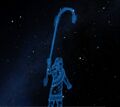 The True Shepherd of Anu with a staff reaching to Auriga (CC BY SMH in Stellarium with drawing by R. Perdok, LWL Planetarium Münster).
 -
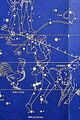 same idea (but even more wrong): Gamlu as part of SIPA.ZI.AN.NA's shepherd's staff; interpretation by Papke (1989).
 -
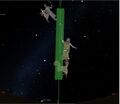 The Babylonian constellations The Rooster, The Shepherd of Anu and the Great Twins depicted in the second GU (GU II) of the GU-text, illustration Susanne M Hoffmann (2022) with Stellarium.


The option of the Shepherd with a staff in Auriga can't be completely neglected but is likely wrong, as mul / dGAM3, The Crook, in Auriga is (a) a weapon and (b) sometimes mentioned in the hand of a figure in Perseus.
Parts of the constellation and individual stars.
(1) The right hand and heel of the True Shepherd of Anu from behind, see GU text.
(2) The right hand of the True Shepherd of Anu' (ν Ori), see dbn-text.
(3) The crown of the True Shepherd of Anu (λ1 Ori), see dbn-text.
(4) The navel of the True Shepherd of Anu (α Orionis), see (Kurtik L06) EN3.DUR.
(5) The beginning sections of the True Shepherd of Anu, see below.
Astrology.
Identifications:
(1) = Saturn; see (Kurtik m35) MUL.MUL, V 12.
(2) = Venus(?); [Sipa]-zi-an-na dDil-bat "True [Shepherd] of An = Venus" [BPO 3[21], 262, K. 3384 rev. 2].
In [Gössman 1950[3], 348, III A] the identities: the True Shepherd of Anu = Mars(?), Mercury(?), Jupiter(?) are also assumed, without, in our opinion, conclusive confirmation.
Predictions:
(3) Visibility of stars in the True Shepherd of Anu; [DIŠ ulSIPA.ZI].AN.NA UL.MEŠ-šu2 UL.UL.MEŠ IDIM ug-dap-pa-šam-ma SAL.ḪUL [DU3-uš] "[If] the stars of [True Shepherd] Anu twinkle (increase in brilliance): an important person will strengthen and [commit] evil deeds" [BPO 3[21], XV 33], parallel: DIŠ mulSIPA.ZI.AN.NA MUL.MEŠ-šu2 it-ta-na-an-bi-ṭu / kab-tu ug-da-ap-pa-ša2-am-ma / le-mut-ti ip-pu-uš / mulDil-bat ina pa-an mulSIPA.ZI.AN.NA GUB-ma "If the stars of the True Shepherd of Anu increases in its radiation: an important person will become excessively powerful and commit evil, (it means): Venus stands before the True Shepherd of Anu." [SAA 8[6], 255 r. 6-7]; [DIŠ ulSIPA.ZI.A]N.NA UL.MEŠ-šu2 un-nu-tu4 NUN na-ram? [...] "[If] the stars of [the True Shepherd] Anu wan: the crown prince, the favorite [...]" [BPO 2[4], XV 34]; [DIŠ mulSIPA].ZI.AN.N[A ina KI.GUB-šu2 ...] u da-am KUR ana K[I.KAL NIGIN] "[If] the True [Shepherd] of A[n (is) in its correct position...] and it is dark: the country [will gather] into for[tresses]" [BPO 2[4], XVIII 2]; [DIŠ mul]SIPA.ZI.AN.NA a-dir AN.MI dSin u dUTU ina KUR DU3.[A.BI GAL2] MAŠ2.ANŠE [...] "[If] the True Shepherd of Anu becomes dim: [there will be] an eclipse of the Moon and Sun in a[ll] countries, the cattle [...]" [BPO 2[4], XVIII 9]; [DIŠ] mulSIPA.ZI.AN.NA KI.GUB KUR2.KUR2 [x x] KA´MI BARA2 ina K[UR...] "[If] the True Shepherd of Anu, (its) position changes [...] (and) becomes dim: the throne in the country [...] [BPO 2[4], XVIII 6]; [DIŠ mul]SIPA.ZI.AN.NA meš-ḫa im-šu-uḫ LUGAL EN BALA ina šer3-t[i-šu2] bu-bu-ʼ-tu2 DIRI-ma BA.B[E] "[If] the True Shepherd of Anu emits mišḫu: the king, the ruler of the dynasty, because of his offenses, will be covered with pustules and die." [BPO 2[4], XVIII 10]; [DIŠ] UD ina GUB.BA-šu2 MUL.MEŠ ma-lu-u2 NAM.BAD.MEŠ GAL2.MEŠ "[If] in its position it (= the True Shepherd of Anu) is filled with stars: there will be pestilence" [BPO 2[4], XVIII 12].
(4) The Navel of the True Shepherd of Anu; [DIŠ ulSIPA.ZI.]AN.NA LI.DUR-su SA5 ina 15-šu2 MI GAL2-ši BAL-tum GA[L2] ... "[If] the Navel of [the True Shepherd] Anu is red (and) there is a dark spot on the right side of it: there will be an upheaval..., the one who is like the master will fall from weapons" [BPO 2[4], XV 32] [BPO 2[4], XV 32]; parallel [ibid., XVII 14]; [DIŠ] mulSIPA.ZI.AN.NA LI.DUR-su MI AN.MI UD.16.KAM [...] "[If] the Navel of the True Shepherd of Anu is dark: on the 16th (there will be) an eclipse [...]" [BPO 2[4], XVI 3; XVIII 5]; [DIŠ] mulSIPA.ZI.AN.NA LI.DUR-su it-ta-na-an-[bit ...] "[If] the Navel of the True Shepherd of Anu is dark: there will be an eclipse [...]" [BPO 2[4], XIII 4], see also (Kurtik L06) EN3.DUR.
(5) Heliacal rising of the True Shepherd An; DIŠ mulSIPA.ZI.AN.NA ina E3-š[u2 ša]-qu GAB I3.GAL2 "If the True Shepherd of Anu, during [its] appearance (stands) high: there will be ..." [BPO 2[4], III 3b]; [DIŠ mul]SIPA.ZI.AN.NA ina KI.[GUB-šu2] / [ša]-qu ina SAG ITI-šu2 IGI MU [x x] "[If] the True Shepherd of Anu in [its] position[s] (stands) high, (and) it appears at the beginning of the corresponding month [...]" [BPO 2[4], XVII 12], see also [ibid., XVIII 3].
(6) Heliacal risings earlier and later than the set time; DIŠ mulSIPA.ZI.AN.NA ina itiSIG4 IGI-mar BE-ma MUL B[I NIM-ma IGI ...] BE-ma MUL BI uḫ-ḫi-ir-ma ITI-šu2 DIB-ma IGI LUGAL KUR BI KUR-s[u...] "The True Shepherd of Anu rises heliacally in the month of simanu; if the star [rises early: ...]; if the star is delayed, and it rises pass the set time in the month: the king of this country, hi[s] country [...]" [BPO 2[4], IX 4], see also [ibid.[4], IX 14, X 4].
(7) The Moon and the True Shepherd of Anu; DIŠ 30 ina IGI.LA2-šu2 mulSIPA.ZI.AN.NA ina SAG-šu2 GUB ina MU BI LUGAL KUR GAL ana KUR TUR SILIM [...] "If the Moon during its appearance, (and) the True Shepherd of Anu stands at its beginning: in this year, the king of a great country will make peace with (the king of) a small country [...]" [NSAM 2[23], 171, §7]; DIŠ mulSIPA.ZI.AN.NA ina ŠA3-šu2 GUB LUGAL ŠU2-tam [DU3-uš] "If (the Moon durings its appearance, and) the True Shepherd of Anu stands in its middle: the king of superiority over all [will achieve]." [NSAM 2, 171, §8]; dPap-sukkal KUR-ma KI dUTU GUB d30 ina mul?SIPA.ZI.AN.<NA> ana? GENNA KUR-ma "Papsukkal has risen and stands in the place(?) of the Sun, the Moon has reached(?) the True Shepherd of Anu Saturn" [SpTU IV, 162 r. 12-13]; DIŠ mulSIPA.ZI.AN.NA ana IGI [30 TE] / [UD].MEŠ BALA MAN GID2.DA [x x x x] "If the True Shepherd of Anu (= Saturn) comes close to the front [of the Moon: da]ys and the reign will be long [...]" [SAA 8[6], 544:4′-5′]; [DIŠ 30 MIN (= ina IGI.LA2-šu2) mulSI]PA.ZI.AN.NA ina ŠA3-šu2 GUB-iz LUGAL SU3 ŠU2-tam DU3-uš / [mulSIPA.ZI].AN.NA ulUDU.IDIM.SAG.UŠ "[If the Moon at its appearance] (and) the True [Shep]herd of Anu stands in the moon: the distant king of might will attain. [True Shepherd] Anu = Saturn" [ACh Suppl.[66], 7:25-26].
(8) The eclipse of the Moon in the True Shepherd of Anu; DIŠ ina KI mulSIPA.ZI.AN.NA u2-lu mulzi-ba-ni-tum a-dir EŠ.BAR Si-par u UD.UNUGki "If (the Moon) eclipses in the realm of the True Shepherd of Anu or in Libra: solution for Sippar and Larsa" [Weidner 1963[67], 118, MNB 1849:40]; DIŠ ina itiGAN UD.14.KAM AN.MI GAR-an KA´MI-su TU LUGAL ši-si-tu4 UGU-šu2 ŠUB-di / ina KI mulxSIPA.ZI.AN.NA ša2-niš ana tar-ṣi mulxPA.BIL.SAG BE.MEŠ "If on the 14th day of the month of kislim an eclipse (of the moon) occurs and it sits in the eclipse: the king, shoutings will befall upon him. (If the eclipse occurs) in the region of the True Shepherd of Anu, or in the direction of Pabilsag: plague" [Rochberg-Halton 1988[20], 285, App. 2.4, BM 47447 r. 25-26], see also (Kurtik d04) DAR.LUGAL, VI 1.
(9) The Moon's halo and the True Shepherd of Anu; DIŠ Sin TUR3 NIGIN2-ma mulSIPA.ZI.AN.NA ina ŠA3-šu2 DU NIM.MEŠ KUR SI.SA2.MEŠ "If the Moon is surrounded by a halo and the True Shepherd of Anu (= Saturn) stands in it: the high lands of the country will prosper" [BPO 2[4], III 30a]; [diš 30] ina itiše ina igi.lal-šu2 tur3 nigin2-ma mulsipa.zi.an.na ina ša3-šu2 gub ina iti.bi an.mi gar-an "[If the Moon], during its appearance in the month of adar, is surrounded by a halo and the True Shepherd of Anu stands in it: there will be an eclipse in that month" [Koch-Westenholz 1999[35], 162:126]; DIŠ 30 TUR3 NIGIN2-ma mulSIPA.ZI.AN.NA ina ŠA3-šu2 GUB-[iz] LUGAL SU.KI kiš-šu2-tu2 DU3-uš KUR-su i-na-aḫ-ḫi-[iš] "If the moon is surrounded by a halo and the True Shepherd of Anu stand[s] in it: the king of Subartu will attain world domination, his country will prosper." [SAA 8[6], 302 r. 3-5], see also [ibid.[6], 451:4-6].
(10) Acronical risings opposite the Moon; mulxSIPA.ZI.AN.NA ana tar-ṣi-šu2 ana U4-ma E11-ma "(this means that) the True Shepherd of Anu opposite the moon (i.e. Sina = Moon) rises acronically" [Rochberg-Halton 1988[20], 290; TU[68], 17:26].
(11) Venus and the True Shepherd of Anu; UD ina GUB.BA-šu2 EŠ4.DAR DU LUGAL KUR-su BAL-su "If Venus stands in his place: the king's country will revolt" [BPO 2[4], XVIII 11]; DIŠ mulDil-bat ina IGI-it mulSIPA.ZI.AN.NA DU KUR UR.BI ŠEŠ ŠEŠ KUR2-ir / RI.RI.GA NAM.LU2.Ux.LU u MAŠ2.ANŠE GAL2-ši "If Venus stands opposite the True Shepherd of Anu: brothers will feud with each other, there will be an epidemic among men and cattle in all countries." [BPO 3[21], 46, VAT 10218:62], the parallel to this prediction in [ibid.[21], 68, BM 75228:7] contains the explanation: [dDil-bat] u d[SAG].UŠ "[Venus] and [Sat]urn," see also [BPO 3[21], 180, K. 229 rev. ii 10; SAA 8, 254 r. 2-5]. See also: [...lu mu]lGU4.AN.NA lu mulSIPA.ZI.AN.NA DU-ma "She (= Venus) stands [... either in] the Heavenly Bull or in the True Shepherd of Anu" [BPO 3[21], 100, K. 35:8].
(12) Planets and the True Shepherd of Anu; [DIŠ] mulUDU.IDIM ana mulSIPA.ZI..AN.NA i-mid UŠ2.MEŠ ina KUR GAR.MEŠ "[If] a planet stands near the True Shepherd of Anu: there will be death in the land" [Largement 1957[22], 246:61; TU[68], 16:61], see also (Kurtik k29) lúKUR2.RA.
(13) The True Shepherd of Anu (=Saturn) and the Star Cluster (=Pleiades); [DIŠ mul]SIPA.ZI.AN.NA ana 15 MUL.MUL i[q-r]ib dEn-lil2 KUR [...] "[If] the True Shepherd of Anu comes [close] to the right side of the Star Cluster: Enlil, the country [...]" [BPO 2[4], XVIII 7]; [DIŠ mul]SIPA.ZI.AN.NA ana 2.30 MUL.MUL iq-rib SAL.KUR2 [...] "[If] the True Shepherd of Anu approaches the left side of the Star Cluster: military action [...] [ibid., XVIII 8], see also (Kurtik m35) MUL.MUL, V 12.
(14) Jupiter approaches the True Shepherd of Anu; see (Kurtik s09) SAG.ME.GAR, III 33.
(15) Mercury stands with the Moon or with the True Shepherd of Anu; see (Kurtik u08) UDU.IDIM.GU4.UD, IV 28.
Historical Dictionaries
| Kurtik (2022) | Gössmann (1950) |
|---|---|
(Kurtik sh14) (mul)Šitaddaru(m) |
|
| вар. чтения: šidallu, šitaddalu; аккадская параллель к mulSIPA.ZI.AN.NA «Праведный Пастух Ану» в основном в лексических текстах, см. s22SIPA.ZI.AN.NA. | |
(Kurtik s22) mulSIPA.AN.NA |
|
| вар.: mulSIPA.AN.NA; шум. «Праведный Пастух Ану»; = šitadallu (šidallu, šitaddaru); 1) созвездие в Орионе (Orion), 2) обозначение знака зодиака Близнецы в поздних текстах [CAD Š/3, 128; Gössman 1950, 348; BPO 2, 14]. См. также b01dBA.LIM, i01dI3-li2-ab-rat, p05dPAP.SUKKAL, s21SIPA. | Example |
| I. Источники.
Лексич. тексты. (1) Одноязычные шумерские списки: mulsipa.zi.an.na [MSL XI, 108:395; 133, col. viii 40; 143, col. x 17]. (2) Серия Urra XXII: mulsipa.e.ne = ti-ša-at-ta-lu [Emar VI/4, 151:155], mul dsipa.zi.an.na = ši-dal-lu [MSL XI, 30, 10:4], [mulsi]pa.zi.an.na = ši-t[a-d]a-rum [Cavigneaux 1979, 17:9], mulsipa.zi.an.na = ši-ta-ad-[a-ru] [Cavigneaux 1981, 79.B.1/5 iv 2], mu[l]sipa.zi.an.na = ši-da-al-lu-[u] [SpTU III, 114A v 18; Bloch–Horowitz 2015, 105:274ʹ]. (3) Серия Ḫg. B VI: mulsipa.zi.an.na = ŠITA2.DAR = ša2 ina kak-ki maḫ-ṣi [MSL XI, 41:44], mulsipa.zi.an.na = (пропуск) = ŠITA2.DA.[AL?] [SpTU III, 116 iii 13]. «Молитвы ночным богам». (1) Старовавилонская молитва: a) Erm. 15642: ši-ta-ad-da-ru-um [Horowitz 2000, 196–197:18], а также [Шилейко 1924, 147; Dossin 1935, 180; Von Soden 1936, 306], b) AO 6769: ši-ta-da-ru [Dossin 1935, 181–182:18]. (2) Хеттская молитва: mulŠi-pa-zi-a-na [KUB IV, 47 r. 44; BPO 2, 2:8; Van der Toorn 1985, 130:44]. (3) Новоассирийская молитва: [mulSI]PA.ZI.AN.NA [Oppenheim 1959, 283:14]. ЕАЕ. См. [Rochberg-Halton 1988, 62, 214 EAE 20 XII Rec. C: 7', 215 EAE 20 XII Rec B Source S r. 44, 218 EAE 20 Source Y:14, 285 App. 2.4 r. 26, 289–290; BPO 2, III 3b, 30–30a, IX 4, 14, X 4, XIV 8, XV 33–35, XVI 2, XVII 12, XVIII 1–3, 6–10; BPO 3, 286; Largement 1957, 246:61; NSAM 2, 249; SpTU I, 93:7'; SpTU IV, 162 r. 13]. Текст HS 245 (The Hilprecht Text). См. a33AN.TA.GUB. «Астролябии». Astrolabe P. Месяц симану, звезды Эа, 240 [Pinches 1900, 574]. Astrolabe B. (1) Менологии: itišu mulsipa.zi.an.na / dNin.šubur sukkal.maḫ An.na dInnin.bi.id.da.ke4 : itišu Ši-ta-ad-da-lu / dPap-sukkal sukkal ṣi-i-ru ša dA-nim u dIš8-tar2 «Дуузу, Праведный Пастух Ану, Ниншубур (акк. Папсукаль), благородный визирь Ану и Иштар» (A i 38–39, 45–47); параллель см. [Çağirgan 404:18–19], см. также [BPO 2 81; CAD Š/3, 128b; Емельянов 1999 79]. (2) Список (12´3): mul ša egir-šu(bi) gub-zu / mulsipa.zi.an.na dnin.šubur / sukkal dA-nim u3 dIš8-tar2 «Созвездие, которое позади него стоит (т.е. позади Челюсти Быка), Праведный Пастух Ану, Ниншубур, посланник Ану и Иштар» (B i 9–11), параллель см. [Oelsner–Horowitz, Ea 4]. (3) Список (3´12): itisig4 mulsipa.zi.an.na šu-ut dE2-a «Симану: Праведный Пастух Ану (на пути) Эа (восходит)» (C i 3). (4) Список (восход–заход=6m): [itisig4] mulsipa.zi.an.na mulur.gu.la mulmuš ˹e3˺ «[Симану:] Праведный Пастух Ану, Лев, Змея восходят» (С 17), b) [mu]lsipa.zi.an.na mulur.gu.la mulmuš ˹šu2˺ «(Кислиму): Праведный Пастух Ану, Лев, Змея заходят» [KAV 218, C 30; Horowitz 2014, 34, 37, 40]. BM 82923. Месяц симану, звезды Эа: mu[lSIPA.ZI.AN.NA // 4,0] // su-kal-lum «[Праведный Пастух Ану // 240] // Посланник» [Walker–Hunger 1977, 30:7]. BM 34713. [itis]ig4 // 4,0 múlsipa.zi.<an>.na // 1,50 múlšu.gi // 55 múlA-nu-ni-tu2 «[С]иману: 240 Праведный Пастух Ану, 110 Старик, 55 Ануниту» [LBAT, 1499:3]. Звезды Эа, Ану и Энлиля. a) Список 12 звезд Ану (№ 6): mulsipa.zi.an.na [CT 33, 9 r. 10; Horowitz 1998, 176]. «Каталог 30 звезд». Ea 4. MUL KI.MIN(=ša EGIR-šu2 GUB-zu) mulSIPA.ZI.AN.NA dNin-šubur (B: dPAP.SUKKAL) ˹SUKKAL˺ AN-nim u3 Iš8-tar2 ana IM.SAG.GA2 «Звезда, которая стоит после него, Праведный Пастух Ану, Ниншубур (В: Папсукаль), визирь Ану и Иштар. (Для предсказания) раннего ветра (т.е. ‘низкой цены’)» [Oelsner–Horowitz 1997–98, 177, note 30]; параллель см. [BPO 2, III 30]. ЕАЕ. См. [BPO 2; BPO 3; BPO 4]. Šumma Sîn ina tāmartīšu. См. [Koch-Westenholz 1999, 157:53, 162:126]. MUL.APIN. (1) Звезды Ану (№ 8): mulSIPA.ZI.AN.NA dPap-sukkal SUKKAL dA-nim u INNIN «Праведный Пастух Ану, Папсукаль, посланник Ану и Иштар» (I ii 2), параллель см. MLC 1688 (col. ii 10). (2) Даты гелиакических восходов: «10-го симану» (I ii 40), см. m17MAŠ.TAB.BA.GAL.GAL. (3) Одновременные суточные восходы и заходы: a) mulSIPA.ZI.AN.NA KUR-ma mulPa-bil-sag ŠU2-bi «Праведный Пастух Ану восходит, Пабилсаг заходит» (I iii 16), b) mulGABA GIR2.TAB u mulUZ3 KURmeš-ma mulŠU.GI u mulSIPA.ZI.AN.NA ŠU2meš «Грудь Скорпиона и Коза восходят, Старик и Праведный Пастух Ану заходят» (I iii 26). (4) Интервалы между датами гелиакических восходов: TA KUR ša2 mulGU4.AN.NA 20 UDmeš ana KUR ša2 mulSIPA.ZI.AN.NA / TA KUR ša2 mulSIPA.ZI.AN.NA 35 UDmeš ana KUR ša2 mulKAK.SI.SA2 «20 дней от восхода Небесного Быка до восхода Праведного Пастуха Ану. 35 дней от восхода Праведного пастуха Ану до восхода Стрелы» (I iii 46–47). (5) Кульминации, одновременные гелиакическим восходам: 10-го симану Демон с Разинутой Пастью кульминирует, Праведный Пастух Ану восходит» (I iv 19–20), см. u06UD.KA.DU8.A. (6) Звезды «на пути Луны»: mulSIPA.ZI.AN.NA (I iv 33), см. s20Sîn. [MA, 31, 41, 48, 50, 56, 63, 68]. «Письма» и «Рапорты». См. [SAA 10, 381a; SAA 8, 352b]. «Большой список звезд». (1) mulsipa.zi.an.na = šita.da.ra / ša2 ina gištukul maḫ-ṣi «Праведный Пастух Ану = Шитадара, тот, кто оружием сражен»; (2) 12 звезд Аккада; (3) 7 lumāšu-звезд [Mesop.Astrol., App. B:163–164, 209, 227]; см. также mulmaš.tab.ba ša ina igi dpap.sukkal / mulsi[pa.z]i.<an.na> в списке 7 Небесных Близнецов и в списке 7 tikpi-звезд [KAR, 142 i 28–29, 36]. MLC 1866. a) См. III. «Символ», а также d04DAR.LUGAL, m16MAŠ.TAB.BA. b) mulSIPA.ZI.AN.NA / dpap-sukkal SUKKAL d60 u an-tu4 «Праведный Пастух Ану, Папсукаль, посланник Ану и Анту» (col. iv 19'–20') [Beaulieu et al. 2018, 38, 42]. Список возгласов птиц (Birdcall texts). it-ti-du-u2mušen iṣ-ṣur dka3-ka3 / mulsipa.zi.an.na uḫ-ta-b[il]… «Франколин — птица божества Кака. (Ее крик): «Праведного Пастуха Ану ограби[ли] …» [Lambert 1970, 114–115:16]. GU-текст. (A) mulsipa.zi.an.na «Праведный Пастух Ану» (β Ori). (B) šu imittu(15) u a-si-du / ˹egir˺-u2 ša2 mulsipa.zi.an.na «правая рука и задняя (т.е. расположенная восточнее) пятка Праведного Пастуха Ану (ξ Ori, κ Ori)» [Pingree–Walker 1988, BM 78161:1–3], см. d04DAR.LUGAL. Dalbanna-текст. A. mul šu zag sipa.[zi.an.na] «Правая рука [Праведного] Пастуха [Ану]» (ν Ori). B. ˹aga˺ mulsipa.zi.an.na «Корона Праведного Пастуха Ану» (λ1 Ori) [Walker 1995, 29; Koch 1995, 44; Hunger-Pingree 1999, 105]. Анафора. А 3427: ina itisig4 ina še-rim ud 28 sipa ki.min(=meš-ḫa im-šuḫ ZI) «В месяце симану утром 28-го дня Праведный Пастух Ану испускает mišḫu и восходит» [Schaumberger 1955, 238:10]. Текст Nv. 10. mulsipa.zi.[an.na] — звезда AN.TA.GUB.BA в месяце абу, см. g06GAM3. «Планисфера К 8538». Сектор 3: [dPap-sukkal] sukkal AN.NA <u> dIštar dI3-li2-ab-rat mulSipa.zi.an.na «Папсукаль, посланник Ану (и) Иштар, Илабрат, Праведный Пастух Ану» [Koch 1989, 56, Abb. 2; 59]. Текст W. 22281a. См. m16MAŠ.TAB.BA. Поздняя астрология, магия и календарь. (1) Предсказания цен на злаки по положениям планет относительно зодиакальных созвездий и другим явлениям: múlSIPA.ZI.AN.NA [SpTU I, 94:39]. (2) Экстиспиция, включающая соответствие между фрагментами печени, божествами, месяцами и звездами: KA.DU10.GA // dNusku(PA.TUG2) // itiSIG4 // mulSIPA.[ZI.AN.NA] «‘Сладкий рот’ есть Нуску; месяц симану; [Праведный] Пастух [Ану]» [SpTU IV, 159:6; Reiner 1995, 78]. Здесь mulSIPA.ZI.AN.NA используется, по-видимому, как обозначение знака зодиака Близнецы, см. s21SIPA. См. также mulSipa-zi-an-na [SpTU II, 42:7, r. 2], múlSIPA.ZI.AN.NA [SpTU III, 102:4, 5; 103:19]. II. Божество. Папсукаль, см. p05dPAP.SUKKAL. Имя en(!) sipa.zi.an.na как царское имя в допотопной части «Шумерского царского списка» см. [Jacobsen 1939, 74–75:20–21]. В плохо сохранившихся копиях списков богов, относящихся к серии AN:dAnum, встречаем также тождество: [d mulsi]pa.zi.an.na = dmin(=ddumu.[zi]) «Праведный [Пас]тух Ану = Думу[зи]»(?) [CT 24, 9:9; 25, 7:9a], свидетельствующее как будто о связи Думузи с созвездием; возражения см. [Foxvog 1993, 106] (см. также [Alster 1985]). В новоассирийском описании храмового ритуала VAT 10099 повествуется о борьбе Мардука с различными божествами, в том числе с mulSIPA.ZI.AN.NA, которого Мардук побеждает (dbēl mulSipa-zi-an-na ik-mu-ma) [Livingstone 1986, 116: 6–7]. Молитвы и ритуалы. (1) Молитвы к ночным богам, см. выше. (2) Серия Šurpu (II 184): dḪendur-sag-ga2 mulSIPA.ZI.AN.NA lip-ṭu-ru «Пусть Хендурсага (и) Праведный Пастух Ану избавят» [Reiner 1970, 18]. (3) Гемерологии на 19-е нисана и 10-е тебету: pad-su ana mulsipa.zi.an.na gar-ma ma-ḫir «Жертвоприношение свое Праведному Пастуху Ану он приносит, и (оно) принято» [KAR, 178, ii 57, rev. ii 48; Labat 1939, 62–63, 134–135]. (4) Ритуал «Воздевания рук» (šu.il2.la2.kam): mulsipa.zi.an.na ilu ellu bānû [x].meš «Праведный Пастух Ану, светлый бог, защита […]» [BMS, 50:1; Ebeling 1953, 146–151; Mayer 1976, 431]. (5) Ритуал против эпидемии [TuL 163, 34:13]. (6) В серии bīt mēseri, см. [Meier 1942, 142:17; Reiner 1995, 17]. (7) Обращения к Праведному Пастуху Ану как к божеству в медицинских текстах см. [Reiner 1995, 56]. (8) В астрологической географии Праведный Пастух Ану был связан с Сиппаром и Ларсой, см. ниже (VI 8). (9) Пожелания благополучия ассирийскому царю: [mul]SIPA.ZI.AN.NA dPAP.SUKKAL SUKKAL dA-nim u dIš-tar / […g]išPA mu-na-ʼi-ir kiš-šat UN.MEŠ lu-šat-me-eḫ-ka […] «Праведный Пастух Ану, Папсукаль, посланник Ану и Иштар, […] скипетр, убивающий всех людей, пусть вручит тебе […]» [Watanabe 1992, 370, K. 6331 r. 4–5]. См. также [Tallqvist 1938, 441; CAD Š/3, 128b; Beaulieu 1992, 60–63]. III. Символ. Бородатое мужское божество в длинной мантии и обычно в рогатой шапке с жезлом в одной руке и другой рукой, вытянутой вдоль тела. Предохранительные фигурки Папсукаля, иногда с надписями, помещались под платформами месопотамских храмов; самый ранний хорошо датируемый пример происходит из Ашшура (XII в. до н.э.) [Ellis 1967]. Описание фигуры созвездия в MLC 1866 (col. ii 10–12): mulSIPA..ZI.AN.NA dpap-sukkal suk-kal-lum d60 u an-tu4 / ṣa-lam šu-u2 lu-bu-uš-tu4 la-biš ziq-nu za-qin ku-ur-ku-ru ša2-kin / MUD u nam-za-qa ta-mi-iḫ «Праведный Пастух Ану, Папсукаль, визирь Ану и Анту. Эта фигура человека, (которая) одета, бородата, имеет kurkurru, / держит замок и ключ.» [Beaulieu et al. 2018, 36, 40]. IV. Отождествление. = Orion [Gössman 1950, 348, I; Waerden 1949, 13; 1952–53, 219; 1974, 73; Weidner 1957–59, 73a, 74; BPO 2, 11, 14; MA, 138; Mesop.Astrol. 208, App. C; Hunger-Pingree 1999, 276; Horowitz 2014, 248, Beaulieu et al. 2018, 75]. = Orion, фигура созвездия, соотнесенная со звездами, см. [Koch 1989, 117, Abb. 17]. V. Части созвездия и отдельные звезды. (1) Правая рука и пятка Праведного Пастуха Ану, находящаяся сзади, см. GU-текст. (2) Правая рука Праведного Пастуха Ану» (ν Ori), см. dbn-текст. (3) Корона Праведного Пастуха Ану (λ1 Ori), см. dbn-текст. (4) Пуп Праведного Пастуха Ану (α Orionis), см. L06LI.DUR. (5) Начальная часть Праведного Пастуха Ану, см. ниже. VI. Астрология. Отождествления: (1) = Сатурн; см. m35MUL.MUL, V 12. (2) = Венера(?); [Sipa]-zi-an-na dDil-bat «Праведный [Пастух] Ану = Венера» [BPO 3, 262, K. 3384 rev. 2]. В [Gössman 1950, 348, III A] предполагаются также тождества: Праведный Пастух Ану = Марс(?), Меркурий(?), Юпитер(?), не имеющие, на наш взгляд, убедительных подтверждений. Предсказания: (3) Видимость звезд в Праведном Пастухе Ану; [DIŠ ulSIPA.ZI].AN.NA UL.MEŠ-šu2 UL.UL.MEŠ IDIM ug-dap-pa-šam-ma SAL.ḪUL [DU3-uš] «[Если] звезды [Праведного Пастуха] Ану мерцают (усиливают блеск): важная персона усилится и [совершит] злые дела» [BPO 3, XV 33], параллель: DIŠ mulSIPA.ZI.AN.NA MUL.MEŠ-šu2 it-ta-na-an-bi-ṭu / kab-tu ug-da-ap-pa-ša2-am-ma / le-mut-ti ip-pu-uš / mulDil-bat ina pa-an mulSIPA.ZI.AN.NA GUB-ma «Если звезды Праведного Пастуха Ану усиливают излучение: важная персона станет чрезмерно могущественной и совершит зло, (это означает): Венера стоит перед Праведным Пастухом Ану» [SAA 8, 255 r. 6–7]; [DIŠ ulSIPA.ZI.A]N.NA UL.MEŠ-šu2 un-nu-tu4 NUN na-ram? […] «[Если] звезды [Праведного Пастуха] Ану ослабели: наследный принц, любимец […]» [BPO 2, XV 34]; [DIŠmulSIPA].ZI.AN.N[A ina KI.GUB-šu2 …] u da-am KUR ana K[I.KAL NIGIN] «[Если] Праведный [Пастух] Ан[у (находится) в своем положении…] и он темный: страна [соберется] в кре[пости]» [BPO 2, XVIII 2]; [DIŠ mul]SIPA.ZI.AN.NA a-dir AN.MI dSin u dUTU ina KUR DU3.[A.BI GAL2] MAŠ2.ANŠE […] «[Если] Праведный Пастух Ану стал тусклым: [произойдут] затмения Луны и Солнца во вс[ех] странах, скот […]» [BPO 2, XVIII 9]; [DIŠ] mulSIPA.ZI.AN.NA KI.GUB KUR2.KUR2 [x x] KA´MI BARA2 ina K[UR…] «[Если] Праведный Пастух Ану положение (свое) изменяет […] (и) становится тусклым: трон в стра[не…] [BPO 2, XVIII 6]; [DIŠ mul]SIPA.ZI.AN.NA meš-ḫa im-šu-uḫ LUGAL EN BALA ina šer3-t[i-šu2] bu-bu-ʼ-tu2 DIRI-ma BA.B[E] «[Если] Праведный Пастух Ану испускает mišḫu: царь, владыка династии, из-за своих преступлений покроется гнойниками и умрет» [BPO 2, XVIII 10]; [DIŠ] UD ina GUB.BA-šu2 MUL.MEŠ ma-lu-u2 NAM.BAD.MEŠ GAL2.MEŠ «[Если] в своем положении он (= Праведный Пастух Ану) наполнен звездами: будет мор» [BPO 2, XVIII 12]. (4) Пуп Праведного Пастуха Ану; [DIŠ ulSIPA.ZI.]AN.NA LI.DUR-su SA5 ina 15-šu2 MI GAL2-ši BAL-tum GA[L2] … «[Если] Пуп [Праведного Пастуха] Ану красный (и) на нем справа темное пятно: буд[ет] переворот …, тот, кто подобен своему господину, от оружия падет» [BPO 2, XV 32]; параллель [ibid., XVII 14]; [DIŠ] mulSIPA.ZI.AN.NA LI.DUR-su MI AN.MI UD.16.KAM […] «[Если] Пуп Праведного Пастуха Ану темный: 16-го (произойдет) затмение […]» [BPO 2, XVI 3; XVIII 5]; [DIŠ] mulSIPA.ZI.AN.NA LI.DUR-su it-ta-na-an-[bit …] «[Если] Пуп Праведного Пастуха Ану мерца[ет…]» [BPO 2, XIII 4], см. также L06LI.DUR. (5) Гелиакический восход Праведного Пастуха Ану; DIŠ mulSIPA.ZI.AN.NA ina E3-š[u2 ša]-qu GAB I3.GAL2 «Если Праведный Пастух Ану при сво[ем] появлении (стоит) высоко: будет …» [BPO 2, III 3b]; [DIŠ mul]SIPA.ZI.AN.NA ina KI.[GUB-šu2] / [ša]-qu ina SAG ITI-šu2 IGI MU [x x] «[Если] Праведный Пастух Ану в [своем] полож[ении] (стоит) высоко, (и) он появляется в начале своего месяца […]» [BPO 2, XVII 12], см. также [ibid., XVIII 3]. (6) Гелиакический восход раньше и позже установленного времени; DIŠ mulSIPA.ZI.AN.NA ina itiSIG4 IGI-mar BE-ma MUL B[I NIM-ma IGI …] BE-ma MUL BI uḫ-ḫi-ir-ma ITI-šu2 DIB-ma IGI LUGAL KUR BI KUR-s[u…] «Праведный Пастух Ану восходит гелиакически в месяце симану; если эта звезда [восходит рано: …]; если эта звезда запаздывает, проходит свой месяц и восходит: царь этой страны сво[ю] страну […]» [BPO 2, IX 4], см. также [ibid., IX 14, X 4].
(8) Затмение Луны в Праведном Пастухе Ану; DIŠ ina KI mulSIPA.ZI.AN.NA u2-lu mulzi-ba-ni-tum a-dir EŠ.BAR Si-par u UD.UNUGki «Если (Луна) затмилась в области Праведного Пастуха Ану или в Весах: решение для Сиппара и Ларсы» [Weidner 1963, 118, MNB 1849:40]; DIŠ ina itiGAN UD.14.KAM AN.MI GAR-an KA´MI-su TU LUGAL ši-si-tu4 UGU-šu2 ŠUB-di / ina KI mulxSIPA.ZI.AN.NA ša2-niš ana tar-ṣi mulxPA.BIL.SAG BE.MEŠ «Если в месяце кислиму в 14-й день происходит затмение (Луны) и она садится затмившейся: царь, крик на него обрушится. (Если затмение происходит) в области Праведного Пастуха Ану, либо в направлении Пабилсага: чума» [Rochberg-Halton 1988, 285, App. 2.4, BM 47447 r. 25–26], cм. также d04DAR.LUGAL, VI 1. (9) Лунное гало и Праведный Пастух Ану; DIŠ Sin TUR3 NIGIN2-ma mulSIPA.ZI.AN.NA ina ŠA3-šu2 DU NIM.MEŠ KUR SI.SA2.MEŠ «Если Луна окружена гало и Праведный Пастух Ану (= Сатурн) стоит в нем: высоко лежащие земли страны будут процветать» [BPO 2, III 30a]; [diš 30] ina itiše ina igi.lal-šu2 tur3 nigin2-ma mulsipa.zi.an.na ina ša3-šu2 gub ina iti.bi an.mi gar-an «[Если Луна] при своем появлении в месяце аддару окружена гало и Праведный Пастух Ану стоит в нем: в этом месяце будет затмение» [Koch-Westenholz 1999, 162:126]; DIŠ 30 TUR3 NIGIN2-ma mulSIPA.ZI.AN.NA ina ŠA3-šu2 GUB-[iz] LUGAL SU.KI kiš-šu2-tu2 DU3-uš KUR-su i-na-aḫ-ḫi-[iš] «Если Луна окружена гало и Праведный Пастух Ану стои[т] в нем: царь Субарту достигнет мирового господства, его страна будет благоденствовать» [SAA 8, 302 r. 3–5], см. также [ibid., 451:4–6]. (10) Акронический восход напротив Луны; mulxSIPA.ZI.AN.NA ana tar-ṣi-šu2 ana U4-ma E11-ma «(это означает, что) Праведный Пастух Ану напротив него (т.е. Сина = Луна) восходит акронически» [Rochberg-Halton 1988, 290; TU, 17:26]. (11) Венера и Праведный Пастух Ану; UD ina GUB.BA-šu2 EŠ4.DAR DU LUGAL KUR-su BAL-su «Если на его месте Венера стоит: страна царя взбунтуется» [BPO 2, XVIII 11]; DIŠ mulDil-bat ina IGI-it mulSIPA.ZI.AN.NA DU KUR UR.BI ŠEŠ ŠEŠ KUR2-ir / RI.RI.GA NAM.LU2.Ux.LU u MAŠ2.ANŠE GAL2-ši «Если Венера стоит напротив Праведного Пастуха Ану: во всех странах брат будет враждовать с братом, эпидемия среди людей и скота будет» [BPO 3, 46, VAT 10218:62], параллель к этому предсказанию в [ibid., 68, BM 75228:7] содержит пояснение: [dDil-bat] u d[SAG].UŠ «[Венера] и [Сат]урн», см. также [BPO 3, 180, K. 229 rev. ii 10; SAA 8, 254 r. 2–5]. См. также: […lu mu]lGU4.AN.NA lu mulSIPA.ZI.AN.NA DU-ma «Она (= Венера) [… либо в] Небесном Быке, либо в Праведном Пастухе Ану стоит» [BPO 3, 100, K. 35:8]. (12) Планета и Праведный Пастух Ану; [DIŠ] mulUDU.IDIM ana mulSIPA.ZI..AN.NA i-mid UŠ2.MEŠ ina KUR GAR.MEŠ «[Если] планета вблизи от Праведного Пастуха Ану стоит: в стране будут смерти» [Largement 1957, 246:61; TU, 16:61], см. также k29lúKUR2.RA. (13) Праведный Пастух Ану (=Сатурн) и Звезды (=Плеяды); [DIŠ mul]SIPA.ZI.AN.NA ana 15 MUL.MUL i[q-r]ib dEn-lil2 KUR […] «[Если] Праведный Пастух Ану при[близил]ся к правой стороне Звезд: Энлиль страну […]» [BPO 2, XVIII 7]; [DIŠ mul]SIPA.ZI.AN.NA ana 2,30 MUL.MUL iq-rib SAL.KUR2 […] «[Если] Праведный Пастух Ану приблизился к левой стороне Звезд: военные действия […] [ibid., XVIII 8], см. также m35MUL.MUL, V 12. (14) Юпитер приближается к Праведному Пастуху Ану; см. s09SAG.ME.GAR, III 33. (15) Меркурий стоит с Луной или с Праведным Пастухом Ану; см. u08UDU.IDIM.GU4.UD, IV 28. |
Example |
References
- ↑ Planetarium Babylonicum 2.0, All Skies Encyclopaedia.
- ↑ 2.0 2.1 2.2 The Assyrian Dictionary of the Oriental Institute of the University of Chicago. Chicago and Glückstadt, 1956 - 2010
- ↑ 3.0 3.1 3.2 Gössmann P.F. Planetarium Babylonicum, Rom, 1950 (A. Deimel. Šumerisches Lexikon 4/2).
- ↑ 4.00 4.01 4.02 4.03 4.04 4.05 4.06 4.07 4.08 4.09 4.10 4.11 4.12 4.13 4.14 4.15 4.16 4.17 4.18 4.19 4.20 4.21 4.22 4.23 Reiner E., Pingree D. Enuma Anu Enlil, Tablets 50-51. Malibu, Undena Publications, 1981 (Babylonian Planetary Omens: Part Two).
- ↑ Hoffmann, S. M. and Krebernik, M. (2023). What do deities tell us about the celestial positioning system, in: R. Rollinger, I. Madreiter, M. Lang, C. Pappi (eds.). The Intellectual Heritage of the Ancient Near East, Papers held at the 64th Rencontre Assyriologique International and 12th Melammu Symposium July 16-20 2018, Innsbruck. Austrian Academy of Sciences Press, 539-579
- ↑ 6.0 6.1 6.2 6.3 6.4 6.5 Hunger H. Astrological Reports to Assyrian Kings. Helsinki, 1992 (State Archives of Assyria, VIII).
- ↑ Materials for the Sumerian Lexicon. Vol. XI. The Series HAR-ra = hubullu. Tablets XX-XXIV. Ed. by E.Reiner with the coll. of M.Civil. Roma, 1974.
- ↑ D. Arnaud. Texte de la bibliothèque, transcriptions et traductions, 1987. (= Emar 6/4).
- ↑ Cavigneaux A. // Baghdader Mitteilungen 10, 132-134.
- ↑ Cavigneaux A. Textes scolaires du temple de Nabû ša Harê. Texts from Babylon I. Baghdad, 1981.
- ↑ 11.0 11.1 11.2 Špätbabylonische Texte aus Uruk. Teil III / Bearb. von Weiher E. von. Berlin, 1988.
- ↑ Bloch, Y. and W. Horowitz (2015): “Urra = hubullu XXII: The Standard Recension,” , Journal of Cuneiform Studies 67: 71-125.
- ↑ Horowitz W. Astral Tablets in the Hermitage, Saint Petersburg // ZA. 2000. Bd. 90. S. 194-206.
- ↑ Шилейко В.К. Таблетка с молитвой ночным богам в собрании Лихачева //ИРАИМК. 1924, Т. 3, Ленинград, с. 144-152.
- ↑ 15.0 15.1 Dossin G. Prières aux “Dieux de la nuit” (AO 6769) // RA 32, № 4, 179-190.
- ↑ von Soden W. Ein Opferschaugebet bei Nacht // ZA. 1936. Bd. 43 (N.F. 9), S. 305-308.
- ↑ Keilschrifturkunden aus Boghazköi (Berlin).
- ↑ K. van der Toorn. Sin and Sanction in Israel and Mesopotamia. A Comparative Study. Maastricht, Van Gorcum, 1985.
- ↑ Oppenheim A.L. A New Prayer to the “Gods of the Night” // Analecta biblica. 1959. Vol. 12. P. 282-301.
- ↑ 20.0 20.1 20.2 Rochberg-Halton F. Aspect of Babylonian Celestial Divination: The Lunar Eclipse Tablets of Enuma Anu Enlil. Horn, 1988 (AfO, Beiheft 22).
- ↑ 21.0 21.1 21.2 21.3 21.4 21.5 21.6 21.7 Reiner E., Pingree D. Babylonian Planetary Omens. Part Three. Groningen, STYX Publications. 1998.
- ↑ 22.0 22.1 Largement R. Contribution à l’Etude des Astres errants dans l’Astrologie chaldéenne // ZA 18, 235-264.
- ↑ 23.0 23.1 Verderame L. Le Tavole I-VI della serie astrologica Enūma Anu Enlil. Roma, Di.Sc.A.M., 2002 (Nisaba. Studi Assiriologici Messinesi).
- ↑ 24.0 24.1 Špätbabylonische Texte aus Uruk. Teil I / Bearb. von H.Hunger. Berlin, 1976.
- ↑ URUK. Špätbabylonische Texte aus dem Planquadrat U 18. Teil IV / Bearb. von Weiher E. von. Mainz am Rhein, 1993.
- ↑ Pinches T.G. Review of R.Brown. Researches into the Origin of the Primitive Constellations of the Greeks, Phoenicians, and Babylonians. Vol. 2. London, 1900 // JRAS. 1900. P. 571-577.
- ↑ Çağirgan G. Three More Duplicates to Astrolabe B // Belleten. 1985. Vol. XLVIII, № 191-192, 399-416.
- ↑ Емельянов В.В. Ниппурский календарь и ранняя история Зодиака. СПб: "Петербургское Востоковедение", 1999.
- ↑ 29.0 29.1 Oelsner J., Horowitz W. The 30-Star-Catalogue HS 1897 and The Late Parallel BM 55502 // AfO. 1997-1998. Bd. 44-45. S. 176-185.
- ↑ Schroeder O. Keilschrifttexte aus Assur verschiedenen Inhalts. Leipzig, 1920.
- ↑ 31.0 31.1 Horowitz, W. (2014), The three stars each: the Astrolabes and related texts, Archiv für Orientforschung AfO Beiheft, 33.
- ↑ Walker C.B.F., Hunger H. Zwölfmaldrei // MDOG. 1977. Bd. 109. S. 27-34.
- ↑ 33.0 33.1 A. Sachs, T. Pinches, J. Strassmaier, Late Babylonian Astronomical and Related Texts, London, 1955.
- ↑ 34.0 34.1 Cuneiform Texts from Babylonian Tablets in the British Museum.
- ↑ 35.0 35.1 Koch-Westenholz U. The Astrological Commentary Šumma Sîn ina tāmartīšu Tablet 1 // Res Orientales. 1999. Vol. XII, 149-165.
- ↑ 36.0 36.1 Hunger, H. and J. M. Steele (2019). The Babylonian Astronomical Compendium MUL.APIN, Routledge, NY
- ↑ 37.0 37.1 Koch-Westenholz U. Mesopotamian Astrology. Copenhagen, Museum Tusculanum Press. 1995.
- ↑ 38.0 38.1 Ebeling E. Keilschrifttexte aus Assur religiösen Inhalts. Bd. I-II. Leipzig 1919, 1920.
- ↑ 39.0 39.1 39.2 Beaulieu, P.-A., Frahm, E., Horowitz, W. & Steele, J. (2018), The Cuneiform Uranology Texts: Drawing the Constellations, American Philosophical Society Press, Philadelphia, USA.
- ↑ Lambert W.G. The Sultantepe Tables. IX. The Birthcall Text // Anatolian Studies. 1970. Vol. 20. P. 111-117.
- ↑ Pingree D., Walker C. A Babylonian Star-Catalogue: BM 78161 / Fs. Sachs, 313-322.
- ↑ Koch J. Der Dalbanna-Sternenkatalog // WO. 1995. Bd. 26. S. 43-85.
- ↑ 43.0 43.1 Astral Sciences in Mesopotamia. Leiden/Boston/Köln, Brill 1999 (Handbuch der Orientalistik 44)
- ↑ Schaumberger J. Anaphora und Aufgangskalender in neuen Ziqpu-Texten // ZA 55 (N.F. 17), 237-251.
- ↑ Koch J. Neue Untersuchungen zur Topographie des babylonischen Fixsternhimmels. Wiesbaden, 1989.
- ↑ Špätbabylonische Texte aus Uruk. Teil II / Bearb. von Weiher E. von. Berlin, 1983.
- ↑ Jacobsen, T. The Sumerian King List. Assyriological Studies, 11. The University of Chicago Press, Chicago, Illinois, 1939.
- ↑ Foxvog D.A. Astral Dumuzi / Near Eastern Studies in Honor of W.W.Hallo. Bethesda, MD, 1993.
- ↑ Livingstone A. Mystical and Mythological Explanatory Works of Assyrian and Babylonian Scholars. Oxford, 1986.
- ↑ Reiner E. Šurpu. A Collection of Sumerian and Akkadian Incantations. Osnabrück, 1970 ( AfO, Beiheft 11).
- ↑ Labat R. Hemerologies et menologies d'Assur. Paris, 1939.
- ↑ King L.W. Babylonian Magic and Sorcery. London, 1896.
- ↑ Ebeling E. Die akkadische Gebetsserie "Handerhebung". Berlin, 1953.
- ↑ Mayer W.R. Untersuchungen zur Formensprache der babylonischen “Gebetsbeschwörungen / Studia Pohl: Series Maior 5. Rome, Biblical Institute Press, 1976.
- ↑ Ebeling E. Tod und Leben nach den Vorstellungen der Babylonier. Berlin-Leipzig, 1931.
- ↑ Meier G.. Die zweite Tafel der Serie bīt mēseri // AfO. 1942. Bd. 14, Heft 3/4. S. 139-142.
- ↑ 57.0 57.1 Reiner E. Astral Magic in Babylonia. Philadelphia, The Amer. Philos. Soc., 1995.
- ↑ Watanabe K. Segenswünsche für den assyrischen König in der 2. Person Sg. (II) // ASJ. 1992. Vol. 14. P. 369-373.
- ↑ Tallqvist K. Akkadische Götterepitheta. Helsingforsiae, 1938.
- ↑ Beaulieu P.-A. Antiquarian Theology in Seleucid Uruk // ASJ. 1992. Vol. 14. P. 47-75.
- ↑ Ellis R.S. "Papsukkal" Figures beneath the daises of Mesopotamia // RA 61, No. 1, 51-61.
- ↑ Waerden B. L. van der. Babylonian astronomy. II. The thirty Six Stars // JNES. V. 8. P. 6-26.
- ↑ Waerden B.L. van der. History of the Zodiac // AfO. 1952-1953. Bd. 16. P. 216-230.
- ↑ Waerden B.L. van der (with contributions by P.Huber). Science Awakening. II. The Birth of Astronomy. Leiden-N.Y. 1974 (Russian translation, see [Van der Waerden 1991]).
- ↑ Weidner E. mul gir2.tab = zuqaqîpi // AfO. 1957-1958. Bd. 18. S. 393-394].
- ↑ Ch. Virolleaud, L'astrologie chaldéenne S(in); Shamasz; Isht(ar); Adad; S/Supp. = Supplément; SS / 2.Supp. = Second Supplément (Paris 1905 - 1912)
- ↑ Weidner E. Astrologische Geographie im Alten Orient // AfO. 1963. Bd. 20. S. 117-121.
- ↑ 68.0 68.1 Thureau-Dangin F. Tablettes d’Uruk. Paris, 1922 (= TCL 6).





