Corona Australis: Difference between revisions
No edit summary |
No edit summary |
||
| (11 intermediate revisions by 2 users not shown) | |||
| Line 1: | Line 1: | ||
Authors: {{PAGEAUTHORS}} | |||
---- | |||
[[File:Corona Australis IAU.svg|alt=star chart|thumb|CrA star chart (IAU and Sky & Telescope magazine, Roger Sinnott & Rick Fienberg).]] | [[File:Corona Australis IAU.svg|alt=star chart|thumb|CrA star chart (IAU and Sky & Telescope magazine, Roger Sinnott & Rick Fienberg).]] | ||
One of the [[:Category:88_IAU-Constellations|88 IAU constellations]]. The constellation was invented in the first century CE. | One of the [[:Category:88_IAU-Constellations|88 IAU constellations]]. The constellation was invented in the first century CE. | ||
==Etymology and History== | ==Etymology and History== | ||
=== Origin of Constellation === | |||
The name ‘Wreath’ for this group of stars has been reliably documented since the 1st century by Geminos. In mathematical astronomy, this constellation first appears in the Almagest; Hipparchus does not mention it. The almost closed ring of stars of approximately equal brightness is mentioned without a name by all earlier authors. | |||
Aratos describes the group as ‘arranged in a ring’. Eratosthenes calls it ‘seven stars of the ship below his [Sagittarius's] lower leg’. This clearly does not refer to the Argo, but to another ship. It is interesting to note in this context that the stars of Corona Australis denote a river boat in Babylonian uranography. | |||
It is quite possible, although not certain, that Eratosthenes' text proves a cultural transfer: In the 3rd century BCE, the Syrian wars raged between the Ptolemies, who ruled Egypt, and the Seleucids, who ruled Mesopotamia. In the last years of Eratosthenes' life and work, there had been a period of peace that made the 2nd century BCE, until the Parthian Wars, an extraordinary heyday of scientific exchange between Babylon and Alexandria. Eratosthenes thus brings together Mesopotamian and newly developed Greek culture. | |||
Modern literature sometimes claims that Hyginus made a possible star prophecy: he tells of a myrtle wreath in memory of the deceased mother of the god Dionysus. However, it is unclear whether he is referring to Corona Borealis or Australis. If Hyginus, the librarian of Augustus, invented the constellation ‘Southern Crown’, there could be a connection to the emperor and his laurel wreath. | |||
=== | It is astonishing that the Southern Crown is depicted on the Farnese Globe. The globe is dated to the 2nd century CE, i.e. the time of Ptolemy. Since the figures are depicted in the Greek style, the globe is considered to be a copy of a Greek original from the BCE era. However, since this star group was not referred to as a wreath until the 1st century CE, the sculptor must have reworked this star figure in a contemporary style. It looks less like a Caesar's crown than a bridal wreath. | ||
==== Babylonian ==== | |||
==== Greco-Roman ==== | |||
===== Aratos ===== | |||
===== Eratosthenes ===== | |||
===== Hipparchus ===== | |||
===== Geminos ===== | |||
==== Almagest ==== | |||
{| class="wikitable" | |||
!id | |||
!Greek | |||
(Heiberg 1898) | |||
!English | |||
(Toomer 1984) | |||
!ident. | |||
|- | |||
! | |||
!Στεφάνου νοτίου ἀστερισμός | |||
!Constellation of the Southern Crown | |||
! | |||
|- | |||
|1 | |||
|τῆς νοτίου περιφερείας ὁ προηγούμενος ἐκτός | |||
|The most advanced ofthe stars on thc southern rim, outside {the crown} | |||
|alf Tel | |||
|- | |||
|2 | |||
|ὁ ἐπόμενος αὐτῶν ἐπὶ τοῦ Στεφάνου | |||
|The star to the rear of this, on the crown | |||
|eta1, eta2 CrA | |||
|- | |||
|3 | |||
|ὁ τούτο ἐπόμενος | |||
|The one to the rear of this | |||
|HR 7122 | |||
|- | |||
|4 | |||
|ὁ ἔτι τούτῳ ἐπόμενος | |||
|The one to the rear again of this | |||
|zet CrA | |||
|- | |||
|5 | |||
|ὁ μετὰ τοῦτου πρὸ τοῦ γουατίου τοῦ Τοξότου | |||
|The one after this, before the knee of Sagittarius | |||
|del CrA | |||
|- | |||
|6 | |||
|ὁ μετὰ τοῦτον καὶ βορειότερος τοῦ ἐν τῷ γόνατι λαμπροῦ | |||
|The one after this, which is north of the bright star in the knee [of Sagittarius] | |||
|bet CrA | |||
|- | |||
|7 | |||
|ὁ τούτου βορειότερος | |||
|The star to the north of this | |||
|alf CrA | |||
|- | |||
|8 | |||
|ὁ ἔπὶ τούτου βορειότερος | |||
|The one to the north again of this | |||
|gam CrA | |||
|- | |||
|9 | |||
|τῶν μετὰ τοῦτον προηγουμένωυ β’ ἐν τῇ βορείῳ περιφερείᾳ ὁ ἐπόμενος | |||
|The rearmost of the 2 stars after this, in advance, in the northern rim | |||
|eps CrA | |||
|- | |||
|10 | |||
|ὁ προηγούμενος τῶν β’ ἀμαυρῶν | |||
|The more advanced of these 2 faint stars | |||
|HR 7129 | |||
|- | |||
|11 | |||
|ὁ τούτου προηγούμενος ἱκανόν | |||
|The star quite some distance in advance of this | |||
|lam CrA | |||
|- | |||
|12 | |||
|ὁ ἔτι τούτου προηχούμευος | |||
|The one in advance again of this | |||
|HR 6942 | |||
|- | |||
|13 | |||
|ὁ λοιπὸς καὶ νοτιώτερος τοῦ προειρημένου | |||
|The last one, which is south of the aforemmtioned star | |||
|tet CrA | |||
|- | |||
| | |||
| | |||
| | |||
| | |||
|- | |||
|all | |||
|ἀστέρες φ, ὥν δ’ μεγέθους ἐ, εξ. ϛ β | |||
|[13 stars, 5 of the fourth magnitude, 6 of the fifth, 2 of the sixth] | |||
| | |||
|} | |||
[[File:Stephanos Notios Youla CH.png|thumb|Convex Hull for the stars inside Stephanos Notios (CC BY Youla Azkarrula).]] | |||
===== Stars within the Constellation Area ===== | |||
{| class="wikitable sortable mw-collapsible" | |||
|+ | |||
!id | |||
!Label | |||
!IAU design. | |||
!description | |||
!Vmag | |||
|- | |||
|1 | |||
|Meridiana | |||
|HIP 94114 | |||
|Constellation lines (Vertex) | |||
|4.087 | |||
|- | |||
|2 | |||
|β Coronae Australis | |||
|HIP 94160 | |||
|Constellation lines (Vertex) | |||
|4.095 | |||
|- | |||
|3 | |||
|γ 1 Coronae Australis | |||
|HIP 93825 | |||
|Constellation lines (Vertex) | |||
|4.21 | |||
|- | |||
|4 | |||
|δ Coronae Australis | |||
|HIP 94005 | |||
|Constellation lines (Vertex) | |||
|4.571 | |||
|- | |||
|5 | |||
|θ Coronae Australis | |||
|HIP 90982 | |||
|Constellation lines (Vertex) | |||
|4.614 | |||
|- | |||
|6 | |||
|ζ Coronae Australis | |||
|HIP 93542 | |||
|Constellation lines (Vertex) | |||
|4.725 | |||
|- | |||
|7 | |||
|ϵ Coronae Australis | |||
|HIP 93174 | |||
|Constellation lines (Vertex) | |||
|4.85 | |||
|- | |||
|8 | |||
|λ Coronae Australis | |||
|HIP 91875 | |||
|Constellation lines (Vertex) | |||
|5.111 | |||
|- | |||
|9 | |||
| - | |||
|HIP 90887 | |||
|Constellation lines (Vertex) | |||
|5.155 | |||
|- | |||
|10 | |||
|μ Coronae Australis | |||
|HIP 92226 | |||
|Inside the hull | |||
|5.217 | |||
|- | |||
|11 | |||
| - | |||
|HIP 92953 | |||
|Constellation lines | |||
|5.346 | |||
|- | |||
|12 | |||
|V686 CrA | |||
|HIP 92989 | |||
|Constellation lines | |||
|5.38 | |||
|- | |||
|13 | |||
| - | |||
|HIP 91989 | |||
|Inside the hull | |||
|5.439 | |||
|- | |||
|14 | |||
|η 1 Coronae Australis | |||
|HIP 92308 | |||
|Constellation lines (Vertex) | |||
|5.456 | |||
|- | |||
|15 | |||
|η 2 Coronae Australis | |||
|HIP 92382 | |||
|Constellation lines | |||
|5.587 | |||
|- | |||
|16 | |||
|V701 CrA | |||
|HIP 93552 | |||
|Inside the hull | |||
|5.716 | |||
|- | |||
|17 | |||
| - | |||
|HIP 93858 | |||
|Inside the hull | |||
|6.16 | |||
|- | |||
|18 | |||
| - | |||
|HIP 93470 | |||
|Inside the hull | |||
|6.209 | |||
|- | |||
|19 | |||
| - | |||
|HIP 90936 | |||
|Inside the hull | |||
|6.217 | |||
|- | |||
|20 | |||
| - | |||
|HIP 93074 | |||
|Inside the hull | |||
|6.284 | |||
|- | |||
|21 | |||
| - | |||
|HIP 92608 | |||
|Inside the hull | |||
|6.45 | |||
|- | |||
|22 | |||
| - | |||
|HIP 92866 | |||
|Inside the hull | |||
|6.47 | |||
|- | |||
|23 | |||
| - | |||
|HIP 92487 | |||
|Inside the hull | |||
|6.49 | |||
|- | |||
|24 | |||
| - | |||
|HIP 93209 | |||
|Inside the hull | |||
|6.497 | |||
|} | |||
=== Transfer and Transformation of the Constellation === | === Transfer and Transformation of the Constellation === | ||
<gallery> | |||
File:CrA Fortin1795.jpg|CrA in Fortin's Atlas Céleste, 3rd edition (1795). | |||
</gallery> | |||
== Mythology == | == Mythology == | ||
'''Greek''' | |||
Eratosthenes does not recount any myth about the river boat on which the archer stands, nor does Geminos give any reasons for the definition of the constellation. It is unclear where the inspiration came from to describe the group as a wreath. However, the Egyptianised style of the Dendera zodiac shows the centaur-like archer on small boats beneath his hooves. This is not surprising in Egypt, where for thousands of years the stars were imagined to glide silently across the sky on barges. | |||
== Weblinks == | == Weblinks == | ||
| Line 23: | Line 294: | ||
* [[References (Medieval and Early Modern)|References (medieval)]] | * [[References (Medieval and Early Modern)|References (medieval)]] | ||
[[Category:Eurasia]] [[Category:Constellation]] [[Category:Modern]] | [[Category:Eurasia]] [[Category:Constellation]] [[Category:Modern]] [[Category:Almagest]] | ||
[[Category:88 IAU-Constellations]] [[Category:European]][[Category:4work]] | [[Category:88 IAU-Constellations]] [[Category:European]][[Category:4work]] | ||
Latest revision as of 18:00, 26 February 2026
Authors: Susanne M Hoffmann, Youla Azkarrula

One of the 88 IAU constellations. The constellation was invented in the first century CE.
Etymology and History
Origin of Constellation
The name ‘Wreath’ for this group of stars has been reliably documented since the 1st century by Geminos. In mathematical astronomy, this constellation first appears in the Almagest; Hipparchus does not mention it. The almost closed ring of stars of approximately equal brightness is mentioned without a name by all earlier authors.
Aratos describes the group as ‘arranged in a ring’. Eratosthenes calls it ‘seven stars of the ship below his [Sagittarius's] lower leg’. This clearly does not refer to the Argo, but to another ship. It is interesting to note in this context that the stars of Corona Australis denote a river boat in Babylonian uranography.
It is quite possible, although not certain, that Eratosthenes' text proves a cultural transfer: In the 3rd century BCE, the Syrian wars raged between the Ptolemies, who ruled Egypt, and the Seleucids, who ruled Mesopotamia. In the last years of Eratosthenes' life and work, there had been a period of peace that made the 2nd century BCE, until the Parthian Wars, an extraordinary heyday of scientific exchange between Babylon and Alexandria. Eratosthenes thus brings together Mesopotamian and newly developed Greek culture.
Modern literature sometimes claims that Hyginus made a possible star prophecy: he tells of a myrtle wreath in memory of the deceased mother of the god Dionysus. However, it is unclear whether he is referring to Corona Borealis or Australis. If Hyginus, the librarian of Augustus, invented the constellation ‘Southern Crown’, there could be a connection to the emperor and his laurel wreath.
It is astonishing that the Southern Crown is depicted on the Farnese Globe. The globe is dated to the 2nd century CE, i.e. the time of Ptolemy. Since the figures are depicted in the Greek style, the globe is considered to be a copy of a Greek original from the BCE era. However, since this star group was not referred to as a wreath until the 1st century CE, the sculptor must have reworked this star figure in a contemporary style. It looks less like a Caesar's crown than a bridal wreath.
Babylonian
Greco-Roman
Aratos
Eratosthenes
Hipparchus
Geminos
Almagest
| id | Greek
(Heiberg 1898) |
English
(Toomer 1984) |
ident. |
|---|---|---|---|
| Στεφάνου νοτίου ἀστερισμός | Constellation of the Southern Crown | ||
| 1 | τῆς νοτίου περιφερείας ὁ προηγούμενος ἐκτός | The most advanced ofthe stars on thc southern rim, outside {the crown} | alf Tel |
| 2 | ὁ ἐπόμενος αὐτῶν ἐπὶ τοῦ Στεφάνου | The star to the rear of this, on the crown | eta1, eta2 CrA |
| 3 | ὁ τούτο ἐπόμενος | The one to the rear of this | HR 7122 |
| 4 | ὁ ἔτι τούτῳ ἐπόμενος | The one to the rear again of this | zet CrA |
| 5 | ὁ μετὰ τοῦτου πρὸ τοῦ γουατίου τοῦ Τοξότου | The one after this, before the knee of Sagittarius | del CrA |
| 6 | ὁ μετὰ τοῦτον καὶ βορειότερος τοῦ ἐν τῷ γόνατι λαμπροῦ | The one after this, which is north of the bright star in the knee [of Sagittarius] | bet CrA |
| 7 | ὁ τούτου βορειότερος | The star to the north of this | alf CrA |
| 8 | ὁ ἔπὶ τούτου βορειότερος | The one to the north again of this | gam CrA |
| 9 | τῶν μετὰ τοῦτον προηγουμένωυ β’ ἐν τῇ βορείῳ περιφερείᾳ ὁ ἐπόμενος | The rearmost of the 2 stars after this, in advance, in the northern rim | eps CrA |
| 10 | ὁ προηγούμενος τῶν β’ ἀμαυρῶν | The more advanced of these 2 faint stars | HR 7129 |
| 11 | ὁ τούτου προηγούμενος ἱκανόν | The star quite some distance in advance of this | lam CrA |
| 12 | ὁ ἔτι τούτου προηχούμευος | The one in advance again of this | HR 6942 |
| 13 | ὁ λοιπὸς καὶ νοτιώτερος τοῦ προειρημένου | The last one, which is south of the aforemmtioned star | tet CrA |
| all | ἀστέρες φ, ὥν δ’ μεγέθους ἐ, εξ. ϛ β | [13 stars, 5 of the fourth magnitude, 6 of the fifth, 2 of the sixth] |

Stars within the Constellation Area
| id | Label | IAU design. | description | Vmag |
|---|---|---|---|---|
| 1 | Meridiana | HIP 94114 | Constellation lines (Vertex) | 4.087 |
| 2 | β Coronae Australis | HIP 94160 | Constellation lines (Vertex) | 4.095 |
| 3 | γ 1 Coronae Australis | HIP 93825 | Constellation lines (Vertex) | 4.21 |
| 4 | δ Coronae Australis | HIP 94005 | Constellation lines (Vertex) | 4.571 |
| 5 | θ Coronae Australis | HIP 90982 | Constellation lines (Vertex) | 4.614 |
| 6 | ζ Coronae Australis | HIP 93542 | Constellation lines (Vertex) | 4.725 |
| 7 | ϵ Coronae Australis | HIP 93174 | Constellation lines (Vertex) | 4.85 |
| 8 | λ Coronae Australis | HIP 91875 | Constellation lines (Vertex) | 5.111 |
| 9 | - | HIP 90887 | Constellation lines (Vertex) | 5.155 |
| 10 | μ Coronae Australis | HIP 92226 | Inside the hull | 5.217 |
| 11 | - | HIP 92953 | Constellation lines | 5.346 |
| 12 | V686 CrA | HIP 92989 | Constellation lines | 5.38 |
| 13 | - | HIP 91989 | Inside the hull | 5.439 |
| 14 | η 1 Coronae Australis | HIP 92308 | Constellation lines (Vertex) | 5.456 |
| 15 | η 2 Coronae Australis | HIP 92382 | Constellation lines | 5.587 |
| 16 | V701 CrA | HIP 93552 | Inside the hull | 5.716 |
| 17 | - | HIP 93858 | Inside the hull | 6.16 |
| 18 | - | HIP 93470 | Inside the hull | 6.209 |
| 19 | - | HIP 90936 | Inside the hull | 6.217 |
| 20 | - | HIP 93074 | Inside the hull | 6.284 |
| 21 | - | HIP 92608 | Inside the hull | 6.45 |
| 22 | - | HIP 92866 | Inside the hull | 6.47 |
| 23 | - | HIP 92487 | Inside the hull | 6.49 |
| 24 | - | HIP 93209 | Inside the hull | 6.497 |
Transfer and Transformation of the Constellation
-
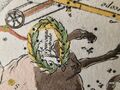 CrA in Fortin's Atlas Céleste, 3rd edition (1795).

Mythology
Greek
Eratosthenes does not recount any myth about the river boat on which the archer stands, nor does Geminos give any reasons for the definition of the constellation. It is unclear where the inspiration came from to describe the group as a wreath. However, the Egyptianised style of the Dendera zodiac shows the centaur-like archer on small boats beneath his hooves. This is not surprising in Egypt, where for thousands of years the stars were imagined to glide silently across the sky on barges.
Weblinks
References
- References (general)