Grus: Difference between revisions
Created page with "One of the 88 IAU constellations. The constellation was invented by Dutch sailors in the 1590s. ==Etymology and History== === Origin of Constellation === === Transfer and Transformation of the Constellation === == Mythology == == Weblinks == * == References == * References (general) * References (Babylonian) * References (ancient Greco-Roman) * References (Medieval and Early Modern)..." Tag: Disambiguation links |
No edit summary |
||
| (5 intermediate revisions by the same user not shown) | |||
| Line 1: | Line 1: | ||
Authors: {{PAGEAUTHORS}} | |||
---- | |||
[[File:Grus IAU.svg|alt=star chart|thumb|Grus star chart (IAU and Sky & Telescope magazine, Roger Sinnott & Rick Fienberg)]] | |||
One of the [[:Category:88_IAU-Constellations|88 IAU constellations]]. The constellation was invented by Dutch sailors in the 1590s. | One of the [[:Category:88_IAU-Constellations|88 IAU constellations]]. The constellation was invented by Dutch sailors in the 1590s. | ||
==Etymology and History== | ==Etymology and History== | ||
[[File:DeHoutman DenReygher.JPG|alt=screenshot(s) of text|thumb|"Reygher" (Heron) was the original name of the constellation in Dutch: see de Houtman (1603) "den Reygher", modern Grus. screenshot of star catalogue.]] | |||
=== Origin of Constellation === | |||
The crane is one of the Dutch constellations: proposed by sailors Frederick de Houtman and Pieter Keyser on the first Dutch East India expedition, the constellation was first depicted by Petrus Plancius on his celestial globe in 1598. As this globe was one of the sources for Johannes Bayer's influential map collection ‘Uranometria’, the crane quickly became part of the standard nomenclature. | |||
Somehow, the figure of a bird with a particularly long neck is intuitive here, but of course it is not clear that it must be a crane. De Houtman's star catalogue originally referred to the figure as a heron in Dutch. Other Dutchmen (such as the globe makers Plancius and van den Keere or the Leiden university librarian Merula) called the constellation Flamingo. In Latin, the name is Phoenicopterus, which is somewhat reminiscent of the neighbouring Phoenix. Of all these variants, Bayer's name ‘crane’ has survived. | |||
=== Transfer and Transformation of the Constellation === | === Transfer and Transformation of the Constellation === | ||
<gallery> | |||
File:Grus Bayer1603.jpg|Grus in Bayer (1603) | |||
File:Gru Fortin1795.jpg|Grus in Fortin's Atlas Céleste, 3rd edition (1795). | |||
</gallery> | |||
== Mythology == | == Mythology == | ||
| Line 18: | Line 26: | ||
* [[References]] (general) | * [[References]] (general) | ||
* [[References (Greco-Roman)|References (ancient Greco-Roman)]] | * [[References (Greco-Roman)|References (ancient Greco-Roman)]] | ||
* [[References (Medieval and Early Modern)|References (medieval)]] | * [[References (Medieval and Early Modern)|References (medieval)]] | ||
[[Category:Eurasia]] [[Category:Constellation | [[Category:Eurasia]] [[Category:Constellation]] [[Category:Modern]] | ||
[[Category:88 IAU-Constellations]] [[Category:European]][[Category:4work]] | [[Category:88 IAU-Constellations]] [[Category:European]][[Category:4work]] | ||
Latest revision as of 18:16, 26 February 2026
Authors: Susanne M Hoffmann

One of the 88 IAU constellations. The constellation was invented by Dutch sailors in the 1590s.
Etymology and History

Origin of Constellation
The crane is one of the Dutch constellations: proposed by sailors Frederick de Houtman and Pieter Keyser on the first Dutch East India expedition, the constellation was first depicted by Petrus Plancius on his celestial globe in 1598. As this globe was one of the sources for Johannes Bayer's influential map collection ‘Uranometria’, the crane quickly became part of the standard nomenclature.
Somehow, the figure of a bird with a particularly long neck is intuitive here, but of course it is not clear that it must be a crane. De Houtman's star catalogue originally referred to the figure as a heron in Dutch. Other Dutchmen (such as the globe makers Plancius and van den Keere or the Leiden university librarian Merula) called the constellation Flamingo. In Latin, the name is Phoenicopterus, which is somewhat reminiscent of the neighbouring Phoenix. Of all these variants, Bayer's name ‘crane’ has survived.
Transfer and Transformation of the Constellation
-
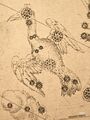 Grus in Bayer (1603)
 -
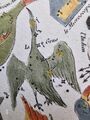 Grus in Fortin's Atlas Céleste, 3rd edition (1795).