Sagitta: Difference between revisions
No edit summary |
|||
| (15 intermediate revisions by 3 users not shown) | |||
| Line 1: | Line 1: | ||
Authors: {{PAGEAUTHORS}} | |||
---- | |||
[[File:Sagitta IAU.svg|alt=star chart|thumb|Sgr star chart (IAU and Sky & Telescope magazine, Roger Sinnott & Rick Fienberg).]] | [[File:Sagitta IAU.svg|alt=star chart|thumb|Sgr star chart (IAU and Sky & Telescope magazine, Roger Sinnott & Rick Fienberg).]] | ||
One of the [[:Category:88_IAU-Constellations|88 IAU constellations]]. Sagitta, The Arrow, is one the classical Greek constellations. In antiquity, it was considered a harbinger of the light and fertility as it is the carriage of the gods Apollo (light god) and his sister Demeter (goddess of fertility) when they arrive from the distant country of Hyperborea after winter. | One of the [[:Category:88_IAU-Constellations|88 IAU constellations]]. Sagitta, The Arrow, is one the classical Greek constellations. The Greek constellation of Sagitta first occurs in Eudoxus. In antiquity, it was considered a harbinger of the light and fertility as it is the carriage of the gods Apollo (light god) and his sister Demeter (goddess of fertility) when they arrive from the distant country of Hyperborea after winter. | ||
==Etymology and History== | ==Etymology and History== | ||
The Greek constellation . | The Arrow is a small constellation that is documented throughout Greek mathematical astronomy: it already appears in Eudoxus's writings in the 4th century BCE. Aratus and Eratosthenes claim that it belongs to a bow, but there is no such bow to be seen anywhere. The constellation of the Archer is located south of the Arrow, so that the Arrow appears to fly over it and was certainly not shot from it. Eratosthenes therefore reports that the Arrow is a projectile of Apollo, the god of light. | ||
It is noteworthy that the myth surrounding the Arrow begins with Asclepius, who is represented in the constellation Ophiuchus. The constellation was called Zababa ([[ZA.BA4.BA4|ZA.BA<sub>4</sub>.BA<sub>4</sub>]]) in Babylonian and was a god of war who has been documented since the 3rd millennium BCE. Seen from his perspective, the arrow flies in the right direction, as if it had been shot by him. However, there is no evidence of a constellation called Arrow in Babylonian, so there is no connection either.[[File:Cyg kugel.jpg|thumb|Earliest preserved depiction of Sagitta on the Kugel Globe (1st century BCE), next to Cygnus.]] | |||
[[File:KugelGlobe Sge.JPG|thumb|Sge, Aql, Cyg, Lyr, Del on the Kugel Globe (1st century BCE), SMH 2024.]] | |||
===Origin of Constellation=== | ===Origin of Constellation=== | ||
==== Babylonian ==== | ==== Babylonian ==== | ||
It is unknown whether this region was considered part of the asterism of The Pig ([[ŠAḪ]]) or any other image ([[UD.KA.DU8.A|UD.KA.DU<sub>8</sub>.A]] or [[TE8.mušen|TE<sub>8</sub><sup>mušen</sup>]], The Eagle). | It is unknown whether this region was considered part of the asterism of The Pig ([[ŠAḪ]]) or any other image ([[UD.KA.DU8.A|UD.KA.DU<sub>8</sub>.A]] or [[TE8.mušen|TE<sub>8</sub><sup>mušen</sup>]], The Eagle). | ||
==== Greco-Roman ==== | ==== Greco-Roman ==== | ||
Interestingly, Sagitta is described by Eratosthenes as huge while the constellation seems to be rather small. It is depicted on the small ones of the three preserved globes but not on the huge one. The tiny Kugel Globe (only 10 cm in diametre) and the Mainz Globe both have the arrow drawn while on the Farnese Globe the image is missing: it would be in the area covered by the huge (much larger than usual and turned around) [[Aquila]], The Eagle. | |||
===== | ===== Aratus ===== | ||
<blockquote>[311] Ahead of the Archer is another Arrow lying all by itself without a bow. The Bird is outstretched beside it, nearer to the north. Close to it another bird is wafted, inferior in size, but stormy when it rises from the sea at the departure of night; and men call it the Eagle. (Kidd 1997)</blockquote> | |||
===== Eratosthenes ===== | ===== Eratosthenes ===== | ||
| Line 28: | Line 34: | ||
There is a lot of cultural reference in this small text: the people of the Hyperboreans is considered in the far north (as the name suggests), it is considered of happy and pious people, but it is uncertain where it is located. The god Apollo usually resides in Delphi (as considered by the ancient Greeks) but leaves this place in winter for the land of the Hyperboreans. His return through the air, riding on a huge arrow, accompanied by his sister Demeter, is usually celebrated in Delphi. | There is a lot of cultural reference in this small text: the people of the Hyperboreans is considered in the far north (as the name suggests), it is considered of happy and pious people, but it is uncertain where it is located. The god Apollo usually resides in Delphi (as considered by the ancient Greeks) but leaves this place in winter for the land of the Hyperboreans. His return through the air, riding on a huge arrow, accompanied by his sister Demeter, is usually celebrated in Delphi. | ||
The contact of the Greeks with peoples in the far north is rather mythological. The tale of Abaris (a wonder man or shaman from the north) gives Eratosthenes's version of a visitor from these far countries. | The contact of the Greeks with peoples in the far north is rather mythological. The tale of Abaris (a wonder man or shaman from the north) gives Eratosthenes's version of a visitor from these far countries. In Heraklides' version of the Abaris tale, the man from the north carries Apollo's arrow around in Greece. | ||
Mythology has it that the temple in Delphi was built multiple times from different material (Sourvinou-Inwood 1979): from laurel, from feathers and wax, from bronce, from stone. The first one probably has a historical background in the temple of Apollo Daphniforos (the laurel bearer) in Eretria which is the most important monument this place. The information on the temple made of feathers probably comes from Heralides (and not Euripides) whose work on this topic is lost. | |||
===== Hipparchus ===== | ===== Hipparchus ===== | ||
====== Rising (Lib II Cap V §10) ====== | |||
<blockquote>The Rising of ...</blockquote> | |||
{| class="wikitable" | |||
|+ | |||
! | |||
! colspan="2" |east | |||
! colspan="2" |south | |||
|- | |||
! | |||
!lam1 | |||
!lam2 | |||
!lam1 | |||
!lam2 | |||
|- | |||
| | |||
|Sgr 5 | |||
|Sgr 9 1/2 | |||
|Vir 19 | |||
|Vir 25 | |||
|- | |||
| | |||
| | |||
| | |||
| | |||
| | |||
|- | |||
|star | |||
|those on the notch | |||
|the on one the tip | |||
| | |||
| | |||
|- | |||
|duration | |||
| colspan="4" |1/3 hours = 20 min = 5 degree | |||
|} | |||
====== Setting (Lib II Cap VI §10) ====== | |||
{| class="wikitable" | |||
! | |||
! colspan="2" |west | |||
! colspan="2" |south | |||
|- | |||
! | |||
!lam1 | |||
!lam2 | |||
!lam1 | |||
!lam2 | |||
|- | |||
| | |||
|Cap 26 1/2 | |||
|Aqr 1 1/2 | |||
|Ari 14 | |||
|Ari 19 1/2 | |||
|- | |||
| | |||
| | |||
| | |||
| | |||
| | |||
|- | |||
|star | |||
|those on the notch (alf,bet) | |||
|the one at the tip | |||
| | |||
| | |||
|- | |||
|duration | |||
| colspan="4" |1/3 hours = 20 min = 5° | |||
|} | |||
====== Stars Mentioned ====== | |||
{| class="wikitable" | |||
|+ | |||
! | |||
!Greek | |||
!German | |||
!English | |||
!ident. | |||
!src | |||
! | |||
!lam_culm | |||
|- | |||
| | |||
| | |||
| | |||
| | |||
| | |||
|Lib II Cap V §10 | |||
|rising, east, first | |||
| | |||
|- | |||
| | |||
| | |||
| | |||
| | |||
| | |||
|Lib II Cap V §10 | |||
|rising, east, last | |||
| | |||
|- | |||
| | |||
| | |||
| | |||
| | |||
| | |||
|Lib II Cap VI §2 | |||
|setting CrB, south, last | |||
|Psc 13.5 | |||
|- | |||
| | |||
| | |||
| | |||
| | |||
| | |||
|Lib II Cap VI §13 | |||
|setting Aql, south, first | |||
|Ari 2 | |||
|- | |||
| | |||
| | |||
| | |||
| | |||
| | |||
|Lib III Cap I §9 | |||
|rising Ori, south, last | |||
|Psc 13 | |||
|} | |||
===== Hyginus, Astronomica ===== | |||
<blockquote>This arrow, they say, is one of the weapons of Hercules, with which he is said to have killed the eagle which ate the liver of Prometheus. It seems not unprofitable to speak of Prometheus at greater length. When the men of old with great ceremony used to carry on the sacrificial rites of the immortal gods, they would burn the victims entire in the flame of the sacrifice. And so, when the poor were prevented from making sacrifices on account of the great expense, Prometheus, who with his wonderful wisdom is thought to have made men, by his pleading is said to have obtained permission from Jove for them to cast only a part of the victim into the fire, and to use the rest for their own food. This practice custom later established. Since he had obtained this permission, not as from a covetous man, but easily, as from a god, Prometheus himself sacrifices two bulls. When he had first placed their entrails on the altar, he put the remaining flesh of the two bulls in one heap, covering it with an oxhide. Whatever bones there were he covered with the other skin and put it down between them, offering Jove the choice of either part for himself. Jupiter, although he didn't act with divine forethought, nor as a god who ought to foresee everything, was deceived by Prometheus — sine we have started to believe the tale! — and thinking each part was a bull, shoe the bones for his half. And so after this, in solemn rites and sacrifices, when the flesh of victims has been consumed, they burn with fire the remaining parts which are the gods. | |||
But, to come back to the subject, Jupiter, when he realized what had been done, in anger took fire from mortals, lest the favour of Prometheus should seem to have more weight than the power of the gods, and that uncooked flesh should not be useful to men. Prometheus, however, who was accustomed to scheming, planned by his own efforts to bring back the fire that had been taken from men. So, when the others were away, he approached the fire of Jove, and with a small bit of this shut in a fennel-stalk he came joyfully, seeming to fly, not to run, tossing the stalk so that the air shut in with its vapours should not put out the flame in so narrow a space. Up to this time, then, men who bring good news usually come with speed. In the rivalry of the games they also make it a practice for the runners to run, shaking torches after the manner of Prometheus. | |||
In return for this deed, Jupiter, to confer a like favour on men, gave a woman to them, fashioned by Vulcan, and endowed with all kinds of gifts by the will of the gods. For this reason she was called Pandora. But Prometheus he bound with an iron chain to a mountain in Scythia named Caucasus for thirty thousand years, as Aeschylus, writer of tragedies, says. Then, too, he sent an eagle to him to eat out his liver which was constantly renewed at night. Some have said that this eagle was born from Typhon and Echidna, other from Terra and Tartarus, but many point out it was made by the hands of Vulcan and given life by Jove. | |||
The following reason for the release of Prometheus has been handed down. When Jupiter, moved by the beauty of Thetis, sought her in marriage, he couldn't win the consent of the timid maiden, but none the less kept planning to bring it about. At that time the Parcae were said to have prophesied what the natural order of events should be. They said that the son of Thetis' husband, whoever he might be, would be more famous than his father. Prometheus heard this as he kept watch, not from inclination but from necessity, and reported it to Jove. He, fearing that what he had done to his father Saturn in a similar situation, would happened to him, namely, that he would be robbed of his power, gave up by necessity his desire to wed Thetis, and out of gratitude to Prometheus thanked him and freed him from his chains. But he didn't go so far as to free him from all binding, since he had sworn to that, but for commemoration bade him bind his finger with the two things, namely, with stone and with iron. Following this practice men have rings fashioned of stone and iron, that they may seem to be appeasing Prometheus. Some also have said that he wore a wreath, as if to claim that he as victor had sinned without punishment. And so men began the practice of wearing wreaths at times of great rejoicing and victory. You may observe this in sports and banquets. | |||
But to come back to the beginning of the inquiry and the death of the eagle. Hercules, when sent by Eurystheus for the apples of the Hesperides, out of ignorance of the way came to Prometheus, who was bound on Mount Caucasus, as we have shown above. When victor, he returned to Prometheus to tell him that that dragon we have mentioned was slain, and to thank him for his kindness since he had pointed out the way. Straightway he gave what honour he could to the one that deserved it, for [he killed the eagle? ] and since it was slain, men began, when victims were sacrificed, to offer livers on the altars of the gods to satisfy them in place of the liver of Prometheus. | |||
Eratosthenes says about the Arrow, that with this Apollo killed the Cyclopes who forged the thunderbolt by which Aesculapius died. Apollo had buried this arrow in the Hyperborean mountain, but when Jupiter pardoned his son, it was borne by the wind and brought to Apollo along with the grain which at that time was growing. Many point out that for this reason it is among the constellations. (Mary Ward 1960)</blockquote> | |||
===== Geminos ===== | ===== Geminos ===== | ||
| Line 82: | Line 231: | ||
| | | | ||
|} | |} | ||
[[File:Oistos Youla CH.png|thumb|Convex Hull for the stars inside Oistos (CC BY Youla Azkarrula).]] | |||
===== Stars within the Constellation Area ===== | |||
{| class="wikitable sortable mw-collapsible" | |||
|+ | |||
!id | |||
!Label | |||
!IAU design. | |||
!description | |||
!Vmag | |||
|- | |||
|1 | |||
|γ Sagittae | |||
|HIP 98337 | |||
|Constellation lines (Vertex) | |||
|3.47 | |||
|- | |||
|2 | |||
|δ Sagittae | |||
|HIP 97365 | |||
|Constellation lines | |||
|3.81 | |||
|- | |||
|3 | |||
|Sham | |||
|HIP 96757 | |||
|Constellation lines (Vertex) | |||
|4.38 | |||
|- | |||
|4 | |||
|β Sagittae | |||
|HIP 96837 | |||
|Constellation lines (Vertex) | |||
|4.38 | |||
|} | |||
===Transfer and Transformation of the Constellation=== | ===Transfer and Transformation of the Constellation=== | ||
<gallery> | <gallery> | ||
File:Cyg kugel.jpg|Sagitta hitting Cygnus, The Swan, on the Kugel Globe (1st century BCE). | |||
File:Aql+sge mainz.jpg|Sagitta in the claws of The Eagle, pointing northwards, on the Mainz Globe (2nd century CE). | |||
File:Aratea 54v and 55r.jpg|Sagitta in the Leiden Aratea (830) | |||
File:1776 - John Flamsteed - L'Aigle, Antinous, La Fleche, Le Renard, Le Dauphin (Aquila, Sagitta, Vulpecula & Anser Delphinus).jpg|Sagitta in Flamsteed (1776) | |||
File:Sidney Hall - Urania's Mirror - Delphinus, Sagitta, Aquila, and Antinous.jpg|Sagitta in Sidney Hall (1822), Urania's Mirror | File:Sidney Hall - Urania's Mirror - Delphinus, Sagitta, Aquila, and Antinous.jpg|Sagitta in Sidney Hall (1822), Urania's Mirror | ||
</gallery> | </gallery> | ||
==Mythology== | ==Mythology== | ||
'''Greek'''<ref>Hoffmann, Susanne M. Wie der Löwe an den Himmel kam. Franckh Kosmos Verlag, Stuttgart 2021</ref> | |||
After Zeus killed the demigod Asclepius ([[Ophiuchus]]) with a thunderbolt because he had brought a dead man back to life, Asclepius' father Apollo was seriously upset. He killed the Cyclopes, who forged the thunderbolts for Zeus. Then he felt compelled to go into exile until his brother Zeus had calmed down and forgiven him for his deed. | |||
Eratosthenes reports two versions of what the arrow has to do with this story: on the one hand, the arrow could be the one that Apollo shot at the Cyclopes and which was then hidden. When Apollo returned, he is said to have rushed through the air together with Demeter, the goddess of fertility. This could be interpreted as riding on the arrow. The background to this story is that Apollo left his sanctuary in Delphi in winter and returned in spring – fitting for a god of light – and thus also brought fertility with him. He hid himself, or in the myth, the arrow, with the Hyperboreans. According to the world view of Herodotus (-5th century), their land lies in the far north-east of the world, in Central Asia. | |||
'''Roman'''<ref>Ian Ridpath (1988). Star Tales - Sagitta, [http://www.ianridpath.com/startales/sagitta.html online edition].</ref> | |||
Hyginus, on the other hand, said that Sagitta was one of the arrows with which Heracles killed the eagle that ate the liver of Prometheus. It was Prometheus who moulded men out of clay in the likeness of the gods, and gave them fire that he had stolen from Zeus. Prometheus carried the fire triumphantly in a vegetable stalk like a runner bearing the Olympic torch. Zeus cruelly punished him for this theft by chaining him to Mount Caucasus, where a long-winged eagle ate his liver during the day. But at night the liver grew again for the eagle to resume his feast in the morning. Heracles freed Prometheus from this eternal torture by shooting the eagle with an arrow. | |||
Germanicus Caesar identified Sagitta as the arrow of Eros which kindled in Zeus his passion for the shepherd boy Ganymede, who is commemorated by the constellation Aquarius. Now, according to Germanicus, the arrow is guarded in the sky by the eagle of Zeus – and Sagitta does indeed lie next to the constellation of the eagle, Aquila. | |||
Alpha Sagittae, magnitude 4.4, has the strange-sounding name Sham, which comes from the Arabic name for the constellation, ''al-sahm'', meaning ‘the arrow’. The constellation’s brightest star is actually Gamma Sagittae, magnitude 3.5, which Ptolemy described as lying on the arrow-head; however, Bayer in his Uranometria extended the shaft to the stars he labelled Eta and Theta, which Ptolemy did not list. Flamsteed and Bode changed the angle of the arrow slightly so that Eta Sagittae lay at its tip and Alpha and Beta on the southern feather, as in the illustration above, whereas according to Ptolemy they should have been at the end of the shaft. | |||
==Weblinks== | ==Weblinks== | ||
Latest revision as of 18:58, 26 February 2026
Authors: Susanne M Hoffmann, Doris Vickers, Youla Azkarrula

One of the 88 IAU constellations. Sagitta, The Arrow, is one the classical Greek constellations. The Greek constellation of Sagitta first occurs in Eudoxus. In antiquity, it was considered a harbinger of the light and fertility as it is the carriage of the gods Apollo (light god) and his sister Demeter (goddess of fertility) when they arrive from the distant country of Hyperborea after winter.
Etymology and History
The Arrow is a small constellation that is documented throughout Greek mathematical astronomy: it already appears in Eudoxus's writings in the 4th century BCE. Aratus and Eratosthenes claim that it belongs to a bow, but there is no such bow to be seen anywhere. The constellation of the Archer is located south of the Arrow, so that the Arrow appears to fly over it and was certainly not shot from it. Eratosthenes therefore reports that the Arrow is a projectile of Apollo, the god of light.
It is noteworthy that the myth surrounding the Arrow begins with Asclepius, who is represented in the constellation Ophiuchus. The constellation was called Zababa (mul dZA.BA4.BA4) in Babylonian and was a god of war who has been documented since the 3rd millennium BCE. Seen from his perspective, the arrow flies in the right direction, as if it had been shot by him. However, there is no evidence of a constellation called Arrow in Babylonian, so there is no connection either.


Origin of Constellation
Babylonian
It is unknown whether this region was considered part of the asterism of The Pig (ŠAḪ) or any other image (UD.KA.DU8.A (𒌓𒅗𒂃𒀀) or TE8mušen, The Eagle).
Greco-Roman
Interestingly, Sagitta is described by Eratosthenes as huge while the constellation seems to be rather small. It is depicted on the small ones of the three preserved globes but not on the huge one. The tiny Kugel Globe (only 10 cm in diametre) and the Mainz Globe both have the arrow drawn while on the Farnese Globe the image is missing: it would be in the area covered by the huge (much larger than usual and turned around) Aquila, The Eagle.
Aratus
[311] Ahead of the Archer is another Arrow lying all by itself without a bow. The Bird is outstretched beside it, nearer to the north. Close to it another bird is wafted, inferior in size, but stormy when it rises from the sea at the departure of night; and men call it the Eagle. (Kidd 1997)
Eratosthenes
Var. 1: This line is the arrow of a bow which belonged, it is said, to Apollo, and with which, to avenge Asclepius, he killed the Cyclops who had forged the thunderbolt for Zeus. He then hid it in the land of the Hyperboreans, in the place where the sanctuary made of feathers. It is said that first thing he did was to get it back, when Zeus forgave him for his murder and put an end to his servitude with Admetus, mentioned by Euripides in Alcestis. The arrow is said to have returned through the air with Demeter Fructiferous. It was of extraordinary size, according to Heraclides of Pontus in his Pont in his book On Justice. Apollo also placed this feature among the stars, and made it a constellation to fix the memory of the battle he had fought.
The Arrow has a star at the tip, one in the middle, and two in the notch. One of them is particularly visible. In all, four.
Var. 2: This is a bow and arrow, said to have belonged to Apollo, and with which he killed the Cyclops who had made made the thunderbolt for Zeus; he killed them to avenge Asclepius. He hid it [the arrow] in the land of the Hyperboreans, in the place where there is a sanctuary made of feathers. When he put an end ... then the point returned through the air with Demeter Fructiferous. It was of extraordinary size. Heraclides of Pontus says in his book On Justice that a certain Abaris moved while being carried by this arrow. So Apollo made it into a constellation to fix the memory of the battle he had fought.
The arrow has four stars.
(Pamias and Zucker, 2013)
There is a lot of cultural reference in this small text: the people of the Hyperboreans is considered in the far north (as the name suggests), it is considered of happy and pious people, but it is uncertain where it is located. The god Apollo usually resides in Delphi (as considered by the ancient Greeks) but leaves this place in winter for the land of the Hyperboreans. His return through the air, riding on a huge arrow, accompanied by his sister Demeter, is usually celebrated in Delphi.
The contact of the Greeks with peoples in the far north is rather mythological. The tale of Abaris (a wonder man or shaman from the north) gives Eratosthenes's version of a visitor from these far countries. In Heraklides' version of the Abaris tale, the man from the north carries Apollo's arrow around in Greece.
Mythology has it that the temple in Delphi was built multiple times from different material (Sourvinou-Inwood 1979): from laurel, from feathers and wax, from bronce, from stone. The first one probably has a historical background in the temple of Apollo Daphniforos (the laurel bearer) in Eretria which is the most important monument this place. The information on the temple made of feathers probably comes from Heralides (and not Euripides) whose work on this topic is lost.
Hipparchus
Rising (Lib II Cap V §10)
The Rising of ...
| east | south | |||
|---|---|---|---|---|
| lam1 | lam2 | lam1 | lam2 | |
| Sgr 5 | Sgr 9 1/2 | Vir 19 | Vir 25 | |
| star | those on the notch | the on one the tip | ||
| duration | 1/3 hours = 20 min = 5 degree | |||
Setting (Lib II Cap VI §10)
| west | south | |||
|---|---|---|---|---|
| lam1 | lam2 | lam1 | lam2 | |
| Cap 26 1/2 | Aqr 1 1/2 | Ari 14 | Ari 19 1/2 | |
| star | those on the notch (alf,bet) | the one at the tip | ||
| duration | 1/3 hours = 20 min = 5° | |||
Stars Mentioned
| Greek | German | English | ident. | src | lam_culm | ||
|---|---|---|---|---|---|---|---|
| Lib II Cap V §10 | rising, east, first | ||||||
| Lib II Cap V §10 | rising, east, last | ||||||
| Lib II Cap VI §2 | setting CrB, south, last | Psc 13.5 | |||||
| Lib II Cap VI §13 | setting Aql, south, first | Ari 2 | |||||
| Lib III Cap I §9 | rising Ori, south, last | Psc 13 |
Hyginus, Astronomica
This arrow, they say, is one of the weapons of Hercules, with which he is said to have killed the eagle which ate the liver of Prometheus. It seems not unprofitable to speak of Prometheus at greater length. When the men of old with great ceremony used to carry on the sacrificial rites of the immortal gods, they would burn the victims entire in the flame of the sacrifice. And so, when the poor were prevented from making sacrifices on account of the great expense, Prometheus, who with his wonderful wisdom is thought to have made men, by his pleading is said to have obtained permission from Jove for them to cast only a part of the victim into the fire, and to use the rest for their own food. This practice custom later established. Since he had obtained this permission, not as from a covetous man, but easily, as from a god, Prometheus himself sacrifices two bulls. When he had first placed their entrails on the altar, he put the remaining flesh of the two bulls in one heap, covering it with an oxhide. Whatever bones there were he covered with the other skin and put it down between them, offering Jove the choice of either part for himself. Jupiter, although he didn't act with divine forethought, nor as a god who ought to foresee everything, was deceived by Prometheus — sine we have started to believe the tale! — and thinking each part was a bull, shoe the bones for his half. And so after this, in solemn rites and sacrifices, when the flesh of victims has been consumed, they burn with fire the remaining parts which are the gods.
But, to come back to the subject, Jupiter, when he realized what had been done, in anger took fire from mortals, lest the favour of Prometheus should seem to have more weight than the power of the gods, and that uncooked flesh should not be useful to men. Prometheus, however, who was accustomed to scheming, planned by his own efforts to bring back the fire that had been taken from men. So, when the others were away, he approached the fire of Jove, and with a small bit of this shut in a fennel-stalk he came joyfully, seeming to fly, not to run, tossing the stalk so that the air shut in with its vapours should not put out the flame in so narrow a space. Up to this time, then, men who bring good news usually come with speed. In the rivalry of the games they also make it a practice for the runners to run, shaking torches after the manner of Prometheus.
In return for this deed, Jupiter, to confer a like favour on men, gave a woman to them, fashioned by Vulcan, and endowed with all kinds of gifts by the will of the gods. For this reason she was called Pandora. But Prometheus he bound with an iron chain to a mountain in Scythia named Caucasus for thirty thousand years, as Aeschylus, writer of tragedies, says. Then, too, he sent an eagle to him to eat out his liver which was constantly renewed at night. Some have said that this eagle was born from Typhon and Echidna, other from Terra and Tartarus, but many point out it was made by the hands of Vulcan and given life by Jove.
The following reason for the release of Prometheus has been handed down. When Jupiter, moved by the beauty of Thetis, sought her in marriage, he couldn't win the consent of the timid maiden, but none the less kept planning to bring it about. At that time the Parcae were said to have prophesied what the natural order of events should be. They said that the son of Thetis' husband, whoever he might be, would be more famous than his father. Prometheus heard this as he kept watch, not from inclination but from necessity, and reported it to Jove. He, fearing that what he had done to his father Saturn in a similar situation, would happened to him, namely, that he would be robbed of his power, gave up by necessity his desire to wed Thetis, and out of gratitude to Prometheus thanked him and freed him from his chains. But he didn't go so far as to free him from all binding, since he had sworn to that, but for commemoration bade him bind his finger with the two things, namely, with stone and with iron. Following this practice men have rings fashioned of stone and iron, that they may seem to be appeasing Prometheus. Some also have said that he wore a wreath, as if to claim that he as victor had sinned without punishment. And so men began the practice of wearing wreaths at times of great rejoicing and victory. You may observe this in sports and banquets.
But to come back to the beginning of the inquiry and the death of the eagle. Hercules, when sent by Eurystheus for the apples of the Hesperides, out of ignorance of the way came to Prometheus, who was bound on Mount Caucasus, as we have shown above. When victor, he returned to Prometheus to tell him that that dragon we have mentioned was slain, and to thank him for his kindness since he had pointed out the way. Straightway he gave what honour he could to the one that deserved it, for [he killed the eagle? ] and since it was slain, men began, when victims were sacrificed, to offer livers on the altars of the gods to satisfy them in place of the liver of Prometheus.
Eratosthenes says about the Arrow, that with this Apollo killed the Cyclopes who forged the thunderbolt by which Aesculapius died. Apollo had buried this arrow in the Hyperborean mountain, but when Jupiter pardoned his son, it was borne by the wind and brought to Apollo along with the grain which at that time was growing. Many point out that for this reason it is among the constellations. (Mary Ward 1960)
Geminos
Almagest Ὀιστὸς
| id | Greek
(Heiberg 1898) |
English
(Toomer 1984) |
ident. |
|---|---|---|---|
| Ὀιστοῦ ἀστερισμός | |||
| 1 | ὁ ἐπὶ τῆς ἀκίδος μουαχός | The lone star on the arrow-head | gam Sge |
| 2 | τῶν ἐν τῷ καλάμῳ τριῶν ὁ ἐπόμενος | Thc rearmost of thc three stars in the shaft | zet Sge |
| 3 | ὁ μέσος αὐτῶν | The middle onc | del Dge |
| 4 | ὁ προγρούμενος τῶν τριῶν | The most advanced of the three | alf Sge |
| 5 | ὁ ἐπ’ ἄκρας τῆς γλυφύδος. | The star on the end of the notch | bet Sge |
| ἀστέρες ἐ, ὧν δ’ μεγέθους ἄ, ε 7, ς’ ἄ. | 5 stars, l of the fourth magnitude, 3 of the fifth, l of the sixth |

Stars within the Constellation Area
| id | Label | IAU design. | description | Vmag |
|---|---|---|---|---|
| 1 | γ Sagittae | HIP 98337 | Constellation lines (Vertex) | 3.47 |
| 2 | δ Sagittae | HIP 97365 | Constellation lines | 3.81 |
| 3 | Sham | HIP 96757 | Constellation lines (Vertex) | 4.38 |
| 4 | β Sagittae | HIP 96837 | Constellation lines (Vertex) | 4.38 |
Transfer and Transformation of the Constellation
-
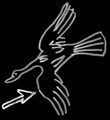 Sagitta hitting Cygnus, The Swan, on the Kugel Globe (1st century BCE).
 -
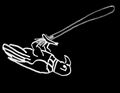 Sagitta in the claws of The Eagle, pointing northwards, on the Mainz Globe (2nd century CE).
 -
 Sagitta in the Leiden Aratea (830)
 -
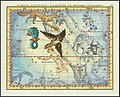 Sagitta in Flamsteed (1776)
 -
 Sagitta in Sidney Hall (1822), Urania's Mirror


.jpg)

Mythology
Greek[1]
After Zeus killed the demigod Asclepius (Ophiuchus) with a thunderbolt because he had brought a dead man back to life, Asclepius' father Apollo was seriously upset. He killed the Cyclopes, who forged the thunderbolts for Zeus. Then he felt compelled to go into exile until his brother Zeus had calmed down and forgiven him for his deed.
Eratosthenes reports two versions of what the arrow has to do with this story: on the one hand, the arrow could be the one that Apollo shot at the Cyclopes and which was then hidden. When Apollo returned, he is said to have rushed through the air together with Demeter, the goddess of fertility. This could be interpreted as riding on the arrow. The background to this story is that Apollo left his sanctuary in Delphi in winter and returned in spring – fitting for a god of light – and thus also brought fertility with him. He hid himself, or in the myth, the arrow, with the Hyperboreans. According to the world view of Herodotus (-5th century), their land lies in the far north-east of the world, in Central Asia.
Roman[2]
Hyginus, on the other hand, said that Sagitta was one of the arrows with which Heracles killed the eagle that ate the liver of Prometheus. It was Prometheus who moulded men out of clay in the likeness of the gods, and gave them fire that he had stolen from Zeus. Prometheus carried the fire triumphantly in a vegetable stalk like a runner bearing the Olympic torch. Zeus cruelly punished him for this theft by chaining him to Mount Caucasus, where a long-winged eagle ate his liver during the day. But at night the liver grew again for the eagle to resume his feast in the morning. Heracles freed Prometheus from this eternal torture by shooting the eagle with an arrow.
Germanicus Caesar identified Sagitta as the arrow of Eros which kindled in Zeus his passion for the shepherd boy Ganymede, who is commemorated by the constellation Aquarius. Now, according to Germanicus, the arrow is guarded in the sky by the eagle of Zeus – and Sagitta does indeed lie next to the constellation of the eagle, Aquila.
Alpha Sagittae, magnitude 4.4, has the strange-sounding name Sham, which comes from the Arabic name for the constellation, al-sahm, meaning ‘the arrow’. The constellation’s brightest star is actually Gamma Sagittae, magnitude 3.5, which Ptolemy described as lying on the arrow-head; however, Bayer in his Uranometria extended the shaft to the stars he labelled Eta and Theta, which Ptolemy did not list. Flamsteed and Bode changed the angle of the arrow slightly so that Eta Sagittae lay at its tip and Alpha and Beta on the southern feather, as in the illustration above, whereas according to Ptolemy they should have been at the end of the shaft.
Weblinks
References
- ↑ Hoffmann, Susanne M. Wie der Löwe an den Himmel kam. Franckh Kosmos Verlag, Stuttgart 2021
- ↑ Ian Ridpath (1988). Star Tales - Sagitta, online edition.