Aries: Difference between revisions
| (10 intermediate revisions by 2 users not shown) | |||
| Line 1: | Line 1: | ||
Authors: {{PAGEAUTHORS}} | |||
---- | |||
[[File:Aries (ari).tiff|alt=star chart|thumb|Aries star chart (IAU and Sky & Telescope magazine, Roger Sinnott & Rick Fienberg)]] | [[File:Aries (ari).tiff|alt=star chart|thumb|Aries star chart (IAU and Sky & Telescope magazine, Roger Sinnott & Rick Fienberg)]] | ||
One of the [[:Category:88_IAU-Constellations|88 IAU constellations]]. | One of the [[:Category:88_IAU-Constellations|88 IAU constellations]] is Aries, The Ram. | ||
==Etymology and History== | ==Etymology and History== | ||
Aries = The Ram in Latin, is a translation of the Ancient Greek constellation name Κριός (krios). It is unknown whether this constellation name was Indigenously from Macedonia, Greece or any other Mediterranean culture and inspired Babylonian transformations, or Babylonian puns led to the creation of a new image with no recognizable patterns among the stars. The latter is regarded more likely. | |||
===Origin of Constellation=== | ===Origin of Constellation=== | ||
In ancient times,<ref name=":0">Hoffmann, Susanne M. Wie der Löwe an den Himmel kam. Franckh Kosmos Verlag, Stuttgart 2021</ref> Aries was associated with the first month of the year because the beginning of the year was equated with the awakening of spring and the lambs' leap. In Old and Middle Babylonian, no animal was conceived at this point in the zodiac, but rather a human being: the wage labourer who was now rehired because cattle had to be herded in the pastures and agriculture had to be practised. The Babylonian constellation ‘Wage Labourer’ was associated with the god of shepherds, Dumuzi, the husband of the goddess Inanna/Ishtar. | |||
How the wage labourer became an aries remains a mystery, for which science has several theories: Of course, it may be that the ram was Greek and that when the Babylonian zodiac was adopted, the foreign labourer was simply replaced by a constellation of their own. However, this is unlikely because all other foreign images were adopted, even if it was difficult to integrate them into their own Greek mythology (see Capricorn). | |||
It is therefore more likely that the change already took place in Babylon before the zodiac was exported all over the world. Since the mid-20th century, there has been a hypothesis of a Babylonian play on words: the labourer is called LU.ḪUN.GA, whereby the prefix LU only indicates that this is a designation for a human being. Like all scientists, the Babylonians tended to use abbreviations and often wrote only the sign for the first spoken syllable, i.e. ḪUN: this is documented on clay tablets. However, this cuneiform sign is very similar to the sign for UDU, sheep, so it could be a joke or a misunderstanding in translations into Greek or other languages. | |||
Aratos and Eratosthenes are certain that a ram was sacrificed here. In general, rams were popular sacrificial animals. In addition, Zeus himself is sometimes identified with a ram. The ram in the sky must therefore be a special ram, and that is what the myth is about. | |||
==== Babylonian ==== | ==== Babylonian ==== | ||
[[File:Kugel Globe Tri.JPG|thumb|Kugel Globe: Aries and Triangulum, 1st century BCE (drawing by SMH 2024)]] | [[File:Psc+ari+aqr+and.jpg|thumb|Dumuzi, the shepherd god, as Hired Man, as lover of Inanna who is depicted in the constellation Anunitu(m); both east of the One Field-constellation (IKU), and north of the Swallow SIM.MAH and the giant, GU.LA, the god Enki/Ea. Drawings by Robert Perdok and Susanne M Hoffmann 2016, mapped in Stellarium.]] | ||
In the Middle Babylonian (MB) compendium MUL.APIN, no constellation of a ram existed. The constellation in the area of modern Aries was The Hired Man ([[ḪUN.GA2|<sup>mul lú</sup>ḪUN.GA<sub>2</sub>]] (𒀯𒇽𒂠𒂷) = ''agru''). | |||
The Babylonian asterism of The Ewe ([[U8|U<sub>8</sub>]]) has nothing to do with this constellation; it is in the area of [[Ursa Major]]. [[File:Kugel Globe Tri.JPG|thumb|Kugel Globe: Aries and Triangulum, 1st century BCE (drawing by SMH 2024)]] | |||
==== Greco-Roman ==== | ==== Greco-Roman ==== | ||
===== Aratos ===== | ===== Aratos ===== | ||
<blockquote>[225] There too are the paths of the Ram, the swiftest because it speeds round the longest circle and yet does not lag behind the Bear Cynosura as it runs. The Ram itself is faint and starless, as if observed by moonlight, but you can still identify it from the girdle of Andromeda: for it is set a little way below her. [231] It traverses the great sky centrally, where the tips of the Claws and Orion’s belt revolve. | <blockquote>[225] There too are the paths of the Ram, the swiftest because it speeds round the longest circle and yet does not lag behind the Bear Cynosura as it runs. The Ram itself is faint and starless, as if observed by moonlight, but you can still identify it from the girdle of Andromeda: for it is set a little way below her. [231] It traverses the great sky centrally, where the tips of the Claws and Orion’s belt revolve.</blockquote><blockquote>(Kidd 1997)</blockquote> | ||
(Kidd 1997)</blockquote> | |||
===== Eratosthenes ===== | ===== Eratosthenes ===== | ||
===== Hipparchus ===== | ===== Hipparchus ===== | ||
====== Rising (Lib II Cap V §10) ====== | |||
<blockquote>The Rising of ...</blockquote> | |||
{| class="wikitable" | |||
|+ | |||
! | |||
! colspan="2" |east | |||
! colspan="2" |south | |||
|- | |||
! | |||
!lam1 | |||
!lam2 | |||
!lam1 | |||
!lam2 | |||
|- | |||
| | |||
| | |||
| | |||
| | |||
| | |||
|- | |||
| | |||
| | |||
| | |||
| | |||
| | |||
|- | |||
|star | |||
| | |||
| | |||
| | |||
| | |||
|- | |||
|duration | |||
| colspan="4" |2 1/8 hours = 127.5 min = 31 7/8 degree | |||
|} | |||
====== Setting (Lib II Cap VI §10) ====== | |||
{| class="wikitable" | |||
! | |||
! colspan="2" |west | |||
! colspan="2" |south | |||
|- | |||
! | |||
!lam1 | |||
!lam2 | |||
!lam1 | |||
!lam2 | |||
|- | |||
| | |||
| | |||
| | |||
| | |||
| | |||
|- | |||
| | |||
| | |||
| | |||
| | |||
| | |||
|- | |||
|star | |||
| | |||
| | |||
| | |||
| | |||
|- | |||
|duration | |||
| colspan="4" |2 2/3 hours = 160 min = 40° | |||
|} | |||
====== Stars Mentioned ====== | |||
{| class="wikitable" | |||
|+ | |||
! | |||
!Greek | |||
!German | |||
!English | |||
!ident. | |||
!src | |||
! | |||
!lam_culm | |||
|- | |||
| | |||
| | |||
| | |||
| | |||
| | |||
|Lib II Cap V §10 | |||
|rising, east, first | |||
| | |||
|- | |||
| | |||
| | |||
| | |||
| | |||
| | |||
|Lib II Cap V §10 | |||
|rising, east, last | |||
| | |||
|- | |||
| | |||
| | |||
| | |||
| | |||
| | |||
|Lib II Cap VI §2 | |||
|setting CrB, south, last | |||
|Psc 13.5 | |||
|- | |||
| | |||
| | |||
| | |||
| | |||
| | |||
|Lib II Cap VI §13 | |||
|setting Aql, south, first | |||
|Ari 2 | |||
|- | |||
| | |||
| | |||
| | |||
| | |||
| | |||
|Lib III Cap I §9 | |||
|rising Ori, south, last | |||
|Psc 13 | |||
|} | |||
===== Hyginus, Astronomica ===== | ===== Hyginus, Astronomica ===== | ||
| Line 74: | Line 214: | ||
|nu Ari | |nu Ari | ||
|- | |- | ||
| | |7 | ||
|ὁ ἐπὶ τῆς ἐκφύσεως τῆς οὐρᾶς | |ὁ ἐπὶ τῆς ἐκφύσεως τῆς οὐρᾶς | ||
|The star on the place where the tail joins [ the body] | |The star on the place where the tail joins [ the body] | ||
|eps Ari | |eps Ari | ||
|- | |- | ||
| | |8 | ||
|τῶν ἐν τῇ οὐρᾷ 7 ὁ προηγούμενος | |τῶν ἐν τῇ οὐρᾷ 7 ὁ προηγούμενος | ||
|The most advanced of the 3 stars in the tail | |The most advanced of the 3 stars in the tail | ||
|del Ari | |del Ari | ||
|- | |- | ||
| | |9 | ||
|ὁ μέσος τῶν τριῶν. | |ὁ μέσος τῶν τριῶν. | ||
|The middle one of the three | |The middle one of the three | ||
|zet Ari | |zet Ari | ||
|- | |- | ||
| | |10 | ||
|ὁ ἐπόμενος αὐτῶν. | |ὁ ἐπόμενος αὐτῶν. | ||
|The rearmost of them | |The rearmost of them | ||
|tau Ari | |tau Ari | ||
|- | |- | ||
| | |11 | ||
|ὁ ἐν τῷ ὀπισθομήρῳ! | |ὁ ἐν τῷ ὀπισθομήρῳ! | ||
|The star in the back of the thigh | |The star in the back of the thigh | ||
|rho Ari | |rho Ari | ||
|- | |- | ||
| | |12 | ||
|ὁ ὑπὸ τὴν ἀγκύληη | |ὁ ὑπὸ τὴν ἀγκύληη | ||
|The star under the knee-bend | |The star under the knee-bend | ||
|sig Ari | |sig Ari | ||
|- | |- | ||
| | |13 | ||
|ὁ ἐπὶ τοῦ ὀπισθίου ἀκρόποδος | |ὁ ἐπὶ τοῦ ὀπισθίου ἀκρόποδος | ||
|The star an the hind hoof | |The star an the hind hoof | ||
| Line 129: | Line 269: | ||
! | ! | ||
|- | |- | ||
| | |14 | ||
|ὁ ὑπὲρ τὴν κεφαλήν, ὃυ Ἴππαρχος ἐπὶ τοῦ ῥύγχους | |ὁ ὑπὲρ τὴν κεφαλήν, ὃυ Ἴππαρχος ἐπὶ τοῦ ῥύγχους | ||
|The star over the head, which Hipparchus [calls] 'the one on the muzzle' | |The star over the head, which Hipparchus [calls] 'the one on the muzzle' | ||
|alf Ari | |alf Ari | ||
|- | |- | ||
| | |15 | ||
|τῶν ὑπὲρ τὴν ὀσφὺν δ ὁ ἐπόμενος καὶ λαμπρότερος. | |τῶν ὑπὲρ τὴν ὀσφὺν δ ὁ ἐπόμενος καὶ λαμπρότερος. | ||
|The 4 stars over the rump: the rearmost,_ which is brighter [than the others] | |The 4 stars over the rump: the rearmost,_ which is brighter [than the others] | ||
|41 Ari | |41 Ari | ||
|- | |- | ||
| | |16 | ||
|τῶν λοιπῶν γ’ καὶ ἀμαυροτέρων ὁ βόρειος. | |τῶν λοιπῶν γ’ καὶ ἀμαυροτέρων ὁ βόρειος. | ||
|The 4 stars over the rump: the northernmost of the other 3, fainter stars | |The 4 stars over the rump: the northernmost of the other 3, fainter stars | ||
|39 Ari | |39 Ari | ||
|- | |- | ||
| | |17 | ||
|μέσος τῶν τριῶν | |μέσος τῶν τριῶν | ||
|The 4 stars over the rump: the middle one of these three | |The 4 stars over the rump: the middle one of these three | ||
|35 Ari | |35 Ari | ||
|- | |- | ||
| | |18 | ||
|ὁ νότιος αὐτῶν. | |ὁ νότιος αὐτῶν. | ||
|The 4 stars over the rump: the southernmost of them | |The 4 stars over the rump: the southernmost of them | ||
| Line 164: | Line 304: | ||
| | | | ||
|} | |} | ||
[[File:Krios Youla CH.png|thumb|Convex Hull for the stars inside Krios (CC BY Youla Azkarrula).]] | |||
===== Stars within the Constellation Area ===== | |||
{| class="wikitable sortable mw-collapsible" | |||
|+ | |||
!id | |||
!Label | |||
!IAU design. | |||
!description | |||
!Vmag | |||
|- | |||
|1 | |||
|Sheratan | |||
|HIP 8903 | |||
|Constellation lines (Vertex) | |||
|2.65 | |||
|- | |||
|2 | |||
|Bharani | |||
|HIP 13209 | |||
|Constellation lines | |||
|3.594 | |||
|- | |||
|3 | |||
|μ Ceti | |||
|HIP 12828 | |||
|Constellation lines (Vertex) | |||
|4.26 | |||
|- | |||
|4 | |||
|Botein | |||
|HIP 14838 | |||
|Constellation lines | |||
|4.37 | |||
|- | |||
|5 | |||
|Lilii Borea | |||
|HIP 13061 | |||
|Constellation lines (Vertex) | |||
|4.51 | |||
|- | |||
|6 | |||
|Mesarthim | |||
|HIP 8832 | |||
|Constellation lines (Vertex) | |||
|4.52 | |||
|- | |||
|7 | |||
|ϵ Arietis | |||
|HIP 13914 | |||
|Constellation lines | |||
|4.63 | |||
|- | |||
|8 | |||
|35 Ari | |||
|HIP 12719 | |||
|Constellation lines | |||
|4.67 | |||
|- | |||
|9 | |||
|ζ Arietis | |||
|HIP 15110 | |||
|Constellation lines | |||
|4.869 | |||
|- | |||
|10 | |||
|κ Arietis | |||
|HIP 9836 | |||
|Inside the hull | |||
|5.019 | |||
|- | |||
|11 | |||
|ι Arietis | |||
|HIP 9110 | |||
|Constellation lines (Vertex) | |||
|5.105 | |||
|- | |||
|12 | |||
|τ 2 Arietis | |||
|HIP 15737 | |||
|Constellation lines (Vertex) | |||
|5.13 | |||
|- | |||
|13 | |||
|38 Ari | |||
|HIP 12832 | |||
|Constellation lines | |||
|5.17 | |||
|- | |||
|14 | |||
|η Arietis | |||
|HIP 10306 | |||
|Constellation lines | |||
|5.2 | |||
|- | |||
|15 | |||
|33 Ari | |||
|HIP 12489 | |||
|Constellation lines | |||
|5.296 | |||
|- | |||
|16 | |||
|* pi. Ari A | |||
|HIP 13165 | |||
|Constellation lines | |||
|5.34 | |||
|- | |||
|17 | |||
|τ 1 Arietis | |||
|HIP 15627 | |||
|Constellation lines (Vertex) | |||
|5.355 | |||
|- | |||
|18 | |||
|ν Arietis | |||
|HIP 12332 | |||
|Constellation lines | |||
|5.451 | |||
|- | |||
|19 | |||
|σ Arietis | |||
|HIP 13327 | |||
|Constellation lines | |||
|5.516 | |||
|- | |||
|20 | |||
|θ Arietis | |||
|HIP 10732 | |||
|Constellation lines | |||
|5.572 | |||
|- | |||
|21 | |||
|ρ 3 Arietis | |||
|HIP 13702 | |||
|Constellation lines | |||
|5.58 | |||
|- | |||
|22 | |||
|31 Ari | |||
|HIP 12153 | |||
|Inside the hull | |||
|5.64 | |||
|- | |||
|23 | |||
|15 Ari | |||
|HIP 10155 | |||
|Inside the hull | |||
|5.688 | |||
|- | |||
|24 | |||
|19 Ari | |||
|HIP 10328 | |||
|Constellation lines | |||
|5.7 | |||
|- | |||
|25 | |||
|μ Arietis | |||
|HIP 12640 | |||
|Inside the hull | |||
|5.74 | |||
|- | |||
|26 | |||
|ο Arietis | |||
|HIP 12803 | |||
|Inside the hull | |||
|5.777 | |||
|- | |||
|27 | |||
| - | |||
|HIP 13834 | |||
|Inside the hull | |||
|5.78 | |||
|- | |||
|28 | |||
|40 Ari | |||
|HIP 13108 | |||
|Inside the hull | |||
|5.83 | |||
|- | |||
|29 | |||
| - | |||
|HIP 11670 | |||
|Inside the hull | |||
|5.879 | |||
|- | |||
|30 | |||
| - | |||
|HIP 13121 | |||
|Inside the hull | |||
|5.89 | |||
|- | |||
|31 | |||
| - | |||
|HIP 9307 | |||
|Inside the hull | |||
|5.892 | |||
|- | |||
|32 | |||
|ρ 2 Arietis | |||
|HIP 13654 | |||
|Inside the hull | |||
|5.93 | |||
|- | |||
|33 | |||
|29 Ari | |||
|HIP 11843 | |||
|Constellation lines | |||
|5.988 | |||
|- | |||
|34 | |||
|53 Ari | |||
|HIP 14514 | |||
|Inside the hull | |||
|6.117 | |||
|- | |||
|35 | |||
|26 Ari | |||
|HIP 11678 | |||
|Inside the hull | |||
|6.13 | |||
|- | |||
|36 | |||
| - | |||
|HIP 11578 | |||
|Inside the hull | |||
|6.19 | |||
|- | |||
|37 | |||
| - | |||
|HIP 9627 | |||
|Inside the hull | |||
|6.214 | |||
|- | |||
|38 | |||
|27 Ari | |||
|HIP 11698 | |||
|Inside the hull | |||
|6.225 | |||
|- | |||
|39 | |||
|54 Ari | |||
|HIP 14586 | |||
|Inside the hull | |||
|6.25 | |||
|- | |||
|40 | |||
| - | |||
|HIP 13448 | |||
|Inside the hull | |||
|6.3 | |||
|- | |||
|41 | |||
|85 Cet | |||
|HIP 12647 | |||
|Inside the hull | |||
|6.31 | |||
|- | |||
|42 | |||
| - | |||
|HIP 14318 | |||
|Inside the hull | |||
|6.37 | |||
|- | |||
|43 | |||
| - | |||
|HIP 10050 | |||
|Constellation lines | |||
|6.39 | |||
|- | |||
|44 | |||
| - | |||
|HIP 12744 | |||
|Inside the hull | |||
|6.39 | |||
|- | |||
|45 | |||
|36 Ari | |||
|HIP 12784 | |||
|Inside the hull | |||
|6.398 | |||
|- | |||
|46 | |||
| - | |||
|HIP 14649 | |||
|Inside the hull | |||
|6.4 | |||
|- | |||
|47 | |||
| - | |||
|HIP 10795 | |||
|Inside the hull | |||
|6.441 | |||
|- | |||
|48 | |||
|30 Ari A | |||
|HIP 12189 | |||
|Inside the hull | |||
|6.48 | |||
|- | |||
|49 | |||
| - | |||
|HIP 15048 | |||
|Inside the hull | |||
|6.5 | |||
|- | |||
|50 | |||
| - | |||
|HIP 13269 | |||
|Inside the hull | |||
|6.63 | |||
|- | |||
|51 | |||
| - | |||
|HIP 9248 | |||
|Constellation lines | |||
|6.79 | |||
|- | |||
|52 | |||
| - | |||
|HIP 9492 | |||
|Constellation lines (Vertex) | |||
|7.19 | |||
|- | |||
|53 | |||
| - | |||
|HIP 9815 | |||
|Constellation lines | |||
|7.55 | |||
|} | |||
===Transfer and Transformation of the Constellation=== | ===Transfer and Transformation of the Constellation=== | ||
<gallery> | <gallery> | ||
| Line 178: | Line 648: | ||
==Mythology== | ==Mythology== | ||
<ref name=":0" />Eratosthenes recounts that the ram was an immortal creature given to the children Phrixos and Helle by the sorceress queen Nephele. She had been rejected by her husband and wanted to save her children from their stepmother. So the flying, talking ram with the golden fleece carried the two children away from the royal palace. He dropped the girl, Helle, into the sea, where she was saved by Poseidon. Helle bore Poseidon a son named Paion, and the sea is now named after the princess, Hellespont. The ram carried the boy, Phrixos, across the Black Sea to King Aietes. Then he took off his golden fleece, gave it to the king as a souvenir, and ascended to the stars himself. | |||
Greek and Roman poets have adapted this story and added more details. They agree that the ram shines only faintly in the sky because its golden fleece remained in Colchis. | |||
There it was hung in the sacred grove, and when the Greeks wanted it back, it gave rise to the voyage of the Argonauts. Jason, who had to earn his throne, travelled across the sea in the Argo and, after his polite requests were ignored, stole the fleece from the grove. He was helped in this by the king's daughter Medea, whom he subsequently married. They spent their wedding night on the golden fleece of the ram. | |||
==Weblinks== | ==Weblinks== | ||
| Line 197: | Line 672: | ||
[[Category:Modern]] | [[Category:Modern]] | ||
[[Category:88 IAU-Constellations]] | [[Category:88 IAU-Constellations]] | ||
[[Category:Zodiac]] | |||
[[Category:4work]] | [[Category:4work]] | ||
Latest revision as of 19:20, 26 February 2026
Authors: Susanne M Hoffmann, Doris Vickers, Youla Azkarrula

One of the 88 IAU constellations is Aries, The Ram.
Etymology and History
Aries = The Ram in Latin, is a translation of the Ancient Greek constellation name Κριός (krios). It is unknown whether this constellation name was Indigenously from Macedonia, Greece or any other Mediterranean culture and inspired Babylonian transformations, or Babylonian puns led to the creation of a new image with no recognizable patterns among the stars. The latter is regarded more likely.
Origin of Constellation
In ancient times,[1] Aries was associated with the first month of the year because the beginning of the year was equated with the awakening of spring and the lambs' leap. In Old and Middle Babylonian, no animal was conceived at this point in the zodiac, but rather a human being: the wage labourer who was now rehired because cattle had to be herded in the pastures and agriculture had to be practised. The Babylonian constellation ‘Wage Labourer’ was associated with the god of shepherds, Dumuzi, the husband of the goddess Inanna/Ishtar.
How the wage labourer became an aries remains a mystery, for which science has several theories: Of course, it may be that the ram was Greek and that when the Babylonian zodiac was adopted, the foreign labourer was simply replaced by a constellation of their own. However, this is unlikely because all other foreign images were adopted, even if it was difficult to integrate them into their own Greek mythology (see Capricorn).
It is therefore more likely that the change already took place in Babylon before the zodiac was exported all over the world. Since the mid-20th century, there has been a hypothesis of a Babylonian play on words: the labourer is called LU.ḪUN.GA, whereby the prefix LU only indicates that this is a designation for a human being. Like all scientists, the Babylonians tended to use abbreviations and often wrote only the sign for the first spoken syllable, i.e. ḪUN: this is documented on clay tablets. However, this cuneiform sign is very similar to the sign for UDU, sheep, so it could be a joke or a misunderstanding in translations into Greek or other languages.
Aratos and Eratosthenes are certain that a ram was sacrificed here. In general, rams were popular sacrificial animals. In addition, Zeus himself is sometimes identified with a ram. The ram in the sky must therefore be a special ram, and that is what the myth is about.
Babylonian

In the Middle Babylonian (MB) compendium MUL.APIN, no constellation of a ram existed. The constellation in the area of modern Aries was The Hired Man (mul lúḪUN.GA2 (𒀯𒇽𒂠𒂷) = agru).
The Babylonian asterism of The Ewe (U8) has nothing to do with this constellation; it is in the area of Ursa Major.

Greco-Roman
Aratos
[225] There too are the paths of the Ram, the swiftest because it speeds round the longest circle and yet does not lag behind the Bear Cynosura as it runs. The Ram itself is faint and starless, as if observed by moonlight, but you can still identify it from the girdle of Andromeda: for it is set a little way below her. [231] It traverses the great sky centrally, where the tips of the Claws and Orion’s belt revolve.
(Kidd 1997)
Eratosthenes
Hipparchus
Rising (Lib II Cap V §10)
The Rising of ...
| east | south | |||
|---|---|---|---|---|
| lam1 | lam2 | lam1 | lam2 | |
| star | ||||
| duration | 2 1/8 hours = 127.5 min = 31 7/8 degree | |||
Setting (Lib II Cap VI §10)
| west | south | |||
|---|---|---|---|---|
| lam1 | lam2 | lam1 | lam2 | |
| star | ||||
| duration | 2 2/3 hours = 160 min = 40° | |||
Stars Mentioned
| Greek | German | English | ident. | src | lam_culm | ||
|---|---|---|---|---|---|---|---|
| Lib II Cap V §10 | rising, east, first | ||||||
| Lib II Cap V §10 | rising, east, last | ||||||
| Lib II Cap VI §2 | setting CrB, south, last | Psc 13.5 | |||||
| Lib II Cap VI §13 | setting Aql, south, first | Ari 2 | |||||
| Lib III Cap I §9 | rising Ori, south, last | Psc 13 |
Hyginus, Astronomica
This is thought to be the ram which carried Phrixus and Helle thought the Hellespont. Hesiod and Pherecydes say that it had a fleece of gold; about his we shall speak at greater length elsewhere. Many have said that Helle fell into the Hellespont, was embraced by Neptune, and bore Paeon, or, as some say, Edonus. They say, too, that Phrixus, on coming safely to Aeetes, sacrificed the ram to Jove, and hung the fleece up in the temple. The image of the ram itself, put among the constellations by Nubes, marks the time of year when grain is sown, because Ino earlier sowed it parched — the chief reason for the flight. Eratosthenes says that the ram itself removed its Golden Fleece, and gave it Phrixus as a memorial, and then came of its own accord to the stars; for this reason it seems somewhat dim, as we said before.
Phrixus was born, some say, in the town of Orchomenus, which is in Boeotia; others say, in the district of the Salones of Thessaly. Still others make Cretheus and Athamas with many others, sons of Aeolus; some, again, say that Salmoneus, son of Athamas, was a grandson of Aeolus. Cretheus had Demodice as wife; others name her Biadice. Moved by the beauty of Phrixus, son of Athamas, she fell in love with him, and could not obtain from him favour in return; so, driven by necessity, she accused him to Cretheus, saying that he had attacked her, and many similar things that women say. Stirred by this report, Cretheus, as was fitting for one who deeply loved his wife and was a king, persuaded Athamas to put Phrixus to death. However, Nubes intervened, and rescuing Phrixus and Helle his sister, put them on the ram, and bade them flee as far as they could through the Hellespont Helle fell off and paid the debt to nature, and the Hellespont was named from her name. Phrixus came to the Colchians, and, as we have said, hung up the fleece of the slain ram in a temple. He himself was brought back to Athamas by Mercury, who proved to his father that, relying on innocence, he had fled.
Hermippus says that at the time when Liber was attacking Africa he came with his army to the place called Ammodes from the great quantities of sand. He was in great danger, since he saw he had to advance, and an added difficulty was the great scarcity of water. The army were almost at the point of exhaustion, and the men were wondering what to do, when a certain ram, wandering apart, came by chance near the soldiers. When it saw them it took safety in flight. The soldiers, however, who had seen it, though they were advancing with difficulty oppressed by the sand and heat, gave chase, as if seeking booty from the flames, and followed it to that place which was named from the temple of Jove Hammon later founded there. When they had come there, the ram which they had followed was nowhere to be seen, but what was more to be desired, they found an abundant supply of water, and, refreshed in body, reported it at once to Liber. In joy he led his army to that place, and founded a temple to Jove Hammon, fashioning a statue there with the horns of a ram. He put the ram among the constellations in such a way that when the sun should be in that sign, all growing things would be refreshed; this happens in the spring for the reason that the ram's flight refreshed the army of Liber. He wished it, too, to be chief of the twelve signs, because the ram had been the best leader of his army.
But Leon, who wrote about Egyptian affairs, speaks of the statue of Hammon as follows. When Liber was ruling over Egypt and the other lands, and was said to have introduced all arts to mankind, a certain Hammon came from Africa and brought to him a great flock of sheep, in order more readily to enjoy his favour and be called the first inventor of something. And so, for his kindness, Liber is thought to have given him the land opposite Egyptian Thebes. Accordingly, those who make statues of Hammon, make them with horned heads, so that men may remember that he first showed the use of flocks. Those, however, who have wished to assign the gift to Liber, as not asked for from Hammon, but brought to him voluntarily, make those horned images for Liber, and say that in commemoration the ram was placed among the constellations. (Mary Ward 1960)
Geminos
Almagest Κριός
| id | Greek
(Heiberg 1898) |
English
(Toomer 1984) |
ident. |
|---|---|---|---|
| Κριοῦ ἀστερισμός | |||
| 1 | τῶν ἐπὶ τοῦ κέρως β ὁ προηγούμενος | The more advanced of the 2 stars on the horn | gam Ari |
| 2 | ὁ ἐπόμεσος αὐτῶν | The rearmost of them | bet Ari |
| 3 | ὁ τῶν ἐπὶ τοῦ ῥύγχους β ὁ βορειότερος | The northernmost of the 2 stars on the muzzle | eta Ari |
| 4 | ὁ φοτιώτερος αὐτῶν | The southernmost of them | tet Ari |
| 5 | ὁ ἐπὶ τοῦ τραχήλου | The star on the neck | iot Ari |
| 6 | ὁ ἐπὶ τῆς ὀσφύος | The star on the rump | nu Ari |
| 7 | ὁ ἐπὶ τῆς ἐκφύσεως τῆς οὐρᾶς | The star on the place where the tail joins [ the body] | eps Ari |
| 8 | τῶν ἐν τῇ οὐρᾷ 7 ὁ προηγούμενος | The most advanced of the 3 stars in the tail | del Ari |
| 9 | ὁ μέσος τῶν τριῶν. | The middle one of the three | zet Ari |
| 10 | ὁ ἐπόμενος αὐτῶν. | The rearmost of them | tau Ari |
| 11 | ὁ ἐν τῷ ὀπισθομήρῳ! | The star in the back of the thigh | rho Ari |
| 12 | ὁ ὑπὸ τὴν ἀγκύληη | The star under the knee-bend | sig Ari |
| 13 | ὁ ἐπὶ τοῦ ὀπισθίου ἀκρόποδος | The star an the hind hoof | mu Ari |
| ἀστέρες ιχ, ὧν γ’ μεγέθους β, δ’ δ,ἐς,ςα | 13 stars, 2 of the third magnitude, 4 of the fourth, 6 of the fifth., 1 of the sixth | ||
| Οἱ περὶ τὸν Κριὸν ἀμόρφωτοι | Stars araund Aries outside the constellation | ||
| 14 | ὁ ὑπὲρ τὴν κεφαλήν, ὃυ Ἴππαρχος ἐπὶ τοῦ ῥύγχους | The star over the head, which Hipparchus [calls] 'the one on the muzzle' | alf Ari |
| 15 | τῶν ὑπὲρ τὴν ὀσφὺν δ ὁ ἐπόμενος καὶ λαμπρότερος. | The 4 stars over the rump: the rearmost,_ which is brighter [than the others] | 41 Ari |
| 16 | τῶν λοιπῶν γ’ καὶ ἀμαυροτέρων ὁ βόρειος. | The 4 stars over the rump: the northernmost of the other 3, fainter stars | 39 Ari |
| 17 | μέσος τῶν τριῶν | The 4 stars over the rump: the middle one of these three | 35 Ari |
| 18 | ὁ νότιος αὐτῶν. | The 4 stars over the rump: the southernmost of them | 33 Ari |
| ἀστέρες ἓ, ὥν γ’ μεγέθους ἄ, δ’ ἂ, γ. | 5 stars, I of the third magnitude, 1 of the fourth, 3 of the fifth |

Stars within the Constellation Area
| id | Label | IAU design. | description | Vmag |
|---|---|---|---|---|
| 1 | Sheratan | HIP 8903 | Constellation lines (Vertex) | 2.65 |
| 2 | Bharani | HIP 13209 | Constellation lines | 3.594 |
| 3 | μ Ceti | HIP 12828 | Constellation lines (Vertex) | 4.26 |
| 4 | Botein | HIP 14838 | Constellation lines | 4.37 |
| 5 | Lilii Borea | HIP 13061 | Constellation lines (Vertex) | 4.51 |
| 6 | Mesarthim | HIP 8832 | Constellation lines (Vertex) | 4.52 |
| 7 | ϵ Arietis | HIP 13914 | Constellation lines | 4.63 |
| 8 | 35 Ari | HIP 12719 | Constellation lines | 4.67 |
| 9 | ζ Arietis | HIP 15110 | Constellation lines | 4.869 |
| 10 | κ Arietis | HIP 9836 | Inside the hull | 5.019 |
| 11 | ι Arietis | HIP 9110 | Constellation lines (Vertex) | 5.105 |
| 12 | τ 2 Arietis | HIP 15737 | Constellation lines (Vertex) | 5.13 |
| 13 | 38 Ari | HIP 12832 | Constellation lines | 5.17 |
| 14 | η Arietis | HIP 10306 | Constellation lines | 5.2 |
| 15 | 33 Ari | HIP 12489 | Constellation lines | 5.296 |
| 16 | * pi. Ari A | HIP 13165 | Constellation lines | 5.34 |
| 17 | τ 1 Arietis | HIP 15627 | Constellation lines (Vertex) | 5.355 |
| 18 | ν Arietis | HIP 12332 | Constellation lines | 5.451 |
| 19 | σ Arietis | HIP 13327 | Constellation lines | 5.516 |
| 20 | θ Arietis | HIP 10732 | Constellation lines | 5.572 |
| 21 | ρ 3 Arietis | HIP 13702 | Constellation lines | 5.58 |
| 22 | 31 Ari | HIP 12153 | Inside the hull | 5.64 |
| 23 | 15 Ari | HIP 10155 | Inside the hull | 5.688 |
| 24 | 19 Ari | HIP 10328 | Constellation lines | 5.7 |
| 25 | μ Arietis | HIP 12640 | Inside the hull | 5.74 |
| 26 | ο Arietis | HIP 12803 | Inside the hull | 5.777 |
| 27 | - | HIP 13834 | Inside the hull | 5.78 |
| 28 | 40 Ari | HIP 13108 | Inside the hull | 5.83 |
| 29 | - | HIP 11670 | Inside the hull | 5.879 |
| 30 | - | HIP 13121 | Inside the hull | 5.89 |
| 31 | - | HIP 9307 | Inside the hull | 5.892 |
| 32 | ρ 2 Arietis | HIP 13654 | Inside the hull | 5.93 |
| 33 | 29 Ari | HIP 11843 | Constellation lines | 5.988 |
| 34 | 53 Ari | HIP 14514 | Inside the hull | 6.117 |
| 35 | 26 Ari | HIP 11678 | Inside the hull | 6.13 |
| 36 | - | HIP 11578 | Inside the hull | 6.19 |
| 37 | - | HIP 9627 | Inside the hull | 6.214 |
| 38 | 27 Ari | HIP 11698 | Inside the hull | 6.225 |
| 39 | 54 Ari | HIP 14586 | Inside the hull | 6.25 |
| 40 | - | HIP 13448 | Inside the hull | 6.3 |
| 41 | 85 Cet | HIP 12647 | Inside the hull | 6.31 |
| 42 | - | HIP 14318 | Inside the hull | 6.37 |
| 43 | - | HIP 10050 | Constellation lines | 6.39 |
| 44 | - | HIP 12744 | Inside the hull | 6.39 |
| 45 | 36 Ari | HIP 12784 | Inside the hull | 6.398 |
| 46 | - | HIP 14649 | Inside the hull | 6.4 |
| 47 | - | HIP 10795 | Inside the hull | 6.441 |
| 48 | 30 Ari A | HIP 12189 | Inside the hull | 6.48 |
| 49 | - | HIP 15048 | Inside the hull | 6.5 |
| 50 | - | HIP 13269 | Inside the hull | 6.63 |
| 51 | - | HIP 9248 | Constellation lines | 6.79 |
| 52 | - | HIP 9492 | Constellation lines (Vertex) | 7.19 |
| 53 | - | HIP 9815 | Constellation lines | 7.55 |
Transfer and Transformation of the Constellation
-
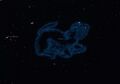 Late Babylonian Aries (Perdok 2016)
 -
 Aries in Leiden Aratea (c. 830)
 -
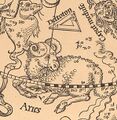 Aries in Dürer (1515).
 -
 Aries in Bayer's Uranometria (1603)
 -
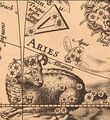 Aries in Plancius (1612)
 -
 Aries and French "Lily" Ignace Gaston Pardies (1674)
 -
 Aries in Hevelius (1690) with Fly
 -
 Aries in Flamsteed/ Fortin (1776) with a Fly
 -
 Aries in Hall (1825) with a Fly


.jpg)
.jpg)
.jpg)

Mythology
[1]Eratosthenes recounts that the ram was an immortal creature given to the children Phrixos and Helle by the sorceress queen Nephele. She had been rejected by her husband and wanted to save her children from their stepmother. So the flying, talking ram with the golden fleece carried the two children away from the royal palace. He dropped the girl, Helle, into the sea, where she was saved by Poseidon. Helle bore Poseidon a son named Paion, and the sea is now named after the princess, Hellespont. The ram carried the boy, Phrixos, across the Black Sea to King Aietes. Then he took off his golden fleece, gave it to the king as a souvenir, and ascended to the stars himself.
Greek and Roman poets have adapted this story and added more details. They agree that the ram shines only faintly in the sky because its golden fleece remained in Colchis.
There it was hung in the sacred grove, and when the Greeks wanted it back, it gave rise to the voyage of the Argonauts. Jason, who had to earn his throne, travelled across the sea in the Argo and, after his polite requests were ignored, stole the fleece from the grove. He was helped in this by the king's daughter Medea, whom he subsequently married. They spent their wedding night on the golden fleece of the ram.