Canis Minor: Difference between revisions
Created page with "alt=star chart|thumb|CMi star chart (IAU and Sky & Telescope magazine, Roger Sinnott & Rick Fienberg). One of the 88 IAU constellations. ==Etymology and History== The Greek constellation ... ===Origin of Constellation=== ===Transfer and Transformation of the Constellation=== ==Mythology== ==Weblinks== * ==References== *References (general) *References (Babylonian) *References (Greco-Ro..." Tags: Visual edit Disambiguation links |
No edit summary |
||
| (17 intermediate revisions by 3 users not shown) | |||
| Line 1: | Line 1: | ||
Authors: {{PAGEAUTHORS}} | |||
---- | |||
[[File:Canis Minor IAU.svg|alt=star chart|thumb|CMi star chart (IAU and Sky & Telescope magazine, Roger Sinnott & Rick Fienberg).]] | [[File:Canis Minor IAU.svg|alt=star chart|thumb|CMi star chart (IAU and Sky & Telescope magazine, Roger Sinnott & Rick Fienberg).]] | ||
One of the [[:Category:88_IAU-Constellations|88 IAU constellations]]. | One of the [[:Category:88_IAU-Constellations|88 IAU constellations]]. In antiquity, this area was named "pro kyon", "the one [star] before the dog". The name ‘Little Dog’ for the constellation is first documented by Ptolemy; however, Eratosthenes already mentions a group of three stars, which is the Hound of Orion. In the Almagest, two stars are listed for this constellation. This can therefore never have been descriptive, but was merely a name.<ref name=":0">Hoffmann, Susanne M. Wie der Löwe an den Himmel kam. Franckh Kosmos Verlag, Stuttgart 2021</ref> | ||
[[File:Ori-grp Kugel hi smh.gif|thumb|Orion-Group of constellations on the Kugel Globe, drawing and animated GIF by SMH 2025.]] | |||
==Etymology and History== | ==Etymology and History== | ||
The Greek | ===Origin of Constellation=== | ||
Aratos, Eratosthenes, Hipparchus and other Greek astronomers call the constellation [[Procyon]],<ref name=":0" /> the name we ascribe to the brightest star today. The star Procyon therefore has one of the few original Greek names: ‘pro’ means ‘before’ and ‘kyos’ is the dog. The Procyon is therefore the ‘pre-dog’ or ‘the star that rises before the dog’, as Eratosthenes unimaginatively explains. Ptolemy calls the single star Sirius ‘the dog’ and therefore only a single bright star is the ‘pre-dog’. Just as the Egyptian word ‘Sothis’ for a group of three stars was later reduced to a single star ([[Sirius]]), the Greek word ‘Procyon’ suffered the same fate. | |||
The bright star Procyon was possibly used in Mesopotamia as an indicator for the rising of Cancer. The stars in Cancer are so faint that you can barely see them at dusk - but the bright Procyon rises at the same time, which is suitable for telling the time. | |||
==== Greco-Roman ==== | |||
===== Aratus ===== | |||
<blockquote>But yet another constellation sweeps across the horizon: they call it the Hydra. Like a living thing [445] it winds at great length, its head comes below the middle of the Crab, its coil under the Lion’s body, and its tail hangs over the Centaur himself. On its middle coil lies the Bowl, and on the last one the figure of a Raven that looks like one pecking the coil. [450] Yes, and there too Procyon shines brightly beneath the Twins. (Kidd 1997)</blockquote> | |||
=== | ===== Eratosthenes ===== | ||
===== Hipparchus ===== | |||
====== Rising (Lib III Cap I §13) ====== | |||
<blockquote>The Rising of ...</blockquote> | |||
{| class="wikitable" | |||
|+ | |||
! | |||
! colspan="2" |east | |||
! colspan="2" |south | |||
|- | |||
! | |||
!lam1 | |||
!lam2 | |||
!lam1 | |||
!lam2 | |||
|- | |||
| | |||
|Cnc 3 1/2 | |||
|Cnc 9 | |||
|Psc 15 | |||
|Psc 19 1/2 | |||
|- | |||
| | |||
| | |||
| | |||
| | |||
| | |||
|- | |||
|star | |||
|the front one which is double (bet, gam) | |||
|the rear and bright one | |||
| | |||
| | |||
|- | |||
|duration | |||
| colspan="4" |1/3 hours = 20 min = 5 degree | |||
|} | |||
====== Setting (Lib III Cap II §13) ====== | |||
{| class="wikitable" | |||
! | |||
! colspan="2" |west | |||
! colspan="2" |south | |||
|- | |||
! | |||
!lam1 | |||
!lam2 | |||
!lam1 | |||
!lam2 | |||
|- | |||
| | |||
|Gem 15 | |||
|Gem 18 | |||
|Lib 1 | |||
|Lib 4 | |||
|- | |||
| | |||
| | |||
| | |||
| | |||
| | |||
|- | |||
|star | |||
|the front one which is double (bet, gam) | |||
|the rear and bright one | |||
| | |||
| | |||
|- | |||
|duration | |||
| colspan="4" |1/5 hours = 12 min = 3° | |||
|} | |||
====== Stars Mentioned ====== | |||
{| class="wikitable" | |||
|+ | |||
! | |||
!Greek | |||
!German | |||
!English | |||
!ident. | |||
!src | |||
! | |||
!lam_culm | |||
|- | |||
| | |||
| | |||
| | |||
| | |||
| | |||
|Lib II Cap V §10 | |||
|rising, east, first | |||
| | |||
|- | |||
| | |||
| | |||
| | |||
| | |||
| | |||
|Lib II Cap V §10 | |||
|rising, east, last | |||
| | |||
|- | |||
| | |||
| | |||
| | |||
| | |||
| | |||
|Lib II Cap VI §2 | |||
|setting CrB, south, last | |||
|Psc 13.5 | |||
|- | |||
| | |||
| | |||
| | |||
| | |||
| | |||
|Lib II Cap VI §13 | |||
|setting Aql, south, first | |||
|Ari 2 | |||
|- | |||
| | |||
| | |||
| | |||
| | |||
| | |||
|Lib III Cap I §9 | |||
|rising Ori, south, last | |||
|Psc 13 | |||
|} | |||
===== Hyginus, Astronomica ===== | |||
<blockquote>Procyon seems to rise before the greater Dog; for this reason it is called the Fore-dog. By some it is thought to be Orion's dog, and it is put in all the same tales in which the greater Dog is numbered. (Mary Ward 1960)</blockquote> | |||
===== Geminos ===== | |||
==== Ancient Globes ==== | |||
The Lesser Dog is only depicted on the Kugel Globe; it is absent on the Farnese Globe and the Mainz Globe. | |||
==== Almagest Προκύων ==== | |||
{| class="wikitable" | |||
!id | |||
!Greek | |||
(Heiberg 1898) | |||
!English | |||
(Toomer 1984) | |||
!ident. | |||
|- | |||
! | |||
!Πρόκυνος ἀστερισμός. | |||
! | |||
! | |||
|- | |||
|1 | |||
|ὁ ἐν τῷ αὐχένι | |||
|The star in the neck | |||
| | |||
|- | |||
|2 | |||
|ὁ κατὰ τῶν ὀπισθίωυ λαμπρὸς καλούμενος Προκύωυ. | |||
|The bright star just over the hindquarters, called Procyon | |||
| | |||
|- | |||
| | |||
| | |||
| | |||
| | |||
|- | |||
|all | |||
|ἀστέρες β, ὧν α μεγέθους α, δ’ ἄ. | |||
|{2 Stars, 1 of the lirst magnitude, 1 of the fourth} | |||
| | |||
|} | |||
[[File:Prokyon Youla CH.png|thumb|Convex Hull for the stars inside Prokyon (CC BY Youla Azkarrula).]] | |||
===== Stars within the Constellation Area ===== | |||
{| class="wikitable sortable mw-collapsible" | |||
|+ | |||
!id | |||
!Label | |||
!IAU design. | |||
!description | |||
!Vmag | |||
|- | |||
|1 | |||
|Procyon | |||
|HIP 37279 | |||
|Constellation lines | |||
|0.37 | |||
|- | |||
|2 | |||
|Gomeisa | |||
|HIP 36188 | |||
|Constellation lines | |||
|2.89 | |||
|} | |||
===Transfer and Transformation of the Constellation=== | ===Transfer and Transformation of the Constellation=== | ||
<gallery> | |||
File:Ori+cma+cmi kugel.jpg|Canis Minor on the Kugel Globe (1st c. BCE), drawing by SMH 2021 | |||
File:Canis Minor Uranometria.jpg|Canis Minor in Bayer's Uranometria (1603) | |||
File:Johannes Hevelius - Prodromus Astronomia - Volume III "Firmamentum Sobiescianum, sive uranographia" - Tavola SS - Canis Minor.jpg|Canis MInor in Hevelius (1690) | |||
File:John Flamsteed - Gemini and Canis Minor.jpg|Canis Minor with Gemini in Flamsteed (1728) | |||
File:CMi bode.jpg|Canis Minor in Bode (1782/1805) | |||
File:1822 - Alexander Jamieson - Monocerus, Canis Minor, Canis Major.jpg|Canis Minor in Jamieson (1822) | |||
File:Sidney Hall - Urania's Mirror - Monoceros, Canis Minor, and Atelier Typographique.jpg|Canis Minor in Hall (1825) | |||
</gallery> | |||
==Mythology== | ==Mythology== | ||
It was the Roman mythographer Hyginus who first handed down a legend about this constellation: if this dog was the dog of Ikarios - which Eratosthenes describes as one of the legends of the Great Dog - then this dog committed suicide when his master was murdered: the wine produced in ancient Greece was very strong and would probably be difficult for us to drink today. It wasn't easy to drink back then either. Ikarios is considered to be the one who introduced winemaking to Athens and it is said that he was murdered by some customers while intoxicated. His dog reported the crime by barking, but when he realised that his master could not be saved, he himself no longer wanted to live. | |||
==Weblinks== | ==Weblinks== | ||
Latest revision as of 14:04, 27 February 2026
Authors: Susanne M Hoffmann, Doris Vickers, Youla Azkarrula

One of the 88 IAU constellations. In antiquity, this area was named "pro kyon", "the one [star] before the dog". The name ‘Little Dog’ for the constellation is first documented by Ptolemy; however, Eratosthenes already mentions a group of three stars, which is the Hound of Orion. In the Almagest, two stars are listed for this constellation. This can therefore never have been descriptive, but was merely a name.[1]

Etymology and History
Origin of Constellation
Aratos, Eratosthenes, Hipparchus and other Greek astronomers call the constellation Procyon,[1] the name we ascribe to the brightest star today. The star Procyon therefore has one of the few original Greek names: ‘pro’ means ‘before’ and ‘kyos’ is the dog. The Procyon is therefore the ‘pre-dog’ or ‘the star that rises before the dog’, as Eratosthenes unimaginatively explains. Ptolemy calls the single star Sirius ‘the dog’ and therefore only a single bright star is the ‘pre-dog’. Just as the Egyptian word ‘Sothis’ for a group of three stars was later reduced to a single star (Sirius), the Greek word ‘Procyon’ suffered the same fate.
The bright star Procyon was possibly used in Mesopotamia as an indicator for the rising of Cancer. The stars in Cancer are so faint that you can barely see them at dusk - but the bright Procyon rises at the same time, which is suitable for telling the time.
Greco-Roman
Aratus
But yet another constellation sweeps across the horizon: they call it the Hydra. Like a living thing [445] it winds at great length, its head comes below the middle of the Crab, its coil under the Lion’s body, and its tail hangs over the Centaur himself. On its middle coil lies the Bowl, and on the last one the figure of a Raven that looks like one pecking the coil. [450] Yes, and there too Procyon shines brightly beneath the Twins. (Kidd 1997)
Eratosthenes
Hipparchus
Rising (Lib III Cap I §13)
The Rising of ...
| east | south | |||
|---|---|---|---|---|
| lam1 | lam2 | lam1 | lam2 | |
| Cnc 3 1/2 | Cnc 9 | Psc 15 | Psc 19 1/2 | |
| star | the front one which is double (bet, gam) | the rear and bright one | ||
| duration | 1/3 hours = 20 min = 5 degree | |||
Setting (Lib III Cap II §13)
| west | south | |||
|---|---|---|---|---|
| lam1 | lam2 | lam1 | lam2 | |
| Gem 15 | Gem 18 | Lib 1 | Lib 4 | |
| star | the front one which is double (bet, gam) | the rear and bright one | ||
| duration | 1/5 hours = 12 min = 3° | |||
Stars Mentioned
| Greek | German | English | ident. | src | lam_culm | ||
|---|---|---|---|---|---|---|---|
| Lib II Cap V §10 | rising, east, first | ||||||
| Lib II Cap V §10 | rising, east, last | ||||||
| Lib II Cap VI §2 | setting CrB, south, last | Psc 13.5 | |||||
| Lib II Cap VI §13 | setting Aql, south, first | Ari 2 | |||||
| Lib III Cap I §9 | rising Ori, south, last | Psc 13 |
Hyginus, Astronomica
Procyon seems to rise before the greater Dog; for this reason it is called the Fore-dog. By some it is thought to be Orion's dog, and it is put in all the same tales in which the greater Dog is numbered. (Mary Ward 1960)
Geminos
Ancient Globes
The Lesser Dog is only depicted on the Kugel Globe; it is absent on the Farnese Globe and the Mainz Globe.
Almagest Προκύων
| id | Greek
(Heiberg 1898) |
English
(Toomer 1984) |
ident. |
|---|---|---|---|
| Πρόκυνος ἀστερισμός. | |||
| 1 | ὁ ἐν τῷ αὐχένι | The star in the neck | |
| 2 | ὁ κατὰ τῶν ὀπισθίωυ λαμπρὸς καλούμενος Προκύωυ. | The bright star just over the hindquarters, called Procyon | |
| all | ἀστέρες β, ὧν α μεγέθους α, δ’ ἄ. | {2 Stars, 1 of the lirst magnitude, 1 of the fourth} |

Stars within the Constellation Area
| id | Label | IAU design. | description | Vmag |
|---|---|---|---|---|
| 1 | Procyon | HIP 37279 | Constellation lines | 0.37 |
| 2 | Gomeisa | HIP 36188 | Constellation lines | 2.89 |
Transfer and Transformation of the Constellation
-
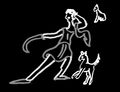 Canis Minor on the Kugel Globe (1st c. BCE), drawing by SMH 2021
 -
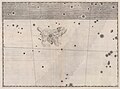 Canis Minor in Bayer's Uranometria (1603)
 -
 Canis MInor in Hevelius (1690)
 -
 Canis Minor with Gemini in Flamsteed (1728)
 -
 Canis Minor in Bode (1782/1805)
 -
 Canis Minor in Jamieson (1822)
 -
 Canis Minor in Hall (1825)


Mythology
It was the Roman mythographer Hyginus who first handed down a legend about this constellation: if this dog was the dog of Ikarios - which Eratosthenes describes as one of the legends of the Great Dog - then this dog committed suicide when his master was murdered: the wine produced in ancient Greece was very strong and would probably be difficult for us to drink today. It wasn't easy to drink back then either. Ikarios is considered to be the one who introduced winemaking to Athens and it is said that he was murdered by some customers while intoxicated. His dog reported the crime by barking, but when he realised that his master could not be saved, he himself no longer wanted to live.





