Bixiu: Difference between revisions
Boshunyang (talk | contribs) No edit summary |
Boshunyang (talk | contribs) |
||
| (One intermediate revision by the same user not shown) | |||
| Line 8: | Line 8: | ||
The shape of Bi was envisioned by ancient Chinese as a hare-catching net with a small mesh and a long handle. In astrology, it is used to govern matters like hunting rabbits or warfare in border regions. | The shape of Bi was envisioned by ancient Chinese as a hare-catching net with a small mesh and a long handle. In astrology, it is used to govern matters like hunting rabbits or warfare in border regions. | ||
[[File:Lodge Bi, in the Western Han Tomb Mural, excavated in Xi'an, Shannxi Province, repainted by Xu Gang.jpg|alt=The rabbit represent the Pleiades, called Mao(昴, Hair) in China|thumb|'''Lodge Bi, in the Western Han Tomb Mural, excavated in Xi'an, Shannxi Province, repainted by Xu Gang''']] | |||
Bi and its surrounding celestial region were viewed as a battlefield on the frontier, with the Mao (昴, Pleiades) as the opposing force, and the border lying at the Tiān Jiē (Celestial Street, 天街). Bi itself is seen as a war chariot, used for hunting or warfare. Its brightest star, α Tau, is regarded as the Border General. Next to it is a star named Fù Ěr (附耳, Attached Ear, σ2 Tau), regarded as an auxiliary constellation to Bi, meaning "whispering close to the ear" or secret plotting. | Bi and its surrounding celestial region were viewed as a battlefield on the frontier, with the Mao (昴, Pleiades) as the opposing force, and the border lying at the Tiān Jiē (Celestial Street, 天街). Bi itself is seen as a war chariot, used for hunting or warfare. Its brightest star, α Tau, is regarded as the Border General. Next to it is a star named Fù Ěr (附耳, Attached Ear, σ2 Tau), regarded as an auxiliary constellation to Bi, meaning "whispering close to the ear" or secret plotting. | ||
[[File:Lodge Bi, in the Eastern Han Tomb Mural, excavated in Qushuhao, Jingbian County, Shannxi Province.jpg|thumb|'''Lodge Bi, in the Eastern Han Tomb Mural, excavated in Qushuhao, Jingbian County, Shannxi Province.''' The rabbit represent the Pleiades, called Mao(昴, Hair) in China.]] | |||
=== Identification of stars === | === Identification of stars === | ||
| Line 89: | Line 91: | ||
|sigma2 Tau | |sigma2 Tau | ||
|} | |} | ||
[[File:Hunting Scenery on Han painting Stone, collected in Shangqiu Museum, photo by Boshun Yang.jpg|thumb|Hunting Scenery on Han dynasty painting Stone, collected in Shangqiu Museum, photo by Boshun Yang]] | |||
=== Maps (Gallery) === | === Maps (Gallery) === | ||
Latest revision as of 13:03, 5 March 2026
Authors: Lyu Haocheng, Boshun YANG, Susanne M Hoffmann

Bì Xiù (Net Mansion/Lodge, 畢宿), or Bì ( Net, 畢), one of the Twenty-Eight Mansions, is the fifth mansion of the White Tiger of the West. It represents a long-handled hunting tool with a small mesh, used for catching hares or birds. It corresponds to eight stars in the constellation Taurus.
Concordance, Etymology, History
The shape of Bi was envisioned by ancient Chinese as a hare-catching net with a small mesh and a long handle. In astrology, it is used to govern matters like hunting rabbits or warfare in border regions.

Bi and its surrounding celestial region were viewed as a battlefield on the frontier, with the Mao (昴, Pleiades) as the opposing force, and the border lying at the Tiān Jiē (Celestial Street, 天街). Bi itself is seen as a war chariot, used for hunting or warfare. Its brightest star, α Tau, is regarded as the Border General. Next to it is a star named Fù Ěr (附耳, Attached Ear, σ2 Tau), regarded as an auxiliary constellation to Bi, meaning "whispering close to the ear" or secret plotting.

Identification of stars
| Star Names or Orders(Qing) | Yi Shitong[1]
Based on catalogue in 18th century |
Pan Nai[2]
based on Xinyixiangfayao Star Map |
Pan Nai[3]
based on catalogues in Yuan dynasty |
Boshun Yang[4]
before Tang dynasty |
Boshun Yang[4]
Song Jingyou(1034) |
|---|---|---|---|---|---|
| 1st/determinative | epsilon Tau | epsilon Tau | epsilon Tau | epsilon Tau | epsilon Tau |
| 2nd | delta3 Tau | delta3 Tau | delta3 Tau | delta3 Tau | delta3 Tau |
| 3rd | delta1 Tau | delta1 Tau | delta1 Tau | delta1 Tau | delta1 Tau |
| 4th | gamma Tau | gamma Tau | gamma Tau | gamma Tau | gamma Tau |
| 5th | alf Tau | alf Tau | alf Tau | alf Tau | alf Tau |
| 6th | theta1 Tau | theta2 Tau | theta1 Tau | theta2 Tau | theta2 Tau |
| 7th | 71 Tau | 71 Tau | 71 Tau | 71 Tau | 71 Tau |
| 8th/Bixiuba(畢宿八, The eighth star of Bixiu)/Bibing(畢柄, The handle of Bi) | lambda Tau | lambda Tau | lambda Tau | lambda Tau | lambda Tau |
| Fu'er | sigma2 Tau | sigma2 Tau | sigma2 Tau | sigma2 Tau | sigma2 Tau |

Maps (Gallery)
- Bixiu (Bi)
-
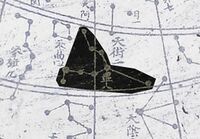 Bixiu in Cheonsang Yeolcha Bunyajido
 -
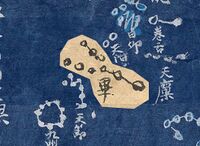 Bixiu in Dunhuang Star Map
 -
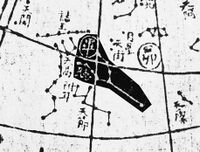 Bixiu in Suzhou Star Map


IAU Working Group on Star Names
In 2026, the name of the historical constellation Bì Xiù (Net Mansion/Lodge, 畢宿) was suggested to be used for one of the stars in this constellation. Since the determinative star of Bixiu is ready named, we decide to use the propose the name Bixiuba(畢宿八, The eighth star of Bixiu) or Bibing(畢柄, The handle of Bi) to lambda Tau.
Decision: ...
References
- ↑ Yi Shitong伊世同. Zhongxi Duizhao Hengxing Tubiao中西对照恒星图表1950. Beijing: Science Press.1981: 56.
- ↑ Pan Nai潘鼐. Zhongguo Hengxing Guance shi中国恒星观测史[M]. Shanghai: Xuelin Pree. 1989. p226.
- ↑ Pan Nai潘鼐. Zhongguo Hengxing Guance shi中国恒星观测史[M]. Shanghai: Xuelin Pree. 2009. p443.
- ↑ 4.0 4.1 B.-S. Yang杨伯顺, Zhongguo Chuantong Hengxing Guance Jingdu ji Xingguan Yanbian Yanjiu 中国传统恒星观测精度及星官演变研究 (A Research on the Accuracy of Chinese Traditional Star Observation and the Evolution of Constellations), PhD thesis, (Hefei: University of Science and Technology of China, 2023). 261.