Asu Usiha: Difference between revisions
HaochengLyu (talk | contribs) Small changes |
No edit summary |
||
| (One intermediate revision by one other user not shown) | |||
| Line 1: | Line 1: | ||
{{DISPLAYTITLE: Asu Usiha}} | {{DISPLAYTITLE: Asu Usiha (ᠠᠰᡠ ᡠᠰᡳᡥᠠ)}} | ||
Authors: {{PAGEAUTHORS}} | Authors: {{PAGEAUTHORS}} | ||
---- | ---- | ||
| Line 56: | Line 56: | ||
[[Category:Asterism ]] | [[Category:Asterism ]] | ||
[[Category:Constellation ]] | [[Category:Constellation]] | ||
[[Category:Eurasia]] | [[Category:Eurasia]] [[Category:Asian]] | ||
[[Category:East Asian]] | [[Category:East Asian]] | ||
[[Category:Chinese ]] | [[Category:Chinese]] [[Category:Her]] | ||
Latest revision as of 16:53, 18 May 2026
Authors: Lyu Haocheng, Susanne M Hoffmann, Youla Azkarrula


Asu Usiha (Manchu: ᠠᠰᡠ ᡠᠰᡳᡥᠠ, Net Stars) , a Manchu shamanic constellation located in Hercules. In Manchu, asu means "net" (used for hunting), and usiha means "star" or "constellation". This star name is also often recorded in Chinese as Gāngxīng or Wǎngxīng(纲星/网星).
Asu Usiha, which is regarded as the embodiment of the hunting deity Banda Mafa (the Hunter God), is closely associated with him. Its shape is depicted as a giant open hunting net, while the neighboring Northern Crown (Corona Borealis) is depicted as a similar net‑bag.
Concordance, Etymology, History
.jpg)
Among the Northeast Asian fishing and hunting peoples, including the Manchus, hunting nets were indispensable and culturally revered tools. Such nets were used to capture a wide variety of game — from birds and small forest mammals to fur-bearing animals such as the sable. The technique of net trapping involved covering a sable's burrow with a net before smoking it out, ensuring the animal was caught without damaging its fur. As a result, sable fur became a primary tribute item to the Qing court and a main source of livelihood for the people of the mountain regions.

In the Manchu shamanic ritual text Prayer to the Asu Usiha, the shaman recites specifically to this constellation, praying for successful hunting and abundant prey. The prayer reads:
Asu Usiha (Net Stars), in the southern sky, stars of the hunt, may all living beings flourish.[2]
The Manchu forebears integrated astronomical observation with productive activities, assigning a hunting function to this particular constellation — Asu Usiha being one such example. During the ritual, the shaman communicates with the stars through the prayer, reflecting the traditional Manchu concept of "star-god unity."[2]
The Hunter God Banda Mafa (Banda Mama)
Banda Mafa (Manchu: ᠪᠠᠨᡩᠠ ᠮᠠᡶᠠ) is the primary hunting deity in Manchu belief. The figure of the Hunter God is closely linked to the hunting net — Asu Usiha is precisely the embodiment of Banda Mafa. It is noteworthy that Banda Mafa is not exclusively a male deity; there exists a dual-gender form: besides Banda Mafa (the male hunter god), there is also Banda Mama (the female hunter god). This feature is consistent with the account given in the Manchu epic Umesiben Mama, indicating a belief tradition in which the hunter god appears as a pair of male and female.[3] In the common narratives of Manchu mythology, there is often a binary opposition that "goddesses are all good, gods are all evil," yet Banda Mafa (the male form) is widely worshipped and praised as a benevolent deity who protects hunting and distributes prey — an important exception to this rule.
-
![The Complete Map of the Shengjing Enclosure (盛京围场全图), held in the Library of Chinese Studies of the Collège de France. The map provides a detailed depiction of the mountains, rivers, and various structures of the Shengjing (Shenyang) imperial hunting enclosure during the Qing dynasty, including a sacrificial altar stele pavilion.[4]](/images/thumb/4/48/Worship_Banda_Mafa.png/370px-Worship_Banda_Mafa.png) The Complete Map of the Shengjing Enclosure (盛京围场全图), held in the Library of Chinese Studies of the Collège de France. The map provides a detailed depiction of the mountains, rivers, and various structures of the Shengjing (Shenyang) imperial hunting enclosure during the Qing dynasty, including a sacrificial altar stele pavilion.[4]
The Complete Map of the Shengjing Enclosure (盛京围场全图), held in the Library of Chinese Studies of the Collège de France. The map provides a detailed depiction of the mountains, rivers, and various structures of the Shengjing (Shenyang) imperial hunting enclosure during the Qing dynasty, including a sacrificial altar stele pavilion.[4] -
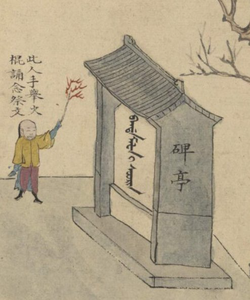 The stele in the pavilion is inscribed with the Manchu phrase banda mafa i soorin, meaning "Seat of the Hunter God."
![The Complete Map of the Shengjing Enclosure (盛京围场全图), held in the Library of Chinese Studies of the Collège de France. The map provides a detailed depiction of the mountains, rivers, and various structures of the Shengjing (Shenyang) imperial hunting enclosure during the Qing dynasty, including a sacrificial altar stele pavilion.[4]](/index.php/File:Worship_Banda_Mafa.png)
.png)
One branch of the Manchus — the Bala people — holds a ceremony for the Hunter God in the mountains each year after the large-scale winter hunt ends. The officiant, known as the abda (hunt leader), acts as shaman, lights a bonfire, cooks various kinds of meat in a hacuhan (small pot) as offerings, sings and dances, and cuts off the heads of three crows to dispel ill fortune. After the ritual, the people load their sledges with the abundant prey and return to the village. Each person keeps what he or she has caught individually, while the communal catch is distributed equally by the abda; even those who caught nothing receive a share.[5] The folk custom of "Da Hua Mo'er" among the Bala people of the Changbai Mountains is also related to the worship of Banda Mafa, reflecting the continuity of the hunter-god cult in Manchu folk culture.[6]
In Manchu shamanic divine oracles, the figure of the Hunter God appears in the Snow Sacrifice Oracle: Song of the Hunter God. This song describes in detail the power of the Hunter God and the manner of worship. After the most important Manchu constellation, the Seven Maidens "Nadan Narhū" (the Pleiades), rises in the east, Asu Usiha is about to set in the west. At this moment, the presiding shaman chants:
- Banda Mama, Banda Mafa,
- Walking between heaven and earth,
- Taming, driving, and luring the multitude of beasts,
- Raising flocks and herds of birds and animals.
- You have three souls:
- The soul of the cave,
- The soul of the flight,
- The soul of the waters.
- Changing your nature at will,
- Freely shifting your soul‑form,
- Herder of Abka Hehe (the Sky Goddess, the foremost of the three creator goddesses in Manchu mythology).[7]
Identification of stars

Asu Usiha was recorded by Fu Yuguang during his fieldwork. The shamanic tradition has its own star charts, but since photography was not permitted, Fu Yuguang had to hand‑copy the star charts of all 20 constellations. Based on his field findings, he identified Asu Usiha with the constellation Hercules.[8]
Maps (Gallery)
- Asu Usiha
-
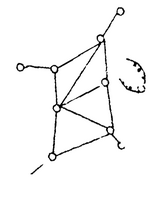 Star chart of Asu Usiha, drawn by Fu Yuguang
 -
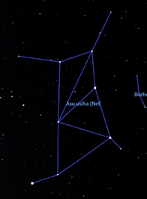 Asu Usiha in Stellarium
 -
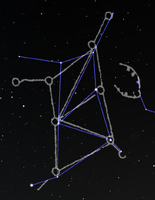 The superposition of traditional star chart and actual stars


IAU Working Group on Star Names
In 2026, the name of the Manchu constellation "Asuusiha" was suggested to be used for one of the stars in this constellation. τ Her is recommended for the following reason: The constellation Asu Usiha is depicted as a hunting net, and τ Her is located at one end of this net, close to the net‑bag represented by the neighboring Northern Crown (Corona Borealis). In traditional hunting culture, the end of a net is typically tied to a tree or secured to the ground with a peg. τ Her therefore plays the role of that anchoring point.
Decision: ...
References
- ↑ Ling, Chunsheng凌纯声 (1934).The Goldi Tribe on the Lower Sungari River松花江下游的赫哲族. Shanghai: Academia Sinica.
- ↑ 2.0 2.1 Guo, Shuyun郭淑云. (2003). Shamanic Star Worship and the Budding of Astronomy in Northern China萨满教星辰崇拜与北方天文学的萌芽. Studies in World Religions, (1), 122–131.
- ↑ Lu, Liankun鲁连坤 (narrator), & Fu, Yuguang富育光 (trans., annot., & arr.). (2007). Umesiben Mama乌布西奔妈妈. Changchun: Jilin People's Publishing House, p. 75.
- ↑ Zhan, Na詹娜. (2020). Folk Narrative and Regional Historical Construction: A Cultural Perspective on Folk Narratives in Liaoning民间叙事与区域史建构:辽宁民间叙事的文化透视. Beijing: China Social Sciences Press.
- ↑ Mu, Yejun穆晔骏. (1984). The Manchu "Bala People" Living in the Zhangguangcai Range居住在张广才岭的满族“巴拉人”. Northern Cultural Relics, (2).
- ↑ Zhang, Lin张林, & Sun, Hao孙颢. (2012). A Brief Investigation of the Life and Cultural Customs of the "Bala People" in the Changbai Mountains长白山“巴拉人”生活与文化习俗考略. Manchu Studies, (2), 90–94.
- ↑ Fu, Yuguang富育光, & Wang, Honggang王宏刚. (1995). Shamanic Goddesses萨满教女神. Shenyang: Liaoning People's Publishing House, pp. 131–132.
- ↑ Fu, Yuguang富育光. (1988). A Study of Manchu Shamanic Star Rituals and Customs满族萨满教星祭俗考. Northern Ethnicities, (1).





