Pictor: Difference between revisions
From All Skies Encyclopaedia
No edit summary |
No edit summary |
||
| (One intermediate revision by one other user not shown) | |||
| Line 31: | Line 31: | ||
* [[References (Medieval and Early Modern)|References (medieval)]] | * [[References (Medieval and Early Modern)|References (medieval)]] | ||
[[Category:Eurasia]] [[Category:European]] [[Category:Constellation]] [[Category:Modern]] | [[Category:Eurasia]] [[Category:European]] [[Category:Asterism]][[Category:Constellation]] [[Category:Modern]] | ||
[[Category:88 IAU-Constellations]][[Category: | [[Category:88 IAU-Constellations]] [[Category:Pic]] | ||
Latest revision as of 12:05, 26 May 2026
Authors: Susanne M Hoffmann, Youla Azkarrula

One of the 88 IAU constellations. It was invented by Lacaille (1752).
Etymology and History

Origin of Constellation
Nicolas Louis de Lacaille conceived this constellation. In 1756, he named it “Le Chavelet du Peintre” in French and described a canvas attached to an easel. Nothing more is known about this. He drew this constellation in a gap in the ancient images, where, next to the bright star Canopus in the ship, the faint stars close to the horizon had not been noticed.
In the 19th century, the English astronomer John Herschel, son of the discoverer of Uranus, suggested shortening the name from ‘Schafflei des Malers’ to ‘Maler’ – and abbreviations are usually popular.
Transfer and Transformation of the Constellation
-
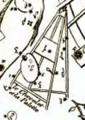 Pictor in Lacaille (1756).
 -
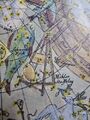 Pictor in Bode (1782, 1805).
 -
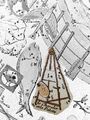 Pictor in Fortin's Atlas Céleste, 3rd edition (1795).







