Taurus: Difference between revisions
| (43 intermediate revisions by 4 users not shown) | |||
| Line 1: | Line 1: | ||
[[File:Taurus (tau). | Authors: {{PAGEAUTHORS}} | ||
---- | |||
[[File:Taurus (tau).jpg|alt=sstar chart of Taurus|thumb|Taurus, The Bull, modern definition. Credit: IAU and Sky & Telescope]] | |||
{{Infobox constellation | |||
| name = Ταῦρος (Tauros) | |||
| native = Ταῦρος | |||
| translation = Bull | |||
| pronounce = Tauros | |||
| IPA = | |||
| culture = Greek (Almagest) | |||
| RA = 51.20332633 to 84.41118925999999 | |||
| dec = 9.02886962 to 29.00130813 | |||
| areatotal = 374.11 | |||
| numbermainstars = 122 | |||
| numberbfstars = 84 | |||
| numberstarsplanets = | |||
| numberbrightstars = 3 | |||
| numbernearbystars = | |||
| brighteststarname = [[Aldebaran]] | |||
| starmagnitude = 0.86 | |||
| neareststarname = | |||
| stardistance = | |||
| numbermessierobjects = | |||
| meteorshowers = | |||
| bordering = Tau | |||
| notes = | |||
| cat = Almagest constellation | |||
}} | |||
One of the 88 [https://en.wikipedia.org/wiki/International_Astronomical_Union IAU] constellations. For the star cluster-asterisms of the [[Pleiades]] and the [[Hyades]] see separate entry. | One of the 88 [https://en.wikipedia.org/wiki/International_Astronomical_Union IAU] constellations. For the star cluster-asterisms of the [[Pleiades]] and the [[Hyades]] see separate entry. | ||
==Etymology and History== | ==Etymology and History== | ||
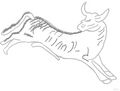
The shape of a bull is quite easily recognisable in the sky in this asterism. Two open star clusters stand out prominently: the Hyades and the Pleiades. They are sometimes seen as the pillars of a gate through which the sun, moon and planets pass. By adding further stars, they become the figure of half a bull. Greek mythology explains the absence of the back of the bull by the fact that it is swimming. | [[File:Fig7 taurueschen 800dpi.jpg|thumb|Taurus as drawn on a clay tablet ([https://recherche.smb.museum/detail/1973695/astronomische-tafel VAT 7851]) from Seleucid time, new drawing published by Hoffmann (2025)<ref name=":1">Hoffmann, S.M. (2025). Image Analysis of VAT 7851, [https://orientalistik.univie.ac.at/publikationen/afo/ Archiv für Orientforschung (AfO)] 56, 45-53</ref>.]] | ||
[[File:TauAll+year.jpg|thumb|Mesopotamian terms in the sign of Taurus; the diagram shows that the terminology was changed around 320±10 BCE (Hoffmann and Hunger 2024).<ref name=":2">Hoffmann, S. M. and Hunger, H. (2024). Terminology in Taurus, The Bull. Nouvelles Assyriologiques Brèves et Utilitaires, 4, 121</ref>]] | |||
[[File:Fig1 taurus tablet 150dpi sciLogs.jpg|thumb|Taurus sign with drawings of Pleiades (Bristle), Hyades (Chariot), Bull, and the Moon during a total lunar eclipse in the Moon's hypsoma; [https://recherche.smb.museum/detail/1973695/astronomische-tafel VAT 7851], drawing by Hoffmann (2025)<ref>Hoffmann, S.M. (2025). Image Analysis of VAT 7851, [https://orientalistik.univie.ac.at/publikationen/afo/ Archiv für Orientforschung (AfO)] 56, 45-53</ref> ]] | |||
The shape of a bull is quite easily recognisable in the sky in this asterism. Two open star clusters stand out prominently: the [[Hyades]] and the [[Pleiades]].<ref>Hoffmann, Susanne M. Wie der Löwe an den Himmel kam. Franckh Kosmos Verlag, Stuttgart 2021</ref> They are sometimes seen as the pillars of a gate through which the sun, moon and planets pass. By adding further stars, they become the figure of half a bull. Greek mythology explains the absence of the back of the bull by the fact that it is swimming. | |||
In reality, of course, the zodiacal constellation | In reality, of course, the zodiacal constellation – like all the others – is taken from Mesopotamia. | ||
[[File:Kugel aur+tau.JPG|thumb|Kugel Globe: Auriga and Taurus (drawing by SMH 2024)<ref>Hoffmann (2025), Some Results on the Ancient Globes, Globe Studies – The Journal of the International Coronelli Society, 69, 4169.</ref>]] | [[File:Kugel aur+tau.JPG|thumb|Kugel Globe: Auriga and Taurus (drawing by SMH 2024)<ref>Hoffmann (2025), Some Results on the Ancient Globes, Globe Studies – The Journal of the International Coronelli Society, 69, 4169.</ref>]] | ||
=== Origin of Constellation === | === Origin of Constellation === | ||
Originally, the celestial bull is part of the Sumerian Epic of Gilgamesh. Gilgamesh was king of Sumer, the southern part of Mesopotamia, in the 3rd millennium. It is unclear how long this king actually lived and ruled, but he is documented in a list of kings. Perhaps several kings (of the same name) are mixed up there. The figure of Gilgamesh in literature symbolises a number of cultural upheavals or as a founder of culture. | Originally, the celestial bull is part of the Sumerian Epic of Gilgamesh. Gilgamesh was king of Sumer, the southern part of Mesopotamia, in the 3rd millennium. It is unclear how long this king actually lived and ruled, but he is documented in a list of kings. Perhaps several kings (of the same name) are mixed up there. The figure of Gilgamesh in literature symbolises a number of cultural upheavals or as a founder of culture. | ||
The most important city in Sumer was Uruk, whose city goddess is Inanna/Ishtar. After Gilgamesh and his friend Enkidu had already performed other heroic deeds, they fight together in Uruk against the celestial bull sent by Ishtar: the | ==== Babylonian ==== | ||
The most important city in Sumer was Uruk, whose city goddess is Inanna/Ishtar. After Gilgamesh and his friend Enkidu had already performed other heroic deeds, they fight together in Uruk against the celestial bull sent by Ishtar: the Bull of Heaven ([[GU4.AN.NA|<sup>mul</sup>GU<sub>4</sub>.AN.NA]]) belonged to Ishtar's father, the sky god Anu, and was therefore a deity or mythical creature. The heroes succeed in defeating the beast when Enkidu grabs the bull from behind and Gilgamesh grabs it from the front. This explains the bisected constellation. | |||
Some researchers see the Mesopotamian constellations Hired Man (today: Aries) and True Shepherd of the Heavens (today: Orion) as a representation of this bullfight between Enkidu (Hired Man on the invisible hindquarters of the bull) and Gilgamesh. The figure of Orion stretches out one hand towards the bull's head and, according to the Almagest, swings a club with the other as if to hit the bull between the horns | Some researchers see the Mesopotamian constellations Hired Man ([[ḪUN.GA2|<sup>l</sup><sup>ú</sup>ḪUN.GA<sub>2</sub>]], today: [[Aries]]) and True Shepherd of the Heavens ([[SIPA.ZI.AN.NA]], today: [[Orion]]) as a representation of this bullfight between Enkidu (Hired Man on the invisible hindquarters of the bull) and Gilgamesh. The figure of Orion stretches out one hand towards the bull's head and, according to the Almagest, swings a club with the other as if to hit the bull between the horns – as reported in the Epic of Gilgamesh (tablet 6). In addition, the shepherd figure (for humans) is a metaphor for rulers, which can be traced back to Sumerian times for kings and lives on today in the symbolism of Christian bishops. However, the divine shepherd is typically Dumuzi, Ishtar's husband, assigned to the labourer's constellation. The connection between the constellations Ori-Tau-Ari is therefore very speculative without written evidence. Writing as a cultural technique had only just been invented at this time. Only a few commercial documents and no astronomical texts have survived from the 3rd millennium.<gallery> | ||
File:O.1054 color.jpg|Bull of Heaven slaughtered (O1054). | |||
File:Tau seal Wallenfels1993.png|Taurus on Mesopotamian seal print, Wallenfels (1993). | |||
File:Tau+cap seal Wallenfels1993.png|Taurus accompanied by a Goat-Fish on Mesopotamian seal print, Wallenfels (1993). | |||
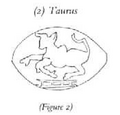
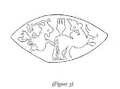
</gallery>Because the zodiac sign (ecliptic section of 30°) is divided in halves with different names before 320 BCE,<ref name=":2" /> it is well possible and perhaps even likely that there were also two constellations seen in this area: GIGIR, the Chariot, and GU<sub>4</sub>.AN.NA, the Bull of Heaven.<ref name=":1" /> This would imply that the Bull constellation before the invention of the zodiac has been considered much smaller than in Seleucid times - with a century of slow transformation between. Yet there is no constellation GIGIR mentioned in the first list of MUL.APIN. | |||
==== Greco-Roman ==== | ==== Greco-Roman ==== | ||
===== Egyptian ===== | |||
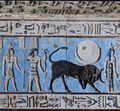
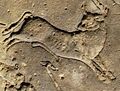
In Ptolemaic times (1st century BCE), when Egypt was ruled by the Romans, new Egyptian temples were built in Esna and Dendera (south and north of Thebes/ Luxor). They display a cultural mixture of Babylonian and Egyptian constellations.<gallery> | |||
File:Tau DenderaEckig GZotti.JPG|Taurus; rectangular zodiac of Dendera | |||
File:Tau DenderaCirc Louvre.JPG|Taurus, circular zodiac of Dendera (CC BY [https://collections.louvre.fr/en/ark:/53355/cl010028871 Musée du Louvre, Département des Antiquités égyptiennes]) | |||
File:Tau DenderaCirc Louvre black inv.jpg|Constellation of a complete Bull in Taurus on the circular Zodiac of Dendera, Egypt (drawing by SMH for Stellarium 2026). | |||
</gallery> | |||
===== Aratos ===== | ===== Aratos ===== | ||
<blockquote>Near the feet | <blockquote>Near the feet of the Charioteer look for the horned Bull crouching. This constellation is very recognisable, so clearly defined is its head: one needs no other sign to identify the ox’s head, so well do the stars themselves model both sides of it as they go round. Their name is also very popular: the Hyades are not just nameless. They are set out all along the Bull’s face; the point of its left horn and the right foot of the adjacent Charioteer are occupied by a single star, and they are pinned together as they go. But the Bull is always ahead of the Charioteer in sinking to the horizon, though it rises simultaneously. (Kidd 1997)</blockquote> | ||
===== Eratosthenes ===== | ===== Eratosthenes ===== | ||
From Pamias and Zucker (2013)<ref>Ératosthènes de Cyrène: Catastérrismes, translated by Pamìas, Jordi und Zucker, Arnaud, Les Belles Lettres, Paris 2013</ref> translated to English by us. | |||
'''Variant 1''' (p. 45–46)<blockquote>It is said that he was placed among the constellations for having carried Europa across the sea from Phoenicia to Crete, as Euripides recounts in his Phrixos. This earned him Zeus's distinction and a place among the most visible constellations. Others claim that it is a cow, the replica of Io, and that it was out of consideration for the latter that it [the constellation] received this privilege from Zeus.</blockquote><blockquote>The stars named Hyades define the contours of the forehead and face of Taurus. At the break in the image of Taurus, at the height of the back, is the Pleiades, which has seven stars, and that is why it is also given the name ‘Heptaster’ (seven stars). In reality, only six are visible, as the seventh is completely unremarkable.</blockquote><blockquote>Taurus has seven stars, and it moves backwards with its head tucked towards its body: one at the base of each of its horns —the brightest being the one on the left—, one above each eye, one above each nostril, one above each shoulder: these are called ‘the Hyades’; it also has one on its left front knee, two on its hooves, one on its right knee, two on its neck, three on its back —the last of which is bright—, one under its belly, and one bright star on its chest. In all, eighteen. </blockquote>'''Variant 2''' (p.47)<blockquote>It is said that he was placed among the constellations for having carried Europa safely across the sea from Phoenicia to Crete, as Euripides recounts in his Phrixos. This earned him Zeus's distinction and a place among the most visible constellations. Others claim that it is a cow that is among the constellations, the replica of Io; out of consideration for the latter, she received this privilege from Zeus.</blockquote><blockquote>The stars named ‘Hyades’ define the contours of the bull's forehead and face; Phercydes of Athens says that they are the nurses of Dionysus, known as the ‘nymphs of Dodona’. Taurus has a star on each of its horns, two on its forehead, one on each eye, one on each nostril (the latter are called ‘the Hyades’); it also has one on its front knee, two on its neck, three on its back, one on its hoof, one on its right knee, two on its belly, and one on its chest. Eighteen in all.</blockquote>'''Eratosthenes's star catalogue''' can be reconstructed from the list of stars he mentions in the last section of each of the constelllation descriptions. Hoffmann (2017)<ref name=":0">Hoffmann, S. M., <nowiki><i>Hipparchs Himmelsglobus</i></nowiki>. Springer Wiesbaden/ New York, 2017. doi:10.1007/978-3-658-18683-8.</ref> made such a catalogue and used it for computational comparison with Hipparchus's, Ptolemy's and Babylonian data; it is based on the edition and translation by Pamias and Geus (2007)<ref>Eratosthenes: Sternsagen, übersetzt von Pamìas, Jordi und Geus, Klaus, Verlag Utopica, Oberhaid 2007</ref> and presented here in English translation. | |||
{|class="wikitable" | |||
|+ | |||
!erat.Cat.ID | |||
!constStarID | |||
!starName | |||
!ident.Bayer | |||
!ident.HIP | |||
!certainty | |||
|- | |||
|213 | |||
|1 | |||
|one star at the base of each of the two horns [associated with the Hyades] | |||
|eps Tau | |||
|20889 | |||
|1 | |||
|- | |||
|214 | |||
|2 | |||
|one star at the base of each of the two horns; the left one (he means right: this is again the view in the sky) is brighter [associated with the Hyades] | |||
|alpha Tau | |||
|21421 | |||
|1 | |||
|- | |||
|215 | |||
|3 | |||
|one on each eye [associated with the Hyades] | |||
|theta2 Tau | |||
|20894 | |||
|1 | |||
|- | |||
|216 | |||
|4 | |||
|one on each eye [associated with the Hyades] | |||
|delta1 Tau | |||
|20455 | |||
|1 | |||
|- | |||
|217 | |||
|5 | |||
|one on the nostrils [associated with the Hyades] | |||
|gamma Tau | |||
|20205 | |||
|1 | |||
|- | |||
|218 | |||
|6 | |||
|one on each shoulder [associated with the Hyades] | |||
|tau Tau | |||
|21881 | |||
|1 | |||
|- | |||
|219 | |||
|7 | |||
|one on each shoulder [associated with the Hyades] | |||
|ups Tau | |||
|20711 | |||
|3 | |||
|- | |||
|220 | |||
|8 | |||
|one on the left foreknee | |||
|0. | |||
|18975 | |||
|3 | |||
|- | |||
|221 | |||
|9 | |||
|two on the hooves | |||
|xi Tau | |||
|16083 | |||
|1 | |||
|- | |||
|222 | |||
|10 | |||
|two on the hooves | |||
|omikron Tau | |||
|15900 | |||
|1 | |||
|- | |||
|223 | |||
|11 | |||
|one on the right knee | |||
|nu Tau | |||
|18907 | |||
|1 | |||
|- | |||
|224 | |||
|12 | |||
|two on the neck | |||
|omega Tau | |||
|19990 | |||
|2 | |||
|- | |||
|225 | |||
|13 | |||
|two on the neck | |||
|kappa1 Tau | |||
|20635 | |||
|2 | |||
|- | |||
|226 | |||
|14 | |||
|three on the back | |||
|psi Tau | |||
|19205 | |||
|1 | |||
|- | |||
|227 | |||
|15 | |||
|three on the back | |||
|psi Tau | |||
|20250 | |||
|1 | |||
|- | |||
|228 | |||
|16 | |||
|three on the back; the rearmost is bright | |||
|zeta Per | |||
|18246 | |||
|1 | |||
|- | |||
|229 | |||
|17 | |||
|one below on the belly | |||
|f Tau | |||
|16369 | |||
|1 | |||
|- | |||
|230 | |||
|18 | |||
|one bright one on the chest | |||
|lambda Tau | |||
|18724 | |||
|1 | |||
|- | |||
|231 | |||
|19 | |||
|near the place where the back […] is cut off, there is Pleias, which consists of seven stars and is therefore also called the Seven Sisters; but only six can be seen, because the seventh shines very faintly | |||
|eta Tau (Alcyone, representative) | |||
|17702 | |||
|1 | |||
|} | |||
===== Hipparchus ===== | ===== Hipparchus ===== | ||
====== Rising (Lib III Cap III §11) ====== | |||
{| class="wikitable" | |||
|+ | |||
! | |||
! colspan="2" |east | |||
! colspan="2" |south | |||
|- | |||
! | |||
!lam1 | |||
!lam2 | |||
!lam1 | |||
!lam2 | |||
|- | |||
| | |||
|Tau 7° | |||
|Tau 29° | |||
|Cap 21.5° | |||
|Psc 9° | |||
|- | |||
| | |||
| | |||
| | |||
| | |||
| | |||
|- | |||
|star | |||
|the southernmost of the four at the cut-off | |||
|the one at the tip of the right horn | |||
| | |||
| | |||
|- | |||
|duration | |||
| colspan="4" |1 1/8 hours = 67.5 min = 16 7/8 degree | |||
|} | |||
====== Setting (Lib III Cap IV §11) ====== | |||
{| class="wikitable" | |||
! | |||
! colspan="2" |west | |||
! colspan="2" |south | |||
|- | |||
! | |||
!lam1 | |||
!lam2 | |||
!lam1 | |||
!lam2 | |||
|- | |||
| | |||
|Psc 20° | |||
|Tau 26° | |||
|Cnc 22° | |||
|Vir 7° | |||
|- | |||
| | |||
| | |||
| | |||
| | |||
| | |||
|- | |||
|star | |||
|the southernmost of the four at the cut-off | |||
|the one at the tip of the left horn | |||
| | |||
| | |||
|- | |||
|duration | |||
| colspan="4" |3 hours = 180 min = 45° | |||
|} | |||
====== Stars Mentioned ====== | |||
{| class="wikitable" | |||
|+ | |||
! | |||
!Greek | |||
!German | |||
!English | |||
!ident. | |||
!src | |||
! | |||
!lam_culm | |||
|- | |||
| | |||
| | |||
| | |||
| | |||
| | |||
|Lib II Cap V §10 | |||
|rising, east, first | |||
| | |||
|- | |||
| | |||
| | |||
| align="left" |Der im rechten Fuß [Aur] | |||
| | |||
|beta Tau | |||
| | |||
|rising, east, last [Aur] | |||
| | |||
|- | |||
| | |||
| | |||
| align="left" |rechter Fuß | |||
| | |||
| | |||
| | |||
|culm [Cet, set, first] | |||
| | |||
|- | |||
| | |||
| | |||
| rowspan="2" align="left" |südlichste am Abschnitt des Stiers | |||
| | |||
| rowspan="2" |omi Tau | |||
| | |||
|culm [Arg, ] | |||
| | |||
|- | |||
| | |||
| | |||
| | |||
| | |||
|rising [Tau], east, first | |||
| | |||
|- | |||
| | |||
| | |||
| align="left" |der hellste in den Hyaden | |||
| | |||
|alf Tau | |||
| | |||
|culm [Leo, end] | |||
| | |||
|- | |||
| | |||
| | |||
| align="left" |Spitze des rechten Hornes | |||
| | |||
|zeta Tau | |||
| | |||
|rising [Tau], east, last | |||
| | |||
|- | |||
| | |||
| | |||
| align="left" |Tau: Schulterblatt | |||
| | |||
|lam Tau | |||
| | |||
|setting [Aqr], culm, last | |||
| | |||
|- | |||
| | |||
| | |||
| align="left" |Hyaden: Stierschnauze | |||
| | |||
|gam Tau | |||
| | |||
|setting [Aqr], culm, last | |||
| | |||
|} | |||
====== Hipparchus's "lost" star Catalogue ====== | |||
The star catalogue of Hipparchus is not preserved. Yet, several scholars have reconstructed it in the past century: Vogt (1925)<ref>Vogt, H., “Versuch einer Wiederherstellung von Hipparchs Fixsternver zeichnis”, <nowiki><i>Astronomische Nachrichten</i></nowiki>, vol. 224, no. 2, Wiley, p. 17, 1925. doi:10.1002/asna.19252240202.</ref>, Grasshoff (1990)<ref>Graßhoff, G., <nowiki><i>The History of Ptolemy's Star Catalogue</i></nowiki>, Springer, New York, 1990 </ref>, Hoffmann (2017)<ref>Hoffmann, S. M., <nowiki><i>Hipparchs Himmelsglobus</i></nowiki>. Springer Wiesbaden/ New York, 2017. doi:10.1007/978-3-658-18683-8.</ref> and Glover (2026)<ref>Glover, E. (2026). ''The Astronomy of Hipparchus'', Cambridge University Press</ref>. Grasshoff's catalogue and computations are not published digitally, Hoffmann published three versions of the Manitius+Hoffmann<ref>Hipparchus's Lost Star Catalogue (1/2 reconstructed) (Hoffmann, 2017) in VizieR</ref> star lists in the CDS [https://vizier.unistra.fr/ VizieR] "catalog of catalogs", and Glover printed the star lists constellationwise in his book. | |||
{|class="wikitable" | |||
|+ Hipparchus's star in Aquarius (Glover 2026) | |||
!hipp.Cat.ID | |||
!constStarID | |||
!starName | |||
!ident.Bayer | |||
!ident.HIP | |||
!concordance | |||
|- | |||
|535 | |||
|1 | |||
| | |||
|α Tau | |||
|21421 | |||
|CPAE | |||
|- | |||
|536 | |||
|2 | |||
| | |||
|β Tau (Aur) | |||
|25428 | |||
|CPAE | |||
|- | |||
|537 | |||
|3 | |||
| | |||
|γ Tau | |||
|20205 | |||
|CPAE | |||
|- | |||
|538 | |||
|4 | |||
| | |||
|ζ Tau | |||
|26451 | |||
|CPAE | |||
|- | |||
|539 | |||
|5 | |||
| | |||
|η Tau (Alc) | |||
|17702 | |||
|CPAE | |||
|- | |||
|540 | |||
|6 | |||
| | |||
|ι Tau | |||
|23497 | |||
|CPAE | |||
|- | |||
|541 | |||
|7 | |||
| | |||
|λ Tau | |||
|18724 | |||
|CPAE | |||
|- | |||
|542 | |||
|8 | |||
| | |||
|μ Tau | |||
|19860 | |||
|CPAE | |||
|- | |||
|543 | |||
|9 | |||
| | |||
|ξ Tau | |||
|16083 | |||
|CPAE | |||
|- | |||
|544 | |||
|10 | |||
| | |||
|ο Tau | |||
|15900 | |||
|CPAE | |||
|- | |||
|545 | |||
|11 | |||
| | |||
|e Tau | |||
|17771 | |||
|CPAE | |||
|- | |||
|546 | |||
|12 | |||
| | |||
|f Tau | |||
|16369 | |||
|CPAE | |||
|- | |||
|547 | |||
|13 | |||
| | |||
|m Tau | |||
|23835 | |||
|CPAE | |||
|- | |||
|548 | |||
|14 | |||
| | |||
|s Tau | |||
|16322 | |||
|CPAE | |||
|- | |||
|549 | |||
|15 | |||
| | |||
|16 Tau | |||
|17489 | |||
|CPAE | |||
|- | |||
|550 | |||
|16 | |||
| | |||
|17 Tau | |||
|17499 | |||
|CPAE | |||
|- | |||
|551 | |||
|17 | |||
| | |||
|18 Tau | |||
|17527 | |||
|CPAE | |||
|- | |||
|552 | |||
|18 | |||
| | |||
|19 Tau | |||
|17531 | |||
|CPAE | |||
|- | |||
|553 | |||
|19 | |||
| | |||
|37 Tau | |||
|19038 | |||
|CPAE | |||
|- | |||
|554 | |||
|20 | |||
| | |||
|ε Tau | |||
|20889 | |||
|non-CPAE | |||
|} | |||
===== Hyginus, Astronomica ===== | ===== Hyginus, Astronomica ===== | ||
| Line 32: | Line 535: | ||
But ancient astronomers placed these Pleiades, daughters of Pleione and Atlas, as we have said, apart from the Bull. When Pleione once was travelling through Boeotia with her daughters, Orion, who was accompanying her, tried to attack her. She escaped, but Orion sought her for seven years and couldn't find her. Jove, pitying the girls, appointed a way to the stars, and later, by some astronomers, they were called the Bull's tail. And so up to this time Orion seems to be following them as they flee towards the west. Our writers call these stars Vergiliae, because they rise after spring. They have still greater honour than the others, too, because their rising is a sign of summer, their setting of winter — a thing is not true of the other constellations. (Mary Ward 1960)</blockquote> | But ancient astronomers placed these Pleiades, daughters of Pleione and Atlas, as we have said, apart from the Bull. When Pleione once was travelling through Boeotia with her daughters, Orion, who was accompanying her, tried to attack her. She escaped, but Orion sought her for seven years and couldn't find her. Jove, pitying the girls, appointed a way to the stars, and later, by some astronomers, they were called the Bull's tail. And so up to this time Orion seems to be following them as they flee towards the west. Our writers call these stars Vergiliae, because they rise after spring. They have still greater honour than the others, too, because their rising is a sign of summer, their setting of winter — a thing is not true of the other constellations. (Mary Ward 1960)</blockquote> | ||
==== Almagest Ταῦρος ==== | ==== Almagest Ταῦρος ==== | ||
| Line 76: | Line 577: | ||
|6 | |6 | ||
|ὁ ἐε τῷ στήθει | |ὁ ἐε τῷ στήθει | ||
|The star in the | |The star in the chest | ||
|lam Tau | |lam Tau | ||
|- | |- | ||
| Line 91: | Line 592: | ||
|9 | |9 | ||
|ὁ ἐπὶ τοῦ ἀριστεροῦ γόνατος | |ὁ ἐπὶ τοῦ ἀριστεροῦ γόνατος | ||
|The star | |The star on the left knee | ||
|90 Tau | |90 Tau | ||
|- | |- | ||
| Line 107: | Line 608: | ||
|ὁ μεταξὺ τούτου καὶ τοῦ βορεύου ὀφθαλμοῦ | |ὁ μεταξὺ τούτου καὶ τοῦ βορεύου ὀφθαλμοῦ | ||
|The stars in the face, called 'the Hyades': the one between this and the northern eye | |The stars in the face, called 'the Hyades': the one between this and the northern eye | ||
| | |del<sup>1</sup> Tau | ||
|- | |- | ||
|13 | |13 | ||
|ὁ μεταξὺ αὐτοῦ καὶ τοῦ φοτύου ὀφδαλμοῦ | |ὁ μεταξὺ αὐτοῦ καὶ τοῦ φοτύου ὀφδαλμοῦ | ||
|The stars in the face, called 'the Hyades': the one between it [ no. 11] and the southern eye | |The stars in the face, called 'the Hyades': the one between it [no. 11] and the southern eye | ||
| | |tet<sup>1</sup> Tau | ||
|- | |- | ||
|14 | |14 | ||
|ὁ λαμπρὸς τῶν Ῥάδων ἐπὶ τοῦ νοτίου ὀφθαλμοῦ ὑπόκιρρος | |ὁ λαμπρὸς τῶν Ῥάδων ἐπὶ τοῦ νοτίου ὀφθαλμοῦ ὑπόκιρρος | ||
|The stars in the face, called 'the Hyades': the bright star | |The stars in the face, called 'the Hyades': the bright star of the Hyades, the reddish one on the southern eye | ||
|alf Tau | |alf Tau | ||
|- | |- | ||
|15 | |15 | ||
|ὁ λοιπὸς καὶ ἐπὶ τοῦ βορεύου ὀφθαλμοῦ | |ὁ λοιπὸς καὶ ἐπὶ τοῦ βορεύου ὀφθαλμοῦ | ||
|The stars in the face, called 'the Hyades': the remaining one, on the | |The stars in the face, called 'the Hyades': the remaining one, on the northern eye | ||
|eps Tau | |eps Tau | ||
|- | |- | ||
| Line 146: | Line 647: | ||
|20 | |20 | ||
|ὁ ἐπὶ τῆς ἐκφύσεως τοῦ βορείου κέρατος. | |ὁ ἐπὶ τῆς ἐκφύσεως τοῦ βορείου κέρατος. | ||
|The star on the place where the northern horn joins [ the head] | |The star on the place where the northern horn joins [the head] | ||
|tau Tau | |tau Tau | ||
|- | |- | ||
|21 | |21 | ||
|ὁ ἐπ’ ἄκρου τοῦ βορείου κέρατος ὁ αὐτὸς τῷ ἐπὶ τοῦ δεξιοῦ ποδὸς τοῦ Ἡνιόχου. | |ὁ ἐπ’ ἄκρου τοῦ βορείου κέρατος ὁ αὐτὸς τῷ ἐπὶ τοῦ δεξιοῦ ποδὸς τοῦ Ἡνιόχου. | ||
|The star on the tip of the northern horn, which is the same as the one on right foot of [[Auriga]] | |The star on the tip of the northern horn, which is the same as the one on the right foot of [[Auriga]] | ||
|bet Tau | |bet Tau | ||
|- | |- | ||
|22 | |22 | ||
|τῶν ἐν τῷ βορείῳ ὠτίῳ β σύνεγγυς ὁ βορειότερος | |τῶν ἐν τῷ βορείῳ ὠτίῳ β σύνεγγυς ὁ βορειότερος | ||
|The northernmost of the 2 stars close | |The northernmost of the 2 stars close together in the northern ear | ||
|ups Tau | |ups Tau | ||
|- | |- | ||
| Line 221: | Line 722: | ||
| | | | ||
|ἀστέρες λβ, ὥν αἱ μεγέθουςα, γ’ς, δ’ ἴἄ, ε φ, ς’ α. | |ἀστέρες λβ, ὥν αἱ μεγέθουςα, γ’ς, δ’ ἴἄ, ε φ, ς’ α. | ||
|32 stars, 1 of the first magnitude, 6 of the third, 11 of the fourth, 13 of the | |{32 stars, 1 of the first magnitude, 6 of the third, 11 of the fourth, 13 of the fifth, 1 of the sixth} | ||
| | | | ||
|- | |- | ||
| Line 231: | Line 732: | ||
! | ! | ||
!Οἱ περὶ τὸν Ταῦρον ἀμόρφωτου. | !Οἱ περὶ τὸν Ταῦρον ἀμόρφωτου. | ||
!Stars | !Stars around Taurus outside the constellation: | ||
! | ! | ||
|- | |- | ||
| Line 266: | Line 767: | ||
|40 | |40 | ||
|τῶν ὑπὸ τὸ βόρειον κέρας ἓ ἐπομένων ὁ προηγούμενος. | |τῶν ὑπὸ τὸ βόρειον κέρας ἓ ἐπομένων ὁ προηγούμενος. | ||
|The 5 | |The 5 stars under and to the rear of the northern horn: the most advanced | ||
|121 Tau | |121 Tau | ||
|- | |- | ||
|41 | |41 | ||
|ὁ τούτῳ ἑπόμενος. | |ὁ τούτῳ ἑπόμενος. | ||
|The 5 | |The 5 stars under and to the rear of the northern horn: the one to the rear of this | ||
|125 Tau | |125 Tau | ||
|- | |- | ||
|42 | |42 | ||
|ὁ ἔτι τούτῳ ἐπόμενος. | |ὁ ἔτι τούτῳ ἐπόμενος. | ||
|The 5 | |The 5 stars under and to the rear of the northern horn: the one to the rear again of the latter | ||
|132 Tau | |132 Tau | ||
|- | |- | ||
|43 | |43 | ||
|τῶν λοιπῶν καὶ ἐπομένωυ β ὁ βορειότερος. | |τῶν λοιπῶν καὶ ἐπομένωυ β ὁ βορειότερος. | ||
|The 5 | |The 5 stars under and to the rear of the northern horn: the northernmost of the remaining, rearmost 2 | ||
|136 Tau | |136 Tau | ||
|- | |- | ||
|44 | |44 | ||
|ὁ νοτιώτερος αὐτῶν. | |ὁ νοτιώτερος αὐτῶν. | ||
|The 5 | |The 5 stars under and to the rear of the northern horn: the southernmost of these two | ||
|139 Tau | |139 Tau | ||
|- | |- | ||
| Line 296: | Line 797: | ||
| | | | ||
|ἀστέρες ιὰ, ὧν δ’ μεγέθους ἄ, 8 ἱ. | |ἀστέρες ιὰ, ὧν δ’ μεγέθους ἄ, 8 ἱ. | ||
|{ | |{11 stars, 1 of the fourth magnitude, 10 of the fifth} | ||
| | | | ||
|} | |} | ||
[[File:Tauros Youla CH.png|thumb|Convex Hull for the stars inside Tauros (CC BY Youla Azkarrula).]] | |||
===== Stars within the Constellation Area ===== | |||
{| class="wikitable sortable mw-collapsible" | |||
|+ | |||
!id | |||
!Label | |||
!IAU design. | |||
!description | |||
!Vmag | |||
|- | |||
|1 | |||
|Aldebaran | |||
|HIP 21421 | |||
|Inside the hull | |||
|0.86 | |||
|- | |||
|2 | |||
|Elnath | |||
|HIP 25428 | |||
|Constellation lines (Vertex) | |||
|1.65 | |||
|- | |||
|3 | |||
|Alcyone | |||
|HIP 17702 | |||
|Inside the hull | |||
|2.87 | |||
|- | |||
|4 | |||
|Tianguan | |||
|HIP 26451 | |||
|Constellation lines (Vertex) | |||
|3.03 | |||
|- | |||
|5 | |||
|λ Tauri | |||
|HIP 18724 | |||
|Constellation lines | |||
|3.41 | |||
|- | |||
|6 | |||
|Chamukuy | |||
|HIP 20894 | |||
|Inside the hull | |||
|3.41 | |||
|- | |||
|7 | |||
|Ain | |||
|HIP 20889 | |||
|Inside the hull | |||
|3.53 | |||
|- | |||
|8 | |||
|ο Tauri | |||
|HIP 15900 | |||
|Constellation lines (Vertex) | |||
|3.6 | |||
|- | |||
|9 | |||
|Atlas | |||
|HIP 17847 | |||
|Inside the hull | |||
|3.63 | |||
|- | |||
|10 | |||
|Prima Hyadum | |||
|HIP 20205 | |||
|Constellation lines | |||
|3.65 | |||
|- | |||
|11 | |||
|ξ Tauri | |||
|HIP 16083 | |||
|Constellation lines | |||
|3.75 | |||
|- | |||
|12 | |||
|Secunda Hyadum | |||
|HIP 20455 | |||
|Constellation lines | |||
|3.76 | |||
|- | |||
|13 | |||
|θ<sup>1</sup> Tauri | |||
|HIP 20885 | |||
|Inside the hull | |||
|3.84 | |||
|- | |||
|14 | |||
|5 Tau | |||
|HIP 16369 | |||
|Constellation lines | |||
|4.1 | |||
|- | |||
|15 | |||
|Merope | |||
|HIP 17608 | |||
|Constellation lines (Vertex) | |||
|4.18 | |||
|- | |||
|16 | |||
|κ<sup>1</sup> Tauri | |||
|HIP 20635 | |||
|Constellation lines | |||
|4.201 | |||
|- | |||
|17 | |||
|τ Tauri | |||
|HIP 21881 | |||
|Constellation lines | |||
|4.258 | |||
|- | |||
|18 | |||
|υ Tauri | |||
|HIP 20711 | |||
|Constellation lines | |||
|4.282 | |||
|- | |||
|19 | |||
|δ<sup>3</sup> Tauri | |||
|HIP 20648 | |||
|Inside the hull | |||
|4.298 | |||
|- | |||
|20 | |||
|37 Tau | |||
|HIP 19038 | |||
|Constellation lines | |||
|4.37 | |||
|- | |||
|21 | |||
|71 Tau | |||
|HIP 20713 | |||
|Inside the hull | |||
|4.48 | |||
|- | |||
|22 | |||
|ι Tauri | |||
|HIP 23497 | |||
|Inside the hull | |||
|4.615 | |||
|- | |||
|23 | |||
|ρ Tauri | |||
|HIP 21273 | |||
|Constellation lines (Vertex) | |||
|4.65 | |||
|- | |||
|24 | |||
|σ<sup>2</sup> Tauri | |||
|HIP 21683 | |||
|Inside the hull | |||
|4.665 | |||
|- | |||
|25 | |||
|π Tauri | |||
|HIP 20732 | |||
|Constellation lines | |||
|4.69 | |||
|- | |||
|26 | |||
| - | |||
|HIP 21029 | |||
|Inside the hull | |||
|4.764 | |||
|- | |||
|27 | |||
|δ<sup>2</sup> Tauri | |||
|HIP 20542 | |||
|Inside the hull | |||
|4.8 | |||
|- | |||
|28 | |||
|114 Tau | |||
|HIP 25539 | |||
|Inside the hull | |||
|4.868 | |||
|- | |||
|29 | |||
|m Tau | |||
|HIP 23835 | |||
|Constellation lines | |||
|4.89 | |||
|- | |||
|30 | |||
|ω<sup>2</sup> Tauri | |||
|HIP 19990 | |||
|Constellation lines | |||
|4.914 | |||
|- | |||
|31 | |||
|109 Tau | |||
|HIP 24822 | |||
|Inside the hull | |||
|4.948 | |||
|- | |||
|32 | |||
|ϕ Tauri | |||
|HIP 20250 | |||
|Constellation lines | |||
|4.951 | |||
|- | |||
|33 | |||
|75 Tau | |||
|HIP 20877 | |||
|Inside the hull | |||
|4.969 | |||
|- | |||
|34 | |||
|30 Tau | |||
|HIP 17771 | |||
|Constellation lines | |||
|5.07 | |||
|- | |||
|35 | |||
|σ<sup>1</sup> Tauri | |||
|HIP 21673 | |||
|Inside the hull | |||
|5.076 | |||
|- | |||
|36 | |||
|97 Tau | |||
|HIP 22565 | |||
|Constellation lines | |||
|5.085 | |||
|- | |||
|37 | |||
|Pleione | |||
|HIP 17851 | |||
|Inside the hull | |||
|5.09 | |||
|- | |||
|38 | |||
|4 Tau | |||
|HIP 16322 | |||
|Constellation lines | |||
|5.124 | |||
|- | |||
|39 | |||
|41 Tau | |||
|HIP 19171 | |||
|Inside the hull | |||
|5.172 | |||
|- | |||
|40 | |||
|ψ Tauri | |||
|HIP 19205 | |||
|Constellation lines (Vertex) | |||
|5.2 | |||
|- | |||
|41 | |||
|58 Tau | |||
|HIP 20261 | |||
|Inside the hull | |||
|5.242 | |||
|- | |||
|42 | |||
|κ<sup>2</sup> Tauri | |||
|HIP 20641 | |||
|Inside the hull | |||
|5.264 | |||
|- | |||
|43 | |||
|l Tau | |||
|HIP 23871 | |||
|Constellation lines | |||
|5.28 | |||
|- | |||
|44 | |||
|56 Tau | |||
|HIP 20186 | |||
|Inside the hull | |||
|5.346 | |||
|- | |||
|45 | |||
|χ Tauri | |||
|HIP 20430 | |||
|Constellation lines | |||
|5.378 | |||
|- | |||
|46 | |||
|44 Tau | |||
|HIP 19513 | |||
|Constellation lines | |||
|5.387 | |||
|- | |||
|47 | |||
| - | |||
|HIP 17776 | |||
|Inside the hull | |||
|5.45 | |||
|- | |||
|48 | |||
|81 Tau | |||
|HIP 21039 | |||
|Inside the hull | |||
|5.454 | |||
|- | |||
|49 | |||
|118 Tau | |||
|HIP 25695 | |||
|Inside the hull | |||
|5.48 | |||
|- | |||
|50 | |||
|53 Tau | |||
|HIP 20171 | |||
|Inside the hull | |||
|5.482 | |||
|- | |||
|51 | |||
|103 Tau | |||
|HIP 23900 | |||
|Inside the hull | |||
|5.5 | |||
|- | |||
|52 | |||
|ω<sup>1</sup> Tauri | |||
|HIP 19388 | |||
|Inside the hull | |||
|5.504 | |||
|- | |||
|53 | |||
|36 Tau | |||
|HIP 19009 | |||
|Inside the hull | |||
|5.512 | |||
|- | |||
|54 | |||
|72 Tau | |||
|HIP 20789 | |||
|Inside the hull | |||
|5.514 | |||
|- | |||
|55 | |||
|80 Tau | |||
|HIP 20995 | |||
|Inside the hull | |||
|5.552 | |||
|- | |||
|56 | |||
|57 Tau | |||
|HIP 20219 | |||
|Inside the hull | |||
|5.568 | |||
|- | |||
|57 | |||
|32 Tau | |||
|HIP 18471 | |||
|Inside the hull | |||
|5.617 | |||
|- | |||
|58 | |||
|63 Tau | |||
|HIP 20484 | |||
|Inside the hull | |||
|5.625 | |||
|- | |||
|59 | |||
|51 Tau | |||
|HIP 20087 | |||
|Inside the hull | |||
|5.631 | |||
|- | |||
|60 | |||
|13 Tau | |||
|HIP 17309 | |||
|Inside the hull | |||
|5.69 | |||
|- | |||
|61 | |||
|60 Tau | |||
|HIP 20400 | |||
|Inside the hull | |||
|5.71 | |||
|- | |||
|62 | |||
| - | |||
|HIP 20842 | |||
|Inside the hull | |||
|5.711 | |||
|- | |||
|63 | |||
| - | |||
|HIP 21819 | |||
|Inside the hull | |||
|5.729 | |||
|- | |||
|64 | |||
|89 Tau | |||
|HIP 21588 | |||
|Inside the hull | |||
|5.776 | |||
|- | |||
|65 | |||
|98 Tau | |||
|HIP 23088 | |||
|Inside the hull | |||
|5.785 | |||
|- | |||
|66 | |||
|99 Tau | |||
|HIP 23068 | |||
|Inside the hull | |||
|5.806 | |||
|- | |||
|67 | |||
|HU Tau | |||
|HIP 21604 | |||
|Inside the hull | |||
|5.842 | |||
|- | |||
|68 | |||
| - | |||
|HIP 18735 | |||
|Inside the hull | |||
|5.865 | |||
|- | |||
|69 | |||
|76 Tau | |||
|HIP 20873 | |||
|Inside the hull | |||
|5.892 | |||
|- | |||
|70 | |||
|39 Tau | |||
|HIP 19076 | |||
|Inside the hull | |||
|5.9 | |||
|- | |||
|71 | |||
|105 Tau | |||
|HIP 23883 | |||
|Inside the hull | |||
|5.92 | |||
|- | |||
|72 | |||
| - | |||
|HIP 19376 | |||
|Inside the hull | |||
|5.927 | |||
|- | |||
|73 | |||
| - | |||
|HIP 19284 | |||
|Inside the hull | |||
|5.94 | |||
|- | |||
|74 | |||
| - | |||
|HIP 18170 | |||
|Inside the hull | |||
|5.946 | |||
|- | |||
|75 | |||
| - | |||
|HIP 20417 | |||
|Inside the hull | |||
|5.95 | |||
|- | |||
|76 | |||
| - | |||
|HIP 22697 | |||
|Inside the hull | |||
|5.961 | |||
|- | |||
|77 | |||
| - | |||
|HIP 20614 | |||
|Inside the hull | |||
|5.965 | |||
|- | |||
|78 | |||
| - | |||
|HIP 22176 | |||
|Inside the hull | |||
|5.981 | |||
|- | |||
|79 | |||
|V1141 Tau | |||
|HIP 20493 | |||
|Inside the hull | |||
|5.986 | |||
|- | |||
|80 | |||
|V1156 Tau | |||
|HIP 24019 | |||
|Inside the hull | |||
|5.997 | |||
|- | |||
|81 | |||
|85 Tau | |||
|HIP 21137 | |||
|Inside the hull | |||
|5.998 | |||
|- | |||
|82 | |||
|V1116 Tau | |||
|HIP 21459 | |||
|Inside the hull | |||
|6.019 | |||
|- | |||
|83 | |||
|33 Tau | |||
|HIP 18485 | |||
|Inside the hull | |||
|6.038 | |||
|- | |||
|84 | |||
| - | |||
|HIP 17921 | |||
|Inside the hull | |||
|6.07 | |||
|- | |||
|85 | |||
| - | |||
|HIP 19261 | |||
|Inside the hull | |||
|6.07 | |||
|- | |||
|86 | |||
| - | |||
|HIP 17453 | |||
|Inside the hull | |||
|6.074 | |||
|- | |||
|87 | |||
| - | |||
|HIP 19641 | |||
|Inside the hull | |||
|6.087 | |||
|- | |||
|88 | |||
| - | |||
|HIP 20255 | |||
|Constellation lines | |||
|6.094 | |||
|- | |||
|89 | |||
| - | |||
|HIP 24820 | |||
|Inside the hull | |||
|6.107 | |||
|- | |||
|90 | |||
|V1137 Tau | |||
|HIP 19672 | |||
|Inside the hull | |||
|6.12 | |||
|- | |||
|91 | |||
|14 Tau | |||
|HIP 17408 | |||
|Inside the hull | |||
|6.14 | |||
|- | |||
|92 | |||
| - | |||
|HIP 20284 | |||
|Inside the hull | |||
|6.141 | |||
|- | |||
|93 | |||
|95 Tau | |||
|HIP 21961 | |||
|Inside the hull | |||
|6.151 | |||
|- | |||
|94 | |||
| - | |||
|HIP 17900 | |||
|Inside the hull | |||
|6.153 | |||
|- | |||
|95 | |||
| - | |||
|HIP 18508 | |||
|Inside the hull | |||
|6.165 | |||
|- | |||
|96 | |||
| - | |||
|HIP 17058 | |||
|Inside the hull | |||
|6.168 | |||
|- | |||
|97 | |||
| - | |||
|HIP 23589 | |||
|Inside the hull | |||
|6.188 | |||
|- | |||
|98 | |||
| - | |||
|HIP 21689 | |||
|Inside the hull | |||
|6.2 | |||
|- | |||
|99 | |||
| - | |||
|HIP 24977 | |||
|Inside the hull | |||
|6.205 | |||
|- | |||
|100 | |||
|108 Tau | |||
|HIP 24512 | |||
|Inside the hull | |||
|6.27 | |||
|- | |||
|101 | |||
|* 24 Tau | |||
|HD 23629 | |||
|Inside the hull | |||
|6.28 | |||
|- | |||
|102 | |||
| - | |||
|HIP 25806 | |||
|Inside the hull | |||
|6.291 | |||
|- | |||
|103 | |||
|48 Tau | |||
|HIP 19877 | |||
|Inside the hull | |||
|6.3 | |||
|- | |||
|104 | |||
|84 Tau | |||
|HIP 21082 | |||
|Inside the hull | |||
|6.303 | |||
|- | |||
|105 | |||
| - | |||
|HIP 18717 | |||
|Inside the hull | |||
|6.305 | |||
|- | |||
|106 | |||
| - | |||
|HIP 22949 | |||
|Inside the hull | |||
|6.324 | |||
|- | |||
|107 | |||
| - | |||
|HIP 22128 | |||
|Inside the hull | |||
|6.329 | |||
|- | |||
|108 | |||
| - | |||
|HIP 24984 | |||
|Inside the hull | |||
|6.33 | |||
|- | |||
|109 | |||
|62 Tau | |||
|HIP 20533 | |||
|Inside the hull | |||
|6.337 | |||
|- | |||
|110 | |||
| - | |||
|HIP 22850 | |||
|Inside the hull | |||
|6.347 | |||
|- | |||
|111 | |||
| - | |||
|HIP 18201 | |||
|Inside the hull | |||
|6.349 | |||
|- | |||
|112 | |||
| - | |||
|HIP 21408 | |||
|Inside the hull | |||
|6.35 | |||
|- | |||
|113 | |||
|SZ Tau | |||
|HIP 21517 | |||
|Inside the hull | |||
|6.37 | |||
|- | |||
|114 | |||
|V766 Tau | |||
|HIP 18033 | |||
|Inside the hull | |||
|6.38 | |||
|- | |||
|115 | |||
|NGC 1647 | |||
|NGC 1647 | |||
|Inside the hull | |||
|6.4 | |||
|- | |||
|116 | |||
| - | |||
|HIP 16924 | |||
|Inside the hull | |||
|6.42 | |||
|- | |||
|117 | |||
|70 Tau | |||
|HIP 20661 | |||
|Inside the hull | |||
|6.439 | |||
|- | |||
|118 | |||
|26 Tau | |||
|HIP 17832 | |||
|Inside the hull | |||
|6.464 | |||
|- | |||
|119 | |||
| - | |||
|HIP 21053 | |||
|Inside the hull | |||
|6.491 | |||
|- | |||
|120 | |||
| - | |||
|HIP 23949 | |||
|Inside the hull | |||
|6.5 | |||
|- | |||
|121 | |||
| - | |||
|HIP 19960 | |||
|Constellation lines | |||
|6.56 | |||
|- | |||
|122 | |||
| - | |||
|HIP 24252 | |||
|Inside the hull | |||
|6.79 | |||
|} | |||
=== Transfer and Transformation of the Constellation === | === Transfer and Transformation of the Constellation === | ||
<gallery> | <gallery> | ||
File:Tau seal Wallenfels1993.png|Taurus on Mesopotamian seal print, Wallenfels (1993). | |||
File:Tau+cap seal Wallenfels1993.png|Taurus accompanied by a goat-fish on Mesopotamian seal print, Wallenfels (1993). | |||
File:Little BULL (drawn by Weidner 1967).png|Bull of Heaven drawn on the clay tablet VAT 7851, drawing by Weidner (1967, reproduced by SMH). | File:Little BULL (drawn by Weidner 1967).png|Bull of Heaven drawn on the clay tablet VAT 7851, drawing by Weidner (1967, reproduced by SMH). | ||
File:Taurus umzeichnung nicer.jpg| | File:Taurus umzeichnung nicer.jpg|Clay tablet VAT 7851, microzodiac tablet with drawings for the zodiac sign of Taurus, The Bull | ||
File:Fig1 taurus tablet 150dpi sciLogs.jpg|alt=Taurus sign with drawings of Pleiades (Bristle), Hyades (Chariot), Bull, and the Moon during a total lunar eclipse in the Moon's hypsoma; drawing by Hoffmann (2025)|Taurus sign on clay tablet VAT 7851 with drawings of Pleiades (Bristle), Hyades (Chariot), Bull, and the Moon during a total lunar eclipse in the Moon's hypsoma; drawing by Hoffmann (2025)<ref>Hoffmann, S.M. (2025). Image Analysis of VAT 7851, [https://orientalistik.univie.ac.at/publikationen/afo/ Archiv für Orientforschung (AfO)] 56, 45-53</ref> | |||
File:HeavenlyBull JessicaGullberg stellarium.jpg|Front part of the Bull of Heaven, painted by Jessica Gullberg for Stellarium. | File:HeavenlyBull JessicaGullberg stellarium.jpg|Front part of the Bull of Heaven, painted by Jessica Gullberg for Stellarium. | ||
File:FarneseSMH2017 web 33.jpg|Taurus as shown on the marble Farnese Globe (drawing SMH) | File:FarneseSMH2017 web 33.jpg|Taurus as shown on the marble Farnese Globe (drawing SMH) | ||
| Line 308: | Line 1,556: | ||
File:Aratea fol. 42v.jpg|Pleiades as Seven Sisters in the Leiden Aratea | File:Aratea fol. 42v.jpg|Pleiades as Seven Sisters in the Leiden Aratea | ||
File:Tau uranometria.png|Taurus in Bayer's Uranometria (1603) | File:Tau uranometria.png|Taurus in Bayer's Uranometria (1603) | ||
File:H.A. Rey's stick figure stellarium-075.png|H.A. Rey's stick figure of Taurus (1952) | |||
File:O. Hlad's stick figure stellarium-076.png|O. Hlad's stick figure of Taurus (1988) | |||
File:Stellarium-029-Alm.png|Reconstruction of Stickfigure based on the depiction of Almagest (100-170 CE). CC-BY Susanne Hoffmann in Stellarium. | |||
File:Stellarium-030-Far.png|Image of the Farnese Globe (2nd century CE) taken by Susanne Hoffmann and imported into Stellarium. | |||
</gallery> | </gallery> | ||
| Line 314: | Line 1,566: | ||
The most famous of the Greek myths about the bull is the abduction of Princess Europa of Phoenicia. Zeus had transformed himself into a bull, she played with him, sat on his back and then he galloped into the water and swam to Crete. Euripides tells this story and also found its way into astronomical literature via Eratosthenes. Today, the motif is depicted on Greek 2 euro coins. | The most famous of the Greek myths about the bull is the abduction of Princess Europa of Phoenicia. Zeus had transformed himself into a bull, she played with him, sat on his back and then he galloped into the water and swam to Crete. Euripides tells this story and also found its way into astronomical literature via Eratosthenes. Today, the motif is depicted on Greek 2 euro coins. | ||
Mythographers favour the Pleiades story of the nymph Pleione and her seven daughters, who supposedly want to remain virgins but are pursued by the lustful Orion. They apparently do not achieve their goal of eternal virginity, because each of them becomes pregnant: none by Orion. Six of them give birth to sons of the gods, one of them | Mythographers favour the Pleiades story of the nymph Pleione and her seven daughters, who supposedly want to remain virgins but are pursued by the lustful Orion. They apparently do not achieve their goal of eternal virginity, because each of them becomes pregnant: none by Orion. Six of them give birth to sons of the gods, one of them – Merope – marries the mortal Sisyphus (from the Greek ‘merops’, mortal). | ||
In Mesopotamia, the Celestial Bull is undoubtedly from the Epic of Gilgamesh: | In Mesopotamia, the Celestial Bull is undoubtedly from the Epic of Gilgamesh: | ||
| Line 325: | Line 1,577: | ||
== Weblinks == | == Weblinks == | ||
* Ridpath, Ian, | * Ridpath, Ian, ''Star Tales'' [http://www.ianridpath.com/startales/taurus.html – Taurus] | ||
* [https://iconographic.warburg.sas.ac.uk/category/vpc-taxonomy-017060 Warburg Institute Iconographic Database – Taurus] | |||
== References == | == References == | ||
| Line 334: | Line 1,587: | ||
* [[References (Medieval and Early Modern)|References (medieval)]] | * [[References (Medieval and Early Modern)|References (medieval)]] | ||
[[Category:Eurasia]] [[Category:Constellation]] [[Category: | [[Category:Eurasia]] [[Category:Mesopotamian]] [[Category:West Asian]] [[Category:Asian]] | ||
[[Category:88 IAU-Constellations]] | [[Category:Constellation]] [[Category:Asterism]] | ||
[[Category:Almagest]] [[Category:Africa]] | |||
[[Category:Modern]][[Category:88 IAU-Constellations]] | |||
[[Category:Tau]] | |||
[[Category:Rubric]] [[Category:Lunar System]] [[Category:Zodiac]] | |||
Latest revision as of 17:29, 26 September 2026
Authors: Susanne M Hoffmann, Youla Azkarrula, Doris Vickers, Ian Ridpath
.jpg)
| Asterism Info | |
| Native | Ταῦρος |
|---|---|
| Romanisation | Tauros |
| Translation | Bull |
| Position (2000) | |
| Right ascension | 51.20332633 to 84.41118925999999 |
| Declination | 9.02886962 to 29.00130813 |
| Area | 374.11 sq. deg. |
| Stars | |
| Bright stars | 122 |
| Bayer/Flamsteed stars | 84 |
| Stars brighter than 3.00m | 3 |
| Brightest star | Aldebaran (0.86m) |
| Taxonomy | |
| category of asterism | Almagest constellation |
| IAU- constellations | Tau |
One of the 88 IAU constellations. For the star cluster-asterisms of the Pleiades and the Hyades see separate entry.
Etymology and History


The shape of a bull is quite easily recognisable in the sky in this asterism. Two open star clusters stand out prominently: the Hyades and the Pleiades.[4] They are sometimes seen as the pillars of a gate through which the sun, moon and planets pass. By adding further stars, they become the figure of half a bull. Greek mythology explains the absence of the back of the bull by the fact that it is swimming.
In reality, of course, the zodiacal constellation – like all the others – is taken from Mesopotamia.

Origin of Constellation
Originally, the celestial bull is part of the Sumerian Epic of Gilgamesh. Gilgamesh was king of Sumer, the southern part of Mesopotamia, in the 3rd millennium. It is unclear how long this king actually lived and ruled, but he is documented in a list of kings. Perhaps several kings (of the same name) are mixed up there. The figure of Gilgamesh in literature symbolises a number of cultural upheavals or as a founder of culture.
Babylonian
The most important city in Sumer was Uruk, whose city goddess is Inanna/Ishtar. After Gilgamesh and his friend Enkidu had already performed other heroic deeds, they fight together in Uruk against the celestial bull sent by Ishtar: the Bull of Heaven (mulGU4.AN.NA) belonged to Ishtar's father, the sky god Anu, and was therefore a deity or mythical creature. The heroes succeed in defeating the beast when Enkidu grabs the bull from behind and Gilgamesh grabs it from the front. This explains the bisected constellation.
Some researchers see the Mesopotamian constellations Hired Man (lúḪUN.GA2, today: Aries) and True Shepherd of the Heavens (SIPA.ZI.AN.NA, today: Orion) as a representation of this bullfight between Enkidu (Hired Man on the invisible hindquarters of the bull) and Gilgamesh. The figure of Orion stretches out one hand towards the bull's head and, according to the Almagest, swings a club with the other as if to hit the bull between the horns – as reported in the Epic of Gilgamesh (tablet 6). In addition, the shepherd figure (for humans) is a metaphor for rulers, which can be traced back to Sumerian times for kings and lives on today in the symbolism of Christian bishops. However, the divine shepherd is typically Dumuzi, Ishtar's husband, assigned to the labourer's constellation. The connection between the constellations Ori-Tau-Ari is therefore very speculative without written evidence. Writing as a cultural technique had only just been invented at this time. Only a few commercial documents and no astronomical texts have survived from the 3rd millennium.
-
 Bull of Heaven slaughtered (O1054).
 -
 Taurus on Mesopotamian seal print, Wallenfels (1993).
 -
 Taurus accompanied by a Goat-Fish on Mesopotamian seal print, Wallenfels (1993).


Because the zodiac sign (ecliptic section of 30°) is divided in halves with different names before 320 BCE,[2] it is well possible and perhaps even likely that there were also two constellations seen in this area: GIGIR, the Chariot, and GU4.AN.NA, the Bull of Heaven.[1] This would imply that the Bull constellation before the invention of the zodiac has been considered much smaller than in Seleucid times - with a century of slow transformation between. Yet there is no constellation GIGIR mentioned in the first list of MUL.APIN.
Greco-Roman
Egyptian
In Ptolemaic times (1st century BCE), when Egypt was ruled by the Romans, new Egyptian temples were built in Esna and Dendera (south and north of Thebes/ Luxor). They display a cultural mixture of Babylonian and Egyptian constellations.
-
 Taurus; rectangular zodiac of Dendera
 -
 Taurus, circular zodiac of Dendera (CC BY Musée du Louvre, Département des Antiquités égyptiennes)
 -
 Constellation of a complete Bull in Taurus on the circular Zodiac of Dendera, Egypt (drawing by SMH for Stellarium 2026).


Aratos
Near the feet of the Charioteer look for the horned Bull crouching. This constellation is very recognisable, so clearly defined is its head: one needs no other sign to identify the ox’s head, so well do the stars themselves model both sides of it as they go round. Their name is also very popular: the Hyades are not just nameless. They are set out all along the Bull’s face; the point of its left horn and the right foot of the adjacent Charioteer are occupied by a single star, and they are pinned together as they go. But the Bull is always ahead of the Charioteer in sinking to the horizon, though it rises simultaneously. (Kidd 1997)
Eratosthenes
From Pamias and Zucker (2013)[6] translated to English by us.
Variant 1 (p. 45–46)
It is said that he was placed among the constellations for having carried Europa across the sea from Phoenicia to Crete, as Euripides recounts in his Phrixos. This earned him Zeus's distinction and a place among the most visible constellations. Others claim that it is a cow, the replica of Io, and that it was out of consideration for the latter that it [the constellation] received this privilege from Zeus.
The stars named Hyades define the contours of the forehead and face of Taurus. At the break in the image of Taurus, at the height of the back, is the Pleiades, which has seven stars, and that is why it is also given the name ‘Heptaster’ (seven stars). In reality, only six are visible, as the seventh is completely unremarkable.
Taurus has seven stars, and it moves backwards with its head tucked towards its body: one at the base of each of its horns —the brightest being the one on the left—, one above each eye, one above each nostril, one above each shoulder: these are called ‘the Hyades’; it also has one on its left front knee, two on its hooves, one on its right knee, two on its neck, three on its back —the last of which is bright—, one under its belly, and one bright star on its chest. In all, eighteen.
Variant 2 (p.47)
It is said that he was placed among the constellations for having carried Europa safely across the sea from Phoenicia to Crete, as Euripides recounts in his Phrixos. This earned him Zeus's distinction and a place among the most visible constellations. Others claim that it is a cow that is among the constellations, the replica of Io; out of consideration for the latter, she received this privilege from Zeus.
The stars named ‘Hyades’ define the contours of the bull's forehead and face; Phercydes of Athens says that they are the nurses of Dionysus, known as the ‘nymphs of Dodona’. Taurus has a star on each of its horns, two on its forehead, one on each eye, one on each nostril (the latter are called ‘the Hyades’); it also has one on its front knee, two on its neck, three on its back, one on its hoof, one on its right knee, two on its belly, and one on its chest. Eighteen in all.
Eratosthenes's star catalogue can be reconstructed from the list of stars he mentions in the last section of each of the constelllation descriptions. Hoffmann (2017)[7] made such a catalogue and used it for computational comparison with Hipparchus's, Ptolemy's and Babylonian data; it is based on the edition and translation by Pamias and Geus (2007)[8] and presented here in English translation.
| erat.Cat.ID | constStarID | starName | ident.Bayer | ident.HIP | certainty |
|---|---|---|---|---|---|
| 213 | 1 | one star at the base of each of the two horns [associated with the Hyades] | eps Tau | 20889 | 1 |
| 214 | 2 | one star at the base of each of the two horns; the left one (he means right: this is again the view in the sky) is brighter [associated with the Hyades] | alpha Tau | 21421 | 1 |
| 215 | 3 | one on each eye [associated with the Hyades] | theta2 Tau | 20894 | 1 |
| 216 | 4 | one on each eye [associated with the Hyades] | delta1 Tau | 20455 | 1 |
| 217 | 5 | one on the nostrils [associated with the Hyades] | gamma Tau | 20205 | 1 |
| 218 | 6 | one on each shoulder [associated with the Hyades] | tau Tau | 21881 | 1 |
| 219 | 7 | one on each shoulder [associated with the Hyades] | ups Tau | 20711 | 3 |
| 220 | 8 | one on the left foreknee | 0. | 18975 | 3 |
| 221 | 9 | two on the hooves | xi Tau | 16083 | 1 |
| 222 | 10 | two on the hooves | omikron Tau | 15900 | 1 |
| 223 | 11 | one on the right knee | nu Tau | 18907 | 1 |
| 224 | 12 | two on the neck | omega Tau | 19990 | 2 |
| 225 | 13 | two on the neck | kappa1 Tau | 20635 | 2 |
| 226 | 14 | three on the back | psi Tau | 19205 | 1 |
| 227 | 15 | three on the back | psi Tau | 20250 | 1 |
| 228 | 16 | three on the back; the rearmost is bright | zeta Per | 18246 | 1 |
| 229 | 17 | one below on the belly | f Tau | 16369 | 1 |
| 230 | 18 | one bright one on the chest | lambda Tau | 18724 | 1 |
| 231 | 19 | near the place where the back […] is cut off, there is Pleias, which consists of seven stars and is therefore also called the Seven Sisters; but only six can be seen, because the seventh shines very faintly | eta Tau (Alcyone, representative) | 17702 | 1 |
Hipparchus
Rising (Lib III Cap III §11)
| east | south | |||
|---|---|---|---|---|
| lam1 | lam2 | lam1 | lam2 | |
| Tau 7° | Tau 29° | Cap 21.5° | Psc 9° | |
| star | the southernmost of the four at the cut-off | the one at the tip of the right horn | ||
| duration | 1 1/8 hours = 67.5 min = 16 7/8 degree | |||
Setting (Lib III Cap IV §11)
| west | south | |||
|---|---|---|---|---|
| lam1 | lam2 | lam1 | lam2 | |
| Psc 20° | Tau 26° | Cnc 22° | Vir 7° | |
| star | the southernmost of the four at the cut-off | the one at the tip of the left horn | ||
| duration | 3 hours = 180 min = 45° | |||
Stars Mentioned
| Greek | German | English | ident. | src | lam_culm | ||
|---|---|---|---|---|---|---|---|
| Lib II Cap V §10 | rising, east, first | ||||||
| Der im rechten Fuß [Aur] | beta Tau | rising, east, last [Aur] | |||||
| rechter Fuß | culm [Cet, set, first] | ||||||
| südlichste am Abschnitt des Stiers | omi Tau | culm [Arg, ] | |||||
| rising [Tau], east, first | |||||||
| der hellste in den Hyaden | alf Tau | culm [Leo, end] | |||||
| Spitze des rechten Hornes | zeta Tau | rising [Tau], east, last | |||||
| Tau: Schulterblatt | lam Tau | setting [Aqr], culm, last | |||||
| Hyaden: Stierschnauze | gam Tau | setting [Aqr], culm, last |
Hipparchus's "lost" star Catalogue
The star catalogue of Hipparchus is not preserved. Yet, several scholars have reconstructed it in the past century: Vogt (1925)[9], Grasshoff (1990)[10], Hoffmann (2017)[11] and Glover (2026)[12]. Grasshoff's catalogue and computations are not published digitally, Hoffmann published three versions of the Manitius+Hoffmann[13] star lists in the CDS VizieR "catalog of catalogs", and Glover printed the star lists constellationwise in his book.
| hipp.Cat.ID | constStarID | starName | ident.Bayer | ident.HIP | concordance |
|---|---|---|---|---|---|
| 535 | 1 | α Tau | 21421 | CPAE | |
| 536 | 2 | β Tau (Aur) | 25428 | CPAE | |
| 537 | 3 | γ Tau | 20205 | CPAE | |
| 538 | 4 | ζ Tau | 26451 | CPAE | |
| 539 | 5 | η Tau (Alc) | 17702 | CPAE | |
| 540 | 6 | ι Tau | 23497 | CPAE | |
| 541 | 7 | λ Tau | 18724 | CPAE | |
| 542 | 8 | μ Tau | 19860 | CPAE | |
| 543 | 9 | ξ Tau | 16083 | CPAE | |
| 544 | 10 | ο Tau | 15900 | CPAE | |
| 545 | 11 | e Tau | 17771 | CPAE | |
| 546 | 12 | f Tau | 16369 | CPAE | |
| 547 | 13 | m Tau | 23835 | CPAE | |
| 548 | 14 | s Tau | 16322 | CPAE | |
| 549 | 15 | 16 Tau | 17489 | CPAE | |
| 550 | 16 | 17 Tau | 17499 | CPAE | |
| 551 | 17 | 18 Tau | 17527 | CPAE | |
| 552 | 18 | 19 Tau | 17531 | CPAE | |
| 553 | 19 | 37 Tau | 19038 | CPAE | |
| 554 | 20 | ε Tau | 20889 | non-CPAE |
Hyginus, Astronomica
The Bull was placed among the stars because it carried Europa safely to Crete, as Euripides says. Some say that when Io was transformed into a heifer, Jupiter, to seem to make amends, put an image among the constellations which resembled a bull in its fore parts, but was dim behind. It faces towards the East, and the stars which outline the face are called Hyades. These, Pherecydes the Athenian says, are the nurses of Liber, seven in number, who earlier were nymphae called Dodonidae. Their names are as follows: Ambrosia, Eudora, Pedile, Coronis, Polyxo, Phyto, and Thyone. They are said to have been put to flight by Lycurgus and all except Ambrosia took refuge with Thetis, as Asclepiades says. But according to Pherecydes, they brought Liber to Thebes and delivered him to Ino, and for this reason Jove expressed his thanks to them by putting them among the constellations.
The Pleiades were so named, according to Musaeaus, because fifteen daughters were born to Atlas and Aethra, daughter of Ocean. Five of them are called Hyades, he shows, because their brother was Hyas, a youth dearly beloved by his sisters. When he was killed in a lion hunt, the five we have mentioned, given over to continual lamentation, are said to have perished. Because they grieved exceedingly at his death, they are called Hyades. The remaining ten brooded over the death of their sisters, and brought death on themselves; because so may experienced the same grief, they were called Pleiades. Alexander says they were called Hyades because they were daughters of Hyas and Boeotia, Pleiades, because born of Pleio, daughter of Ocean, and Atlas.
The Pleiades are called seven in number, but only six can be seen. This reason has been advanced, that of the seven, six mated with immortals (three with Jove, two with Neptune, and one with Mars); the seventh was said to have been the wife of Sisyphus. From Electra and Jove, Dardanus was born; from Maia and Jove, Mercury; from Taygete and Jove, Lacedaemon; from Alcyone and Neptune, Hyrieus; from Celaeno and Neptune, Lycus and Nycteus. Mars by Sterope begat Oinomaus, but others call her the wife of Oinomaus. Merope, wed to Sisyphus, bore Glaucus, who, as many say, was the father of Bellerophon. On account of her other sisters she was placed among the constellations, but because she married a mortal, her star is dim. Others say Electra does not appear because the Pleiades are thought to lead the circling dance for the stars, but after Troy was captured and her descendants through Dardanus overthrown, moved by grief she left them and took her place in the circle called Arctic. From this she appears, in grief for such a long time, with her hair unbound, that, because of this, she is called a comet.
But ancient astronomers placed these Pleiades, daughters of Pleione and Atlas, as we have said, apart from the Bull. When Pleione once was travelling through Boeotia with her daughters, Orion, who was accompanying her, tried to attack her. She escaped, but Orion sought her for seven years and couldn't find her. Jove, pitying the girls, appointed a way to the stars, and later, by some astronomers, they were called the Bull's tail. And so up to this time Orion seems to be following them as they flee towards the west. Our writers call these stars Vergiliae, because they rise after spring. They have still greater honour than the others, too, because their rising is a sign of summer, their setting of winter — a thing is not true of the other constellations. (Mary Ward 1960)
Almagest Ταῦρος
| id | Greek
(Heiberg 1898) |
English
(Toomer 1984) |
ident. |
|---|---|---|---|
| Ταύρου ἀστερισμός | Constellation of Taurus | ||
| 1 | τῶν ἐν τῇ ἀποτομῇ δ’ ὁ βόρειος. | The northernmost of the 4 stars in the cut-off | 5 Tau |
| 2 | ὁ ἐχόμενος αὐτοῦ. | The one close by this | 4 Tau |
| 3 | ὁ ἔτι τούτου ἐχόμενος. | The one close again to the latter | xi Tau |
| 4 | ὁ νοτιώτατος τῶν δ | The southernmost of the 4 | omi Tau |
| 5 | ὁ τούτοις ἐπόμενος ἐπὶ τῆς δεξιᾶς ὡμοπλάτης | The one to the rear of these, on the right shoulder-blade | 30 Tau |
| 6 | ὁ ἐε τῷ στήθει | The star in the chest | lam Tau |
| 7 | ὁ ἐπὶ τοῦ δεξιοῦ γόρατος | The star on the right knee | mu Tau |
| 8 | ὁ ἐπὶ τοῦ δεξιοῦ σφυροῦ | The star on the right hock | nu Tau |
| 9 | ὁ ἐπὶ τοῦ ἀριστεροῦ γόνατος | The star on the left knee | 90 Tau |
| 10 | ὁ ἐπὶ τοῦ ἀριστεροῦ πήχεως | The star on the left lower leg | 88 Tau |
| 11 | τῶν ἐν τῷ προσώπῳ καλουμένων Τάδων ὁ ἐπὶ τῶν μυκτήρων | The stars in the face, called 'the Hyades': the one on the nostrils | gam Tau |
| 12 | ὁ μεταξὺ τούτου καὶ τοῦ βορεύου ὀφθαλμοῦ | The stars in the face, called 'the Hyades': the one between this and the northern eye | del1 Tau |
| 13 | ὁ μεταξὺ αὐτοῦ καὶ τοῦ φοτύου ὀφδαλμοῦ | The stars in the face, called 'the Hyades': the one between it [no. 11] and the southern eye | tet1 Tau |
| 14 | ὁ λαμπρὸς τῶν Ῥάδων ἐπὶ τοῦ νοτίου ὀφθαλμοῦ ὑπόκιρρος | The stars in the face, called 'the Hyades': the bright star of the Hyades, the reddish one on the southern eye | alf Tau |
| 15 | ὁ λοιπὸς καὶ ἐπὶ τοῦ βορεύου ὀφθαλμοῦ | The stars in the face, called 'the Hyades': the remaining one, on the northern eye | eps Tau |
| 16 | ὁ ἐπὶ τῆς ἐκφύσεως τοῦ νοτίου κέρατος καὶ τοῦ ὠτίου | The star on the place where the southern horn and the ear join [the head] | 97 Tau |
| 17 | ὁ τῶν ἐπὶ τοῦ φοτίου κέρατος β ὁ νοτιώτερος | The southernmost of the 2 stars on the southern horn | 104 Tau |
| 18 | ὁ βορειότερος αὐτῶν | The northernmost of these | 106 Tau |
| 19 | ὁ ἐπ’ ἄκρου τοῦ νοτίου κέρατος | The star on the tip of the southern horn | zet Tau |
| 20 | ὁ ἐπὶ τῆς ἐκφύσεως τοῦ βορείου κέρατος. | The star on the place where the northern horn joins [the head] | tau Tau |
| 21 | ὁ ἐπ’ ἄκρου τοῦ βορείου κέρατος ὁ αὐτὸς τῷ ἐπὶ τοῦ δεξιοῦ ποδὸς τοῦ Ἡνιόχου. | The star on the tip of the northern horn, which is the same as the one on the right foot of Auriga | bet Tau |
| 22 | τῶν ἐν τῷ βορείῳ ὠτίῳ β σύνεγγυς ὁ βορειότερος | The northernmost of the 2 stars close together in the northern ear | ups Tau |
| 23 | ὁ νοτιώτερος αὐτῶν. | The southernmost of them | kap Tau |
| 24 | τῶν ἐν τῷ τραχήλῳ β μικρῶν ὁ προηγούμενος | The more advanced of the 2 small stars in the neck | 37 Tau |
| 25 | ὁ ἐπόμενος αὐτῶν | The rearmost of them | omega Tau |
| 26 | τοῦ ἐν τῷ αὐχένι τετραπλεύρου τῆς προηγουμένης πλευρᾶς ὁ νοτιώτερος | The quadrilateral in the neck: the southernmost star on the advance side | 44 Tau |
| 27 | ὁ βορειότερος τῆς προηγουμένης πλευρᾶς | The quadrilateral in the neck: the northernmost star on the advance side | psi Tau |
| 28 | τῆς ἐπομένης πλευρᾶς ὁ νοτιώτερος | The quadrilateral in the neck: the southernmost star on the rear side | chi Tau |
| 29 | ὁ βορειότερος τῆς ἐπομένης πλευρᾶς. | The quadrilateral in the neck: the northernmost one on the rear side | phi Tau |
| 30 | τῆς Πλειάδος τὸ βόρειου πέρας τῆς ἠγουμένης πλευρᾶς | The Pleiades: the northern end of the advance side | 19 Tau |
| 31 | τὸ νότιον πέρας τῆς ἠγουμένης πλευρᾶς | The Pleiades: the southern end of the advance side | 23 Tau |
| 32 | τὸ ἐπόμενου καὶ στεηότατον πέρας τῆς Πλειάδος. | The Pleiades: the rearmost and narrowest end of the Pleiades | 27 Tau |
| 33 | ὁ ἔκτος καὶ μικρὸς τῆς Πλειάδος ἀπ’ ἄρκτων | The Pleiades: the small star outside the Pleiades, towards the north | HR 1188 |
| ἀστέρες λβ, ὥν αἱ μεγέθουςα, γ’ς, δ’ ἴἄ, ε φ, ς’ α. | {32 stars, 1 of the first magnitude, 6 of the third, 11 of the fourth, 13 of the fifth, 1 of the sixth} | ||
| Οἱ περὶ τὸν Ταῦρον ἀμόρφωτου. | Stars around Taurus outside the constellation: | ||
| 34 | ὁ ὑπὸ τὸν δεξιὸν πόδα καὶ τὴν ὡμοπλάτην. | The star under the right foot and the shoulder-blade | 10 Tau |
| 35 | τῶν ὑπὲρ τὸ νότιον κέρας γ’ ὁ προηγούμενος. | The most advanced of the 3 stars over the southern horn | iot Tau |
| 36 | ὁ μέσος τῶν τριῶν. | The middle one of the three | 109 Tau |
| 37 | ὁ ἐπόμενος αὐτῶν. | The rearmost of them | 114 Tau |
| 38 | τῶν ὑπὸ τὸ ἄκρου τοῦ νοτίου κέρατος β’ ὁ βορειότερος. | The northernmost of the 2 stars under the tip of the southern horn | 126 Tau |
| 39 | ὁ νοτιώτερος αὐτῶν. | The southernmost of them | 129 Tau |
| 40 | τῶν ὑπὸ τὸ βόρειον κέρας ἓ ἐπομένων ὁ προηγούμενος. | The 5 stars under and to the rear of the northern horn: the most advanced | 121 Tau |
| 41 | ὁ τούτῳ ἑπόμενος. | The 5 stars under and to the rear of the northern horn: the one to the rear of this | 125 Tau |
| 42 | ὁ ἔτι τούτῳ ἐπόμενος. | The 5 stars under and to the rear of the northern horn: the one to the rear again of the latter | 132 Tau |
| 43 | τῶν λοιπῶν καὶ ἐπομένωυ β ὁ βορειότερος. | The 5 stars under and to the rear of the northern horn: the northernmost of the remaining, rearmost 2 | 136 Tau |
| 44 | ὁ νοτιώτερος αὐτῶν. | The 5 stars under and to the rear of the northern horn: the southernmost of these two | 139 Tau |
| ἀστέρες ιὰ, ὧν δ’ μεγέθους ἄ, 8 ἱ. | {11 stars, 1 of the fourth magnitude, 10 of the fifth} |

Stars within the Constellation Area
| id | Label | IAU design. | description | Vmag |
|---|---|---|---|---|
| 1 | Aldebaran | HIP 21421 | Inside the hull | 0.86 |
| 2 | Elnath | HIP 25428 | Constellation lines (Vertex) | 1.65 |
| 3 | Alcyone | HIP 17702 | Inside the hull | 2.87 |
| 4 | Tianguan | HIP 26451 | Constellation lines (Vertex) | 3.03 |
| 5 | λ Tauri | HIP 18724 | Constellation lines | 3.41 |
| 6 | Chamukuy | HIP 20894 | Inside the hull | 3.41 |
| 7 | Ain | HIP 20889 | Inside the hull | 3.53 |
| 8 | ο Tauri | HIP 15900 | Constellation lines (Vertex) | 3.6 |
| 9 | Atlas | HIP 17847 | Inside the hull | 3.63 |
| 10 | Prima Hyadum | HIP 20205 | Constellation lines | 3.65 |
| 11 | ξ Tauri | HIP 16083 | Constellation lines | 3.75 |
| 12 | Secunda Hyadum | HIP 20455 | Constellation lines | 3.76 |
| 13 | θ1 Tauri | HIP 20885 | Inside the hull | 3.84 |
| 14 | 5 Tau | HIP 16369 | Constellation lines | 4.1 |
| 15 | Merope | HIP 17608 | Constellation lines (Vertex) | 4.18 |
| 16 | κ1 Tauri | HIP 20635 | Constellation lines | 4.201 |
| 17 | τ Tauri | HIP 21881 | Constellation lines | 4.258 |
| 18 | υ Tauri | HIP 20711 | Constellation lines | 4.282 |
| 19 | δ3 Tauri | HIP 20648 | Inside the hull | 4.298 |
| 20 | 37 Tau | HIP 19038 | Constellation lines | 4.37 |
| 21 | 71 Tau | HIP 20713 | Inside the hull | 4.48 |
| 22 | ι Tauri | HIP 23497 | Inside the hull | 4.615 |
| 23 | ρ Tauri | HIP 21273 | Constellation lines (Vertex) | 4.65 |
| 24 | σ2 Tauri | HIP 21683 | Inside the hull | 4.665 |
| 25 | π Tauri | HIP 20732 | Constellation lines | 4.69 |
| 26 | - | HIP 21029 | Inside the hull | 4.764 |
| 27 | δ2 Tauri | HIP 20542 | Inside the hull | 4.8 |
| 28 | 114 Tau | HIP 25539 | Inside the hull | 4.868 |
| 29 | m Tau | HIP 23835 | Constellation lines | 4.89 |
| 30 | ω2 Tauri | HIP 19990 | Constellation lines | 4.914 |
| 31 | 109 Tau | HIP 24822 | Inside the hull | 4.948 |
| 32 | ϕ Tauri | HIP 20250 | Constellation lines | 4.951 |
| 33 | 75 Tau | HIP 20877 | Inside the hull | 4.969 |
| 34 | 30 Tau | HIP 17771 | Constellation lines | 5.07 |
| 35 | σ1 Tauri | HIP 21673 | Inside the hull | 5.076 |
| 36 | 97 Tau | HIP 22565 | Constellation lines | 5.085 |
| 37 | Pleione | HIP 17851 | Inside the hull | 5.09 |
| 38 | 4 Tau | HIP 16322 | Constellation lines | 5.124 |
| 39 | 41 Tau | HIP 19171 | Inside the hull | 5.172 |
| 40 | ψ Tauri | HIP 19205 | Constellation lines (Vertex) | 5.2 |
| 41 | 58 Tau | HIP 20261 | Inside the hull | 5.242 |
| 42 | κ2 Tauri | HIP 20641 | Inside the hull | 5.264 |
| 43 | l Tau | HIP 23871 | Constellation lines | 5.28 |
| 44 | 56 Tau | HIP 20186 | Inside the hull | 5.346 |
| 45 | χ Tauri | HIP 20430 | Constellation lines | 5.378 |
| 46 | 44 Tau | HIP 19513 | Constellation lines | 5.387 |
| 47 | - | HIP 17776 | Inside the hull | 5.45 |
| 48 | 81 Tau | HIP 21039 | Inside the hull | 5.454 |
| 49 | 118 Tau | HIP 25695 | Inside the hull | 5.48 |
| 50 | 53 Tau | HIP 20171 | Inside the hull | 5.482 |
| 51 | 103 Tau | HIP 23900 | Inside the hull | 5.5 |
| 52 | ω1 Tauri | HIP 19388 | Inside the hull | 5.504 |
| 53 | 36 Tau | HIP 19009 | Inside the hull | 5.512 |
| 54 | 72 Tau | HIP 20789 | Inside the hull | 5.514 |
| 55 | 80 Tau | HIP 20995 | Inside the hull | 5.552 |
| 56 | 57 Tau | HIP 20219 | Inside the hull | 5.568 |
| 57 | 32 Tau | HIP 18471 | Inside the hull | 5.617 |
| 58 | 63 Tau | HIP 20484 | Inside the hull | 5.625 |
| 59 | 51 Tau | HIP 20087 | Inside the hull | 5.631 |
| 60 | 13 Tau | HIP 17309 | Inside the hull | 5.69 |
| 61 | 60 Tau | HIP 20400 | Inside the hull | 5.71 |
| 62 | - | HIP 20842 | Inside the hull | 5.711 |
| 63 | - | HIP 21819 | Inside the hull | 5.729 |
| 64 | 89 Tau | HIP 21588 | Inside the hull | 5.776 |
| 65 | 98 Tau | HIP 23088 | Inside the hull | 5.785 |
| 66 | 99 Tau | HIP 23068 | Inside the hull | 5.806 |
| 67 | HU Tau | HIP 21604 | Inside the hull | 5.842 |
| 68 | - | HIP 18735 | Inside the hull | 5.865 |
| 69 | 76 Tau | HIP 20873 | Inside the hull | 5.892 |
| 70 | 39 Tau | HIP 19076 | Inside the hull | 5.9 |
| 71 | 105 Tau | HIP 23883 | Inside the hull | 5.92 |
| 72 | - | HIP 19376 | Inside the hull | 5.927 |
| 73 | - | HIP 19284 | Inside the hull | 5.94 |
| 74 | - | HIP 18170 | Inside the hull | 5.946 |
| 75 | - | HIP 20417 | Inside the hull | 5.95 |
| 76 | - | HIP 22697 | Inside the hull | 5.961 |
| 77 | - | HIP 20614 | Inside the hull | 5.965 |
| 78 | - | HIP 22176 | Inside the hull | 5.981 |
| 79 | V1141 Tau | HIP 20493 | Inside the hull | 5.986 |
| 80 | V1156 Tau | HIP 24019 | Inside the hull | 5.997 |
| 81 | 85 Tau | HIP 21137 | Inside the hull | 5.998 |
| 82 | V1116 Tau | HIP 21459 | Inside the hull | 6.019 |
| 83 | 33 Tau | HIP 18485 | Inside the hull | 6.038 |
| 84 | - | HIP 17921 | Inside the hull | 6.07 |
| 85 | - | HIP 19261 | Inside the hull | 6.07 |
| 86 | - | HIP 17453 | Inside the hull | 6.074 |
| 87 | - | HIP 19641 | Inside the hull | 6.087 |
| 88 | - | HIP 20255 | Constellation lines | 6.094 |
| 89 | - | HIP 24820 | Inside the hull | 6.107 |
| 90 | V1137 Tau | HIP 19672 | Inside the hull | 6.12 |
| 91 | 14 Tau | HIP 17408 | Inside the hull | 6.14 |
| 92 | - | HIP 20284 | Inside the hull | 6.141 |
| 93 | 95 Tau | HIP 21961 | Inside the hull | 6.151 |
| 94 | - | HIP 17900 | Inside the hull | 6.153 |
| 95 | - | HIP 18508 | Inside the hull | 6.165 |
| 96 | - | HIP 17058 | Inside the hull | 6.168 |
| 97 | - | HIP 23589 | Inside the hull | 6.188 |
| 98 | - | HIP 21689 | Inside the hull | 6.2 |
| 99 | - | HIP 24977 | Inside the hull | 6.205 |
| 100 | 108 Tau | HIP 24512 | Inside the hull | 6.27 |
| 101 | * 24 Tau | HD 23629 | Inside the hull | 6.28 |
| 102 | - | HIP 25806 | Inside the hull | 6.291 |
| 103 | 48 Tau | HIP 19877 | Inside the hull | 6.3 |
| 104 | 84 Tau | HIP 21082 | Inside the hull | 6.303 |
| 105 | - | HIP 18717 | Inside the hull | 6.305 |
| 106 | - | HIP 22949 | Inside the hull | 6.324 |
| 107 | - | HIP 22128 | Inside the hull | 6.329 |
| 108 | - | HIP 24984 | Inside the hull | 6.33 |
| 109 | 62 Tau | HIP 20533 | Inside the hull | 6.337 |
| 110 | - | HIP 22850 | Inside the hull | 6.347 |
| 111 | - | HIP 18201 | Inside the hull | 6.349 |
| 112 | - | HIP 21408 | Inside the hull | 6.35 |
| 113 | SZ Tau | HIP 21517 | Inside the hull | 6.37 |
| 114 | V766 Tau | HIP 18033 | Inside the hull | 6.38 |
| 115 | NGC 1647 | NGC 1647 | Inside the hull | 6.4 |
| 116 | - | HIP 16924 | Inside the hull | 6.42 |
| 117 | 70 Tau | HIP 20661 | Inside the hull | 6.439 |
| 118 | 26 Tau | HIP 17832 | Inside the hull | 6.464 |
| 119 | - | HIP 21053 | Inside the hull | 6.491 |
| 120 | - | HIP 23949 | Inside the hull | 6.5 |
| 121 | - | HIP 19960 | Constellation lines | 6.56 |
| 122 | - | HIP 24252 | Inside the hull | 6.79 |
Transfer and Transformation of the Constellation
-
Taurus on Mesopotamian seal print, Wallenfels (1993).
-
Taurus accompanied by a goat-fish on Mesopotamian seal print, Wallenfels (1993).
-
 Bull of Heaven drawn on the clay tablet VAT 7851, drawing by Weidner (1967, reproduced by SMH).
 -
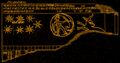 Clay tablet VAT 7851, microzodiac tablet with drawings for the zodiac sign of Taurus, The Bull
 -
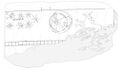 Taurus sign on clay tablet VAT 7851 with drawings of Pleiades (Bristle), Hyades (Chariot), Bull, and the Moon during a total lunar eclipse in the Moon's hypsoma; drawing by Hoffmann (2025)[14]
 -
 Front part of the Bull of Heaven, painted by Jessica Gullberg for Stellarium.
 -
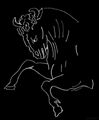 Taurus as shown on the marble Farnese Globe (drawing SMH)
 -
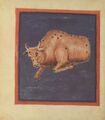 Taurus in the Leiden Aratea, 9th century, the Pleiades marked with six dots
 -
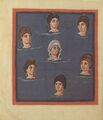 Pleiades as Seven Sisters in the Leiden Aratea
 -
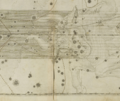 Taurus in Bayer's Uranometria (1603)
 -
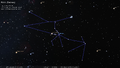 H.A. Rey's stick figure of Taurus (1952)
 -
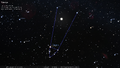 O. Hlad's stick figure of Taurus (1988)
 -
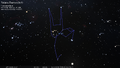 Reconstruction of Stickfigure based on the depiction of Almagest (100-170 CE). CC-BY Susanne Hoffmann in Stellarium.
 -
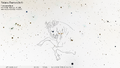 Image of the Farnese Globe (2nd century CE) taken by Susanne Hoffmann and imported into Stellarium.
.png)


Greek Mythology

The most famous of the Greek myths about the bull is the abduction of Princess Europa of Phoenicia. Zeus had transformed himself into a bull, she played with him, sat on his back and then he galloped into the water and swam to Crete. Euripides tells this story and also found its way into astronomical literature via Eratosthenes. Today, the motif is depicted on Greek 2 euro coins.
Mythographers favour the Pleiades story of the nymph Pleione and her seven daughters, who supposedly want to remain virgins but are pursued by the lustful Orion. They apparently do not achieve their goal of eternal virginity, because each of them becomes pregnant: none by Orion. Six of them give birth to sons of the gods, one of them – Merope – marries the mortal Sisyphus (from the Greek ‘merops’, mortal).
In Mesopotamia, the Celestial Bull is undoubtedly from the Epic of Gilgamesh:
Gilgamesh was a cruel ruler under whom his subjects suffered. The gods therefore created a companion for him. This one, Enkidu, had grown up among animals and represents the moral antithesis to Gilgamesh: He criticises the ruler's cruelty. After a wrestling match, they become friends and set off together to cut down trees in the sacred cedar forest. First they have to defeat the guardian of this forest, which they succeed in doing, but afterwards Enkidu regrets the deed because the forest is no longer so beautiful and is inhabited and ‘animated’ by animals. Next they come to Uruk, where the city goddess offers Gilgamesh to become her husband. He refuses, pointing out that her other suitors have fared badly. Ishtar then complains to her father Anu and asks him for the Bull of Heaven to set him on Gilgamesh, who has insulted her. Anu points out that the city of Uruk and its inhabitants are threatened with great famine if he is brought down to earth, but Ishtar says that she has made provisions for the people. Nevertheless, 300 men fall victim to this bull before Enkidu and Gilgamesh slaughter it and sacrifice it to the sun god.
Enkidu must atone for this deed with death and Gilgamesh, who initially sets out in search of the herb of life for immortality, finally realises that there are more important things than power and violence and that immortality can only be achieved through good deeds. He invents the city wall to pacify Uruk and becomes a good king.
A bull associated with the sun is a fairly common religious motif: it also appears in the contemporary Egyptian deity Apis and later in the cult of Mithras.
Weblinks
- Ridpath, Ian, Star Tales – Taurus
- Warburg Institute Iconographic Database – Taurus
References
- ↑ 1.0 1.1 Hoffmann, S.M. (2025). Image Analysis of VAT 7851, Archiv für Orientforschung (AfO) 56, 45-53
- ↑ 2.0 2.1 Hoffmann, S. M. and Hunger, H. (2024). Terminology in Taurus, The Bull. Nouvelles Assyriologiques Brèves et Utilitaires, 4, 121
- ↑ Hoffmann, S.M. (2025). Image Analysis of VAT 7851, Archiv für Orientforschung (AfO) 56, 45-53
- ↑ Hoffmann, Susanne M. Wie der Löwe an den Himmel kam. Franckh Kosmos Verlag, Stuttgart 2021
- ↑ Hoffmann (2025), Some Results on the Ancient Globes, Globe Studies – The Journal of the International Coronelli Society, 69, 4169.
- ↑ Ératosthènes de Cyrène: Catastérrismes, translated by Pamìas, Jordi und Zucker, Arnaud, Les Belles Lettres, Paris 2013
- ↑ Hoffmann, S. M., <i>Hipparchs Himmelsglobus</i>. Springer Wiesbaden/ New York, 2017. doi:10.1007/978-3-658-18683-8.
- ↑ Eratosthenes: Sternsagen, übersetzt von Pamìas, Jordi und Geus, Klaus, Verlag Utopica, Oberhaid 2007
- ↑ Vogt, H., “Versuch einer Wiederherstellung von Hipparchs Fixsternver zeichnis”, <i>Astronomische Nachrichten</i>, vol. 224, no. 2, Wiley, p. 17, 1925. doi:10.1002/asna.19252240202.
- ↑ Graßhoff, G., <i>The History of Ptolemy's Star Catalogue</i>, Springer, New York, 1990
- ↑ Hoffmann, S. M., <i>Hipparchs Himmelsglobus</i>. Springer Wiesbaden/ New York, 2017. doi:10.1007/978-3-658-18683-8.
- ↑ Glover, E. (2026). The Astronomy of Hipparchus, Cambridge University Press
- ↑ Hipparchus's Lost Star Catalogue (1/2 reconstructed) (Hoffmann, 2017) in VizieR
- ↑ Hoffmann, S.M. (2025). Image Analysis of VAT 7851, Archiv für Orientforschung (AfO) 56, 45-53





