Ara: Difference between revisions
No edit summary |
|||
| (24 intermediate revisions by 3 users not shown) | |||
| Line 2: | Line 2: | ||
---- | ---- | ||
[[File:Ara constellation (ara).tif|thumb|Ara constellation map, CC BY 4.0 (IAU).]] | [[File:Ara constellation (ara).tif|thumb|Ara constellation map, CC BY 4.0 (IAU).]] | ||
[[File:Ara aufrecht Kugel2024.jpg|alt=drawing|thumb|Ara in the ensemble with Centaurus and Lupus, | {{Infobox constellation | ||
| name = Θυμιατήριον (Thymiaterion) | |||
| native = Θυμιατήριον | |||
| translation = Altar | |||
| pronounce = Thymiaterion | |||
| IPA = | |||
| culture = Greek (Almagest) | |||
| RA = 254.6550507 to 271.6577841 | |||
| dec = -56.37772633 to -46.5056844 | |||
| areatotal = 88.32 | |||
| numbermainstars = 21 | |||
| numberbfstars = 13 | |||
| numberstarsplanets = | |||
| numberbrightstars = 2 | |||
| numbernearbystars = | |||
| brighteststarname = β Arae | |||
| starmagnitude = 2.85 | |||
| neareststarname = | |||
| stardistance = | |||
| numbermessierobjects = | |||
| meteorshowers = | |||
| bordering = Ara | |||
| notes = | |||
| cat = Almagest constellation | |||
}} | |||
[[File:Ara aufrecht Kugel2024.jpg|alt=drawing|thumb|Ara in the ensemble with Centaurus and Lupus, depiction on the [[Kugel Globe]], dating 4th century CE or later (drawing SMH).]] | |||
[[File:Aratea 72v.jpg|thumb|Leiden Aratea, Fol. 72v Ara, Public domain]] | [[File:Aratea 72v.jpg|thumb|Leiden Aratea, Fol. 72v Ara, Public domain]] | ||
[[File:Stellarium-001 ara.jpg|thumb|Constellation Ara (Altar) according to Ptolemy's Almagest: simulation with Stellarium 24.x.]] | [[File:Stellarium-001 ara.jpg|thumb|Constellation Ara (Altar) according to Ptolemy's Almagest: simulation with Stellarium 24.x.]] | ||
| Line 8: | Line 33: | ||
==Etymology and History== | ==Etymology and History== | ||
Aratos only mentions the altar of smoke several times as a sacred site and does not comment on it further, while Eratosthenes explains that it is the altar where the gods once conspired when Zeus went to battle against Cronus. The exact meaning is, therefore, not always clear. | Aratos only mentions the altar of smoke several times as a sacred site and does not comment on it further, while Eratosthenes explains that it is the altar where the gods once conspired when Zeus went to battle against Cronus. The exact meaning is, therefore, not always clear. | ||
=== Aratus === | The area beneath the scorpion's sting in the Milky Way is strewn with bright and dark clouds, with the dark clouds of the Milky Way resembling smoke from an altar illuminated by the fire below. The constellation lies below the bulge of the Milky Way, with the brightest and most extensive of its clouds in the constellations of Scutum, Sagittarius and Scorpius. It therefore appears that the smoke altar was originally a dark constellation that was later reinterpreted.<ref name=":0">Hoffmann, Susanne M. Wie der Löwe an den Himmel kam. Franckh Kosmos Verlag, Stuttgart 2021</ref> | ||
However, it remains a mystery why the altar hangs upside down, at least in Roman times, i.e. in Ptolemy's work: the fire smokes downwards (from ζ Arae to the south-west). Presumably, this was different in Hellenistic times, i.e. in the Greek original: the uniform cylindrical shape of the Greek altar on the Farnese Globe differs significantly from the Ptolemaic shape, which resembles the representation in the Leiden Aratea from the 9th century (Carolingian period). Eratosthenes describes an altar made up of four stars (two on the brazier and two on the base, a cylinder), while Ptolemy mentions seven. All this points to a significant transformation of the original image, but it is difficult to prove: Aratos only mentions the smoke altar several times as a sacred site and does not comment on it further, while Eratosthenes explains that it is the altar where the gods once conspired when Zeus went into battle against Kronos. | |||
=== Greco-Roman Sources === | |||
==== Aratus ==== | |||
<blockquote>Now below the blazing sting of the great monster Scorpion, close to the south hovers the Altar. [404] This constellation you will observe only for a short time above the horizon, for its period of visibility is the opposite of Arcturus’. In fact the paths of Arcturus come fully overhead, whereas the Altar goes quickly under the western sea. Yet even round that Altar ancient Night, [409] sad for the suffering of men, has set an important sign of storm at sea; for ships in distress are not to her liking, and she displays different signs in different ways in her pity for storm-tossed men. So pray, I beg you, that at sea this constellation be not visible in mid-sky overarched by clouds everywhere else, [415] cloudless itself and brilliant, but higher up oppressed by billowing clouds, as they are often packed when an autumn northerly piles them up. For Night herself frequently contrives this sign also for a southerly, showing favour to sailors in distress. [420] And if they give heed to her timely signal, and promptly make everything ready and shipshape, in due course their trouble is easier; but if a terrible squall of wind falls upon the ship from on high quite unexpectedly, and disorders all of the canvas, [425] sometimes they sail on entirely submerged, sometimes, if they find Zeus coming to help them as they pray, and there is lightning in the north, in spite of their many travails they do look again upon each other on board ship. With this sign fear a southerly, until you see Boreas flashing lightning. (Kidd 1997)</blockquote> | <blockquote>Now below the blazing sting of the great monster Scorpion, close to the south hovers the Altar. [404] This constellation you will observe only for a short time above the horizon, for its period of visibility is the opposite of Arcturus’. In fact the paths of Arcturus come fully overhead, whereas the Altar goes quickly under the western sea. Yet even round that Altar ancient Night, [409] sad for the suffering of men, has set an important sign of storm at sea; for ships in distress are not to her liking, and she displays different signs in different ways in her pity for storm-tossed men. So pray, I beg you, that at sea this constellation be not visible in mid-sky overarched by clouds everywhere else, [415] cloudless itself and brilliant, but higher up oppressed by billowing clouds, as they are often packed when an autumn northerly piles them up. For Night herself frequently contrives this sign also for a southerly, showing favour to sailors in distress. [420] And if they give heed to her timely signal, and promptly make everything ready and shipshape, in due course their trouble is easier; but if a terrible squall of wind falls upon the ship from on high quite unexpectedly, and disorders all of the canvas, [425] sometimes they sail on entirely submerged, sometimes, if they find Zeus coming to help them as they pray, and there is lightning in the north, in spite of their many travails they do look again upon each other on board ship. With this sign fear a southerly, until you see Boreas flashing lightning. (Kidd 1997)</blockquote> | ||
=== (Pseudo-)Eratosthenes === | ==== (Pseudo-)Eratosthenes ==== | ||
<blockquote>'''Var. 1.''' It is the one on which the gods originally sealed their alliance their alliance by an oath when Zeus launched his his offensive against Cronos. When they had succeeded in their endeavour, the gods also placed the altar in the sky as a memorial; men also carry the altar the altar at their banquets and sacrifice on it, when they have decided to make an agreement between themselves under oath; they touch it with their right hand, believing that this gesture is a guarantee of their good faith. | Pamias and Zucker (2013, 114-116)<ref>Jordi Pàmias i Massana and Arnaud Zucker (2013). Ératosthènes de Cyrène – Catastérismes, Les Belles Lettres, Paris, 114-116</ref>:<blockquote>'''Var. 1.''' It is the one on which the gods originally sealed their alliance their alliance by an oath when Zeus launched his his offensive against Cronos. When they had succeeded in their endeavour, the gods also placed the altar in the sky as a memorial; men also carry the altar the altar at their banquets and sacrifice on it, when they have decided to make an agreement between themselves under oath; they touch it with their right hand, believing that this gesture is a guarantee of their good faith. | ||
The Altar has two stars on the hearth and two on the base. In all, four. | The Altar has two stars on the hearth and two on the base. In all, four. | ||
| Line 21: | Line 52: | ||
It has two stars on the hearth and two at the base. base. Four in all.</blockquote>English from French:<blockquote>French translation by: Jordi Pàmias i Massana and Arnaud Zucker (2013). Ératosthènes de Cyrène – Catastérismes, Les Belles Lettres, Paris, 114-116</blockquote> | It has two stars on the hearth and two at the base. base. Four in all.</blockquote>English from French:<blockquote>French translation by: Jordi Pàmias i Massana and Arnaud Zucker (2013). Ératosthènes de Cyrène – Catastérismes, Les Belles Lettres, Paris, 114-116</blockquote> | ||
'''Eratosthenes's star catalogue''' can be reconstructed from the list of stars he mentions in the last section of each of the constelllation descriptions. Hoffmann (2017)<ref name=":02">Hoffmann, S. M., <nowiki><i>Hipparchs Himmelsglobus</i></nowiki>. Springer Wiesbaden/ New York, 2017. doi:10.1007/978-3-658-18683-8.</ref> made such a catalogue and used it for computational comparison with Hipparchus's, Ptolemy's and Babylonian data; it is based on the edition and translation by Pamias and Geus (2007)<ref>Eratosthenes: Sternsagen, übersetzt von Pamìas, Jordi und Geus, Klaus, Verlag Utopica, Oberhaid 2007</ref> and presented here in English translation. | |||
{|class="wikitable" | |||
|+ | |||
!erat.Cat.ID | |||
!constStarID | |||
!starName | |||
!ident.Bayer | |||
!ident.HIP | |||
!certainty | |||
|- | |||
| 618 | |||
| 1 | |||
| two stars on the coal basin | |||
| beta Ara | |||
| 85258 | |||
| 2 | |||
|- | |||
| 619 | |||
| 2 | |||
| two stars on the coal basin | |||
| zeta Ara | |||
| 83081 | |||
| 2 | |||
|- | |||
| 620 | |||
| 3 | |||
| two [stars] at the base | |||
| eta Ara | |||
| 82363 | |||
| 2 | |||
|- | |||
| 621 | |||
| 4 | |||
| two [stars] at the base | |||
| delta Ara | |||
| 85727 | |||
| 2 | |||
|} | |||
==== Hipparchus ==== | ==== Hipparchus ==== | ||
===== Hyginus, Astronomica | ====== Rising (Lib III Cap I §7) ====== | ||
<blockquote>The Rising of ...</blockquote> | |||
{| class="wikitable" | |||
|+ | |||
! | |||
! colspan="2" |east | |||
! colspan="2" |south | |||
|- | |||
! | |||
!lam1 | |||
!lam2 | |||
!lam1 | |||
!lam2 | |||
|- | |||
| | |||
|Sgr 15 | |||
|Sgr 23 | |||
|Lib 2 | |||
|Lib 11 | |||
|- | |||
| | |||
| | |||
| | |||
| | |||
| | |||
|- | |||
|star | |||
|From the south side of the boat, from those in the left foot | |||
|Of the Centaur the bright one in the front feet | |||
| | |||
| | |||
|- | |||
|duration | |||
| colspan="4" |1/2 hours = 30 min = 7 1/2 degree | |||
|} | |||
====== Setting (Lib II Cap VI §10) ====== | |||
{| class="wikitable" | |||
! | |||
! colspan="2" |west | |||
! colspan="2" |south | |||
|- | |||
! | |||
!lam1 | |||
!lam2 | |||
!lam1 | |||
!lam2 | |||
|- | |||
| | |||
|Leo 18 1/2 | |||
|Lib 9 | |||
|Sgr 5 | |||
|Cap 4 1/2 | |||
|- | |||
| | |||
| | |||
| | |||
| | |||
| | |||
|- | |||
|star | |||
|the southern one of those at the edge, which is double (bet,gam) | |||
|the northern one of those in the base | |||
| | |||
| | |||
|- | |||
|duration | |||
| colspan="4" |2 1/6 hours = 130 min = 32 1/2° | |||
|} | |||
====== Hipparchus's "lost" star Catalogue ====== | |||
The star catalogue of Hipparchus is not preserved. Yet, several scholars have reconstructed it in the past century: Vogt (1925)<ref>Vogt, H., “Versuch einer Wiederherstellung von Hipparchs Fixsternver zeichnis”, <nowiki><i>Astronomische Nachrichten</i></nowiki>, vol. 224, no. 2, Wiley, p. 17, 1925. doi:10.1002/asna.19252240202.</ref>, Grasshoff (1990)<ref>Graßhoff, G., <nowiki><i>The History of Ptolemy's Star Catalogue</i></nowiki>, Springer, New York, 1990 </ref>, Hoffmann (2017)<ref>Hoffmann, S. M., <nowiki><i>Hipparchs Himmelsglobus</i></nowiki>. Springer Wiesbaden/ New York, 2017. doi:10.1007/978-3-658-18683-8.</ref> and Glover (2026)<ref>Glover, E. (2026). ''The Astronomy of Hipparchus'', Cambridge University Press</ref>. Grasshoff's catalogue and computations are not published digitally, Hoffmann published three versions of the Manitius+Hoffmann<ref>Hipparchus's Lost Star Catalogue (1/2 reconstructed) (Hoffmann, 2017) in VizieR</ref> star lists in the CDS [https://vizier.unistra.fr/ VizieR] "catalog of catalogs", and Glover printed the star lists constellationwise in his book. | |||
{|class="wikitable" | |||
|+ Hipparchus's star in Ara (Glover 2026) | |||
!hipp.Cat.ID | |||
!constStarID | |||
!starName | |||
!ident.Bayer | |||
!ident.HIP | |||
!concordance | |||
|- | |||
|38 | |||
|1 | |||
| the bright star in the middle | |||
|α Ara | |||
|85792 | |||
|CPAE | |||
|- | |||
|39 | |||
|2 | |||
| one of the stars on the edge | |||
|β Ara | |||
|85258 | |||
|CPAE | |||
|- | |||
|40 | |||
|3 | |||
| the more southerly star on the edge | |||
|γ Ara | |||
|85267 | |||
|CPAE | |||
|- | |||
|41 | |||
|4 | |||
| the star in the brazier | |||
|ε Ara (ε1) | |||
|83153 | |||
|CPAE | |||
|- | |||
|42 | |||
|5 | |||
| the more southerly of the stars in the base | |||
|θ Ara | |||
|88714 | |||
|CPAE | |||
|- | |||
|43 | |||
|6 | |||
| the more northerly of the stars in the base | |||
|σ Ara | |||
|86092 | |||
|CPAE | |||
|} | |||
==== Hyginus, Astronomica ==== | |||
<blockquote>On this altar the gods are thought to have first made offerings and formed an alliance when they were about to oppose the Titans. The Cyclopes made it. From this observance men established the custom that when they plan to do something, they make sacrifices before beginning the undertaking. (Mary Ward 1960)</blockquote> | <blockquote>On this altar the gods are thought to have first made offerings and formed an alliance when they were about to oppose the Titans. The Cyclopes made it. From this observance men established the custom that when they plan to do something, they make sacrifices before beginning the undertaking. (Mary Ward 1960)</blockquote> | ||
=== Ptolemy's Almagest === | ==== Ptolemy's Almagest ==== | ||
{| class="wikitable" | {| class="wikitable" | ||
|+Θυμιατηρίου ἀστερισμός | |+Θυμιατηρίου ἀστερισμός | ||
| Line 55: | Line 251: | ||
|τῶν ἐν τῷ ἐπιπύρῳ 3’ ὁ βόρειος | |τῶν ἐν τῷ ἐπιπύρῳ 3’ ὁ βόρειος | ||
|The northernmost of the 3 stars in the brazier | |The northernmost of the 3 stars in the brazier | ||
| | |ε<sup>1</sup> Ara | ||
|- | |- | ||
|5 | |5 | ||
| Line 81: | Line 277: | ||
|{7 stars, 5 of the fourth magnitude, 2 of the fifth} | |{7 stars, 5 of the fourth magnitude, 2 of the fifth} | ||
| | | | ||
|} | |||
[[File:Thymiaterion Youla CH.png|thumb|Convex Hull for the stars inside Thymiaterion (CC BY Youla Azkarrula).]] | |||
===== Stars within the Constellation Area ===== | |||
{| class="wikitable sortable mw-collapsible" | |||
|+ | |||
!id | |||
!Label | |||
!IAU design. | |||
!description | |||
!Vmag | |||
|- | |||
|1 | |||
|β Arae | |||
|HIP 85258 | |||
|Constellation lines | |||
|2.85 | |||
|- | |||
|2 | |||
|α Arae | |||
|HIP 85792 | |||
|Constellation lines | |||
|2.95 | |||
|- | |||
|3 | |||
|ζ Arae | |||
|HIP 83081 | |||
|Constellation lines (Vertex) | |||
|3.076 | |||
|- | |||
|4 | |||
|γ Arae | |||
|HIP 85267 | |||
|Constellation lines (Vertex) | |||
|3.34 | |||
|- | |||
|5 | |||
|θ Arae | |||
|HIP 88714 | |||
|Constellation lines (Vertex) | |||
|3.66 | |||
|- | |||
|6 | |||
|ϵ<sup>1</sup> Arae | |||
|HIP 83153 | |||
|Constellation lines (Vertex) | |||
|4.05 | |||
|- | |||
|7 | |||
|σ Arae | |||
|HIP 86092 | |||
|Constellation lines (Vertex) | |||
|4.59 | |||
|- | |||
|8 | |||
|λ Arae | |||
|HIP 86486 | |||
|Inside the hull | |||
|4.77 | |||
|- | |||
|9 | |||
|Cervantes | |||
|HIP 86796 | |||
|Inside the hull | |||
|5.15 | |||
|- | |||
|10 | |||
|NGC 6397 | |||
|NGC 6397 | |||
|Inside the hull | |||
|5.17 | |||
|- | |||
|11 | |||
|κ Arae | |||
|HIP 85312 | |||
|Inside the hull | |||
|5.193 | |||
|- | |||
|12 | |||
|ϵ<sup>2</sup> Arae | |||
|HIP 83431 | |||
|Inside the hull | |||
|5.278 | |||
|- | |||
|13 | |||
| - | |||
|HIP 83187 | |||
|Inside the hull | |||
|5.633 | |||
|- | |||
|14 | |||
| - | |||
|HIP 85470 | |||
|Inside the hull | |||
|5.723 | |||
|- | |||
|15 | |||
| - | |||
|HIP 86248 | |||
|Inside the hull | |||
|5.878 | |||
|- | |||
|16 | |||
| - | |||
|HIP 85409 | |||
|Inside the hull | |||
|5.898 | |||
|- | |||
|17 | |||
| - | |||
|HIP 86064 | |||
|Inside the hull | |||
|6.08 | |||
|- | |||
|18 | |||
| - | |||
|HIP 85393 | |||
|Inside the hull | |||
|6.17 | |||
|- | |||
|19 | |||
| - | |||
|HIP 84759 | |||
|Inside the hull | |||
|6.267 | |||
|- | |||
|20 | |||
| - | |||
|HIP 85975 | |||
|Inside the hull | |||
|6.32 | |||
|- | |||
|21 | |||
|V626 Ara | |||
|HIP 86628 | |||
|Inside the hull | |||
|6.35 | |||
|} | |} | ||
| Line 91: | Line 424: | ||
The area near the sting of the scorpion is streaked with light and dark clouds of the Milky Way, and the dark clouds of the Milky Way could be the smoke of an altar illuminated by the fire below.<ref>Hoffmann, S.M. (2023). “The Rhetoric on Clouds in the Ancient Star Catalogue”. ''Rhetoric & Science'' Vol. II, Centre for the Study of the Ancient World (CSAW), Ionian University</ref> Some researchers suggest that the figure of a smoky altar only becomes vivid when more southerly stars are added, which were visible at that time due to precession. This is unnecessary. Human imagination is of no use in reconstructing constellations; we need data. We can speculate a lot about the constellations of the archaic civilisation, as no scientific data has survived from this period that would enable a correct reconstruction. | The area near the sting of the scorpion is streaked with light and dark clouds of the Milky Way, and the dark clouds of the Milky Way could be the smoke of an altar illuminated by the fire below.<ref>Hoffmann, S.M. (2023). “The Rhetoric on Clouds in the Ancient Star Catalogue”. ''Rhetoric & Science'' Vol. II, Centre for the Study of the Ancient World (CSAW), Ionian University</ref> Some researchers suggest that the figure of a smoky altar only becomes vivid when more southerly stars are added, which were visible at that time due to precession. This is unnecessary. Human imagination is of no use in reconstructing constellations; we need data. We can speculate a lot about the constellations of the archaic civilisation, as no scientific data has survived from this period that would enable a correct reconstruction. | ||
=== Mediaeval, Renaissance and Early Modern Source === | |||
==== Alfonsine Tables (1483) ==== | |||
In 1483 the printer Erhard Ratdolt, working in Venice, published Tabulae Alphonsinae or the Alphonsine Tables, a compilation of astronomical data tabulating the positions and movements of the planets. | |||
==== Dürer (1515) ==== | |||
The pair of celestial maps created by Albrecht Dürer in 1515, one showing the Northern Hemisphere sky and the other the Southern Hemisphere sky, are generally regarded as the first printed star charts published in Europe. | |||
Schickard wrote it ... . | |||
==== Bayer and de Houtman (1603) ==== | |||
In his Uranometria, Bayer gives all the name alternatives mentioned above: | |||
==== Rudolphine Tables (1627) ==== | |||
[[File:Ara RudolphinTables1627.png|thumb|Ara in Rudolphine Tables (Kepler 1627).]] | |||
The Tabulae Rudolphinae were ordered and dedicated to Emperor Rudolph II of the Holy Roman Empire. The main purpose was to allow the computation of the positions of the five classically known planets, but the tables also consist of a star catalogue. They were published by Johannes Kepler (1627), including earlier work and observational data by Tycho Brahe. The original Latin title is "Tabulæ Rudolphinæ, Quibus Astronomicæ Scientiæ, Temporum longinquitate collapsæ Restauratio continetur".<ref>Kepler (1627). ''Tabulæ Rudolphinæ, Quibus Astronomicæ Scientiæ, Temporum longinquitate collapsæ Restauratio continetur.'' [https://schriftgut.sh/viewer/image/PPN587862734/274/ online] </ref> | |||
The constellation name is given "'''In Thuribulo'''". | |||
=== Transfer and Transformation of the Constellation === | === Transfer and Transformation of the Constellation === | ||
Eratosthenes describes an altar of four stars (two on the brazier and two on the base, a cylinder), while Ptolemy mentions seven. This demonstrates obviously that the constellation was imagined differently by these two (and probably also other) authors. <gallery> | Eratosthenes describes an altar of four stars (two on the brazier and two on the base, a cylinder), while Ptolemy mentions seven. This demonstrates obviously that the constellation was imagined differently by these two (and probably also other) authors. <gallery> | ||
File:Ara aufrecht Kugel2024.jpg|Ara in the ensemble with Lupus, sacrified by Centaurus (Kugel Globe). | File:Ara aufrecht Kugel2024.jpg|Ara in the ensemble with Lupus, sacrified by Centaurus (Kugel Globe). | ||
File:Ara kugel.jpg|Ara on the ancient Kugel Globe ( | File:Ara kugel.jpg|Ara on the ancient Kugel Globe (4th c. CE) | ||
File:Ara farnese bg.png|Ara on the ancient Farnese Globe, 2nd c. CE with Hellenistic predecessor | File:Ara farnese bg.png|Ara on the ancient Farnese Globe, 2nd c. CE with Hellenistic predecessor | ||
File:Ara mainz.jpg|Ara on the ancient Mainz Globe (2nd c. CE) | File:Ara mainz.jpg|Ara on the ancient Mainz Globe (2nd c. CE) | ||
| Line 101: | Line 453: | ||
File:Ara Duerer.jpg|Dürer's Ara (1515), pointing southwards | File:Ara Duerer.jpg|Dürer's Ara (1515), pointing southwards | ||
File:Blaeu1602 Ara.JPG|Blaeu (1602) is copied from Plancius/ Hondius (1598) and shows Ara's flames burning southwards. [https://collections.rmg.co.uk/mediaLib/360/media-360270/large.jpg RMG] | File:Blaeu1602 Ara.JPG|Blaeu (1602) is copied from Plancius/ Hondius (1598) and shows Ara's flames burning southwards. [https://collections.rmg.co.uk/mediaLib/360/media-360270/large.jpg RMG] | ||
File:Blaeu1603 Ara.JPG|Blaeu (1603), his second globe made with de Houtman's data for the southern constellations, also corrects the direction of Ara: The flames now burn northwards and the smoke indicates the position of the southern Milky Way between Sco and Sgr. [https://collections.rmg.co.uk/mediaLib/398/media-398216/large.jpg RMG] | File:Blaeu1603 Ara.JPG|Blaeu (1603), his second globe made with de Houtman's data for the southern constellations, also corrects the direction of Ara: The flames now burn northwards and the smoke indicates the position of the southern Milky Way between Sco and Sgr. [https://collections.rmg.co.uk/mediaLib/398/media-398216/large.jpg RMG] | ||
File:Ara Fortin1795.jpg|Ara in Fortin's Atlas Céleste, 3rd edition (1795). | File:Ara Fortin1795.jpg|Ara in Fortin's Atlas Céleste, 3rd edition (1795). | ||
File:H.A. Rey's stick figure stellarium-006.png|(1952) H.A. Rey's stick figure of Ara | |||
File:O. Hlad's stick figure stellarium-006.png|(1988) O. Hlad's stick figure of Ara | |||
File:Stellarium-009-Alm.png|Reconstruction of Stickfigure based on the depiction of Almagest (100-170 CE). CC-BY Susanne Hoffmann in Stellarium. | |||
File:Stellarium-007-Far.png|Image of the Farnese Globe (2nd century CE) taken by Susanne Hoffmann and imported into Stellarium. | |||
</gallery> | </gallery> | ||
== Greek Mythology == | == Greek Mythology == | ||
Greek mythology recalls the god Kronos, who overthrew his father, Uranos, to gain power. He was prophesied by an oracle that he himself would therefore also be overthrown by one of his sons and to thwart this he devoured all his children immediately after birth. At some point, his wife, the goddess Rhea, could no longer bear to see this and rescued a baby to raise him on Crete with a goat's milk. It was Zeus. When he grew up, he forced his father to spit out his siblings, and together, they began a battle for world domination. The archaic goddess of the earth, Gaia, advised them to unleash some of the monsters that Kronos had imprisoned. So Zeus released the brutal Cyclopes and Centaurs, who forged weapons for him and his siblings and, according to Eratosthenes, also made ‘a cover for the fire’ so that the gods would not have to see its powerful glow. This was the altar that initially served the gods around Zeus as an oath of their covenant and from then on also served humans. | <ref name=":0" />Greek mythology recalls the god Kronos, who overthrew his father, Uranos, to gain power. He was prophesied by an oracle that he himself would therefore also be overthrown by one of his sons and to thwart this he devoured all his children immediately after birth. At some point, his wife, the goddess Rhea, could no longer bear to see this and rescued a baby to raise him on Crete with a goat's milk. It was Zeus. When he grew up, he forced his father to spit out his siblings, and together, they began a battle for world domination. The archaic goddess of the earth, Gaia, advised them to unleash some of the monsters that Kronos had imprisoned. So Zeus released the brutal Cyclopes and Centaurs, who forged weapons for him and his siblings and, according to Eratosthenes, also made ‘a cover for the fire’ so that the gods would not have to see its powerful glow. This was the altar that initially served the gods around Zeus as an oath of their covenant and from then on also served humans. | ||
Whenever people swear, take oaths or seal covenants, they do so at such an altar ‘as an impartial guarantor’. They place their right hand on the altar to express their goodwill and to seal something. | Whenever people swear, take oaths or seal covenants, they do so at such an altar ‘as an impartial guarantor’. They place their right hand on the altar to express their goodwill and to seal something. | ||
| Line 115: | Line 471: | ||
== Weblinks == | == Weblinks == | ||
* | * [https://iconographic.warburg.sas.ac.uk/category/vpc-taxonomy-017077 Warburg Institute Iconographic Database – Ara] | ||
* Ian Ridpath's ''Star Tales'' [http://www.ianridpath.com/startales/ara.html – Ara] | |||
== References == | == References == | ||
| Line 124: | Line 481: | ||
* [[References (Medieval and Early Modern)|References (medieval)]] | * [[References (Medieval and Early Modern)|References (medieval)]] | ||
[[Category:Eurasia]] [[Category:Constellation]] [[Category:Almagest]] [[Category:West Asian]] [[Category:Modern]] | [[Category:Eurasia]] | ||
[[Category:88 IAU-Constellations]] | [[Category:Asterism]] [[Category:Constellation]] [[Category:Super-Constellation]] | ||
[[Category:Almagest]] [[Category:Greco-Roman]] [[Category:Africa]] | |||
[[Category:West Asian]] [[Category:Asian]] | |||
[[Category:Modern]] [[Category:88 IAU-Constellations]] | |||
[[Category:Ara]] | |||
Latest revision as of 03:06, 25 September 2026
Authors: Susanne M Hoffmann, Youla Azkarrula, Doris Vickers, Ian Ridpath

| Asterism Info | |
| Native | Θυμιατήριον |
|---|---|
| Romanisation | Thymiaterion |
| Translation | Altar |
| Position (2000) | |
| Right ascension | 254.6550507 to 271.6577841 |
| Declination | -56.37772633 to -46.5056844 |
| Area | 88.32 sq. deg. |
| Stars | |
| Bright stars | 21 |
| Bayer/Flamsteed stars | 13 |
| Stars brighter than 3.00m | 2 |
| Brightest star | β Arae (2.85m) |
| Taxonomy | |
| category of asterism | Almagest constellation |
| IAU- constellations | Ara |


Ara, The Altar (or Censer), is one of the 88 IAU constellations. The constellation appears in all ancient Greek literature from Aratus to Ptolemy; the ancient Greek term is Θυμιατήριον (Thymiaterion) in Hipparchus and θυτήριον (Thyterion) in Pseudo-Eratosthenes. It forms a unit of sense with the neighbouring super-constellation of Centaurus and Lupus, as the centaur sacrifices the animal to the gods at the altar.
Etymology and History
Aratos only mentions the altar of smoke several times as a sacred site and does not comment on it further, while Eratosthenes explains that it is the altar where the gods once conspired when Zeus went to battle against Cronus. The exact meaning is, therefore, not always clear.
The area beneath the scorpion's sting in the Milky Way is strewn with bright and dark clouds, with the dark clouds of the Milky Way resembling smoke from an altar illuminated by the fire below. The constellation lies below the bulge of the Milky Way, with the brightest and most extensive of its clouds in the constellations of Scutum, Sagittarius and Scorpius. It therefore appears that the smoke altar was originally a dark constellation that was later reinterpreted.[1]
However, it remains a mystery why the altar hangs upside down, at least in Roman times, i.e. in Ptolemy's work: the fire smokes downwards (from ζ Arae to the south-west). Presumably, this was different in Hellenistic times, i.e. in the Greek original: the uniform cylindrical shape of the Greek altar on the Farnese Globe differs significantly from the Ptolemaic shape, which resembles the representation in the Leiden Aratea from the 9th century (Carolingian period). Eratosthenes describes an altar made up of four stars (two on the brazier and two on the base, a cylinder), while Ptolemy mentions seven. All this points to a significant transformation of the original image, but it is difficult to prove: Aratos only mentions the smoke altar several times as a sacred site and does not comment on it further, while Eratosthenes explains that it is the altar where the gods once conspired when Zeus went into battle against Kronos.
Greco-Roman Sources
Aratus
Now below the blazing sting of the great monster Scorpion, close to the south hovers the Altar. [404] This constellation you will observe only for a short time above the horizon, for its period of visibility is the opposite of Arcturus’. In fact the paths of Arcturus come fully overhead, whereas the Altar goes quickly under the western sea. Yet even round that Altar ancient Night, [409] sad for the suffering of men, has set an important sign of storm at sea; for ships in distress are not to her liking, and she displays different signs in different ways in her pity for storm-tossed men. So pray, I beg you, that at sea this constellation be not visible in mid-sky overarched by clouds everywhere else, [415] cloudless itself and brilliant, but higher up oppressed by billowing clouds, as they are often packed when an autumn northerly piles them up. For Night herself frequently contrives this sign also for a southerly, showing favour to sailors in distress. [420] And if they give heed to her timely signal, and promptly make everything ready and shipshape, in due course their trouble is easier; but if a terrible squall of wind falls upon the ship from on high quite unexpectedly, and disorders all of the canvas, [425] sometimes they sail on entirely submerged, sometimes, if they find Zeus coming to help them as they pray, and there is lightning in the north, in spite of their many travails they do look again upon each other on board ship. With this sign fear a southerly, until you see Boreas flashing lightning. (Kidd 1997)
(Pseudo-)Eratosthenes
Pamias and Zucker (2013, 114-116)[2]:
Var. 1. It is the one on which the gods originally sealed their alliance their alliance by an oath when Zeus launched his his offensive against Cronos. When they had succeeded in their endeavour, the gods also placed the altar in the sky as a memorial; men also carry the altar the altar at their banquets and sacrifice on it, when they have decided to make an agreement between themselves under oath; they touch it with their right hand, believing that this gesture is a guarantee of their good faith.
The Altar has two stars on the hearth and two on the base. In all, four.
Var. 2: It is the one on which the gods originally sealed their alliance with an oath when Zeus launched against Cronos; the Cyclops had built this edifice and covered the fire so that no one had the power of the lightning. When they succeeded in their enterprise, the gods also placed this altar in the sky as well; men also carry the altar to their banquets and sacrifice on it when they have decided to make an agreement between themselves, as well as at competitions, for those who want to take an oath, believing it to be the surest legal guarantee. They touch it with their right hand, considering it as a sign of good faith. Diviners also sacrifice on this altar when they want to ‘see’ with greater certainty.
It has two stars on the hearth and two at the base. base. Four in all.
English from French:
French translation by: Jordi Pàmias i Massana and Arnaud Zucker (2013). Ératosthènes de Cyrène – Catastérismes, Les Belles Lettres, Paris, 114-116
Eratosthenes's star catalogue can be reconstructed from the list of stars he mentions in the last section of each of the constelllation descriptions. Hoffmann (2017)[3] made such a catalogue and used it for computational comparison with Hipparchus's, Ptolemy's and Babylonian data; it is based on the edition and translation by Pamias and Geus (2007)[4] and presented here in English translation.
| erat.Cat.ID | constStarID | starName | ident.Bayer | ident.HIP | certainty |
|---|---|---|---|---|---|
| 618 | 1 | two stars on the coal basin | beta Ara | 85258 | 2 |
| 619 | 2 | two stars on the coal basin | zeta Ara | 83081 | 2 |
| 620 | 3 | two [stars] at the base | eta Ara | 82363 | 2 |
| 621 | 4 | two [stars] at the base | delta Ara | 85727 | 2 |
Hipparchus
Rising (Lib III Cap I §7)
The Rising of ...
| east | south | |||
|---|---|---|---|---|
| lam1 | lam2 | lam1 | lam2 | |
| Sgr 15 | Sgr 23 | Lib 2 | Lib 11 | |
| star | From the south side of the boat, from those in the left foot | Of the Centaur the bright one in the front feet | ||
| duration | 1/2 hours = 30 min = 7 1/2 degree | |||
Setting (Lib II Cap VI §10)
| west | south | |||
|---|---|---|---|---|
| lam1 | lam2 | lam1 | lam2 | |
| Leo 18 1/2 | Lib 9 | Sgr 5 | Cap 4 1/2 | |
| star | the southern one of those at the edge, which is double (bet,gam) | the northern one of those in the base | ||
| duration | 2 1/6 hours = 130 min = 32 1/2° | |||
Hipparchus's "lost" star Catalogue
The star catalogue of Hipparchus is not preserved. Yet, several scholars have reconstructed it in the past century: Vogt (1925)[5], Grasshoff (1990)[6], Hoffmann (2017)[7] and Glover (2026)[8]. Grasshoff's catalogue and computations are not published digitally, Hoffmann published three versions of the Manitius+Hoffmann[9] star lists in the CDS VizieR "catalog of catalogs", and Glover printed the star lists constellationwise in his book.
| hipp.Cat.ID | constStarID | starName | ident.Bayer | ident.HIP | concordance |
|---|---|---|---|---|---|
| 38 | 1 | the bright star in the middle | α Ara | 85792 | CPAE |
| 39 | 2 | one of the stars on the edge | β Ara | 85258 | CPAE |
| 40 | 3 | the more southerly star on the edge | γ Ara | 85267 | CPAE |
| 41 | 4 | the star in the brazier | ε Ara (ε1) | 83153 | CPAE |
| 42 | 5 | the more southerly of the stars in the base | θ Ara | 88714 | CPAE |
| 43 | 6 | the more northerly of the stars in the base | σ Ara | 86092 | CPAE |
Hyginus, Astronomica
On this altar the gods are thought to have first made offerings and formed an alliance when they were about to oppose the Titans. The Cyclopes made it. From this observance men established the custom that when they plan to do something, they make sacrifices before beginning the undertaking. (Mary Ward 1960)
Ptolemy's Almagest
| id | Greek
(Heiberg 1898) |
English
(Toomer 1984) |
ident. |
|---|---|---|---|
| 1 | ὁ τῶν ἐν τῇ βάσει β ὁ βορειότερος | The northernmost of the 2 stars in the base | σ Ara |
| 2 | ὁ νοτιώτερος αὐτῶν | The southernmost of them | θ Ara |
| 3 | ὁ ἐν μέσῳ τῷ βωμίσκῳ | The star in the middle of the little altar | α Ara |
| 4 | τῶν ἐν τῷ ἐπιπύρῳ 3’ ὁ βόρειος | The northernmost of the 3 stars in the brazier | ε1 Ara |
| 5 | τῶν λοιπῶν καὶ συνεχῶν β ὁ νοτιώτερος | The southernmost of the other 2 which are close together | γ Ara |
| 6 | ὁ βορειότερος αὐτῶν | The northernmost of these [2] | β Ara |
| 7 | ὁ ἐπ’ ἄκρου τοῦ καοστῆρος | The star on the end of the burning-apparatus | ζ Ara |
| all | ἀστέρες ξ, ὧν δ’ μεγέθους ἐ, ε’ β | {7 stars, 5 of the fourth magnitude, 2 of the fifth} |

Stars within the Constellation Area
| id | Label | IAU design. | description | Vmag |
|---|---|---|---|---|
| 1 | β Arae | HIP 85258 | Constellation lines | 2.85 |
| 2 | α Arae | HIP 85792 | Constellation lines | 2.95 |
| 3 | ζ Arae | HIP 83081 | Constellation lines (Vertex) | 3.076 |
| 4 | γ Arae | HIP 85267 | Constellation lines (Vertex) | 3.34 |
| 5 | θ Arae | HIP 88714 | Constellation lines (Vertex) | 3.66 |
| 6 | ϵ1 Arae | HIP 83153 | Constellation lines (Vertex) | 4.05 |
| 7 | σ Arae | HIP 86092 | Constellation lines (Vertex) | 4.59 |
| 8 | λ Arae | HIP 86486 | Inside the hull | 4.77 |
| 9 | Cervantes | HIP 86796 | Inside the hull | 5.15 |
| 10 | NGC 6397 | NGC 6397 | Inside the hull | 5.17 |
| 11 | κ Arae | HIP 85312 | Inside the hull | 5.193 |
| 12 | ϵ2 Arae | HIP 83431 | Inside the hull | 5.278 |
| 13 | - | HIP 83187 | Inside the hull | 5.633 |
| 14 | - | HIP 85470 | Inside the hull | 5.723 |
| 15 | - | HIP 86248 | Inside the hull | 5.878 |
| 16 | - | HIP 85409 | Inside the hull | 5.898 |
| 17 | - | HIP 86064 | Inside the hull | 6.08 |
| 18 | - | HIP 85393 | Inside the hull | 6.17 |
| 19 | - | HIP 84759 | Inside the hull | 6.267 |
| 20 | - | HIP 85975 | Inside the hull | 6.32 |
| 21 | V626 Ara | HIP 86628 | Inside the hull | 6.35 |
Origin of Constellation[10]
Religious Roots. The constellation has no Babylonian predecessors but appears to originate from Greek archaic times. The neighbouring depiction of a sacrificial animal in our constellation Lupus. Ara seems to have formed part of an archaic Greek super-constellation for spring rituals: The wise centaur representing the turn from the wild to civilized human societies, sacrifies (an animal at the altar) to some divine powers.
Upright or not? The oldest Greek depiction, however, the Kugel Globe as well as the Mainz Globe (typically dated to Ptolemy's time) both show Ara in an upright position: The flames from the burning apparatus go northwards. Only the Farnese Globe shows it upside down (like Ptolemy's description). If the dating is correct, the Mainz Globe and the Farnese Globe are of similar age (both roughly 2nd century CE). As their visualisations differ, the change may have happened in this time (post-Augustus).
Change of Interpretation? The extreme southern position of the constellation, its diminutive size compared to its immense ritual significance and its illogical upside-down reversal (at least in Ptolemy) lead to the hypothesis that it could have been larger in earlier times and could have enclosed the sting of the scorpion (or parts of it). The scorpion eventually came to Greece from Babylonian astronomy via the zodiac (around 400 BCE), and there are no complete celestial descriptions from before that time. We, therefore, need to find out whether another culture may also have seen parts of the altar here. It is well possible that the Cen+Lup+Ara super-constellation originated from the Greek culture, was "overwritten" by the Babylonian giant Scorpion.
The area near the sting of the scorpion is streaked with light and dark clouds of the Milky Way, and the dark clouds of the Milky Way could be the smoke of an altar illuminated by the fire below.[11] Some researchers suggest that the figure of a smoky altar only becomes vivid when more southerly stars are added, which were visible at that time due to precession. This is unnecessary. Human imagination is of no use in reconstructing constellations; we need data. We can speculate a lot about the constellations of the archaic civilisation, as no scientific data has survived from this period that would enable a correct reconstruction.
Mediaeval, Renaissance and Early Modern Source
Alfonsine Tables (1483)
In 1483 the printer Erhard Ratdolt, working in Venice, published Tabulae Alphonsinae or the Alphonsine Tables, a compilation of astronomical data tabulating the positions and movements of the planets.
Dürer (1515)
The pair of celestial maps created by Albrecht Dürer in 1515, one showing the Northern Hemisphere sky and the other the Southern Hemisphere sky, are generally regarded as the first printed star charts published in Europe.
Schickard wrote it ... .
Bayer and de Houtman (1603)
In his Uranometria, Bayer gives all the name alternatives mentioned above:
Rudolphine Tables (1627)

The Tabulae Rudolphinae were ordered and dedicated to Emperor Rudolph II of the Holy Roman Empire. The main purpose was to allow the computation of the positions of the five classically known planets, but the tables also consist of a star catalogue. They were published by Johannes Kepler (1627), including earlier work and observational data by Tycho Brahe. The original Latin title is "Tabulæ Rudolphinæ, Quibus Astronomicæ Scientiæ, Temporum longinquitate collapsæ Restauratio continetur".[12]
The constellation name is given "In Thuribulo".
Transfer and Transformation of the Constellation
Eratosthenes describes an altar of four stars (two on the brazier and two on the base, a cylinder), while Ptolemy mentions seven. This demonstrates obviously that the constellation was imagined differently by these two (and probably also other) authors.
-
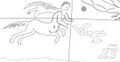 Ara in the ensemble with Lupus, sacrified by Centaurus (Kugel Globe).
 -
 Ara on the ancient Kugel Globe (4th c. CE)
 -
 Ara on the ancient Farnese Globe, 2nd c. CE with Hellenistic predecessor
 -
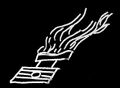 Ara on the ancient Mainz Globe (2nd c. CE)
 -
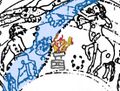 Ara in the ensemble: framed by the two centaurs in Centaurus and Sagittarius, one sacrificing Lupus, the other hunting Scorpius.
 -
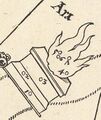 Dürer's Ara (1515), pointing southwards
 -
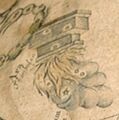 Blaeu (1602) is copied from Plancius/ Hondius (1598) and shows Ara's flames burning southwards. RMG
 -
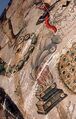 Blaeu (1603), his second globe made with de Houtman's data for the southern constellations, also corrects the direction of Ara: The flames now burn northwards and the smoke indicates the position of the southern Milky Way between Sco and Sgr. RMG
 -
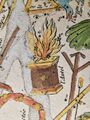 Ara in Fortin's Atlas Céleste, 3rd edition (1795).
 -
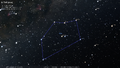 (1952) H.A. Rey's stick figure of Ara
 -
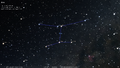 (1988) O. Hlad's stick figure of Ara
 -
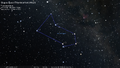 Reconstruction of Stickfigure based on the depiction of Almagest (100-170 CE). CC-BY Susanne Hoffmann in Stellarium.
 -
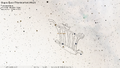 Image of the Farnese Globe (2nd century CE) taken by Susanne Hoffmann and imported into Stellarium.


Greek Mythology
[1]Greek mythology recalls the god Kronos, who overthrew his father, Uranos, to gain power. He was prophesied by an oracle that he himself would therefore also be overthrown by one of his sons and to thwart this he devoured all his children immediately after birth. At some point, his wife, the goddess Rhea, could no longer bear to see this and rescued a baby to raise him on Crete with a goat's milk. It was Zeus. When he grew up, he forced his father to spit out his siblings, and together, they began a battle for world domination. The archaic goddess of the earth, Gaia, advised them to unleash some of the monsters that Kronos had imprisoned. So Zeus released the brutal Cyclopes and Centaurs, who forged weapons for him and his siblings and, according to Eratosthenes, also made ‘a cover for the fire’ so that the gods would not have to see its powerful glow. This was the altar that initially served the gods around Zeus as an oath of their covenant and from then on also served humans.
Whenever people swear, take oaths or seal covenants, they do so at such an altar ‘as an impartial guarantor’. They place their right hand on the altar to express their goodwill and to seal something.
Eratosthenes reports that such an altar is also used by fortune-tellers for their sacrifices so that their predictions of the future are more accurate.
Weblinks
- Warburg Institute Iconographic Database – Ara
- Ian Ridpath's Star Tales – Ara
References
- ↑ 1.0 1.1 Hoffmann, Susanne M. Wie der Löwe an den Himmel kam. Franckh Kosmos Verlag, Stuttgart 2021
- ↑ Jordi Pàmias i Massana and Arnaud Zucker (2013). Ératosthènes de Cyrène – Catastérismes, Les Belles Lettres, Paris, 114-116
- ↑ Hoffmann, S. M., <i>Hipparchs Himmelsglobus</i>. Springer Wiesbaden/ New York, 2017. doi:10.1007/978-3-658-18683-8.
- ↑ Eratosthenes: Sternsagen, übersetzt von Pamìas, Jordi und Geus, Klaus, Verlag Utopica, Oberhaid 2007
- ↑ Vogt, H., “Versuch einer Wiederherstellung von Hipparchs Fixsternver zeichnis”, <i>Astronomische Nachrichten</i>, vol. 224, no. 2, Wiley, p. 17, 1925. doi:10.1002/asna.19252240202.
- ↑ Graßhoff, G., <i>The History of Ptolemy's Star Catalogue</i>, Springer, New York, 1990
- ↑ Hoffmann, S. M., <i>Hipparchs Himmelsglobus</i>. Springer Wiesbaden/ New York, 2017. doi:10.1007/978-3-658-18683-8.
- ↑ Glover, E. (2026). The Astronomy of Hipparchus, Cambridge University Press
- ↑ Hipparchus's Lost Star Catalogue (1/2 reconstructed) (Hoffmann, 2017) in VizieR
- ↑ Hoffmann, S.M.: Wie der Löwe an den Himmel kam. Franckh Kosmos Verlag, Stuttgart 2021
- ↑ Hoffmann, S.M. (2023). “The Rhetoric on Clouds in the Ancient Star Catalogue”. Rhetoric & Science Vol. II, Centre for the Study of the Ancient World (CSAW), Ionian University
- ↑ Kepler (1627). Tabulæ Rudolphinæ, Quibus Astronomicæ Scientiæ, Temporum longinquitate collapsæ Restauratio continetur. online







