Canes Venatici: Difference between revisions
No edit summary |
IanRidpath (talk | contribs) →Weblinks: Added link |
||
| (7 intermediate revisions by 3 users not shown) | |||
| Line 2: | Line 2: | ||
---- | ---- | ||
[[File:Canes Venatici (cvn).tif|alt=star chart|thumb|CVn star chart (IAU and Sky & Telescope magazine, Roger Sinnott & Rick Fienberg)]] | [[File:Canes Venatici (cvn).tif|alt=star chart|thumb|CVn star chart (IAU and Sky & Telescope magazine, Roger Sinnott & Rick Fienberg)]] | ||
One of the [[:Category:88_IAU-Constellations|88 IAU constellations]]. The constellation was invented by Hevelius (1687) in | One of the [[:Category:88_IAU-Constellations|88 IAU constellations]]. The constellation was invented by Hevelius (1687) in its present shape but with predecessors in other cultures and atlases. | ||
==Etymology and History== | ==Etymology and History== | ||
[[File:CVn Johannes-Hevelii-Prodromus-astronomiae.jpg|alt=historical map|thumb|CVn depicted in Hevelius (1687).]] | [[File:CVn Johannes-Hevelii-Prodromus-astronomiae.jpg|alt=historical map|thumb|CVn depicted in Hevelius (1687).]] | ||
[[File:CVn Hevelius.JPG|alt=screenshot of text|thumb|Canes Venatici as desctibed in Hevelius (1687).]] | |||
=== Origin of Constellation === | |||
<ref>Hoffmann, Susanne M. Wie der Löwe an den Himmel kam. Franckh Kosmos Verlag, Stuttgart 2021</ref>In English star charts from the 1670s, it had already become customary to name the brightest nameless star in this area in memory of the beheaded king: Francis Lamb (1673) and Edward Sherburne (1675) drew a human heart with a crown around this star. They named it Cor Caroli Regis Martyris in memory of Charles I. The name for the lonely star was shortened by subsequent astronomers to [[Cor Caroli|Cor Caroli,]] Heart of Charles. | |||
The constellation of the Dogs is also a fictional character. In 1687, Hevelius drew the figure of two slender dogs held on a leash by Bootes. The southern one contains two bright stars, while the northern one contains only stars at the limit of visibility. A century later, Bode wrote the names of the dogs, Asterion (the starry one) and Chara (joy), on the animals' collars. | |||
Many Babylonian stars in this region of the sky cannot be identified with certainty, as there are no coordinates or data available. The designation “star of abundance” can refer to a single star or a group of stars, and Cor Caroli is one of the possible identification suggestions – but it could also be Arcturus in Bootes. The name is usually interpreted as a reference to a conspicuous bright single star, but this is not documented anywhere. Arcturus is much brighter and calendrically significant, and Cor Caroli had no other name in ancient times. If this is the Babylonian “star of abundance,” the name was not translated into Greek. | |||
Ptolemy lists the brightest stars of the hunting dogs in his star catalog, but for him they do not belong to any constellation. They appear in an intermediate section of the catalog under the heading “Great Bear” as the “stars outside the figure, around it.” These stars do not have proper names, but are referred to as “the star south of the tail [of the Bear] at some distance” and “the weaker of the two.”<gallery> | |||
<gallery> | |||
File:Cvn Bode1782.jpg|Canes Venatici in Bode (1782, 1805): The constellation has boundary line and the southern one of the dogs has the "Heart of Charles II" on the leash (sic! must be Charles I). | File:Cvn Bode1782.jpg|Canes Venatici in Bode (1782, 1805): The constellation has boundary line and the southern one of the dogs has the "Heart of Charles II" on the leash (sic! must be Charles I). | ||
</gallery> | </gallery> | ||
| Line 20: | Line 24: | ||
File:CVn Flamsteed 1729 detail.jpg|Canes Venatici in Flamsteed (1729) | File:CVn Flamsteed 1729 detail.jpg|Canes Venatici in Flamsteed (1729) | ||
File:CVn Bode1782-1805.jpg|CVn in Bode (1782,1805) with the "Heart of Charles II" | File:CVn Bode1782-1805.jpg|CVn in Bode (1782,1805) with the "Heart of Charles II" | ||
File:H.A. Rey's stick figure stellarium-012.png|(1952) H.A. Rey's stick figure of Canes Venatici | |||
File:O. Hlad's stick figure stellarium-012.png|(1988) O. Hlad's stick figure of Canes Venatici | |||
</gallery> | </gallery> | ||
== Mythology == | == Mythology == | ||
In this case, there is no myth surrounding the constellation of the hunting dogs, as it was neither ancient nor based on a story, but merely a whim of the artist. | |||
A contemporary legend surrounding the brightest star arose in 1660 from a claim made by Sir Charles Scarborough, personal physician to the new King Charles II. He said that the star beneath the tail of the bear and next to the shepherd Bootes had shone particularly brightly on the night that Crown Prince Charles returned to London after a long exile. This statement probably does not correspond to any astronomical reality, but is a classic narrative of celestial signs indicating the ascension of a soul: the motif already appears in the case of Emperor Augustus of Rome, who saw himself as the legitimate successor to the autocrat Gaius Julius Caesar because the gods sent a comet visible during the day on the occasion of the festival held for his funeral. In Rome, this comet was popularly interpreted as the ascension of the soul of the murdered dictator. Like Gaius Julius, Charles I had also been murdered by political opponents, and as a result, the monarchy was suspended for just under 11.5 years. | |||
Charles I of England, Scotland, and Ireland also interpreted himself (like his fathers and Augustus of Rome before him) as “King by the Grace of God” and repeatedly defied parliamentary decisions. The resulting conflict and his attempt to introduce the Anglican Church in Scotland triggered two civil wars. He was eventually arrested and beheaded on January 30, 1649. It was not until the end of May 1660 that the monarchy was restored and his son Charles II was crowned. Supporters of the monarchy therefore sought a “divine sign” to legitimize the new king, and a shining star was particularly suitable for this purpose. | |||
== Weblinks == | == Weblinks == | ||
* | * | ||
Ian Ridpath's ''Star Tales'' [http://www.ianridpath.com/startales/canesvenatici.html – Canes Venatici] | |||
== References == | == References == | ||
| Line 34: | Line 46: | ||
* [[References (Medieval and Early Modern)|References (medieval)]] | * [[References (Medieval and Early Modern)|References (medieval)]] | ||
[[Category:Eurasia]] [[Category:Constellation]] [[Category:Modern]] | [[Category:Eurasia]] [[Category:Constellation]] [[Category:Asterism]] [[Category:Modern]] | ||
[[Category:88 IAU-Constellations]] [[Category: | [[Category:88 IAU-Constellations]] [[Category:CVn]][[Category:European]] | ||
Latest revision as of 08:02, 22 July 2026
Authors: Susanne M Hoffmann, Youla Azkarrula, Ian Ridpath

One of the 88 IAU constellations. The constellation was invented by Hevelius (1687) in its present shape but with predecessors in other cultures and atlases.
Etymology and History


Origin of Constellation
[1]In English star charts from the 1670s, it had already become customary to name the brightest nameless star in this area in memory of the beheaded king: Francis Lamb (1673) and Edward Sherburne (1675) drew a human heart with a crown around this star. They named it Cor Caroli Regis Martyris in memory of Charles I. The name for the lonely star was shortened by subsequent astronomers to Cor Caroli, Heart of Charles.
The constellation of the Dogs is also a fictional character. In 1687, Hevelius drew the figure of two slender dogs held on a leash by Bootes. The southern one contains two bright stars, while the northern one contains only stars at the limit of visibility. A century later, Bode wrote the names of the dogs, Asterion (the starry one) and Chara (joy), on the animals' collars.
Many Babylonian stars in this region of the sky cannot be identified with certainty, as there are no coordinates or data available. The designation “star of abundance” can refer to a single star or a group of stars, and Cor Caroli is one of the possible identification suggestions – but it could also be Arcturus in Bootes. The name is usually interpreted as a reference to a conspicuous bright single star, but this is not documented anywhere. Arcturus is much brighter and calendrically significant, and Cor Caroli had no other name in ancient times. If this is the Babylonian “star of abundance,” the name was not translated into Greek.
Ptolemy lists the brightest stars of the hunting dogs in his star catalog, but for him they do not belong to any constellation. They appear in an intermediate section of the catalog under the heading “Great Bear” as the “stars outside the figure, around it.” These stars do not have proper names, but are referred to as “the star south of the tail [of the Bear] at some distance” and “the weaker of the two.”
-
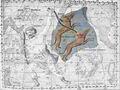 Canes Venatici in Bode (1782, 1805): The constellation has boundary line and the southern one of the dogs has the "Heart of Charles II" on the leash (sic! must be Charles I).

Transfer and Transformation of the Constellation
-
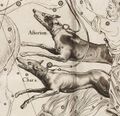 CVn in Hevelius (1687)
 -
 Canes Venatici in Flamsteed (1729)
 -
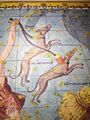 CVn in Bode (1782,1805) with the "Heart of Charles II"
 -
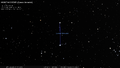 (1952) H.A. Rey's stick figure of Canes Venatici
 -
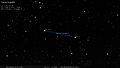 (1988) O. Hlad's stick figure of Canes Venatici


Mythology
In this case, there is no myth surrounding the constellation of the hunting dogs, as it was neither ancient nor based on a story, but merely a whim of the artist.
A contemporary legend surrounding the brightest star arose in 1660 from a claim made by Sir Charles Scarborough, personal physician to the new King Charles II. He said that the star beneath the tail of the bear and next to the shepherd Bootes had shone particularly brightly on the night that Crown Prince Charles returned to London after a long exile. This statement probably does not correspond to any astronomical reality, but is a classic narrative of celestial signs indicating the ascension of a soul: the motif already appears in the case of Emperor Augustus of Rome, who saw himself as the legitimate successor to the autocrat Gaius Julius Caesar because the gods sent a comet visible during the day on the occasion of the festival held for his funeral. In Rome, this comet was popularly interpreted as the ascension of the soul of the murdered dictator. Like Gaius Julius, Charles I had also been murdered by political opponents, and as a result, the monarchy was suspended for just under 11.5 years.
Charles I of England, Scotland, and Ireland also interpreted himself (like his fathers and Augustus of Rome before him) as “King by the Grace of God” and repeatedly defied parliamentary decisions. The resulting conflict and his attempt to introduce the Anglican Church in Scotland triggered two civil wars. He was eventually arrested and beheaded on January 30, 1649. It was not until the end of May 1660 that the monarchy was restored and his son Charles II was crowned. Supporters of the monarchy therefore sought a “divine sign” to legitimize the new king, and a shining star was particularly suitable for this purpose.
Weblinks
Ian Ridpath's Star Tales – Canes Venatici
References
- ↑ Hoffmann, Susanne M. Wie der Löwe an den Himmel kam. Franckh Kosmos Verlag, Stuttgart 2021





