Dupa: Difference between revisions
No edit summary |
|||
| (3 intermediate revisions by the same user not shown) | |||
| Line 1: | Line 1: | ||
Authors: {{PAGEAUTHORS}} | Authors: {{PAGEAUTHORS}} | ||
---- | ---- | ||
[[File:LintangDUPA.jpg|thumb|Lintang Kukus in the cloth (CC-BY UPTD Museum Bali Inventary no. 09.752)]] | |||
[[File:Dupa.png|thumb|Lintang Dupa in lontar Prasi Palelintangan (CC-BY Alfred Maaß, (1929), Astrologische Kalender der Balinesen)]] | [[File:Dupa.png|thumb|Lintang Dupa in lontar Prasi Palelintangan (CC-BY Alfred Maaß, (1929), Astrologische Kalender der Balinesen)]] | ||
Dupa is an Oceanic name from Bali (Indonesia). The lintang of dupa is found in intersection of Coma (Monday, in saptawara) and Paing (in pancawara) in a series of palelintangan. Lintang dupa means an incense constellation.<ref>Maass, Alfred, “Astrologische Kalender der Balinesen,” in Koninklijk Bataviaasch Genootschap van Kunsten en Wetenschappen, Feestbundel bij gelegenheid van zijn 150 jarig bestaan 1778-1928, 2 vols. (Weltevreden, 1929), Vol. 2, 126-157.</ref> | Dupa is an Oceanic name from Bali (Indonesia). The lintang of dupa is found in intersection of Coma (Monday, in saptawara) and Paing (in pancawara) in a series of palelintangan. Lintang dupa means an incense constellation.<ref name=":1">Maass, Alfred, “Astrologische Kalender der Balinesen,” in Koninklijk Bataviaasch Genootschap van Kunsten en Wetenschappen, Feestbundel bij gelegenheid van zijn 150 jarig bestaan 1778-1928, 2 vols. (Weltevreden, 1929), Vol. 2, 126-157.</ref> | ||
==Etymology and History== | ==Etymology and History== | ||
| Line 25: | Line 26: | ||
==== Identification ==== | ==== Identification ==== | ||
The identifications, Maaß (1929) gives according to the aforementioned and his own studies during visits of the country and in European and Batavian libraries (p.150).<ref name=":1" /> | The identifications, Maaß (1929) gives according to the aforementioned and his own studies during visits of the country and in European and Batavian libraries (p.150).<ref name=":1" /> | ||
In the information given by the UPTD Museum Bali, lintang Dupa is a comet.<ref name=":0" /> | |||
=== Transfer and Transformation of the Constellation === | === Transfer and Transformation of the Constellation === | ||
| Line 43: | Line 46: | ||
=== Numerology (Neptu/Urip) === | === Numerology (Neptu/Urip) === | ||
Coma (Monday, in saptawara) has a value of 4 and Paing (in pancawara) has a value of 9. Thus, the total urip on this lintang is 13.<ref name=":0">Tim Kajian Palelintangan, “Gabungan Kajian Palelintangan,” Museum Bali (2021), 1-149.</ref> | Coma (Monday, in saptawara) has a value of 4 and Paing (in pancawara) has a value of 9. Thus, the total urip on this lintang is 13.<ref name=":0">Palelintangan Museum Study Team (Tim Kajian Palelintangan Museum), “Gabungan Kajian Palelintangan,” Museum Bali (2021), 1-149.</ref> | ||
=== Astrological Characteristics === | === Astrological Characteristics === | ||
| Line 63: | Line 66: | ||
[[Category:Indonesia]] [[Category: | [[Category:Indonesia]] [[Category:Southeast Asian]] [[Category:Asian]] [[Category:Balinese]] [[Category:Tail Star]] [[Category:Transient]] | ||
[[Category:Balinese]] | |||
Latest revision as of 06:47, 7 June 2026
Authors: Youla Azkarrula, Susanne M Hoffmann


Dupa is an Oceanic name from Bali (Indonesia). The lintang of dupa is found in intersection of Coma (Monday, in saptawara) and Paing (in pancawara) in a series of palelintangan. Lintang dupa means an incense constellation.[1]
Etymology and History
Dupa (IPA: /du·pa/) is derived from the Sanskrit धूप dhūpa, which means aroma, fragrance, incense, vapor that gives off an aroma.
Spelling Variants
- kukus
- kěmukus
Origin of Constellation
Balinese incense comes from the word “dup” which in Balinese means “fragrant aroma”. The use of incense in religious practices in Bali has existed since ancient times. It is believed that incense has magical powers and can connect the human world with the world of the gods. Balinese incense is used in religious ceremonies, to purify sacred places, homes, and people from negative forces. Incense is also used in alternative therapies. The aroma of incense is believed to help relieve stress, improve concentration, and create a calm atmosphere.
Balinese cultural figure, I Made Bandem, said that Chinese culture developed very well and influenced many other countries in Asia. Incense is one proof of this cultural mix. Made Bandem said that incense was originally produced in China. Then it spread to other countries such as Indonesia, especially in Bali.
In the 7th to 8th centuries in China, under the rule of the Tang Dynasty, many Buddhist monks made pilgrimages to India via Indonesia. At that time, Buddhist beliefs were almost the same as those that grew in Bali, namely lighting a fire using pasepan. Pasepan is interpreted as burning incense, sandalwood, and majegau wood for fragrance. The journey of the monks who made incense in a practical forms. Since then, incense has been used, including on the island of Bali until now.[2]
General information

The astronomical identification of the constellation is taken from Maaß (1929)[1] who explains in general that these constellations and the according ritual practice
"sind seit alten Zeiten in einem Werk ,,wariga" niedergelegt, in dem wir zwei Kulturschichten, nämlich indische und malaio-polynesische Bestandteile wiederfinden."
English: "are written down in a work called "wariga" since old times; there we recognise two cultural layers, i.e. the Indian and the Malayo-Polynesian."
He also quotes other scholars[3][4][5][6] and his earlier work[7][8] reporting that this work dates back to the 9th century CE when Bali was part of a Hindu empire on the neighbouring island of Java.[1] Neubronner van der Tuuk even uses the Old Javanese spelling.
Identification
The identifications, Maaß (1929) gives according to the aforementioned and his own studies during visits of the country and in European and Batavian libraries (p.150).[1]
In the information given by the UPTD Museum Bali, lintang Dupa is a comet.[9]
Transfer and Transformation of the Constellation
Mythology / Religion
The philosophy of incense is rooted in the teachings of the Vedas. In the Rig Veda, Fire (Agni) is referred to as the link between humans and Brahman (the creator). So that the burning incense will bring offerings to the divine realm as well as being a protector from dark forces. The Sama Veda also teaches the important role of Agni in sacred rituals as a guide to the implementation of sacred offerings (yadnya).[10]
Image Variants
-
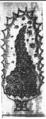 Lintang Dupa (CC-BY Alfred Maaß, (1929), Astrologische Kalender der Balinesen)
 -
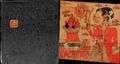 Lintang Dupa in the cloth (CC-BY UPTD Museum Bali Inventary no. 09.746)
 -
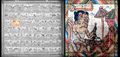 Lintang Kukus in the cloth (CC-BY UPTD Museum Bali Inventary no. 09.752)
 -
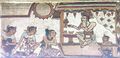 Lintang Kukus (CC-BY Youla Azkarrula taken in the ceiling of Taman Gili Klungkung Palace Bali)


Cultural Beliefs
Numerology (Neptu/Urip)
Coma (Monday, in saptawara) has a value of 4 and Paing (in pancawara) has a value of 9. Thus, the total urip on this lintang is 13.[9]
Astrological Characteristics
If men will look effeminate, if women appear like men. Be careful in maintaining body health, fortune ebbs and flows, If only he could pass the age of 50 to 80 years, he will live long and be happy in his old age. They have good nature, polite to anyone. But unfortunately they are often involved with his hard character, until his conscience is blinded.[9]
Matching Gemstones
Mirah (Ruby), Ijo Rangreng (Peros).[9]
Weblinks
All HIP Stars within this constellation
Dupa is not a star cluster but comets. Balinese will refer any comet by calling it lintang dupa, and they include them as lintang (asterism)
References
- References (general)
- ↑ 1.0 1.1 1.2 1.3 Maass, Alfred, “Astrologische Kalender der Balinesen,” in Koninklijk Bataviaasch Genootschap van Kunsten en Wetenschappen, Feestbundel bij gelegenheid van zijn 150 jarig bestaan 1778-1928, 2 vols. (Weltevreden, 1929), Vol. 2, 126-157.
- ↑ Ermalia, Ayu Afria Ulita, "Sejarah Masuknya Dupa ke Bali, Budayawan: Pengaruh Tiongkok," (2021) https://bali.idntimes.com/life/education/awal-mula-masuknya-dupa-di-bali-00-r544s-m5my1m
- ↑ Friedrich, R. (1849). Voorloopig verslag van het eiland Bali, Batavia, Verb. Bat Gen. Deel 23, Nr. 13
- ↑ HINLOOPEN LABBERT0N, D. VAN (1910). Geillustreerd handboek van Insulinde. Amsterdam: "Vivat"
- ↑ PIGEAUD, TH. (1925). Een stuk over sterrenkunde uit het Anggastyaparwwa ...... Weltevreden: Albrecht. Tijdsch. v. lnd, T.-, L.- en Vk. deel LXV
- ↑ Nieuwenkamp, W. O. J. (1905), Schetsen van Bali en Lombok. (Eigen Haard)
- ↑ MAASS, ALFRED (1920). Sterne und Sternbilder im malaiischen Archipel. Berlin. Zeitschrift für Ethnologie Jg. 1920/21, H. 1
- ↑ MAASS, ALFRED (1924). Sternkunde und Sterndeuterei im malaiischen Archipel. Batavia, den Haag. Tijdsch. v. T.-, L.-en Vk. deel LX IV
- ↑ 9.0 9.1 9.2 9.3 Palelintangan Museum Study Team (Tim Kajian Palelintangan Museum), “Gabungan Kajian Palelintangan,” Museum Bali (2021), 1-149.
- ↑ Telusur Bali, "Kenapa Umat Hindu Menggunakan Dupa Saat Sembahyang? Ini Makna dan Fungsinya," (2025) https://telusur.balitrekker.com/kenapa-umat-hindu-menggunakan-dupa-saat-sembahyang-ini-makna-dan-fungsi/