Lepus: Difference between revisions
| (20 intermediate revisions by 4 users not shown) | |||
| Line 2: | Line 2: | ||
---- | ---- | ||
[[File:Lepus IAU.svg|alt=star chart|thumb|Lep star chart (IAU and Sky & Telescope magazine, Roger Sinnott & Rick Fienberg).]] | [[File:Lepus IAU.svg|alt=star chart|thumb|Lep star chart (IAU and Sky & Telescope magazine, Roger Sinnott & Rick Fienberg).]] | ||
One of the [[:Category:88_IAU-Constellations|88 IAU constellations]]. | {{Infobox constellation | ||
| name = Λαγῶς (Lagos) | |||
| native = Λαγῶς | |||
| translation = Hare | |||
| pronounce = Lagos | |||
| IPA = | |||
| culture = Greek (Almagest) | |||
| RA = 76.36526836 to 91.24637272 | |||
| dec = -22.44838549 to -11.86910091 | |||
| areatotal = 113.78 | |||
| numbermainstars = 33 | |||
| numberbfstars = 17 | |||
| numberstarsplanets = | |||
| numberbrightstars = 2 | |||
| numbernearbystars = | |||
| brighteststarname = [[Arneb]] | |||
| starmagnitude = 2.57 | |||
| neareststarname = | |||
| stardistance = | |||
| numbermessierobjects = | |||
| meteorshowers = | |||
| bordering = Lep | |||
| notes = | |||
| cat = Almagest constellation | |||
}} | |||
One of the [[:Category:88_IAU-Constellations|88 IAU constellations]]. The constellation is likely Greek, as there is no Babylonian or Egyptian equivalent known. | |||
==Etymology and History== | ==Etymology and History== | ||
[[File:Ori-grp Kugel hi smh.gif|thumb|Orion-Group of constellations on the Kugel Globe, drawing and animated GIF by SMH 2025.]]Alongside Andromeda and Perseus, the group around Orion forms the second mythological constellation complex. It is said to depict a hunting scene. The hare is pursued by one or two hounds of Orion. This is how it can be seen in the sky: The hare stands to the west of the constellation of the Great Dog, so it rises before it and runs in front of it the whole time during the night. | [[File:Ori-grp Kugel hi smh.gif|thumb|Orion-Group of constellations on the Kugel Globe, drawing and animated GIF by SMH 2025.]]<ref name=":0">Hoffmann, Susanne M. Wie der Löwe an den Himmel kam. Franckh Kosmos Verlag, Stuttgart 2021</ref>Alongside Andromeda and Perseus, the group around Orion forms the second mythological constellation complex. It is said to depict a hunting scene. The hare is pursued by one or two hounds of Orion. This is how it can be seen in the sky: The hare stands to the west of the constellation of the Great Dog, so it rises before it and runs in front of it the whole time during the night. | ||
===Origin of Constellation=== | ===Origin of Constellation=== | ||
| Line 22: | Line 47: | ||
===== Eratosthenes ===== | ===== Eratosthenes ===== | ||
Pamias and Zucker (2013,<ref>Pamìas, Jordi und Zucker, Arnaud (2013). Ératosthènes de Cyrène: Catastérrismes, Belles Lettres, Paris</ref> 104-105).<blockquote>'''Var. 1 (Περὶ τοῦ Λαγωοῦ)''': This is the hare that was flushed out during the famous hunt. It seems that Hermes placed this animal amongst the constellations because of its speed. It is apparently the only four-legged animal to carry out multiple pregnancies at once, giving birth to some young whilst still carrying others in its womb, according to the philosopher Aristotle in his *Treatise on Animals*. Archelaus, in his *On the Particular Natures*, speaks on this subject in similar terms. </blockquote><blockquote>The Hare has one star on each ear, two on its body, one on its back, and one on each paw. Seven in all.</blockquote><blockquote>'''Var. 2 (Λαγωοῦ)''': This is the hare that was flushed out during the famous hunt. Hermes is said to have placed this animal amongst the constellations because of its speed. It is said to be the only four-legged animal capable of carrying out several pregnancies at once, giving birth to some young whilst carrying others in its womb, according to the philosopher Aristotle in his *Treatise on Animals*.</blockquote><blockquote>The Hare has one star on each ear, two on its body—including a bright one on its back—and one on each hind leg. Six in total.</blockquote>'''Eratosthenes's star catalogue''' can be reconstructed from the list of stars he mentions in the last section of each of the constelllation descriptions. Hoffmann (2017)<ref name=":02">Hoffmann, S. M., <nowiki><i>Hipparchs Himmelsglobus</i></nowiki>. Springer Wiesbaden/ New York, 2017. doi:10.1007/978-3-658-18683-8.</ref> made such a catalogue and used it for computational comparison with Hipparchus's, Ptolemy's and Babylonian data; it is based on the edition and translation by Pamias and Geus (2007)<ref>Eratosthenes: Sternsagen, übersetzt von Pamìas, Jordi und Geus, Klaus, Verlag Utopica, Oberhaid 2007</ref> and presented here in English translation. | |||
{|class="wikitable" | |||
|+ | |||
!erat.Cat.ID | |||
!constStarID | |||
!starName | |||
!ident.Bayer | |||
!ident.HIP | |||
!certainty | |||
|- | |||
|552 | |||
|1 | |||
|one star on each ear | |||
|zeta Lep | |||
|27288 | |||
|1 | |||
|- | |||
|553 | |||
|2 | |||
|one star on each ear | |||
|eta Lep | |||
|28103 | |||
|1 | |||
|- | |||
|554 | |||
|3 | |||
|two on the body [the one on the belly] | |||
|beta Lep | |||
|25606 | |||
|1 | |||
|- | |||
|555 | |||
|4 | |||
|two on the body, of which the one on the back is bright | |||
|alpha Lep | |||
|25985 | |||
|1 | |||
|- | |||
|556 | |||
|5 | |||
|one on each of the hind legs | |||
|delta Lep | |||
|27654 | |||
|1 | |||
|- | |||
|557 | |||
|6 | |||
|one on each of the hind legs | |||
|gam Lep | |||
|27072 | |||
|1 | |||
|} | |||
===== Hipparchus ===== | ===== Hipparchus ===== | ||
| Line 40: | Line 117: | ||
|- | |- | ||
| | | | ||
| | |Gem 27 | ||
| | |Cnc 11 1/2 | ||
| | |Psc 4 | ||
| | |Psc 25 | ||
|- | |- | ||
| | | | ||
| Line 52: | Line 129: | ||
|- | |- | ||
|star | |star | ||
| | |of the four in the ears, the front one of the northern (iot.) | ||
| | |the southern one of those in the rear feet | ||
| | | | ||
| | | | ||
|- | |- | ||
|duration | |duration | ||
| colspan="4" | | | colspan="4" |1 1/5 hours = 72 min = 18 degree | ||
|} | |} | ||
| Line 74: | Line 151: | ||
|- | |- | ||
| | | | ||
| | |Ari 26 1/2 | ||
| | |Tau 14 | ||
| | |Cnc 30 | ||
| | |Leo 21 | ||
|- | |- | ||
| | | | ||
| Line 86: | Line 163: | ||
|- | |- | ||
|star | |star | ||
| | |the one in the front feet | ||
| | |the one at the tip of the tail | ||
| | | | ||
| | | | ||
|- | |- | ||
|duration | |duration | ||
| colspan="4" | | | colspan="4" |1 1/3 hours = 80 min = 20° | ||
|} | |} | ||
====== | ====== Hipparchus's "lost" star Catalogue ====== | ||
{| class="wikitable" | |||
|+ | The star catalogue of Hipparchus is not preserved. Yet, several scholars have reconstructed it in the past century: Vogt (1925)<ref>Vogt, H., “Versuch einer Wiederherstellung von Hipparchs Fixsternver zeichnis”, <nowiki><i>Astronomische Nachrichten</i></nowiki>, vol. 224, no. 2, Wiley, p. 17, 1925. doi:10.1002/asna.19252240202.</ref>, Grasshoff (1990)<ref>Graßhoff, G., <nowiki><i>The History of Ptolemy's Star Catalogue</i></nowiki>, Springer, New York, 1990 </ref>, Hoffmann (2017)<ref>Hoffmann, S. M., <nowiki><i>Hipparchs Himmelsglobus</i></nowiki>. Springer Wiesbaden/ New York, 2017. doi:10.1007/978-3-658-18683-8.</ref> and Glover (2026)<ref>Glover, E. (2026). ''The Astronomy of Hipparchus'', Cambridge University Press</ref>. Grasshoff's catalogue and computations are not published digitally, Hoffmann published three versions of the Manitius+Hoffmann<ref>Hipparchus's Lost Star Catalogue (1/2 reconstructed) (Hoffmann, 2017) in VizieR</ref> star lists in the CDS [https://vizier.unistra.fr/ VizieR] "catalog of catalogs", and Glover printed the star lists constellationwise in his book. | ||
! | {|class="wikitable" | ||
! | |+ Hipparchus's star in Aquarius (Glover 2026) | ||
! | |||
! | !hipp.Cat.ID | ||
!ident. | !constStarID | ||
! | !starName | ||
!ident.Bayer | |||
!ident.HIP | |||
!concordance | |||
|- | |||
|367 | |||
|1 | |||
| | |||
|α Lep | |||
|25985 | |||
|CPAE | |||
|- | |||
|368 | |||
|2 | |||
| | |||
|β Lep | |||
|25606 | |||
|CPAE | |||
|- | |||
|369 | |||
|3 | |||
| | |||
|γ Lep | |||
|27072 | |||
|CPAE | |||
|- | |||
|370 | |||
|4 | |||
| | |||
|δ Lep | |||
|27654 | |||
|CPAE | |||
|- | |||
|371 | |||
|5 | |||
| | |||
|ε Lep | |||
|23685 | |||
|CPAE | |||
|- | |||
|372 | |||
|6 | |||
| | |||
|θ Lep | |||
|28910 | |||
|CPAE | |||
|- | |- | ||
| | |373 | ||
| | |7 | ||
| | | | ||
| | |ι Lep | ||
| | |24244 | ||
| | |CPAE | ||
|- | |- | ||
| | |374 | ||
| | |8 | ||
| | | | ||
| | |κ Lep | ||
| | |24327 | ||
| | |CPAE | ||
|- | |- | ||
| | |375 | ||
| | |9 | ||
| | | | ||
| | |λ Lep | ||
| | |24845 | ||
| | |CPAE | ||
|- | |- | ||
| | |376 | ||
| | |10 | ||
| | | | ||
| | |ν Lep | ||
| | |24873 | ||
| | |CPAE | ||
|- | |- | ||
| | |377 | ||
| | |11 | ||
| | | | ||
| | |α Col (Lep) | ||
| | |26634 | ||
| | |CPAE | ||
|} | |} | ||
| Line 171: | Line 281: | ||
! | ! | ||
!Λαγωοῦ ἀστερισμός | !Λαγωοῦ ἀστερισμός | ||
! | !Constellation of the Hare | ||
! | ! | ||
|- | |- | ||
|1 | |1 | ||
|τοῦ κατὰ τῶν ὤτων τετραπλεύρου τῆς ἠγουμένης πλευρᾶς ὁ βόρειος. | |τοῦ κατὰ τῶν ὤτων τετραπλεύρου τῆς ἠγουμένης πλευρᾶς ὁ βόρειος. | ||
|The quadrilateral just over the ears: the | |The quadrilateral just over the ears: the northern star on the advance side | ||
|iot Lep | |iot Lep | ||
|- | |- | ||
| Line 211: | Line 321: | ||
|8 | |8 | ||
|ὁ ὑπὸ τὴν κοιλίαυ | |ὁ ὑπὸ τὴν κοιλίαυ | ||
|The star under | |The star under the belly | ||
|bet Lep | |bet Lep | ||
|- | |- | ||
|9 | |9 | ||
|τῶν ἐν τοῦς ὀπισθίοις ποσὶο β ὁ βορειότερος | |τῶν ἐν τοῦς ὀπισθίοις ποσὶο β ὁ βορειότερος | ||
|The northernmost of | |The northernmost of the 2 stars in the hind legs | ||
|del Lep | |del Lep | ||
|- | |- | ||
|10 | |10 | ||
|ὁ νοτιώτερος αὐτῶν | |ὁ νοτιώτερος αὐτῶν | ||
| | |The southernmost of them | ||
|gam Lep | |gam Lep | ||
|- | |- | ||
| Line 452: | Line 562: | ||
|Inside the hull | |Inside the hull | ||
|6.47 | |6.47 | ||
|} | |||
=== Arabic Tradition === | |||
[[File:Arneb Lepus+ThroneETCofJawza RL.png|thumb|The Arabic constellations of the (classical) Hare next to some autriches and the throne and footprint of al-Jawza (CC BY Roland Laffitte 2025).]] | |||
When Arabic scholars adopted the constellations from the Almagest (written in Greek), they mixed those with indigenous Arabian constellations. | |||
Roland Laffitte (2025) elaborates: <blockquote>This constellation, known as ''Λαγωός / Lagōos'', the ‘Hare’, to the Greeks since Eudoxus, was adopted by the Arabs through the astronomers of the classical period, who named it al-Arnab, meaning the same thing. Arabic ''al-Arnab'', al-Ḥağğāğ > the ancient Latin name ''Lepus'', Gerard of Cremona.</blockquote>Next to the (classical) Hare, they placed the indigenous ostriches and the throne ([[Arshaljawza]]) and foot ([[Kursialjawza]]) of the female giant, [[Jawza|al-Jawza]]. Hence in the imagination of the ancient Arabs, we find several representations in this celestial realm: | |||
* ''al-Arnab,'' the Hare (see α Lep, [[Arneb]]) | |||
* ''al-Nihāl'', ‘the [Ostriches] that have quenched their thirst ” (see ''β Lep'', [[Nihal]]), a group belonging to the great animal scene of the Ostriches extending eastwards to ''al-Ẓalīm'', “the male Ostrich”, | |||
* the Throne of al-Jawza ([[Arshaljawza]]) | |||
* and her footrest ([[Kursialjawza]]) | |||
'''''Λαγωός / al-Arnab,'' ‘the Hare’ (Ḥağğāğ, Isḥāq)''' | |||
{| class="wikitable" | |||
!Arabic | |||
(orig.) | |||
! valign="top" |Transliteration | |||
! valign="top" |Translation | |||
!Identification | |||
(RL) | |||
! valign="top" |author | |||
|- | |||
| | |||
| valign="top" |''Wasaṭ al-Badan'' | |||
| valign="top" |the middle of the body | |||
| valign="top" |''α Lep'' | |||
| valign="top" |Battānī | |||
|- | |||
| | |||
| valign="top" |''Badan al-Arnab'' | |||
| valign="top" |the body of the Hare | |||
| | |||
| valign="top" |Marrākušī | |||
|- | |||
| | |||
| valign="top" |''Ẓhar al-Arnab'' | |||
| valign="top" |the back of the Hare | |||
| | |||
| valign="top" |Tīzīnī | |||
|- | |||
| | |||
| valign="top" |''Baṭn al-Arnab'' | |||
| valign="top" |the belly of the Hare | |||
| valign="top" |''β Lep'' | |||
| valign="top" |Marrākušī | |||
|- | |||
| valign="top" | | |||
| valign="top" |''Yad al-Arnab'' | |||
| valign="top" |the hare's paw | |||
| valign="top" |''ε Lep'' | |||
| valign="top" |Battānī | |||
|- | |||
| valign="top" | | |||
| valign="top" |''Kaff al-Arnab'' | |||
| valign="top" |the hare's paw | |||
| valign="top" | | |||
| valign="top" |Tīzīnī | |||
|- | |||
| valign="top" | | |||
| valign="top" |''al-Qaṭan'' | |||
| valign="top" |the kidney | |||
| valign="top" |''ζ Lep'' | |||
| valign="top" |Battānī | |||
|- | |||
| valign="top" | | |||
| valign="top" |''Ṭaraf al-Ḏanab'' | |||
| valign="top" |the tip of the tail | |||
| valign="top" |''η Lep'' | |||
| valign="top" |Battānī | |||
|- | |||
| valign="top" | | |||
| valign="top" |''Ḏanab al-Arnab'' | |||
| valign="top" |the tail of the hare | |||
| valign="top" | | |||
| valign="top" |Miṣrī | |||
|- | |||
| valign="top" | | |||
| valign="top" |''al-Ḏaqan'' | |||
| valign="top" |the chin | |||
| valign="top" |''μ Lep'' | |||
| valign="top" |Battānī | |||
|- | |||
| valign="top" | | |||
| valign="top" |''Ḏaqan al-Arnab'' | |||
| valign="top" |the hare's chin | |||
| | |||
| valign="top" |Tīzīnī | |||
|} | |} | ||
===Transfer and Transformation of the Constellation=== | ===Transfer and Transformation of the Constellation=== | ||
<gallery> | |||
File:Rooster stellarium.jpg|Babylonian Rooster (Jessica Gullberg for Stellarium 2022). | |||
File:Ori-grp Kugel hi smh.gif|Orion-Group with Hare on the Kugel Globe; SMH 2025. | |||
File:Arneb Lepus+ThroneETCofJawza RL.png|Arabic Hare with autriches and Jawza (Roland Laffitte 2025) | |||
File:H.A. Rey's stick figure stellarium-045.png|(1952) H.A. Rey's stick figure of Lepus | |||
File:O. Hlad's stick figure stellarium-046.png|(1988) O. Hlad's stick figure of Lepus | |||
</gallery> | |||
==Mythology== | ==Mythology== | ||
'''Greek'''<ref name=":0" /> | |||
Eratosthenes explains the hare in relation to the hunting scene mentioned above. Hares were popular prey, and according to Pliny, popular belief held that hare meat made the body more beautiful for nine days. | |||
Hermes, the messenger of the gods, is said to have placed the hare among the stars: both hares and the messenger of the gods are popularly regarded as particularly fast and skilled travellers, even beyond roads and well-trodden paths. They are therefore also considered particularly clever: Mercury/Hermes is also the god responsible for quick thinking. | |||
Eratosthenes, however, limits himself to stating the biological characteristics of the hare, so that there was probably no real myth here, but rather the constellation was simply given a meaning for didactic purposes. | |||
In particular, he reports that the hare is the only quadruped that can be pregnant with several young at the same time, some of which it keeps in its belly while others are born. Here he alludes to the fact that female hares can be pregnant by different hares at the same time. This so-called superfecundation can lead to a time lag between births, meaning that even foetuses from the same cycle are not born at the same time. What Eratosthenes and his source Aristotle did not know is that this is also possible in other animals – even in humans, which is reported in the tabloid media due to its rarity. | |||
==Weblinks== | ==Weblinks== | ||
* [https://iconographic.warburg.sas.ac.uk/category/vpc-taxonomy-017074 Warburg Institute Iconographic Database – Lepus] | |||
* | * Ian Ridpath ''Star Tales'' [http://www.ianridpath.com/startales/lepus.html – Lepus] | ||
==References== | ==References== | ||
| Line 473: | Line 687: | ||
[[Category:Almagest]] | [[Category:Almagest]] | ||
[[Category:Mesopotamian]] | [[Category:Mesopotamian]] | ||
[[Category:West Asian]] | [[Category:West Asian]] [[Category:Asian]] | ||
[[Category:Modern]] | [[Category:Modern]] [[Category:Asterism]] | ||
[[Category:88 IAU-Constellations]] | [[Category:88 IAU-Constellations]] [[Category:Lep]] | ||
[[Category:European]] | [[Category:European]] | ||
Latest revision as of 15:07, 26 August 2026
Authors: Susanne M Hoffmann, Roland Laffitte, Youla Azkarrula, Doris Vickers, IanRidpath

| Asterism Info | |
| Native | Λαγῶς |
|---|---|
| Romanisation | Lagos |
| Translation | Hare |
| Position (2000) | |
| Right ascension | 76.36526836 to 91.24637272 |
| Declination | -22.44838549 to -11.86910091 |
| Area | 113.78 sq. deg. |
| Stars | |
| Bright stars | 33 |
| Bayer/Flamsteed stars | 17 |
| Stars brighter than 3.00m | 2 |
| Brightest star | Arneb (الأرنب) (2.57m) |
| Taxonomy | |
| category of asterism | Almagest constellation |
| IAU- constellations | Lep |
One of the 88 IAU constellations. The constellation is likely Greek, as there is no Babylonian or Egyptian equivalent known.
Etymology and History

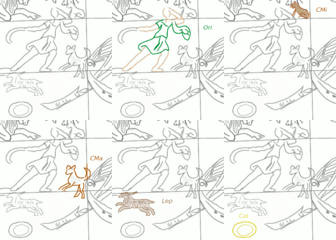
[1]Alongside Andromeda and Perseus, the group around Orion forms the second mythological constellation complex. It is said to depict a hunting scene. The hare is pursued by one or two hounds of Orion. This is how it can be seen in the sky: The hare stands to the west of the constellation of the Great Dog, so it rises before it and runs in front of it the whole time during the night.
Origin of Constellation

Babylonian
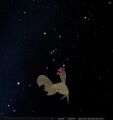
The constellation has no Babylonian origin, because in Mesopotamia there was the constellation of the Rooster (DAR.LUGAL) in this position.
MUL.APIN was copied throughout the -1st millennium, so presumably continued to be used in Babylonian astronomy. It is therefore unclear when and where the transformation from the rooster to the hare took place. It is quite possible that the hare was a separate Greek constellation or originated from another conquered civilisation.
Greco-Roman
Aratus
Under the two feet of Orion the Hare is hunted constantly all the time: Sirius moves for ever behind it as if in pursuit, [341] rises after it and watches it as it sets. (Kidd 1997)
Eratosthenes
Pamias and Zucker (2013,[2] 104-105).
Var. 1 (Περὶ τοῦ Λαγωοῦ): This is the hare that was flushed out during the famous hunt. It seems that Hermes placed this animal amongst the constellations because of its speed. It is apparently the only four-legged animal to carry out multiple pregnancies at once, giving birth to some young whilst still carrying others in its womb, according to the philosopher Aristotle in his *Treatise on Animals*. Archelaus, in his *On the Particular Natures*, speaks on this subject in similar terms.
The Hare has one star on each ear, two on its body, one on its back, and one on each paw. Seven in all.
Var. 2 (Λαγωοῦ): This is the hare that was flushed out during the famous hunt. Hermes is said to have placed this animal amongst the constellations because of its speed. It is said to be the only four-legged animal capable of carrying out several pregnancies at once, giving birth to some young whilst carrying others in its womb, according to the philosopher Aristotle in his *Treatise on Animals*.
The Hare has one star on each ear, two on its body—including a bright one on its back—and one on each hind leg. Six in total.
Eratosthenes's star catalogue can be reconstructed from the list of stars he mentions in the last section of each of the constelllation descriptions. Hoffmann (2017)[3] made such a catalogue and used it for computational comparison with Hipparchus's, Ptolemy's and Babylonian data; it is based on the edition and translation by Pamias and Geus (2007)[4] and presented here in English translation.
| erat.Cat.ID | constStarID | starName | ident.Bayer | ident.HIP | certainty |
|---|---|---|---|---|---|
| 552 | 1 | one star on each ear | zeta Lep | 27288 | 1 |
| 553 | 2 | one star on each ear | eta Lep | 28103 | 1 |
| 554 | 3 | two on the body [the one on the belly] | beta Lep | 25606 | 1 |
| 555 | 4 | two on the body, of which the one on the back is bright | alpha Lep | 25985 | 1 |
| 556 | 5 | one on each of the hind legs | delta Lep | 27654 | 1 |
| 557 | 6 | one on each of the hind legs | gam Lep | 27072 | 1 |
Hipparchus
Rising (Lib II Cap V §10)
The Rising of ...
| east | south | |||
|---|---|---|---|---|
| lam1 | lam2 | lam1 | lam2 | |
| Gem 27 | Cnc 11 1/2 | Psc 4 | Psc 25 | |
| star | of the four in the ears, the front one of the northern (iot.) | the southern one of those in the rear feet | ||
| duration | 1 1/5 hours = 72 min = 18 degree | |||
Setting (Lib II Cap VI §10)
| west | south | |||
|---|---|---|---|---|
| lam1 | lam2 | lam1 | lam2 | |
| Ari 26 1/2 | Tau 14 | Cnc 30 | Leo 21 | |
| star | the one in the front feet | the one at the tip of the tail | ||
| duration | 1 1/3 hours = 80 min = 20° | |||
Hipparchus's "lost" star Catalogue
The star catalogue of Hipparchus is not preserved. Yet, several scholars have reconstructed it in the past century: Vogt (1925)[5], Grasshoff (1990)[6], Hoffmann (2017)[7] and Glover (2026)[8]. Grasshoff's catalogue and computations are not published digitally, Hoffmann published three versions of the Manitius+Hoffmann[9] star lists in the CDS VizieR "catalog of catalogs", and Glover printed the star lists constellationwise in his book.
| hipp.Cat.ID | constStarID | starName | ident.Bayer | ident.HIP | concordance |
|---|---|---|---|---|---|
| 367 | 1 | α Lep | 25985 | CPAE | |
| 368 | 2 | β Lep | 25606 | CPAE | |
| 369 | 3 | γ Lep | 27072 | CPAE | |
| 370 | 4 | δ Lep | 27654 | CPAE | |
| 371 | 5 | ε Lep | 23685 | CPAE | |
| 372 | 6 | θ Lep | 28910 | CPAE | |
| 373 | 7 | ι Lep | 24244 | CPAE | |
| 374 | 8 | κ Lep | 24327 | CPAE | |
| 375 | 9 | λ Lep | 24845 | CPAE | |
| 376 | 10 | ν Lep | 24873 | CPAE | |
| 377 | 11 | α Col (Lep) | 26634 | CPAE |
Hyginus, Astronomica
The hare is said to be fleeing the dog of the hunter Orion, for when, as was proper, they represented Orion as a hunter, they wanted to indicate what he was hunting, and so they put the fleeing hare at his feet. Some say that it was put there by Mercury, and that it had been given the faculty, beyond other kinds of quadrapeds, of being pregnant with new offspring when giving birth to others. Those who disagree with this reason say that so noble and great a hunter as Orion (we spoke about him in the discussion of Scorpio) shouldn't be represented hunting hares. Callimachus, too, is blamed, because, when he was singing the praises of Diana, he said she delighted in the flesh of hares and hunted them. So they have represented Orion fighting the Bull. The following story of the hare has been recorded. There were no hares on the island of Leros, and a certain young man of the state, led by a liking for the breed, brought in from another country a pregnant female, and watched over her very carefully as she bore her young. When she had borne them, many of the citizens developed an interest, and by acquiring some for money, some as gifts, they all began to raise hares. In no long time such a multitude of hares was produced that the whole island was swarming with them. When men gave them nothing to eat, they made inroads on the grain fields and devoured everything. The inhabitants, faced with disaster because of this, since they were reduced to hunger, by co-operation of the whole state were said at length to have driven them from the island, through with difficulty. So afterwards they put the image of a hare in the stars, that men should remember that there was nothing so desirable in life but that later they might experience more grief than pleasure from it. (Mary Ward 1960)
Geminos
Almagest Λαγωός
| id | Greek
(Heiberg 1898) |
English
(Toomer 1984) |
ident. |
|---|---|---|---|
| Λαγωοῦ ἀστερισμός | Constellation of the Hare | ||
| 1 | τοῦ κατὰ τῶν ὤτων τετραπλεύρου τῆς ἠγουμένης πλευρᾶς ὁ βόρειος. | The quadrilateral just over the ears: the northern star on the advance side | iot Lep |
| 2 | ὁ νότιος τῆς ἠγουμένης πλευρᾶς | The quadrilateral just over the ears: the southern star on the advance side | kap Lep |
| 3 | τῆς ἐπομένης πλευρᾶς ὁ βόρειος | The quadrilateral just over the ears: the northern star on the rear side | nu Lep |
| 4 | ὁ φότιος τῆς ἐπομένης πλευρᾶς | The quadrilateral just over the ears: the southern star on the rear side | lam Lep |
| 5 | ὁ ἐῃ τῷ γερείῳ. | The star in the cheek | mu Lep |
| 6 | ὁ ἐπὶ τοῦ ἐμπροσθίου ἀριστεροῦ ἀκρόποδος | The star on the left front foot | eps Lep |
| 7 | ὁ ἐν μέσῳ τῷ σώματι | The star in the middle of the body | alf Lep |
| 8 | ὁ ὑπὸ τὴν κοιλίαυ | The star under the belly | bet Lep |
| 9 | τῶν ἐν τοῦς ὀπισθίοις ποσὶο β ὁ βορειότερος | The northernmost of the 2 stars in the hind legs | del Lep |
| 10 | ὁ νοτιώτερος αὐτῶν | The southernmost of them | gam Lep |
| 11 | ὁ ἐπὶ τῆς ὀσφύος. | The star on the rump | zet Lep |
| 12 | ὁ ἐπ’ ἄκρας τῆς οὐρᾶς | The star on the tip of the tail | eta Lep |
| all | ἀστέρες ἰβ, ὧν γ μεγέθους β, δ’s, ε' δ | {12 stars, 2 of the third magnitude, 6 of the fourth, 4 of the fifth} |

Stars within the Constellation Area
| id | Label | IAU design. | description | Vmag |
|---|---|---|---|---|
| 1 | Arneb | HIP 25985 | Inside the hull | 2.57 |
| 2 | Nihal | HIP 25606 | Constellation lines | 2.84 |
| 3 | ϵ Leporis | HIP 23685 | Constellation lines (Vertex) | 3.18 |
| 4 | μ Leporis | HIP 24305 | Constellation lines | 3.29 |
| 5 | ζ Leporis | HIP 27288 | Constellation lines | 3.525 |
| 6 | γ Leporis | HIP 27072 | Constellation lines (Vertex) | 3.6 |
| 7 | η Leporis | HIP 28103 | Constellation lines (Vertex) | 3.72 |
| 8 | δ Leporis | HIP 27654 | Constellation lines (Vertex) | 3.85 |
| 9 | λ Leporis | HIP 24845 | Constellation lines | 4.29 |
| 10 | κ Leporis | HIP 24327 | Constellation lines | 4.44 |
| 11 | ι Leporis | HIP 24244 | Constellation lines (Vertex) | 4.45 |
| 12 | - | HIP 24927 | Constellation lines | 4.729 |
| 13 | 17 Lep | HIP 28816 | Constellation lines (Vertex) | 4.93 |
| 14 | 8 Lep | HIP 25202 | Inside the hull | 5.229 |
| 15 | ν Leporis | HIP 24873 | Constellation lines | 5.284 |
| 16 | - | HIP 24679 | Inside the hull | 5.488 |
| 17 | - | HIP 27517 | Constellation lines | 5.49 |
| 18 | 10 Lep | HIP 25853 | Inside the hull | 5.525 |
| 19 | - | HR 2021 | Inside the hull | 5.58 |
| 20 | - | HIP 25280 | Inside the hull | 5.636 |
| 21 | - | HIP 26966 | Inside the hull | 5.727 |
| 22 | - | HIP 25397 | Inside the hull | 5.817 |
| 23 | 12 Lep | HIP 26865 | Inside the hull | 5.89 |
| 24 | - | HIP 24786 | Constellation lines | 5.96 |
| 25 | - | HIP 25532 | Inside the hull | 6.065 |
| 26 | - | HIP 26866 | Inside the hull | 6.144 |
| 27 | V* AK Lep | HR 1982 | Inside the hull | 6.15 |
| 28 | - | HIP 27308 | Inside the hull | 6.157 |
| 29 | - | HIP 26821 | Inside the hull | 6.2 |
| 30 | - | HIP 24394 | Inside the hull | 6.21 |
| 31 | - | HIP 27075 | Inside the hull | 6.341 |
| 32 | - | HIP 24825 | Inside the hull | 6.39 |
| 33 | - | HIP 25059 | Inside the hull | 6.47 |
Arabic Tradition

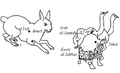
When Arabic scholars adopted the constellations from the Almagest (written in Greek), they mixed those with indigenous Arabian constellations.
Roland Laffitte (2025) elaborates:
This constellation, known as Λαγωός / Lagōos, the ‘Hare’, to the Greeks since Eudoxus, was adopted by the Arabs through the astronomers of the classical period, who named it al-Arnab, meaning the same thing. Arabic al-Arnab, al-Ḥağğāğ > the ancient Latin name Lepus, Gerard of Cremona.
Next to the (classical) Hare, they placed the indigenous ostriches and the throne (Arshaljawza (عرش الجوزاء)) and foot (Kursialjawza (كرسي الجوزاء)) of the female giant, al-Jawza. Hence in the imagination of the ancient Arabs, we find several representations in this celestial realm:
- al-Arnab, the Hare (see α Lep, Arneb (الأرنب))
- al-Nihāl, ‘the [Ostriches] that have quenched their thirst ” (see β Lep, Nihal (النِّهال)), a group belonging to the great animal scene of the Ostriches extending eastwards to al-Ẓalīm, “the male Ostrich”,
- the Throne of al-Jawza (Arshaljawza (عرش الجوزاء))
- and her footrest (Kursialjawza (كرسي الجوزاء))
Λαγωός / al-Arnab, ‘the Hare’ (Ḥağğāğ, Isḥāq)
| Arabic
(orig.) |
Transliteration | Translation | Identification
(RL) |
author |
|---|---|---|---|---|
| Wasaṭ al-Badan | the middle of the body | α Lep | Battānī | |
| Badan al-Arnab | the body of the Hare | Marrākušī | ||
| Ẓhar al-Arnab | the back of the Hare | Tīzīnī | ||
| Baṭn al-Arnab | the belly of the Hare | β Lep | Marrākušī | |
| Yad al-Arnab | the hare's paw | ε Lep | Battānī | |
| Kaff al-Arnab | the hare's paw | Tīzīnī | ||
| al-Qaṭan | the kidney | ζ Lep | Battānī | |
| Ṭaraf al-Ḏanab | the tip of the tail | η Lep | Battānī | |
| Ḏanab al-Arnab | the tail of the hare | Miṣrī | ||
| al-Ḏaqan | the chin | μ Lep | Battānī | |
| Ḏaqan al-Arnab | the hare's chin | Tīzīnī |
Transfer and Transformation of the Constellation
-
 Babylonian Rooster (Jessica Gullberg for Stellarium 2022).
 -
 Orion-Group with Hare on the Kugel Globe; SMH 2025.
 -
 Arabic Hare with autriches and Jawza (Roland Laffitte 2025)
 -
 (1952) H.A. Rey's stick figure of Lepus
 -
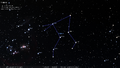 (1988) O. Hlad's stick figure of Lepus


Mythology
Greek[1]
Eratosthenes explains the hare in relation to the hunting scene mentioned above. Hares were popular prey, and according to Pliny, popular belief held that hare meat made the body more beautiful for nine days.
Hermes, the messenger of the gods, is said to have placed the hare among the stars: both hares and the messenger of the gods are popularly regarded as particularly fast and skilled travellers, even beyond roads and well-trodden paths. They are therefore also considered particularly clever: Mercury/Hermes is also the god responsible for quick thinking.
Eratosthenes, however, limits himself to stating the biological characteristics of the hare, so that there was probably no real myth here, but rather the constellation was simply given a meaning for didactic purposes.
In particular, he reports that the hare is the only quadruped that can be pregnant with several young at the same time, some of which it keeps in its belly while others are born. Here he alludes to the fact that female hares can be pregnant by different hares at the same time. This so-called superfecundation can lead to a time lag between births, meaning that even foetuses from the same cycle are not born at the same time. What Eratosthenes and his source Aristotle did not know is that this is also possible in other animals – even in humans, which is reported in the tabloid media due to its rarity.
Weblinks
- Warburg Institute Iconographic Database – Lepus
- Ian Ridpath Star Tales – Lepus
References
- ↑ 1.0 1.1 Hoffmann, Susanne M. Wie der Löwe an den Himmel kam. Franckh Kosmos Verlag, Stuttgart 2021
- ↑ Pamìas, Jordi und Zucker, Arnaud (2013). Ératosthènes de Cyrène: Catastérrismes, Belles Lettres, Paris
- ↑ Hoffmann, S. M., <i>Hipparchs Himmelsglobus</i>. Springer Wiesbaden/ New York, 2017. doi:10.1007/978-3-658-18683-8.
- ↑ Eratosthenes: Sternsagen, übersetzt von Pamìas, Jordi und Geus, Klaus, Verlag Utopica, Oberhaid 2007
- ↑ Vogt, H., “Versuch einer Wiederherstellung von Hipparchs Fixsternver zeichnis”, <i>Astronomische Nachrichten</i>, vol. 224, no. 2, Wiley, p. 17, 1925. doi:10.1002/asna.19252240202.
- ↑ Graßhoff, G., <i>The History of Ptolemy's Star Catalogue</i>, Springer, New York, 1990
- ↑ Hoffmann, S. M., <i>Hipparchs Himmelsglobus</i>. Springer Wiesbaden/ New York, 2017. doi:10.1007/978-3-658-18683-8.
- ↑ Glover, E. (2026). The Astronomy of Hipparchus, Cambridge University Press
- ↑ Hipparchus's Lost Star Catalogue (1/2 reconstructed) (Hoffmann, 2017) in VizieR