Pherkad Minor: Difference between revisions
No edit summary |
infobox |
||
| (10 intermediate revisions by 4 users not shown) | |||
| Line 2: | Line 2: | ||
Authors: {{PAGEAUTHORS}} | Authors: {{PAGEAUTHORS}} | ||
---- | ---- | ||
"Pherkad Minor" is the | [[File:PherkedMinor profileCard SadeghFaghanpour-IAU-WGSN.jpg|thumb|Pherkad Minor profile card (CC BY Sadegh Faghanpour for IAU WGSN).]] | ||
{{Infobox constellation | |||
| name = Pherkad Minor | |||
| native = فرقد and minor | |||
| translation = small calf | |||
| pronounce = | |||
| IPA = | |||
| culture = IAU | |||
| RA = 229.2745394 | |||
| dec = 71.82390204 | |||
| areatotal = 0 | |||
| numbermainstars = 1 | |||
| numberbfstars = 1 | |||
| numberstarsplanets = | |||
| numberbrightstars = 0 | |||
| numbernearbystars = | |||
| brighteststarname = Pherkad Minor | |||
| starmagnitude = 5.01 | |||
| neareststarname = | |||
| stardistance = | |||
| numbermessierobjects = | |||
| meteorshowers = | |||
| bordering = UMi | |||
| notes = | |||
| cat = IAU-Star Name | |||
}} | |||
[[File:PherkedMinor stickfigure SadeghFaghanpour-IAU-WGSN.jpg|thumb|Pherkad Minor stick figure (CC BY Sadegh Faghanpour for IAU WGSN).]] | |||
"Pherkad Minor" is the IAU-adopted name for 11 UMi (5.01 mag) in [[Ursa Minor]]. | |||
==Concordance, Etymology, History== | ==Concordance, Etymology, History== | ||
The name "Pherkad" has been used in recent times. It is derived from the singular form of the ind-A asterism name al-farqadan, "the Two Calves", for β and γ UMi | |||
The name "[[Pherkad]]" has been used in recent times. It is derived from the singular form of the ind-A asterism name al-farqadan, "the Two Calves", for β and γ UMi. The name Pherkad was adopted by WGSN for the 3rd magnitude star γ UMi into the IAU-Catalog of Star Names in 2016. | |||
The star [https://simbad.cds.unistra.fr/simbad/sim-id?Ident=Pherkad+Minor 11 UMi] ((HR 5714, HD 136726, HIP 74793) is a somewhat fainter (Vmag = 5.01) neighbour to γ UMi (Vmag = 3.00 mag), approximately 17 arcminutes away westward. | |||
In the years after his 1801 discovery of the dwarf planet Ceres, Giuseppe Piazzi published the "Palermo Catalogue" containing positions for over 7000 stars, with a first edition in 1802 and a second edition in 1814 ("[https://babel.hathitrust.org/cgi/pt?id=nyp.33433087548214&view=1up&seq=5 Praecipuarum Stellarum Inerrantium Positiones Mediae Ineunte Saeculo XIX. Ex Observationibus Habitis In Specula Panormitana Ab anno 1792 ad annum 1813]") . In compiling this catalog, Piazzi included nearly 200 proper names for stars, some of which were new. Some names were borrowed from names of Arabian asterisms but with transliterated names, sometimes with descriptors, and assigned to individual stars. Piazzi labeled the brighter star γ UMi as "Pherkad ma." [i.e. "major"] and the fainter nearby star 11 UMi was labeled "Pherkad mi." [i.e. "minor"]. Shortly afterwards, Franz Xaver von Zach (1816) reproduced a list of the star names from Piazzi's Palermo Catalog ("[https://books.google.com/books?id=O3lbAAAAQAAJ&q=Pherkad+Minor Verzeichnifs der in Piazzi's neustem Stern-Catalog (Edit. Panormi 1814.) vorkommenden arabischen Stern-Namen]"), writing out "Pherkad minor" for 11 UMi. | |||
Despite their relative proximity, γ UMi and 11 UMi are unrelated. 11 UMi is a red giant star (spectral type K4III) approximately 411 light years away, while the brighter star γ UMi is a white giant (spectral type A2III) star at distance 493 light years. | |||
In 2009, a candidate giant exoplanet was reported by [https://ui.adsabs.harvard.edu/abs/2009A%26A...505.1311D/abstract Dollinger et al.] orbiting 11 UMi with a ~1.4 year period. The minimum mass of the companion has been reported to be between about [https://exoplanetarchive.ipac.caltech.edu/overview/11%20UMi#planet_11-UMi-b_collapsible 10 and 15 Jupiter masses], and with an unknown inclination, the true mass of the companion may correspond to a brown dwarf rather than giant exoplanet. | |||
==Mythology== | ==Mythology== | ||
==IAU Working Group on Star Names== | ==IAU Working Group on Star Names== | ||
The name has been in SIMBAD for | The name Pherkad Minor was in sufficiently common use that it has been in SIMBAD for some time. IAU WGSN adopted the name for the IAU Catalog of Star Names in 2026. | ||
<gallery> | |||
File:PherkadMinor stellarium.jpg|Pherkad Minor in Stellarium (2026). | |||
File:PherkedMinor profileCard SadeghFaghanpour-IAU-WGSN.jpg| (CC BY Sadegh Faghanpour for IAU WGSN). | |||
File:PherkedMinor stickfigure SadeghFaghanpour-IAU-WGSN.jpg| (CC BY Sadegh Faghanpour for IAU WGSN). | |||
</gallery> | |||
== Weblinks == | == Weblinks == | ||
* | * [https://exoplanetarchive.ipac.caltech.edu/overview/11%20UMi NASA Exoplanet Archive link for 11 UMi] | ||
== Reference == | == Reference == | ||
* [[References|References (general)]] | * [[References|References (general)]] | ||
* [[References (Medieval and Early Modern)|References (early modern)]] | * [[References (Medieval and Early Modern)|References (early modern)]] | ||
* Ian Ridpath's | * Ian Ridpath's ''Star Tales'' – [http://ianridpath.com/startales/ursaminor.html Ursa Minor] | ||
[[Category:Single star-asterism]] | [[Category:Single star-asterism]] [[Category:Asterism]] | ||
[[Category:Star Name]] | [[Category:Star Name]] | ||
[[Category:IAU-Star Name]] | [[Category:IAU-Star Name]] | ||
[[Category:Eurasia]] | [[Category:Eurasia]] | ||
[[Category:East Asian]] | [[Category:East Asian]] [[Category:Asian]][[Category:Modern]] | ||
Latest revision as of 01:59, 17 August 2026
Authors: Eric Mamajek, Susanne M Hoffmann, Youla Azkarrula, Ian Ridpath

| Asterism Info | |
| Native | فرقد and minor |
|---|---|
| Translation | small calf |
| Position (2000) | |
| Right ascension | 229.2745394 |
| Declination | 71.82390204 |
| Area | 0 sq. deg. |
| Stars | |
| Bright stars | 1 |
| Bayer/Flamsteed stars | 1 |
| Stars brighter than 3.00m | 0 |
| Brightest star | Pherkad Minor (5.01m) |
| Taxonomy | |
| category of asterism | IAU-Star Name |
| IAU- constellations | UMi |

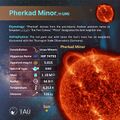
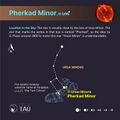
"Pherkad Minor" is the IAU-adopted name for 11 UMi (5.01 mag) in Ursa Minor.
Concordance, Etymology, History
The name "Pherkad" has been used in recent times. It is derived from the singular form of the ind-A asterism name al-farqadan, "the Two Calves", for β and γ UMi. The name Pherkad was adopted by WGSN for the 3rd magnitude star γ UMi into the IAU-Catalog of Star Names in 2016.
The star 11 UMi ((HR 5714, HD 136726, HIP 74793) is a somewhat fainter (Vmag = 5.01) neighbour to γ UMi (Vmag = 3.00 mag), approximately 17 arcminutes away westward.
In the years after his 1801 discovery of the dwarf planet Ceres, Giuseppe Piazzi published the "Palermo Catalogue" containing positions for over 7000 stars, with a first edition in 1802 and a second edition in 1814 ("Praecipuarum Stellarum Inerrantium Positiones Mediae Ineunte Saeculo XIX. Ex Observationibus Habitis In Specula Panormitana Ab anno 1792 ad annum 1813") . In compiling this catalog, Piazzi included nearly 200 proper names for stars, some of which were new. Some names were borrowed from names of Arabian asterisms but with transliterated names, sometimes with descriptors, and assigned to individual stars. Piazzi labeled the brighter star γ UMi as "Pherkad ma." [i.e. "major"] and the fainter nearby star 11 UMi was labeled "Pherkad mi." [i.e. "minor"]. Shortly afterwards, Franz Xaver von Zach (1816) reproduced a list of the star names from Piazzi's Palermo Catalog ("Verzeichnifs der in Piazzi's neustem Stern-Catalog (Edit. Panormi 1814.) vorkommenden arabischen Stern-Namen"), writing out "Pherkad minor" for 11 UMi.
Despite their relative proximity, γ UMi and 11 UMi are unrelated. 11 UMi is a red giant star (spectral type K4III) approximately 411 light years away, while the brighter star γ UMi is a white giant (spectral type A2III) star at distance 493 light years.
In 2009, a candidate giant exoplanet was reported by Dollinger et al. orbiting 11 UMi with a ~1.4 year period. The minimum mass of the companion has been reported to be between about 10 and 15 Jupiter masses, and with an unknown inclination, the true mass of the companion may correspond to a brown dwarf rather than giant exoplanet.
Mythology
IAU Working Group on Star Names
The name Pherkad Minor was in sufficiently common use that it has been in SIMBAD for some time. IAU WGSN adopted the name for the IAU Catalog of Star Names in 2026.
-
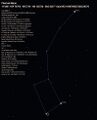 Pherkad Minor in Stellarium (2026).
 -
 (CC BY Sadegh Faghanpour for IAU WGSN).
 -
 (CC BY Sadegh Faghanpour for IAU WGSN).

Weblinks
Reference
- References (general)
- References (early modern)
- Ian Ridpath's Star Tales – Ursa Minor





