Tepiamenit: Difference between revisions
No edit summary |
mNo edit summary |
||
| (20 intermediate revisions by 4 users not shown) | |||
| Line 1: | Line 1: | ||
Authors: {{PAGEAUTHORS}} | Authors: {{PAGEAUTHORS}} | ||
---- | ---- | ||
Tepiamenit, Predecessor of the Pole, is a modern star name adopted by the International Astronomical Union in the IAU-Catalog of Star Names (IAU-CSN). Its origin is ancient Egyptian. It is the name of the star | [[File:Tepiamenit profileCard SadeghFaghanpour-IAU-WGSN.jpg|thumb|Tepiamenit profile card (CC BY Sadegh Faghanpour, IAU WGSN).]] | ||
{{Infobox constellation | |||
| name = Tepiamenit | |||
| native = Tepiamenit | |||
| translation = Predecessor of the Pole | |||
| pronounce = | |||
| IPA = | |||
| culture = IAU | |||
| RA = 206.8155757 | |||
| dec = 17.45689154 | |||
| areatotal = 0 | |||
| numbermainstars = 1 | |||
| numberbfstars = 1 | |||
| numberstarsplanets = 1 (τ Boo b) | |||
| numberbrightstars = 0 | |||
| numbernearbystars = | |||
| brighteststarname = Tepiamenit | |||
| starmagnitude = 4.49 | |||
| neareststarname = | |||
| stardistance = | |||
| numbermessierobjects = | |||
| meteorshowers = | |||
| bordering = Boo | |||
| notes = | |||
| cat = IAU-Star Name | |||
}} | |||
[[File:Tepiamenit stickfigure SadeghFaghanpour-IAU-WGSN.jpg|thumb|Tepiamenit stick figure (CC BY Sadegh Faghanpour, IAU WGSN).]] | |||
Tepiamenit, Predecessor of the Pole, is a modern star name adopted by the International Astronomical Union in the IAU-Catalog of Star Names (IAU-CSN). Its origin is ancient Egyptian. It is the name of the star τ Boo (HIP 67275, HR 5185) in constellation [[Bootes|Boötes]]. | |||
==Concordance, Etymology, History== | ==Concordance, Etymology, History== | ||
Tepiamenit (spelled ''tpy` mnỉt''<sub>6</sub>) as a term is mentioned in the Ramesside Star Clocks (RSC) that are found in tombs of some Ramses kings. | Tepiamenit (spelled ''tpy` mnỉt''<sub>6</sub>) as a term is mentioned in the Ramesside Star Clocks (RSC) that are found in tombs of some Ramses kings. | ||
[[File:Menit.png|thumb|Menit in hieroglyphs]] | |||
"[[Menit]]" is the Pole or Mooring post and refers to the Celestial and Ecliptic Poles. In depictions it is drawn as a triangular device held at its position by [[Reret]], the Hippopotamus. [[Reret]] and [[Menit]] together form a super-constellation of high cultural importance in the ancient Egyptian sky. | |||
" | As there has been no pole star in the 2nd millennium BCE, the "pole" was in a dark area and Belmonte (2003)<ref>Belmonte, J. A., 2003. The Ramesside star clocks and the ancient Egyptian constellations. In M. Blomberg, P. E. Blomberg and G. Henriksson (Eds.), ''Calendars, Symbols, and Orientations: Legacies of Astronomy in Culture'' (pp. 57–65). ''Uppsala Astronomical Observatory report'', 59. Uppsala Ocarina Books.</ref> identifies its right ascension with [[Alkaid]] (η UMa) in [[Ursa Major]]. | ||
Between Tepiamenit, Predecessor of the Pole, and the Pole itself, there is [[Muphrid]] (η Boo). In the epoch around 1250 BCE, Muphrid (11h 14m) and Alkaid (11h 18m) have almost the same right ascension. Therefore, it appears consequent to search Tepiamenit also at roughly the same right ascension and in the vicinity of Muphrid. Tepiamenit as a term is directly written in hieroglyphs in some RSCs, but without a number, close to the neighbouring right ascension (the one given for Muphrid). So, it has to be located in the area of [[Bootes]] (or Ursa Major). | |||
Belmonte (2003) identifies τ Boo, which is separated from Muphrid by only 2°. | |||
Belmonte (2003) identifies τ Boo which is separated from Muphrid by only 2°. | |||
==Mythology== | ==Mythology== | ||
==IAU Working Group on Star Names== | ==IAU Working Group on Star Names== | ||
The name was | [[File:Reret+Menit stellarium.jpg|thumb|The Reret with Menit from the Berlin sarcophagus of Nectanebo (credit: Staatliche Museen zu Berlin – Ägyptisches Museum und Papyrussammlung, ÄM 7.) mapped to Stellarium (CC BY SMH for WGSN).]] | ||
The name was proposed as a candidate proper name for a naked eye star in the vicinity of Muphrid that would preserve the heritage of this ancient Egyptian asterism. The WGSN adopted the name '''Tepiamenit''' for the star τ Bootis and added it to the IAU-CSN on April 16, 2026. | |||
The name was assigned specifically to the bright (V=4.50 magnitude) F7V-type star τ Boo A (HD 120136, GJ 527A, HR 5185, HIP 67275) , which is in a binary system with a faint red dwarf companion τ Boo B. | |||
=== Exoplanet === | |||
Orbiting τ Boo A / Tepiamenit on a very close-in 3.3-day orbital period orbit is the famous exoplanet τ Boo Ab, which was one of the first 'hot Jupiter' type exoplanets with >1373.03 M<sub>⨁</sub> discovered (by [https://ui.adsabs.harvard.edu/abs/1997ApJ...474L.115B/abstract Paul Butler and collaborators 1997)]. τ Boo Ab and its host star were one of the initial exoplanetary systems selected for public naming in the first IAU NameExoWorlds (2015) campaign, however the top vote-getting selection was disqualified, and the system went unnamed ([https://www.cambridge.org/core/journals/proceedings-of-the-international-astronomical-union/article/iau-from-new-worlds-to-exoworlds-recollections-of-a-mandate/3169A64226F084E3BF80B30F2FDBB4D5 Montmerle 2019]). <gallery> | |||
File:Rrt-hippoGoddess sarcophagus NeuesMusBerlin.jpg|Rrt at sarcophagus of Nectanebo (Staatliche Museen zu Berlin – Ägyptisches Museum und Papyrussammlung, ÄM 7). | |||
File:Reret+Menit stellarium.jpg|Reret and Menit (Berlin) mapped to Stellarium - version of "smaller" constellation as depicted in Dendera | |||
File:Rrt+mnt IAUstarNames stellarium.jpg|Reret and Menit on Stellarium map, original huge constellation, with the two IAU-star names Khepdenreret and Tepiamenit (CC BY WGSN) | |||
File:Eg const pole1250BCE stellarium.jpg|Egyptian constellation of the late (Roman time) Dendera Zodiac with the precession circle and the circumpolar circle for Northern Egypt in 1250 BCE. Simulation with Stellarium<ref>Zotti, Georg; Hoffmann, Susanne M.; Wolf, Alexander; Chéreau, Fabien & Chéreau, Guillaume, "The Simulated Sky: Stellarium for Cultural Astronomy Research", ''Journal of Skyscape Archaeology'', '''6(2)''' (2020), 221--258 <nowiki>https://doi.org/10.1558/jsa.17822</nowiki>.</ref>. | |||
File:Tepiamenit stickfigure SadeghFaghanpour-IAU-WGSN.jpg|Tepiamenit stick figure (CC BY Sadegh Faghanpour, IAU WGSN). | |||
</gallery> | |||
== Weblinks == | == Weblinks == | ||
* | * NASA Exoplanet Archive entry for τ Bootis system: https://exoplanetarchive.ipac.caltech.edu/overview/tau%20Boo | ||
* SIMBAD entry for star τ Bootis A: https://simbad.cds.unistra.fr/simbad/sim-id?Ident=tau+Boo | |||
== Reference == | == Reference == | ||
* [[References|References (general)]] | * [[References|References (general)]] | ||
* [[References (Medieval and Early Modern)|References (early modern)]] | * [[References (Medieval and Early Modern)|References (early modern)]] | ||
[[Category:Single star-asterism]] | [[Category:Single star-asterism]] [[Category:Asterism]] | ||
[[Category:Star Name]] | [[Category:Star Name]] | ||
[[Category:IAU-Star Name]] | [[Category:IAU-Star Name]] | ||
[[Category:Africa]] | [[Category:Africa]] [[Category:North Africa]] | ||
[[Category:Egyptian]] | [[Category:Egyptian]] | ||
[[Category:Boo]] | |||
Latest revision as of 02:37, 17 August 2026
Authors: Susanne M Hoffmann, Eric Mamajek, Youla Azkarrula

| Asterism Info | |
| Native | Tepiamenit |
|---|---|
| Translation | Predecessor of the Pole |
| Position (2000) | |
| Right ascension | 206.8155757 |
| Declination | 17.45689154 |
| Area | 0 sq. deg. |
| Stars | |
| Bright stars | 1 |
| Bayer/Flamsteed stars | 1 |
| Stars brighter than 3.00m | 0 |
| Brightest star | Tepiamenit (4.49m) |
| exoplanets | 1 (τ Boo b) |
| Taxonomy | |
| category of asterism | IAU-Star Name |
| IAU- constellations | Boo |

Tepiamenit, Predecessor of the Pole, is a modern star name adopted by the International Astronomical Union in the IAU-Catalog of Star Names (IAU-CSN). Its origin is ancient Egyptian. It is the name of the star τ Boo (HIP 67275, HR 5185) in constellation Boötes.
Concordance, Etymology, History
Tepiamenit (spelled tpy` mnỉt6) as a term is mentioned in the Ramesside Star Clocks (RSC) that are found in tombs of some Ramses kings.

"Menit" is the Pole or Mooring post and refers to the Celestial and Ecliptic Poles. In depictions it is drawn as a triangular device held at its position by Reret, the Hippopotamus. Reret and Menit together form a super-constellation of high cultural importance in the ancient Egyptian sky.
As there has been no pole star in the 2nd millennium BCE, the "pole" was in a dark area and Belmonte (2003)[1] identifies its right ascension with Alkaid (η UMa) in Ursa Major.
Between Tepiamenit, Predecessor of the Pole, and the Pole itself, there is Muphrid (η Boo). In the epoch around 1250 BCE, Muphrid (11h 14m) and Alkaid (11h 18m) have almost the same right ascension. Therefore, it appears consequent to search Tepiamenit also at roughly the same right ascension and in the vicinity of Muphrid. Tepiamenit as a term is directly written in hieroglyphs in some RSCs, but without a number, close to the neighbouring right ascension (the one given for Muphrid). So, it has to be located in the area of Boötes (or Ursa Major).
Belmonte (2003) identifies τ Boo, which is separated from Muphrid by only 2°.
Mythology
IAU Working Group on Star Names

The name was proposed as a candidate proper name for a naked eye star in the vicinity of Muphrid that would preserve the heritage of this ancient Egyptian asterism. The WGSN adopted the name Tepiamenit for the star τ Bootis and added it to the IAU-CSN on April 16, 2026.
The name was assigned specifically to the bright (V=4.50 magnitude) F7V-type star τ Boo A (HD 120136, GJ 527A, HR 5185, HIP 67275) , which is in a binary system with a faint red dwarf companion τ Boo B.
Exoplanet
Orbiting τ Boo A / Tepiamenit on a very close-in 3.3-day orbital period orbit is the famous exoplanet τ Boo Ab, which was one of the first 'hot Jupiter' type exoplanets with >1373.03 M⨁ discovered (by Paul Butler and collaborators 1997). τ Boo Ab and its host star were one of the initial exoplanetary systems selected for public naming in the first IAU NameExoWorlds (2015) campaign, however the top vote-getting selection was disqualified, and the system went unnamed (Montmerle 2019).
-
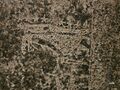 Rrt at sarcophagus of Nectanebo (Staatliche Museen zu Berlin – Ägyptisches Museum und Papyrussammlung, ÄM 7).
 -
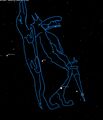 Reret and Menit (Berlin) mapped to Stellarium - version of "smaller" constellation as depicted in Dendera
 -
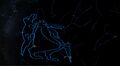 Reret and Menit on Stellarium map, original huge constellation, with the two IAU-star names Khepdenreret and Tepiamenit (CC BY WGSN)
 -
![Egyptian constellation of the late (Roman time) Dendera Zodiac with the precession circle and the circumpolar circle for Northern Egypt in 1250 BCE. Simulation with Stellarium[2].](/images/thumb/0/09/Eg_const_pole1250BCE_stellarium.jpg/120px-Eg_const_pole1250BCE_stellarium.jpg) Egyptian constellation of the late (Roman time) Dendera Zodiac with the precession circle and the circumpolar circle for Northern Egypt in 1250 BCE. Simulation with Stellarium[2].
Egyptian constellation of the late (Roman time) Dendera Zodiac with the precession circle and the circumpolar circle for Northern Egypt in 1250 BCE. Simulation with Stellarium[2]. -
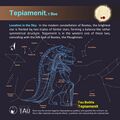 Tepiamenit stick figure (CC BY Sadegh Faghanpour, IAU WGSN).


![Egyptian constellation of the late (Roman time) Dendera Zodiac with the precession circle and the circumpolar circle for Northern Egypt in 1250 BCE. Simulation with Stellarium[2].](/index.php/File:Eg_const_pole1250BCE_stellarium.jpg)
Weblinks
- NASA Exoplanet Archive entry for τ Bootis system: https://exoplanetarchive.ipac.caltech.edu/overview/tau%20Boo
- SIMBAD entry for star τ Bootis A: https://simbad.cds.unistra.fr/simbad/sim-id?Ident=tau+Boo
Reference
- ↑ Belmonte, J. A., 2003. The Ramesside star clocks and the ancient Egyptian constellations. In M. Blomberg, P. E. Blomberg and G. Henriksson (Eds.), Calendars, Symbols, and Orientations: Legacies of Astronomy in Culture (pp. 57–65). Uppsala Astronomical Observatory report, 59. Uppsala Ocarina Books.
- ↑ Zotti, Georg; Hoffmann, Susanne M.; Wolf, Alexander; Chéreau, Fabien & Chéreau, Guillaume, "The Simulated Sky: Stellarium for Cultural Astronomy Research", Journal of Skyscape Archaeology, 6(2) (2020), 221--258 https://doi.org/10.1558/jsa.17822.





