Tianjin: Difference between revisions
HaochengLyu (talk | contribs) Created page with "{{DISPLAYTITLE: Tianjin (天津)}} Authors: {{PAGEAUTHORS}} ---- alt=Tianjin in Stellarium|thumb|Tianjin in Stellarium, across the Milky Way ''Tiān Jīn'' (天津, Celestial Fork), a Chinese constellation consists of 9 stars, located in Cygnus. This constellation is regarded as the "fork or bridge of the Milky Way in the sky" because it spans across the Milky Way. == Concordance, Etymology, History == === Identification of star..." |
No edit summary |
||
| (13 intermediate revisions by 5 users not shown) | |||
| Line 3: | Line 3: | ||
---- | ---- | ||
[[File:Tianjin in Stellarium.png|alt=Tianjin in Stellarium|thumb|Tianjin in Stellarium, across the Milky Way]] | [[File:Tianjin in Stellarium.png|alt=Tianjin in Stellarium|thumb|Tianjin in Stellarium, across the Milky Way]] | ||
''Tiān Jīn'' (天津, Celestial | {{Infobox constellation | ||
| name = Tianjin (天津) | |||
| native = 天津 | |||
| translation = Celestial Ford | |||
| pronounce = Tiānjīn | |||
| IPA = /tʰjɛn˥.t͡ɕin˥/ | |||
| culture = Chinese | |||
| RA = ... to ... | |||
| dec = ... to ... | |||
| areatotal = xx.xx | |||
| numbermainstars = 9 | |||
| numberbfstars = 9 | |||
| numberstarsplanets = | |||
| numberbrightstars = 4 | |||
| numbernearbystars = | |||
| brighteststarname = α Cyg | |||
| starmagnitude = 1.25 | |||
| neareststarname = | |||
| stardistance = | |||
| numbermessierobjects = | |||
| meteorshowers = | |||
| bordering = Cyg | |||
| notes = | |||
| cat = constellation | |||
}} | |||
[[File:Tianjinnan Event.jpg|thumb|Tianjin event card (CC BY M. Sadegh Faghanpour for IAU WGSN).]] | |||
''Tiān Jīn'' (天津, Celestial Ford or Celestial Ferry), a Chinese constellation consists of 9 stars, located in [[Cygnus]]. This constellation is regarded as the "ferry or bridge of the Milky Way in the sky" because it spans across the Milky Way. | |||
== Concordance, Etymology, History == | == Concordance, Etymology, History == | ||
The imagery of a celestial ferry had already taken root in the Chinese imagination more than two millennia ago. The great poet Qu Yuan (c. 340–278 BCE) of the Warring States period—often called China's first romantic poet—wrote in his masterpiece ''Li Sao'' ("On Encountering Sorrow"):<blockquote>At dawn I set forth from the Celestial Ferry (Tianjin); | |||
By dusk I had reached the westernmost horizon.<ref>Zhu, Xi 朱熹. ''Chu Ci Ji Zhu 楚辞集注''. Beijing: Zhonghua shu ju, 1991.</ref></blockquote>This magnificent line describes the poet's spiritual journey through the heavens, unbounded by earthly limits. Though Qu Yuan was not necessarily referring to the specific constellation later codified as Tianjin, his verse reveals that the image of a "Ferry of the Milky Way" had already entered the Chinese literary imagination in very ancient times. | |||
The earliest recorded description of what would later become the Tianjin constellation appears in Sima Qian's (c. 145–86 BCE) ''Records of the Grand Historian (Shiji)''. In the "Treatise on Celestial Offices," Sima Qian wrote:<blockquote>Beside ''[[Wangliang]]'', there are eight stars cutting across the Milky Way, called "Celestial Pier" (''Tianhuang''). Beside the Celestial Pier is the River Star (''Jiangxing''). When the River Star stirs, men wade across the waters.</blockquote>According to scholars of later eras, Tianhuang (another name for Tianjin) and the River Star together comprised the nine stars of the future Tianjin constellation. The River Star is [[Deneb]], the brightest of the nine, while the other eight constitute the "pier." The omen that "men wade across the waters" would later inspire another constellation, ''Ren'' (Humans), consisting of five stars placed adjacent to Tianjin. (There is also another Chinese constellation named Tianhuang, consisting of five stars in the constellation [[Auriga]], which should not be confused with the Tianhuang associated with Tianjin.)<ref>Zhu Wenxin朱文鑫. ''A Study of the Star Charts in Sima Qian's "Treatise on Celestial Offices"'' 史记天官书恒星图考. p. 52. Shanghai: The Commercial Press. First edition 1927, second edition 1934.</ref> | |||
After Chen Zhuo (active 3rd century CE) unified the Chinese constellation system, the name of Tianjin was fixed. The ''Book of Jin (Jinshu'', 晋书'')'' states in its "Treatise on Astronomy":<blockquote>Tianjin consists of nine stars lying across the Milky Way. It is also called ''Tianhan'' (a name of the Milky Way) or ''Tianjiang'' (Celestial River). It presides over the ferries and bridges of the Four Great Rivers (the Yangtze, Yellow, Huai, and Ji, refers to all rivers in general), thereby enabling the gods to traverse the four directions. If one star is missing, the fords and passes are blocked.</blockquote> | |||
==== Tianjin and the Legend of the Cowherd and Weaver Girl ==== | |||
→ ''see also Japanese'' [[Hikoboshi and Orihime]][[File:Weaving Girl, Cowherd and Celestial Ford.png|thumb|Weaving Girl (Zhinü), Cowherd(Niulang) and the Celestial Ford (Tianjin)]] | |||
For those less concerned with the formal constellation, Tianjin lives on in a more beloved story—the legend of the Cowherd and the Weaver Girl. | |||
The Weaver Girl (Zhinü) was a celestial maiden who wove the clouds and rosy dawns. The Cowherd (Niulang) was a handsome mortal who fell in love with her. They married and had two children, but the Queen Mother of the West was furious. She scratched a great river across the sky—the Milky Way—to separate them forever. The lovers could only weep across the celestial river once a year, on the seventh night of the seventh lunar month, when a flock of magpies would form a bridge with their wings, allowing them to meet for one fleeting embrace. | |||
In many folk traditions, the bridge of magpies is none other than the Tianjin constellation itself. The nine stars of Tianjin stretch across the Milky Way exactly where the magpies are said to alight. Every summer, stargazers can see the "Summer Triangle"—[[Deneb]] (one star of Tianjin), [[Vega]] (the Weaver Girl), and [[Altair]] (the Cowherd)—forming a vast triangle in the eastern sky, the stars of the lovers and their bridge. | |||
==== Tianjin in Geography ==== | |||
The Tianjin constellation was so well known that its name was later applied to several places on Earth. In traditional Chinese thought, there was a long‑held principle of ''xiang tian fa di'' (象天法地, modeling the earthly upon the heavenly), whereby human constructions were deliberately designed to mirror celestial patterns. | |||
'''Tianjin Bridge (Luoyang)''' | |||
The clearest example is the Tianjin Bridge built across the Luo River in Luoyang during the Sui dynasty (605 CE). Following ''xiang tian fa di'', the Luo River was conceived as the earthly counterpart of the Milky Way (Tianhan), and the bridge that spanned it was accordingly named after the Tianjin constellation. The bridge was part of a larger celestial allegory in the Sui‑Tang eastern capital, where seven key structures (including Heavenly Tower and Heavenly Street) mirrored the Sun, Moon, and five visible planets. Its stone pier foundations have been excavated in modern times. | |||
'''Tianjin Municipality''' | |||
[[File:Tianzi Jindu.png|alt=A memorial park in Tianjin city, featuring a stone inscribed with "Tianzi Jindu" — a Ming-dynasty reinterpretation of the word "Tianjin", literally meaning "Ford of the Son of Heaven (Emperor)".|thumb|A memorial park in Tianjin city, featuring a stone inscribed with "''Tianzi Jindu''" — a Ming-dynasty reinterpretation of the word "Tianjin", literally meaning "Ford of the Son of Heaven (Emperor)".]] | |||
The modern city of Tianjin also owes its name to this constellation. According to the History of Jin (''Jinshi'', 金史), a Tianjin River (天津河) already existed by 1206 CE. It was named after the constellation, taking its meaning from the phrase "a bridge across the Milky Way, a thoroughfare serving all waterways" ('''''Tian'''han '''Jin'''liang,'' '''''Tong'''cao Zhong'''ji''''', '''天'''汉'''津'''梁、'''通'''漕众'''济'''), which explicitly draws on the celestial concept. The Tianjin River was designated as a section of the Grand Canal, serving as a key channel for grain transportation. Around the same time, another waterway, the ''Tongji'' River (通济渠), was also named based on the same phrase.<ref>Feng Zhiyuan 冯志远. "The Historical Changes of the Tianjin River. 天津河的历史变迁" ''Tianjin Daily'', 3 Dec. 2024, p. 12.</ref> The two rivers were placed under the unified management of a single patrol officer, known as the Tianjin River Patrol Officer.<ref>Toqto'a托克托, et al. "Volume 8: Rivers and Canals.卷八:河渠志" ''History of Jin金史''</ref> | |||
A later, widely known tradition dates to the Ming dynasty. In 1400, Zhu Di, the Prince of Yan, boarded ships at the Tianjin River near what is now the Jinhua Bridge on the South Canal during the Jingnan Campaign against his nephew, the Jianwen Emperor. From this point, he switched from overland to waterborne advance and sailed south along the Grand Canal. After seizing the throne and ascending as the Yongle Emperor, he reportedly renamed the settlement Tianjin, meaning the "Ford of the Son of Heaven (Emperor)" ('''''Tian'''zi '''Jin'''du'', '''天'''子'''津'''渡), in commemoration of his departure point. In 1404, he formally established the Tianjin Guard, which is traditionally regarded as the founding date of the city. | |||
'''Beyond Earth''' | |||
In 2019, the International Astronomical Union named a lunar crater at the Chang'e‑4 landing site "Tianjin". Together with neighboring craters Zhinü (Weaver Girl) and Hegu (Cowherd), it recreates the Summer Triangle on the lunar surface – with Tianjin again representing the celestial bridge. | |||
=== Identification of stars === | === Identification of stars === | ||
Tianjin Star is quite prominent in the sky, corresponding to the 9 stars in the constellation [[Cygnus]], without controversy. | |||
{| class="wikitable" | {| class="wikitable" | ||
|+ | |+ | ||
!Star Names or Orders( | !Star Names or Orders(Qing) | ||
!Ho PENG YOKE<ref>P.-Y. Ho, “Ancient And Mediaeval Observations of Comets and Novae in Chinese Sources,” ''Vistas in Astronomy'', 5(1962), 127-225.</ref> | !style="color: gray;" |Ho PENG YOKE<ref>P.-Y. Ho, “Ancient And Mediaeval Observations of Comets and Novae in Chinese Sources,” ''Vistas in Astronomy'', 5(1962), 127-225.</ref> | ||
!Yi Shitong<ref>Yi Shitong伊世同. ''Zhongxi Duizhao Hengxing Tubiao''中西对照恒星图表1950. Beijing: Science Press.1981: 56.</ref> | !style="color: gray;" |Yi Shitong<ref>Yi Shitong伊世同. ''Zhongxi Duizhao Hengxing Tubiao''中西对照恒星图表1950. Beijing: Science Press.1981: 56.</ref> | ||
Based on catalogue in 18th century | Based on catalogue in 18th century | ||
!Pan Nai<ref name=":0">Pan Nai潘鼐. ''Zhongguo Hengxing Guance shi''中国恒星观测史[M]. Shanghai: Xuelin Pree. 1989. p226.</ref> | !style="color: gray;" |Pan Nai<ref name=":0">Pan Nai潘鼐. ''Zhongguo Hengxing Guance shi''中国恒星观测史[M]. Shanghai: Xuelin Pree. 1989. p226.</ref> | ||
based on Xinyixiangfayao Star Map | based on Xinyixiangfayao Star Map | ||
!Pan Nai<ref>Pan Nai潘鼐. ''Zhongguo Hengxing Guance shi''中国恒星观测史[M]. Shanghai: Xuelin Pree. 2009. p443.</ref> | !style="color: gray;" |Pan Nai<ref>Pan Nai潘鼐. ''Zhongguo Hengxing Guance shi''中国恒星观测史[M]. Shanghai: Xuelin Pree. 2009. p443.</ref> | ||
based on catalogues in Yuan dynasty | based on catalogues in Yuan dynasty | ||
!SUN X. & J. Kistemaker<ref>Sun Xiaochun. & Kistemaker J. ''The Chinese sky during the Han''. Leiden: Brill. 1997, Pp241-6.</ref> | !style="color: gray;" |SUN X. & J. Kistemaker<ref>Sun Xiaochun. & Kistemaker J. ''The Chinese sky during the Han''. Leiden: Brill. 1997, Pp241-6.</ref> | ||
Han Dynasty | Han Dynasty | ||
!Boshun Yang<ref name=":1">B.-S. Yang杨伯顺, ''Zhongguo Chuantong Hengxing Guance Jingdu ji Xingguan Yanbian Yanjiu'' 中国传统恒星观测精度及星官演变研究 (A Research on the Accuracy of Chinese Traditional Star Observation and the Evolution of Constellations), PhD thesis, (Hefei: University of Science and Technology of China, 2023). 261.</ref> | !Boshun Yang<ref name=":1">B.-S. Yang杨伯顺, ''Zhongguo Chuantong Hengxing Guance Jingdu ji Xingguan Yanbian Yanjiu'' 中国传统恒星观测精度及星官演变研究 (A Research on the Accuracy of Chinese Traditional Star Observation and the Evolution of Constellations), PhD thesis, (Hefei: University of Science and Technology of China, 2023). 261.</ref> | ||
| Line 26: | Line 85: | ||
|- | |- | ||
| 1st | | 1st | ||
| γ Cyg | |style="color: gray;" | γ Cyg | ||
| γ Cyg | |style="color: gray;" | γ Cyg | ||
| γ Cyg | |style="color: gray;" | γ Cyg | ||
| γ Cyg | |style="color: gray;" | γ Cyg | ||
| γ Cyg | |style="color: gray;" | γ Cyg | ||
| γ Cyg | | γ Cyg | ||
| γ Cyg | | γ Cyg | ||
|- | |- | ||
| 2nd (Determinative) | | 2nd (Determinative) | ||
| δ Cyg | |style="color: gray;" | δ Cyg | ||
| δ Cyg | |style="color: gray;" | δ Cyg | ||
| δ Cyg | |style="color: gray;" | δ Cyg | ||
| δ Cyg | |style="color: gray;" | δ Cyg | ||
| δ Cyg | |style="color: gray;" | δ Cyg | ||
| δ Cyg | | δ Cyg | ||
| δ Cyg | | δ Cyg | ||
|- | |- | ||
| 3rd | | 3rd | ||
| ο1 Cyg | |style="color: gray;" | ο1 Cyg | ||
| 30 Cyg | |style="color: gray;" | 30 Cyg | ||
| ο1 Cyg | |style="color: gray;" | ο1 Cyg | ||
| ο1 Cyg | |style="color: gray;" | ο1 Cyg | ||
| ο1 Cyg | |style="color: gray;" | ο1 Cyg | ||
| ο1 Cyg | | ο1 Cyg | ||
| ο1 Cyg | | ο1 Cyg | ||
|- | |- | ||
|4th | |4th (Jiangxing, 江星) | ||
| α Cyg | |style="color: gray;" | α Cyg | ||
| α Cyg | |style="color: gray;" | α Cyg | ||
| α Cyg | |style="color: gray;" | α Cyg | ||
| α Cyg | |style="color: gray;" | α Cyg | ||
| α Cyg | |style="color: gray;" | α Cyg | ||
| α Cyg | | α Cyg | ||
| α Cyg | | α Cyg | ||
|- | |- | ||
|5th | |5th | ||
|ν Cyg | |style="color: gray;" |ν Cyg | ||
|ν Cyg | |style="color: gray;" |ν Cyg | ||
|ν Cyg | |style="color: gray;" |ν Cyg | ||
|ν Cyg | |style="color: gray;" |ν Cyg | ||
|ν Cyg | |style="color: gray;" |ν Cyg | ||
|ν Cyg | |ν Cyg | ||
|ν Cyg | |ν Cyg | ||
|- | |- | ||
|6th | |6th | ||
|τ Cyg | |style="color: gray;" |τ Cyg | ||
|τ Cyg | |style="color: gray;" |τ Cyg | ||
|τ Cyg | |style="color: gray;" |τ Cyg | ||
|τ Cyg | |style="color: gray;" |τ Cyg | ||
|τ Cyg | |style="color: gray;" |τ Cyg | ||
|τ Cyg | |τ Cyg | ||
|τ Cyg | |τ Cyg | ||
|- | |- | ||
|7th | |7th | ||
|υ Cyg | |style="color: gray;" |υ Cyg | ||
|υ Cyg | |style="color: gray;" |υ Cyg | ||
|υ Cyg | |style="color: gray;" |υ Cyg | ||
|υ Cyg | |style="color: gray;" |υ Cyg | ||
|υ Cyg | |style="color: gray;" |υ Cyg | ||
|υ Cyg | |υ Cyg | ||
|υ Cyg | |υ Cyg | ||
|- | |- | ||
|8th | |8th | ||
|ζ Cyg | |style="color: gray;" |ζ Cyg | ||
|ζ Cyg | |style="color: gray;" |ζ Cyg | ||
|ζ Cyg | |style="color: gray;" |ζ Cyg | ||
|ζ Cyg | |style="color: gray;" |ζ Cyg | ||
|ζ Cyg | |style="color: gray;" |ζ Cyg | ||
|ζ Cyg | |ζ Cyg | ||
|ζ Cyg | |ζ Cyg | ||
|- | |- | ||
|9th | |9th | ||
|ε Cyg | |style="color: gray;" |ε Cyg | ||
|ε Cyg | |style="color: gray;" |ε Cyg | ||
|ε Cyg | |style="color: gray;" |ε Cyg | ||
|ε Cyg | |style="color: gray;" |ε Cyg | ||
|ε Cyg | |style="color: gray;" |ε Cyg | ||
|ε Cyg | |ε Cyg | ||
|ε Cyg | |ε Cyg | ||
| Line 108: | Line 167: | ||
=== Maps (Gallery) === | === Maps (Gallery) === | ||
<gallery widths="300" heights="300" caption="Tianjin"> | |||
File:Tianjin on Cheonsang Yeolcha Bunyajido.png|Tianjin on ''Cheonsang Yeolcha Bunyajido'' | |||
File:Tianjin on Suzhou Star Map.png|Tianjin on Suzhou Star Map | |||
File:Tianjin on 18th century star map.png|Tianjin on ''Yixiang Kaocheng'' star map (18th century) | |||
</gallery> | |||
| | |||
| | |||
== IAU Working Group on Star Names == | == IAU Working Group on Star Names == | ||
In | In 2026, the name "[[Tianjinnan]]" was suggested to be used for ζ Cyg in this constellation. "Tianjinnan" means "Southern star of Tianjin", because ζ Cyg is the southernmost star in the Tianjin asterism. "Tianjinnan" is not the star's historical proper name, but this style of naming (asterism + derection) was common in pre-modern China. The name "Tianjin" carries important cultural connotations, which makes it a meaningful choice. | ||
ζ Cyg is a G8 giant star 46 parsecs away, and a binary star -- reported as a double-lined spectroscopic binary (SBC9 2958), and resolved in the Washington Double Star catalog as WDS J21129+3014 Aa and Ab. [https://ui.adsabs.harvard.edu/abs/1992Obs...112..168G/abstract Griffin & Keenan (1992)] present a survey of the ζ Cyg binary, and discuss its spectral peculiarities and the nature of its companion - a white dwarf. The spectrum of ζ Cyg shows it to be rich in s-process elements like barium, and these are explained by past accretion of the star by mass transferred from the companion star when it was a red giant. | |||
==References == | ==References == | ||
| Line 132: | Line 185: | ||
[[Category:Asterism ]] | [[Category:Asterism ]] | ||
[[Category:Constellation ]] | [[Category:Constellation ]] | ||
[[Category:Eurasia]] | [[Category:Eurasia]] [[Category:Asian]] | ||
[[Category:East Asian]] | [[Category:East Asian]] | ||
[[Category:Chinese ]] | [[Category:Chinese ]] [[Category:Cyg]] | ||
[[Category:Solar System]][[Category:Surface Structure]][[Category:Lunar Crater]] | |||
Latest revision as of 10:38, 10 September 2026
Authors: Lyu Haocheng, Eric Mamajek, Susanne M Hoffmann, Boshun YANG, Youla Azkarrula

| Asterism Info | |
| Native | 天津 |
|---|---|
| Romanisation | Tiānjīn |
| IPA | /tʰjɛn˥.t͡ɕin˥/ |
| Translation | Celestial Ford |
| Position (2000) | |
| Right ascension | ... to ... |
| Declination | ... to ... |
| Area | xx.xx sq. deg. |
| Stars | |
| Bright stars | 9 |
| Bayer/Flamsteed stars | 9 |
| Stars brighter than 3.00m | 4 |
| Brightest star | α Cyg (1.25m) |
| Taxonomy | |
| category of asterism | constellation |
| IAU- constellations | Cyg |

Tiān Jīn (天津, Celestial Ford or Celestial Ferry), a Chinese constellation consists of 9 stars, located in Cygnus. This constellation is regarded as the "ferry or bridge of the Milky Way in the sky" because it spans across the Milky Way.
Concordance, Etymology, History
The imagery of a celestial ferry had already taken root in the Chinese imagination more than two millennia ago. The great poet Qu Yuan (c. 340–278 BCE) of the Warring States period—often called China's first romantic poet—wrote in his masterpiece Li Sao ("On Encountering Sorrow"):
At dawn I set forth from the Celestial Ferry (Tianjin); By dusk I had reached the westernmost horizon.[1]
This magnificent line describes the poet's spiritual journey through the heavens, unbounded by earthly limits. Though Qu Yuan was not necessarily referring to the specific constellation later codified as Tianjin, his verse reveals that the image of a "Ferry of the Milky Way" had already entered the Chinese literary imagination in very ancient times. The earliest recorded description of what would later become the Tianjin constellation appears in Sima Qian's (c. 145–86 BCE) Records of the Grand Historian (Shiji). In the "Treatise on Celestial Offices," Sima Qian wrote:
Beside Wangliang (王良), there are eight stars cutting across the Milky Way, called "Celestial Pier" (Tianhuang). Beside the Celestial Pier is the River Star (Jiangxing). When the River Star stirs, men wade across the waters.
According to scholars of later eras, Tianhuang (another name for Tianjin) and the River Star together comprised the nine stars of the future Tianjin constellation. The River Star is Deneb, the brightest of the nine, while the other eight constitute the "pier." The omen that "men wade across the waters" would later inspire another constellation, Ren (Humans), consisting of five stars placed adjacent to Tianjin. (There is also another Chinese constellation named Tianhuang, consisting of five stars in the constellation Auriga, which should not be confused with the Tianhuang associated with Tianjin.)[2] After Chen Zhuo (active 3rd century CE) unified the Chinese constellation system, the name of Tianjin was fixed. The Book of Jin (Jinshu, 晋书) states in its "Treatise on Astronomy":
Tianjin consists of nine stars lying across the Milky Way. It is also called Tianhan (a name of the Milky Way) or Tianjiang (Celestial River). It presides over the ferries and bridges of the Four Great Rivers (the Yangtze, Yellow, Huai, and Ji, refers to all rivers in general), thereby enabling the gods to traverse the four directions. If one star is missing, the fords and passes are blocked.
Tianjin and the Legend of the Cowherd and Weaver Girl
→ see also Japanese Hikoboshi and Orihime (ひこぼし:彦星 and おりひめ:織姫)

For those less concerned with the formal constellation, Tianjin lives on in a more beloved story—the legend of the Cowherd and the Weaver Girl.
The Weaver Girl (Zhinü) was a celestial maiden who wove the clouds and rosy dawns. The Cowherd (Niulang) was a handsome mortal who fell in love with her. They married and had two children, but the Queen Mother of the West was furious. She scratched a great river across the sky—the Milky Way—to separate them forever. The lovers could only weep across the celestial river once a year, on the seventh night of the seventh lunar month, when a flock of magpies would form a bridge with their wings, allowing them to meet for one fleeting embrace.
In many folk traditions, the bridge of magpies is none other than the Tianjin constellation itself. The nine stars of Tianjin stretch across the Milky Way exactly where the magpies are said to alight. Every summer, stargazers can see the "Summer Triangle"—Deneb (one star of Tianjin), Vega (the Weaver Girl), and Altair (the Cowherd)—forming a vast triangle in the eastern sky, the stars of the lovers and their bridge.
Tianjin in Geography
The Tianjin constellation was so well known that its name was later applied to several places on Earth. In traditional Chinese thought, there was a long‑held principle of xiang tian fa di (象天法地, modeling the earthly upon the heavenly), whereby human constructions were deliberately designed to mirror celestial patterns.
Tianjin Bridge (Luoyang)
The clearest example is the Tianjin Bridge built across the Luo River in Luoyang during the Sui dynasty (605 CE). Following xiang tian fa di, the Luo River was conceived as the earthly counterpart of the Milky Way (Tianhan), and the bridge that spanned it was accordingly named after the Tianjin constellation. The bridge was part of a larger celestial allegory in the Sui‑Tang eastern capital, where seven key structures (including Heavenly Tower and Heavenly Street) mirrored the Sun, Moon, and five visible planets. Its stone pier foundations have been excavated in modern times.
Tianjin Municipality

The modern city of Tianjin also owes its name to this constellation. According to the History of Jin (Jinshi, 金史), a Tianjin River (天津河) already existed by 1206 CE. It was named after the constellation, taking its meaning from the phrase "a bridge across the Milky Way, a thoroughfare serving all waterways" (Tianhan Jinliang, Tongcao Zhongji, 天汉津梁、通漕众济), which explicitly draws on the celestial concept. The Tianjin River was designated as a section of the Grand Canal, serving as a key channel for grain transportation. Around the same time, another waterway, the Tongji River (通济渠), was also named based on the same phrase.[3] The two rivers were placed under the unified management of a single patrol officer, known as the Tianjin River Patrol Officer.[4]
A later, widely known tradition dates to the Ming dynasty. In 1400, Zhu Di, the Prince of Yan, boarded ships at the Tianjin River near what is now the Jinhua Bridge on the South Canal during the Jingnan Campaign against his nephew, the Jianwen Emperor. From this point, he switched from overland to waterborne advance and sailed south along the Grand Canal. After seizing the throne and ascending as the Yongle Emperor, he reportedly renamed the settlement Tianjin, meaning the "Ford of the Son of Heaven (Emperor)" (Tianzi Jindu, 天子津渡), in commemoration of his departure point. In 1404, he formally established the Tianjin Guard, which is traditionally regarded as the founding date of the city.
Beyond Earth
In 2019, the International Astronomical Union named a lunar crater at the Chang'e‑4 landing site "Tianjin". Together with neighboring craters Zhinü (Weaver Girl) and Hegu (Cowherd), it recreates the Summer Triangle on the lunar surface – with Tianjin again representing the celestial bridge.
Identification of stars
Tianjin Star is quite prominent in the sky, corresponding to the 9 stars in the constellation Cygnus, without controversy.
| Star Names or Orders(Qing) | Ho PENG YOKE[5] | Yi Shitong[6]
Based on catalogue in 18th century |
Pan Nai[7]
based on Xinyixiangfayao Star Map |
Pan Nai[8]
based on catalogues in Yuan dynasty |
SUN X. & J. Kistemaker[9]
Han Dynasty |
Boshun Yang[10]
before Tang dynasty |
Boshun Yang[10]
Song Jingyou(1034) |
|---|---|---|---|---|---|---|---|
| 1st | γ Cyg | γ Cyg | γ Cyg | γ Cyg | γ Cyg | γ Cyg | γ Cyg |
| 2nd (Determinative) | δ Cyg | δ Cyg | δ Cyg | δ Cyg | δ Cyg | δ Cyg | δ Cyg |
| 3rd | ο1 Cyg | 30 Cyg | ο1 Cyg | ο1 Cyg | ο1 Cyg | ο1 Cyg | ο1 Cyg |
| 4th (Jiangxing, 江星) | α Cyg | α Cyg | α Cyg | α Cyg | α Cyg | α Cyg | α Cyg |
| 5th | ν Cyg | ν Cyg | ν Cyg | ν Cyg | ν Cyg | ν Cyg | ν Cyg |
| 6th | τ Cyg | τ Cyg | τ Cyg | τ Cyg | τ Cyg | τ Cyg | τ Cyg |
| 7th | υ Cyg | υ Cyg | υ Cyg | υ Cyg | υ Cyg | υ Cyg | υ Cyg |
| 8th | ζ Cyg | ζ Cyg | ζ Cyg | ζ Cyg | ζ Cyg | ζ Cyg | ζ Cyg |
| 9th | ε Cyg | ε Cyg | ε Cyg | ε Cyg | ε Cyg | ε Cyg | ε Cyg |
Maps (Gallery)
- Tianjin
-
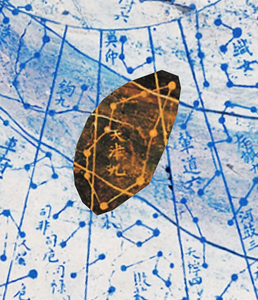 Tianjin on Cheonsang Yeolcha Bunyajido
 -
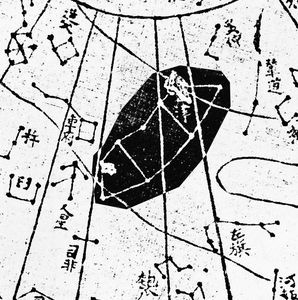 Tianjin on Suzhou Star Map
 -
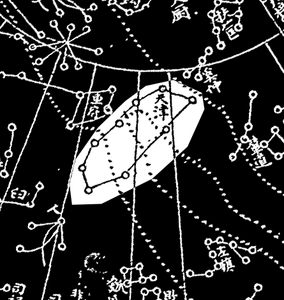 Tianjin on Yixiang Kaocheng star map (18th century)


IAU Working Group on Star Names
In 2026, the name "Tianjinnan" was suggested to be used for ζ Cyg in this constellation. "Tianjinnan" means "Southern star of Tianjin", because ζ Cyg is the southernmost star in the Tianjin asterism. "Tianjinnan" is not the star's historical proper name, but this style of naming (asterism + derection) was common in pre-modern China. The name "Tianjin" carries important cultural connotations, which makes it a meaningful choice.
ζ Cyg is a G8 giant star 46 parsecs away, and a binary star -- reported as a double-lined spectroscopic binary (SBC9 2958), and resolved in the Washington Double Star catalog as WDS J21129+3014 Aa and Ab. Griffin & Keenan (1992) present a survey of the ζ Cyg binary, and discuss its spectral peculiarities and the nature of its companion - a white dwarf. The spectrum of ζ Cyg shows it to be rich in s-process elements like barium, and these are explained by past accretion of the star by mass transferred from the companion star when it was a red giant.
References
- ↑ Zhu, Xi 朱熹. Chu Ci Ji Zhu 楚辞集注. Beijing: Zhonghua shu ju, 1991.
- ↑ Zhu Wenxin朱文鑫. A Study of the Star Charts in Sima Qian's "Treatise on Celestial Offices" 史记天官书恒星图考. p. 52. Shanghai: The Commercial Press. First edition 1927, second edition 1934.
- ↑ Feng Zhiyuan 冯志远. "The Historical Changes of the Tianjin River. 天津河的历史变迁" Tianjin Daily, 3 Dec. 2024, p. 12.
- ↑ Toqto'a托克托, et al. "Volume 8: Rivers and Canals.卷八:河渠志" History of Jin金史
- ↑ P.-Y. Ho, “Ancient And Mediaeval Observations of Comets and Novae in Chinese Sources,” Vistas in Astronomy, 5(1962), 127-225.
- ↑ Yi Shitong伊世同. Zhongxi Duizhao Hengxing Tubiao中西对照恒星图表1950. Beijing: Science Press.1981: 56.
- ↑ Pan Nai潘鼐. Zhongguo Hengxing Guance shi中国恒星观测史[M]. Shanghai: Xuelin Pree. 1989. p226.
- ↑ Pan Nai潘鼐. Zhongguo Hengxing Guance shi中国恒星观测史[M]. Shanghai: Xuelin Pree. 2009. p443.
- ↑ Sun Xiaochun. & Kistemaker J. The Chinese sky during the Han. Leiden: Brill. 1997, Pp241-6.
- ↑ 10.0 10.1 B.-S. Yang杨伯顺, Zhongguo Chuantong Hengxing Guance Jingdu ji Xingguan Yanbian Yanjiu 中国传统恒星观测精度及星官演变研究 (A Research on the Accuracy of Chinese Traditional Star Observation and the Evolution of Constellations), PhD thesis, (Hefei: University of Science and Technology of China, 2023). 261.





