Matrcakra: Difference between revisions
No edit summary |
infobox |
||
| (6 intermediate revisions by one other user not shown) | |||
| Line 2: | Line 2: | ||
Authors: {{PAGEAUTHORS}} B S | Authors: {{PAGEAUTHORS}} B S | ||
---- | ---- | ||
{{Infobox constellation | |||
| name = Matrichakra | |||
| native = मातृचक्र | |||
| translation = The Circle | |||
| pronounce = | |||
| IPA = | |||
| culture = IAU | |||
| RA = 237.3985292 | |||
| dec = 26.06839286 | |||
| areatotal = 0 | |||
| numbermainstars = 1 | |||
| numberbfstars = 1 | |||
| numberstarsplanets = | |||
| numberbrightstars = 0 | |||
| numbernearbystars = | |||
| brighteststarname = Matrichakra | |||
| starmagnitude = 4.63 | |||
| neareststarname = | |||
| stardistance = | |||
| numbermessierobjects = | |||
| meteorshowers = | |||
| bordering = CrB | |||
| notes = | |||
| cat = IAU-Star Name | |||
}} | |||
[[File:Globe matrichakra.jpg|thumb|Matrichakra on a globe in Jaipur (18th c.); the full name is written.]] | [[File:Globe matrichakra.jpg|thumb|Matrichakra on a globe in Jaipur (18th c.); the full name is written.]] | ||
Mātṛcakra | {{Infobox constellation | ||
| name = मातृचक्र | |||
| native = मातृचक्र | |||
| translation = Circle | |||
| pronounce = Mātṛcakra | |||
| IPA = | |||
| culture = Sanskrit | |||
| RA = 231.9573086 to 240.3606872 | |||
| dec = 26.06839286 to 31.35897752 | |||
| areatotal = 30.39 | |||
| numbermainstars = 9 | |||
| numberbfstars = 8 | |||
| numberstarsplanets = | |||
| numberbrightstars = 1 | |||
| numbernearbystars = | |||
| brighteststarname = [[Alphecca]] | |||
| starmagnitude = 2.24 | |||
| neareststarname = | |||
| stardistance = | |||
| numbermessierobjects = | |||
| meteorshowers = | |||
| bordering = CrB | |||
| notes = | |||
| cat = constellation | |||
}} | |||
Matrichakra is an English phonetic, simplified spelling that served for the adoption of the term as a star name for one of the stars in Corona Borealis. As a modern star name adopted by the International Astronomical Union in the IAU-Catalog of Star Names (IAU-CSN), it is the name of the star δ CrB in constellation [[Corona Borealis]]. | Mātṛcakra (मातृचक्र), is an Indian name for [[Corona Borealis]]<ref>R. Venketeswara Pai and B. S. Shylaja (2016) "Measurement of coordinates of Nakśatras in Indian astronomy" (Sarvasiddhāntarāja by Nityānanda, 1639 CE)</ref>; it is a '''constellation'''. | ||
Matrichakra ('''modern star name''') is an English phonetic, simplified spelling that served for the adoption of the term as a star name for one of the stars in Corona Borealis. As a modern star name adopted by the International Astronomical Union in the IAU-Catalog of Star Names (IAU-CSN), it is the name of the star δ CrB in constellation [[Corona Borealis]]. | |||
==Concordance, Etymology, History== | ==Concordance, Etymology, History== | ||
| Line 31: | Line 82: | ||
The word matr refers to the mother. Since this is a mandala, it is a group of mothers. The word visakha refers to another deity, Skanda, with six faces. Therefore, putting the words together, we may gather that these were the six mothers who nourished the six-headed baby. However, the same story is told in the context of Krttika, Pleiades. In the absence of any chart of an earlier period (maybe this was in use at the beginning of the millennium), this remains a speculation | The word matr refers to the mother. Since this is a mandala, it is a group of mothers. The word visakha refers to another deity, Skanda, with six faces. Therefore, putting the words together, we may gather that these were the six mothers who nourished the six-headed baby. However, the same story is told in the context of Krttika, Pleiades. In the absence of any chart of an earlier period (maybe this was in use at the beginning of the millennium), this remains a speculation | ||
== IAU Working Group on Star Names == | |||
The name was discussed and adopted by the IAU WGSN in 2026 to keep the heritage of this constellation: WGSN named the brightest stars of the semi-circle of bright stars of CrB after historical names of this asterism in the cultures of origin (e.g. Ancient Greek, Sanskrit, Sumerian). The Indian name was given to the star δ CrB, prominently one of the middle stars of the "diadem", where it starts to bend. | |||
δ CrB is a yellow giant star of spectral type G and visual brightness ~4.6 mag. The brightness varies a slightly with a period of 45 days, as it is a close binary of RS CVn-type. Its luminosity and spectrum indicate that this main-sequence star has recently traversed the Hertzsprung Gap. It is well possible that it has already exhausted the hydrogen in its core and has now begun fusing hydrogen in a surrounding shell; recent papers give this scenario a chance of 64 %. | |||
== Weblinks == | == Weblinks == | ||
| Line 40: | Line 94: | ||
[[Category:Indian]] [[Category:Asterism]] [[Category:Constellation]][[Category:Eurasia]][[Category:South Asian]] | [[Category:Indian]] [[Category:Sanskrit]] | ||
[[Category:Asterism]] [[Category:Constellation]][[Category:IAU-Star Name]] | |||
[[Category:Eurasia]][[Category:Asian]][[Category:South Asian]] | |||
[[Category:CrB]] | |||
<references /> | <references /> | ||
https://srsarma.in/catalogue.php | https://srsarma.in/catalogue.php | ||
Latest revision as of 01:21, 17 August 2026
Authors: Susanne M Hoffmann, Youla Azkarrula, Shylaja B S
| Asterism Info | |
| Native | मातृचक्र |
|---|---|
| Translation | The Circle |
| Position (2000) | |
| Right ascension | 237.3985292 |
| Declination | 26.06839286 |
| Area | 0 sq. deg. |
| Stars | |
| Bright stars | 1 |
| Bayer/Flamsteed stars | 1 |
| Stars brighter than 3.00m | 0 |
| Brightest star | Matrichakra (4.63m) |
| Taxonomy | |
| category of asterism | IAU-Star Name |
| IAU- constellations | CrB |

| Asterism Info | |
| Native | मातृचक्र |
|---|---|
| Romanisation | Mātṛcakra |
| Translation | Circle |
| Position (2000) | |
| Right ascension | 231.9573086 to 240.3606872 |
| Declination | 26.06839286 to 31.35897752 |
| Area | 30.39 sq. deg. |
| Stars | |
| Bright stars | 9 |
| Bayer/Flamsteed stars | 8 |
| Stars brighter than 3.00m | 1 |
| Brightest star | Alphecca (2.24m) |
| Taxonomy | |
| category of asterism | constellation |
| IAU- constellations | CrB |
Mātṛcakra (मातृचक्र), is an Indian name for Corona Borealis[1]; it is a constellation.
Matrichakra (modern star name) is an English phonetic, simplified spelling that served for the adoption of the term as a star name for one of the stars in Corona Borealis. As a modern star name adopted by the International Astronomical Union in the IAU-Catalog of Star Names (IAU-CSN), it is the name of the star δ CrB in constellation Corona Borealis.
Concordance, Etymology, History
Variants
- Mātrīcakra
- Matrichakra
- Mātṛmanḍala (मातृमन्डल )
All these terms are synonymous; Manḍala and Cakra both mean "circular" or "circle". This is not be confused with viśākhā of the 27 nakshatras.
Origin of Constellation

On early modern Indian astrolabes, the individual stars are listed with coordinates with this name included. In fact, the constellation is marked as Viśākhā Mātṛmanḍala abbreviated as vi ma on some astrolabes. The pointer tip is for α CrB (Alphecca), but this only marks the brightest star of the asterism. Therefore, it is assumed that the name refers to a single star. The word mandala signifies a group, a circular arrangement.
The example of the globe from 18th century shows the name and the the stars of Corona Borealis marked.
Transfer and Transformation of the Constellation
-
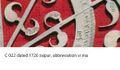 The astrolabe C022 dated 1720 has the marker with the abbreviation vi ma for viśākhāmātṛmanḍala
 -
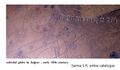 Matrichakra on globe in Jaipur (18th century) with the full name.
Religion/ Tales/ Mythology
The word matr refers to the mother. Since this is a mandala, it is a group of mothers. The word visakha refers to another deity, Skanda, with six faces. Therefore, putting the words together, we may gather that these were the six mothers who nourished the six-headed baby. However, the same story is told in the context of Krttika, Pleiades. In the absence of any chart of an earlier period (maybe this was in use at the beginning of the millennium), this remains a speculation
IAU Working Group on Star Names
The name was discussed and adopted by the IAU WGSN in 2026 to keep the heritage of this constellation: WGSN named the brightest stars of the semi-circle of bright stars of CrB after historical names of this asterism in the cultures of origin (e.g. Ancient Greek, Sanskrit, Sumerian). The Indian name was given to the star δ CrB, prominently one of the middle stars of the "diadem", where it starts to bend. δ CrB is a yellow giant star of spectral type G and visual brightness ~4.6 mag. The brightness varies a slightly with a period of 45 days, as it is a close binary of RS CVn-type. Its luminosity and spectrum indicate that this main-sequence star has recently traversed the Hertzsprung Gap. It is well possible that it has already exhausted the hydrogen in its core and has now begun fusing hydrogen in a surrounding shell; recent papers give this scenario a chance of 64 %.
Weblinks
References
- References (general)
- ↑ R. Venketeswara Pai and B. S. Shylaja (2016) "Measurement of coordinates of Nakśatras in Indian astronomy" (Sarvasiddhāntarāja by Nityānanda, 1639 CE)





