Leo Minor: Difference between revisions
IanRidpath (talk | contribs) →Weblinks: Added link |
|||
| (7 intermediate revisions by 2 users not shown) | |||
| Line 1: | Line 1: | ||
Authors: {{PAGEAUTHORS}} | |||
---- | |||
[[File:Leo Minor IAU.svg|alt=star chart|thumb|Leo Minor star chart (IAU and Sky & Telescope magazine, Roger Sinnott & Rick Fienberg).]] | [[File:Leo Minor IAU.svg|alt=star chart|thumb|Leo Minor star chart (IAU and Sky & Telescope magazine, Roger Sinnott & Rick Fienberg).]] | ||
One of the [[:Category:88_IAU-Constellations|88 IAU constellations]]. The constellation was invented by Hevelius (1687). | One of the [[:Category:88_IAU-Constellations|88 IAU constellations]]. The constellation was invented by Hevelius (1687). | ||
==Etymology and History== | ==Etymology and History== | ||
===Origin of Constellation=== | |||
[[File:LMi Hevelii-Prodromus-astronomiae-6.jpg|alt=historical map|thumb|Leo Minor depicted in Hevelius (1687).]] | [[File:LMi Hevelii-Prodromus-astronomiae-6.jpg|alt=historical map|thumb|Leo Minor depicted in Hevelius (1687).]] | ||
[[File:LeoMinor Hevelius.JPG|alt=screenshot(s) of text|thumb|Leo Minor described in Hevelius (1687).]] | |||
<ref>Hoffmann, Susanne M. Wie der Löwe an den Himmel kam. Franckh Kosmos Verlag, Stuttgart 2021</ref>This constellation is very small, a gap filler, so to speak, consisting only of stars of fourth magnitude at best. Only one of these stars is listed in the Almagest, namely among the stars outside the figure of the Great Bear ([[Ursa Major]]), itself not belonging to any constellation. The constellation was inserted into the gap between the Great Bear and Leo when telescopes were rapidly being built in ever larger forms in the 17th century. It was invented by the Gdańsk brewer and councillor Johannes Hevelius (1611-1687). He had built several large telescopes and made astronomical observations together with his wife. An extensive star catalogue was published by his wife after his death. | |||
Although Hevelius had access to the Uranometria (1603) and was familiar with the nomenclature of stars introduced by Joh. Bayer, he did not consistently name the stars in his own fixed star register. He only wrote the Latin word ‘leader’ (praecipua) on the brightest star, which was later interpreted as a proper name by the Italian astronomer Piazzi. | |||
A systematic naming of the stars was only undertaken about 150 years later by another astronomer: Francis Baily (1774–1844) assigned the stars in Leo Minor the usual letter designations in Johannes Bayer's nomenclature system (1603). However, he made a mistake, so that there is no ‘alpha’ star in Leo Minor, but the brightest star is called ‘beta’. | |||
===Transfer and Transformation of the Constellation=== | ===Transfer and Transformation of the Constellation=== | ||
| Line 14: | Line 20: | ||
File:LMi Hevel detail.jpg|Leo Minor in Hevelius's defining map (1687) | File:LMi Hevel detail.jpg|Leo Minor in Hevelius's defining map (1687) | ||
File:Lynx+LMi Bode1782.jpg|Leo Minor and Lynx in Bode (1782, 1805) | File:Lynx+LMi Bode1782.jpg|Leo Minor and Lynx in Bode (1782, 1805) | ||
File:H.A. Rey's stick figure stellarium-044.png|(1952) H.A. Rey's stick figure of Leo Minor | |||
File:O. Hlad's stick figure stellarium-045.png|(1988) O. Hlad's stick figure of Leo Minor | |||
</gallery> | </gallery> | ||
| Line 20: | Line 28: | ||
==Weblinks== | ==Weblinks== | ||
* | * Ian Ridpath's ''Star Tales'' [http://www.ianridpath.com/startales/leominor.html– Leo Minor] | ||
==References== | ==References== | ||
| Line 31: | Line 39: | ||
[[Category:Constellation]] | [[Category:Constellation]] | ||
[[Category:Modern]] | [[Category:Modern]] | ||
[[Category:88 IAU-Constellations]] | [[Category:88 IAU-Constellations]] [[Category:LMi]] | ||
[[Category:European]] | [[Category:European]] | ||
Latest revision as of 16:01, 22 July 2026
Authors: Susanne M Hoffmann, Youla Azkarrula, Ian Ridpath

One of the 88 IAU constellations. The constellation was invented by Hevelius (1687).
Etymology and History
Origin of Constellation


[1]This constellation is very small, a gap filler, so to speak, consisting only of stars of fourth magnitude at best. Only one of these stars is listed in the Almagest, namely among the stars outside the figure of the Great Bear (Ursa Major), itself not belonging to any constellation. The constellation was inserted into the gap between the Great Bear and Leo when telescopes were rapidly being built in ever larger forms in the 17th century. It was invented by the Gdańsk brewer and councillor Johannes Hevelius (1611-1687). He had built several large telescopes and made astronomical observations together with his wife. An extensive star catalogue was published by his wife after his death.
Although Hevelius had access to the Uranometria (1603) and was familiar with the nomenclature of stars introduced by Joh. Bayer, he did not consistently name the stars in his own fixed star register. He only wrote the Latin word ‘leader’ (praecipua) on the brightest star, which was later interpreted as a proper name by the Italian astronomer Piazzi.
A systematic naming of the stars was only undertaken about 150 years later by another astronomer: Francis Baily (1774–1844) assigned the stars in Leo Minor the usual letter designations in Johannes Bayer's nomenclature system (1603). However, he made a mistake, so that there is no ‘alpha’ star in Leo Minor, but the brightest star is called ‘beta’.
Transfer and Transformation of the Constellation
-
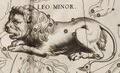 Leo Minor in Hevelius's defining map (1687)
 -
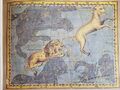 Leo Minor and Lynx in Bode (1782, 1805)
 -
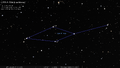 (1952) H.A. Rey's stick figure of Leo Minor
 -
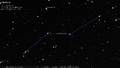 (1988) O. Hlad's stick figure of Leo Minor


Mythology
Weblinks
- Ian Ridpath's Star Tales Leo Minor
References
- ↑ Hoffmann, Susanne M. Wie der Löwe an den Himmel kam. Franckh Kosmos Verlag, Stuttgart 2021





