Lyra: Difference between revisions
No edit summary |
|||
| (34 intermediate revisions by 4 users not shown) | |||
| Line 1: | Line 1: | ||
Authors: {{PAGEAUTHORS}} | |||
---- | |||
[[File:Lyra IAU.svg|alt=star chart|thumb|Lyra star chart (IAU and Sky & Telescope magazine, Roger Sinnott & Rick Fienberg).]] | [[File:Lyra IAU.svg|alt=star chart|thumb|Lyra star chart (IAU and Sky & Telescope magazine, Roger Sinnott & Rick Fienberg).]] | ||
{{Infobox constellation | |||
| name = Λύρα (Lyra) | |||
| native = Λύρα | |||
| translation = Lyre | |||
| pronounce = Lyra | |||
| IPA = | |||
| culture = Greek (Almagest) | |||
| RA = 279.155601 to 289.0920557 | |||
| dec = 30.7334046 to 39.67012917 | |||
| areatotal = 67.85 | |||
| numbermainstars = 33 | |||
| numberbfstars = 19 | |||
| numberstarsplanets = | |||
| numberbrightstars = 1 | |||
| numbernearbystars = | |||
| brighteststarname = [[Vega]] | |||
| starmagnitude = 0.03 | |||
| neareststarname = | |||
| stardistance = | |||
| numbermessierobjects = | |||
| meteorshowers = | |||
| bordering = Lyr | |||
| notes = | |||
| cat = Almagest constellation | |||
}} | |||
Lyra, The Lyre, one of the [[:Category:88_IAU-Constellations|88 IAU constellations]]. | |||
[[File:KugelGlobe Sge.JPG|thumb|Cyg, Lyr, Del, Aql and Sge on the Kugel Globe (1st century BCE), SMH 2024.]] | |||
==Etymology and History== | ==Etymology and History== | ||
The Greek | '''Note:'''<ref name=":0">Hoffmann, Susanne M. Wie der Löwe an den Himmel kam. Franckh Kosmos Verlag, Stuttgart 2021</ref> In some languages, the translation may be ambiguous but it is by no means a barrel organ. The lyre is a musical instrument used in Greek folk music, surrounded by an opulent mythology. According to legend, Hermes invented the instrument when he strung a turtle shell with strings. In original Greek depictions, the sound box of the heavenly lyre therefore has the shape of a turtle – e.g. on the globe of the Farnese Atlas. | ||
===Origin of Constellation=== | |||
The myths surrounding the lyre contain numerous topoi from Greek culture:<ref name=":0" /> Hermes is the son of one of the [[Pleiades|Pleiade]]<nowiki/>s, the seven daughters of Atlas. That is why his lyre has seven strings. Orpheus is the son of one of the nine Muses, which is why his lyre has nine strings. This alludes to a piece of music history, as the number of strings developed from three to as many as 18. | |||
Orpheus' journey with his lyre into the underworld is topical for the characteristic of music to overcome the limits of mortality and attain immortality. | |||
The name of the brightest star, [[Vega]], is of Arabic origin. It comes from ''an-naṣr al-waqi,'' the Arabic expression for a ‘diving eagle’ on the hunt. This is a constellation that is probably of Arabic origin and differs from the Greek eagle. Knowledge of this origin of the star's name has been passed down to this day, which is why modern star charts sometimes depict an eagle holding a lyre in its beak. This representation has a heraldic effect. Joh. E. Bode also depicts the constellation in this way in his trilingual ''Uranographia'' (1801), but then writes in German ‘der Geyer mit der Leyer’ (the eagle with the lyre) or in Latin: Vulture et Lyra. It is quite possible that he renamed the constellation because of the amusing rhyme. | |||
However, depictions of the Greek instrument vary greatly: sometimes the foot is at the top, sometimes at the bottom. In the drawings from Bode's two star charts – the ''Anleitung zur Kenntniß des gestirnten Himmels'' (Guide to the Knowledge of the Starry Sky) from 1782 and the ''Uranographia'' from 1801 – we find both variants even from the same author. | |||
==== Babylonian ==== | |||
The constellation has no precursors in Babylon.<ref name=":0" /> In Mesopotamia, the constellation of the Sumerian deity [[Gula]] was located at this point in the sky. She is one of the most important goddesses because, among other things, she is responsible for medicine. Since the 3rd millennium, depictions of Gula have been handed down in the form of reliefs and statues: she is often seated on a throne (or symbolically on a temple building). She is usually accompanied by her attribute animal, the dog, which occupies parts of the neighbouring constellation Hercules. | |||
The star Vega is called ‘goat star’ in Babylonian and is of great importance in the cult of medicine. Recipes for medicines often state that a mixture should be irradiated by the goat star before being administered to the patient, i.e. it should be placed outside at night. | |||
==== Greco-Roman ==== | |||
===== Aratus ===== | |||
<blockquote>The Tortoise too is small; when Hermes was actually still in his cradle, he hollowed out the shell and bade it be called a Lyre. [270] He set it down in front of the unknown figure, when he had brought it to the sky. The figure, as he crouches, comes near it with his left knee, while the Bird’s head at one extremity circles opposite it: the Lyre is set fast between the Bird’s head and the knee. (Kidd 1997)</blockquote> | |||
===== Eratosthenes ===== | |||
Pamias and Zucker (2013,<ref>Pamìas, Jordi und Zucker, Arnaud (2013). Ératosthènes de Cyrène: Catastérrismes, Belles Lettres, Paris</ref> 73-75)<blockquote>'''Var. 1 (Περὶ τῆς Λύρας)''': It occupies the ninth position, and is the constellation of the Muses. It was originally fashioned by Hermes from a tortoise shell and Apollo’s oxen; it had seven strings, corresponding to the number of Atlas’s daughters. Apollo received it from him and, after composing a song on the lyre, presented it to Orpheus who, being the son of Calliope, one of the Muses, gave it nine strings, corresponding to the number of the Muses; Orpheus developed its potential and gained such fame among men that he was even credited with the power to charm wild beasts through his playing. After descending into Hades because of his wife, and having seen what went on there, he ceased to honour Dionysus, to whom he nevertheless owed his fame, and regarded Helios as the mightiest of the gods, invoking him also by the name of Apollo. He would wake at night, climb the mountain known as Pangaeus at dawn, and stand facing the east to be the first to see the sun. Dionysus was angered by this and sent the Bassarides against him, as the tragic poet Aeschylus relates; they tore him to pieces and scattered his limbs in all directions. The Muses gathered them up and buried them on the mountains called Leibethra. […] He consented to this, and so she was placed <in the heavens>. She signals a change of weather in what is commonly…</blockquote><blockquote>'''Var. 2 (Λύρας)''': It ranks ninth among the constellations, and is the constellation of the Muses. It was originally fashioned by Hermes from a tortoise and Apollo’s oxen; it was fitted with seven strings, corresponding to the number of Atlas’s daughters. Apollo received it from his hands and, after composing a song on the lyre, offered it to Orpheus who, being the son of Calliope, one of the Muses, gave it nine strings, corresponding to the number of the Muses; Orpheus developed its capabilities and gained such fame among men that he was even credited with the power to charm, through his playing, even stones and wild beasts. He refused to honour Dionysus, and regarded Helios, whom he also called Apollo, as the mightiest of the gods. He would wake at night, climb the mountain known as Pangaeus at dawn, and stand facing the east to be the first to see the sun. Dionysus was angered by this and sent the Bassarides against him, as the poet Aeschylus relates; they tore him to pieces and scattered his limbs in all directions. The Muses gathered them up and buried them on the mountains called Leibethra.</blockquote><blockquote>And as they did not know to whom to give the lyre, they asked Zeus to place it amongst the constellations, so that it might appear amongst the stars in memory of Orpheus and of themselves. Zeus agreed, and so it was placed in the heavens. It signals a change in the weather in connection with Orpheus’s misfortune, for it sets with each passing season.</blockquote><blockquote>It bears a star on each ear, one at the tip of each arm, one at one end, one on each shoulder, one on the crossbar, and one at its base—white and shining. Nine in all.</blockquote>'''Eratosthenes's star catalogue''' can be reconstructed from the list of stars he mentions in the last section of each of the constelllation descriptions. Hoffmann (2017)<ref name=":02">Hoffmann, S. M., <nowiki><i>Hipparchs Himmelsglobus</i></nowiki>. Springer Wiesbaden/ New York, 2017. doi:10.1007/978-3-658-18683-8.</ref> made such a catalogue and used it for computational comparison with Hipparchus's, Ptolemy's and Babylonian data; it is based on the edition and translation by Pamias and Geus (2007)<ref>Eratosthenes: Sternsagen, übersetzt von Pamìas, Jordi und Geus, Klaus, Verlag Utopica, Oberhaid 2007</ref> and presented here in English translation. | |||
{|class="wikitable" | |||
|+ | |||
!erat.Cat.ID | |||
!constStarID | |||
!starName | |||
!ident.Bayer | |||
!ident.HIP | |||
!certainty | |||
|- | |||
|391 | |||
|1 | |||
|one star on each side of the crest | |||
|delta2 Lyr | |||
|92791 | |||
|2 | |||
|- | |||
|392 | |||
|2 | |||
|one star on each side of the crest | |||
|zeta1 Lyr | |||
|91971 | |||
|2 | |||
|- | |||
|393 | |||
|3 | |||
|one on each arm | |||
|eta Lyr | |||
|94481 | |||
|1 | |||
|- | |||
|394 | |||
|4 | |||
|one on each arm | |||
|beta Lyr | |||
|92420 | |||
|1 | |||
|- | |||
|395 | |||
|5 | |||
|similarly, one on the tip | |||
|eps Lyr | |||
|91926 | |||
|2 | |||
|- | |||
|396 | |||
|6 | |||
|one on each shoulder | |||
|gam Lyr | |||
|93194 | |||
|1 | |||
|- | |||
|397 | |||
|7 | |||
|one on each shoulder | |||
|theta Lyr | |||
|94713 | |||
|1 | |||
|- | |||
|398 | |||
|8 | |||
|one on the bridge | |||
|iota Lyr | |||
|93903 | |||
|1 | |||
|- | |||
|399 | |||
|9 | |||
|a white and bright one on the base | |||
|alpha Lyr | |||
|91262 | |||
|1 | |||
|} | |||
===== Ovid, Fasti ===== | |||
<blockquote>[1, 315] Should the Nones be at hand, showers discharged from sable clouds will be your sign, at the rising of the Lyre. | |||
[1, 653] When the seventh sun, reckoned from that day, shall have set in the sea, the Lyre will shine no longer anywhere in the sky. | |||
[1, 655] After the setting of that constellation (the Lyre), the fire that glitters in the middle of the Lion’s breast will be sunk below the horizon at nightfall. (James George Frazer 1931)</blockquote> | |||
===== Hipparchus ===== | |||
====== Rising (Lib II Cap V §10) ====== | |||
<blockquote>The Rising of ...</blockquote> | |||
{| class="wikitable" | |||
|+ | |||
! | |||
! colspan="2" |east | |||
! colspan="2" |south | |||
|- | |||
! | |||
!lam1 | |||
!lam2 | |||
!lam1 | |||
!lam2 | |||
|- | |||
| | |||
|Sco 8 1/2 | |||
|Sco 18 | |||
|Leo 12 1/2 | |||
|Leo 26 | |||
|- | |||
| | |||
| | |||
| | |||
| | |||
| | |||
|- | |||
|star | |||
|the one north of the bright one (eps) | |||
|the eastern one of the three on the jetty | |||
| | |||
| | |||
|- | |||
|duration | |||
| colspan="4" |4/5 hours = 48 min = 12 degree | |||
|} | |||
====== Setting (Lib II Cap VI §10) ====== | |||
{| class="wikitable" | |||
! | |||
! colspan="2" |west | |||
! colspan="2" |south | |||
|- | |||
! | |||
!lam1 | |||
!lam2 | |||
!lam1 | |||
!lam2 | |||
|- | |||
| | |||
|Aqr 4 | |||
|Aqr 12 | |||
|Ari 12 1/2 | |||
|Tau 3 | |||
|- | |||
| | |||
| | |||
| | |||
| | |||
| | |||
|- | |||
|star | |||
|the front one of the two bright on the jetty (beta) | |||
|the one north of the bright one (eps) | |||
| | |||
| | |||
|- | |||
|duration | |||
| colspan="4" |2/3 hours = 40 min = 10° | |||
|} | |||
====== Hipparchus's "lost" star Catalogue ====== | |||
The star catalogue of Hipparchus is not preserved. Yet, several scholars have reconstructed it in the past century: Vogt (1925)<ref>Vogt, H., “Versuch einer Wiederherstellung von Hipparchs Fixsternver zeichnis”, <nowiki><i>Astronomische Nachrichten</i></nowiki>, vol. 224, no. 2, Wiley, p. 17, 1925. doi:10.1002/asna.19252240202.</ref>, Grasshoff (1990)<ref>Graßhoff, G., <nowiki><i>The History of Ptolemy's Star Catalogue</i></nowiki>, Springer, New York, 1990 </ref>, Hoffmann (2017)<ref>Hoffmann, S. M., <nowiki><i>Hipparchs Himmelsglobus</i></nowiki>. Springer Wiesbaden/ New York, 2017. doi:10.1007/978-3-658-18683-8.</ref> and Glover (2026)<ref>Glover, E. (2026). ''The Astronomy of Hipparchus'', Cambridge University Press</ref>. Grasshoff's catalogue and computations are not published digitally, Hoffmann published three versions of the Manitius+Hoffmann<ref>Hipparchus's Lost Star Catalogue (1/2 reconstructed) (Hoffmann, 2017) in VizieR</ref> star lists in the CDS [https://vizier.unistra.fr/ VizieR] "catalog of catalogs", and Glover printed the star lists constellationwise in his book. | |||
{|class="wikitable" | |||
|+ Hipparchus's star in Aquarius (Glover 2026) | |||
!hipp.Cat.ID | |||
!constStarID | |||
!starName | |||
!ident.Bayer | |||
!ident.HIP | |||
!concordance | |||
|- | |||
|388 | |||
|1 | |||
| | |||
|α Lyr | |||
|91262 | |||
|CPAE | |||
|- | |||
|389 | |||
|2 | |||
| | |||
|β Lyr | |||
|92420 | |||
|CPAE | |||
|- | |||
|390 | |||
|3 | |||
| | |||
|γ Lyr | |||
|93194 | |||
|CPAE | |||
|- | |||
|391 | |||
|4 | |||
| | |||
|ε Lyr (ε1) | |||
|91919 | |||
|CPAE | |||
|- | |||
|392 | |||
|5 | |||
| | |||
|13 (R) Lyr | |||
|92862 | |||
|CPAE | |||
|- | |||
|393 | |||
|6 | |||
| | |||
|μ Lyr | |||
|90191 | |||
|non-CPAE | |||
|} | |||
===== Hyginus, Astronomica ===== | |||
<blockquote>The Lyre was put among the constellations for the following reason, as Eratosthenes says. Made at first by Mercury from a tortoise shell, it was given to Orpheus, son of Calliope and Oiagrus, who was passionately devoted to music. It is thought that by his skill he could charm even wild beasts to listen. When, grieving for his wife Eurydice, he descended to the Lower World, he praised the children of the gods in his song, all except Father Liber; him he overlooked and forgot, as Oineus did Diana in sacrifice. Afterwards, then, when Orpheus was taking delight in song, seated, as many say, on Mt. Olympus, which separates Macedonia from Thrace, or on Pangaion, as Eratosthenes says, Liber is said to have roused the Bacchanals against him. They slew him and dismembered his body. But others say that this happened because he had looked on the rites of Liber. The Muses gathered the scattered limbs and gave them burial, and as the greatest favour they could confer, they put as a memorial his lyre, pictured with stars, among the constellations. Apollo and Jove consented, for Orpheus had praised Apollo highly, and Jupiter granted this favour to his daughter. | |||
Others say that when Mercury first made the lyre on Mount Cyllene in Arcadia, he made it with seven strings to correspond to the number of Atlantides, since Maia, his mother, was of their company. Later, when he had driven away the cattle of Apollo and had been caught in the act, to win pardon more easily, at Apollo's request he gave him permission to claim the invention of the lyre, and received from him a certain staff as reward. When Mercury, holding it in his hand, was journeying to Arcadia and saw two snakes with bodies intertwined, apparently fighting, he put down the staff between them. They separated then, and so he said that the staff had been appointed to bring peace. Some, in making caducei, put two snakes intertwined on the rod, because this seemed to Mercury a bringer of peace. Following his example, they use the staff in athletic contests and other contests of this kind. | |||
But to return to the subject at hand. Apollo took the lyre, and is said to have taught Orpheus on it, and after he himself had invented the cithara, he gave the lyre to Orpheus. | |||
Some also have said that Venus and Proserpina came to Jove for his decision, asking him to which of them he would grant Adonis. Calliope, the judge appointed by Jove, decided that each should posses him half of the year. But Venus, angry because she had not been granted what she thought was her right, stirred the women in Thrace by love, each to seek Orpheus for herself, so that they tore him limb from limb. His head, carried down from the mountain into the sea, was cast by the waves upon the island of Lesbos. It was taken up and buried by the people of Lesbos, and in return for this kindness, they have the reputation of being exceedingly skilled in the art of music. The lyre, as we have said, was put by the Muses among the stars. | |||
Some say that because Orpheus first favored love for youths, he seemed to insult women, and for this reason they killed him. (Mary Ward 1960)</blockquote> | |||
===== Geminos ===== | |||
==== Almagest Δύρα. ==== | |||
{| class="wikitable" | |||
!id | |||
!Greek | |||
(Heiberg 1898) | |||
!English | |||
(Toomer 1984) | |||
!ident. | |||
|- | |||
! | |||
!Λόρας ἀστερισμός. | |||
!Constellation of Lyra | |||
! | |||
|- | |||
|1 | |||
|ὁ λαμπρὸς ὁ ἐπὶ τοῦ ὀστράκου καλούμευος Δύρα. | |||
|The bright star on the shell, called Lyra | |||
|alf Lyr | |||
|- | |||
|2 | |||
|τῶν παρακειμένων αὐτῷ β συνεχῶν ὁ βόρειος | |||
|The northernmost of the 2 stars lying near the latter, close together | |||
|eps Lyr | |||
|- | |||
|3 | |||
|ὁ νοτιώτερος αὐτῶν. | |||
|The southernmost of them | |||
|zet Lyr | |||
|- | |||
|4 | |||
|ὁ τούτοις ἐπόμενος καὶ μέσος τῆς ἐκφύσεως τῶν κεράτωυ | |||
|The one to the rear of these, in between the points where the horns [of the lyre] are attached | |||
|del Lyr | |||
|- | |||
|5 | |||
|τῶν ἐν τῷ πρὸς ἀνατολὴν τοῦ ὀστράκου β συνεχῶν ὁ βόρειος. | |||
|The northernmost of the 2 stars close together in the region to the east of the shell | |||
|eta Lyr | |||
|- | |||
|6 | |||
|ὁ νοτιώτερος αὐτῶν | |||
|The southernmost of them | |||
|tet Lyr | |||
|- | |||
|7 | |||
|τῶν ἐν τῷ ξυγώματι προηγουμένων β ὁ βορειότερος. | |||
|The northernmost of the two advance stars in the bridge | |||
|bet Lyr | |||
|- | |||
|8 | |||
|ὁ νοτιώτερος αὐτῶν | |||
|The southernmost of them | |||
|nu Lyr | |||
|- | |||
|9 | |||
|τῶν ἐν τῷ ζυγώματι ἐπομένων β ὁ βορειότερος αὐτῶν. | |||
|The northernmost of the two rear stars in the bridge | |||
|gam Lyr | |||
|- | |||
|10 | |||
|ὁ ροτιώτερος αὐτῶν. | |||
|The southernmost of them | |||
|lam Lyr | |||
|- | |||
| | |||
| | |||
| | |||
| | |||
|- | |||
| | |||
|ἀστέρες ἱ, ὥρ α μεγέθους ἄ, γ’ β, δ’ ὅ | |||
|{10 stars, 1 of the first magnitude, 2 of the third, 7 of the fourth} | |||
| | |||
|} | |||
[[File:Lyra Youla CH.png|thumb|Convex Hull for the stars inside Lyra (CC BY Youla Azkarrula).]] | |||
===== Stars within the Constellation Area ===== | |||
{| class="wikitable sortable mw-collapsible" | |||
|+ | |||
!id | |||
!Label | |||
!IAU design. | |||
!description | |||
!Vmag | |||
|- | |||
|1 | |||
|Vega | |||
|HIP 91262 | |||
|Constellation lines (Vertex) | |||
|0.03 | |||
|- | |||
|2 | |||
|Sulafat | |||
|HIP 93194 | |||
|Constellation lines | |||
|3.25 | |||
|- | |||
|3 | |||
|Sheliak | |||
|HIP 92420 | |||
|Constellation lines | |||
|3.42 | |||
|- | |||
|4 | |||
|NAME del Lyr Cluster | |||
|NAME del Lyr Cluster | |||
|Inside the hull | |||
|3.8 | |||
|- | |||
|5 | |||
|δ<sup>2</sup> Lyrae | |||
|HIP 92791 | |||
|Constellation lines | |||
|4.3 | |||
|- | |||
|6 | |||
|ζ<sup>1</sup> Lyrae | |||
|HIP 91971 | |||
|Constellation lines | |||
|4.36 | |||
|- | |||
|7 | |||
|θ Lyrae | |||
|HIP 94713 | |||
|Constellation lines (Vertex) | |||
|4.38 | |||
|- | |||
|8 | |||
|Aladfar | |||
|HIP 94481 | |||
|Constellation lines (Vertex) | |||
|4.398 | |||
|- | |||
|9 | |||
|λ Lyrae | |||
|HIP 93279 | |||
|Constellation lines | |||
|4.93 | |||
|- | |||
|10 | |||
|* eps<sup>1</sup> Lyr A | |||
|HIP 91919 | |||
|Constellation lines (Vertex) | |||
|4.991 | |||
|- | |||
|11 | |||
|17 Lyr | |||
|HIP 93917 | |||
|Constellation lines | |||
|5.22 | |||
|- | |||
|12 | |||
|ν<sup>2</sup> Lyrae | |||
|HIP 92405 | |||
|Constellation lines | |||
|5.226 | |||
|- | |||
|13 | |||
|* eps<sup>2</sup> Lyr A | |||
|HIP 91926 | |||
|Inside the hull | |||
|5.23 | |||
|- | |||
|14 | |||
|ι Lyrae | |||
|HIP 93903 | |||
|Constellation lines | |||
|5.253 | |||
|- | |||
|15 | |||
| - | |||
|HR 7162 | |||
|Inside the hull | |||
|5.277 | |||
|- | |||
|16 | |||
| - | |||
|HIP 91235 | |||
|Constellation lines (Vertex) | |||
|5.41 | |||
|- | |||
|17 | |||
| - | |||
|HIP 93718 | |||
|Inside the hull | |||
|5.56 | |||
|- | |||
|18 | |||
|δ<sup>1</sup> Lyrae | |||
|HIP 92728 | |||
|Constellation lines | |||
|5.573 | |||
|- | |||
|19 | |||
|ζ<sup>2</sup> Lyrae | |||
|HIP 91973 | |||
|Inside the hull | |||
|5.585 | |||
|- | |||
|20 | |||
| - | |||
|HIP 91883 | |||
|Constellation lines (Vertex) | |||
|5.682 | |||
|- | |||
|21 | |||
|V542 Lyr | |||
|HIP 93104 | |||
|Inside the hull | |||
|5.883 | |||
|- | |||
|22 | |||
|ν<sup>1</sup> Lyrae | |||
|HIP 92398 | |||
|Inside the hull | |||
|5.91 | |||
|- | |||
|23 | |||
| - | |||
|HIP 92833 | |||
|Inside the hull | |||
|6.03 | |||
|- | |||
|24 | |||
|Xihe | |||
|HIP 91852 | |||
|Inside the hull | |||
|6.037 | |||
|- | |||
|25 | |||
| - | |||
|HIP 93354 | |||
|Inside the hull | |||
|6.038 | |||
|- | |||
|26 | |||
| - | |||
|HIP 92243 | |||
|Inside the hull | |||
|6.054 | |||
|- | |||
|27 | |||
| - | |||
|HIP 93720 | |||
|Constellation lines (Vertex) | |||
|6.06 | |||
|- | |||
|28 | |||
| - | |||
|HIP 92551 | |||
|Inside the hull | |||
|6.082 | |||
|- | |||
|29 | |||
| - | |||
|HIP 93437 | |||
|Inside the hull | |||
|6.381 | |||
|- | |||
|30 | |||
| - | |||
|HIP 93210 | |||
|Inside the hull | |||
|6.403 | |||
|- | |||
|31 | |||
| - | |||
|HIP 91820 | |||
|Inside the hull | |||
|6.44 | |||
|- | |||
|32 | |||
| - | |||
|HIP 91707 | |||
|Inside the hull | |||
|6.473 | |||
|- | |||
|33 | |||
| - | |||
|HIP 91552 | |||
|Inside the hull | |||
|6.489 | |||
|} | |||
=== Mediaeval, Renaissance and Early Modern Source === | |||
==== Alfonsine Tables (1483) ==== | |||
In 1483 the printer Erhard Ratdolt, working in Venice, published Tabulae Alphonsinae or the Alphonsine Tables, a compilation of astronomical data tabulating the positions and movements of the planets. | |||
=== | ==== Dürer (1515) ==== | ||
The pair of celestial maps created by Albrecht Dürer in 1515, one showing the Northern Hemisphere sky and the other the Southern Hemisphere sky, are generally regarded as the first printed star charts published in Europe. | |||
Schickard wrote it ... . | |||
==== Bayer and de Houtman (1603) ==== | |||
In his Uranometria, Bayer gives all the name alternatives mentioned above: | |||
==== Rudolphine Tables (1627) ==== | |||
[[File:Lyr+Cyg RudolphTab.png|thumb|Lyr in the Rudolphine Tables (Kepler 1627).]] | |||
The Tabulae Rudolphinae were ordered and dedicated to Emperor Rudolph II of the Holy Roman Empire. The main purpose was to allow the computation of the positions of the five classically known planets, but the tables also consist of a star catalogue. They were published by Johannes Kepler (1627), including earlier work and observational data by Tycho Brahe. The original Latin title is "Tabulæ Rudolphinæ, Quibus Astronomicæ Scientiæ, Temporum longinquitate collapsæ Restauratio continetur". | |||
Kepler uses classical '''Lyra''' as the primary designation but gives the name variant '''Vultur Cadens''' witnessing traces of the Arabic constellation of the "Eagle that rushes down" in this area of the sky. | |||
===Transfer and Transformation of the Constellation=== | ===Transfer and Transformation of the Constellation=== | ||
<gallery> | <gallery> | ||
File:Aratea fol. 44v.jpg|Lyr in Leiden Aratea (~840 CE) | |||
File:Lyra Uranometria.jpg|Lyra in Bayer (1603) | |||
File:Lyr+Cyg RudolphTab.png|Lyr = Vultur Cadens in Kepler (1627) | |||
File:Hugo-de-Groot-Syntagma-Arateorum MG 0619.tif|Lyra in Hugo-de-Groot: Syntagma Arateorum | |||
File:Lyra Hevelius1690.jpg|Lyra in Hevelius (1690) | |||
File:1776 - John Flamsteed - La Lyre, Le Cigne, Le Lezard, Le Renard (Lyra, Cygnus, Lacerta, Vupecula).jpg|Lyra in Flamsteed (1776) | |||
File:Lyr Fortin1795.jpg|Lyra in Fortin's Atlas Céleste, 3rd edition (1795). | File:Lyr Fortin1795.jpg|Lyra in Fortin's Atlas Céleste, 3rd edition (1795). | ||
File:8 Uranographia.jpg|Lyra in Bode (1801) | |||
File:Young1807 Lyra.JPG|Lyra in Young (1807): A Course of Lectures on Natural Philosophy and the Mechanical Arts. | |||
File:Sidney Hall - Urania's Mirror - Lacerta, Cygnus, Lyra, Vulpecula and Anser.jpg|Lyra in Hall (1825) | |||
File:H.A. Rey's stick figure stellarium-049.png|(1952) H.A. Rey's stick figure of Lyra | |||
File:O. Hlad's stick figure stellarium-050.png|(1988) O. Hlad's stick figure of Lyra | |||
File:Stellarium-088-Alm.png|Reconstruction of Stickfigure based on the depiction of Almagest (100-170 CE). CC-BY Susanne Hoffmann in Stellarium. | |||
File:Stellarium-087-Far.png|Image of the Farnese Globe (2nd century CE) taken by Susanne Hoffmann and imported into Stellarium. | |||
</gallery> | </gallery> | ||
==Mythology== | ==Mythology<ref name=":0" />== | ||
The god Hermes tended Apollo's cattle – a rather idle occupation, during which a quick-witted fellow like him could easily come up with brilliant ideas. He strung seven strings across a turtle shell and coaxed sounds from it. Since he then stole Apollo's cattle, he gave Apollo the lyre as compensation. Apollo composed a song with it and then passed the lyre on to Orpheus. Orpheus added two strings and became a famous singer. He was reputed to be able to charm animals and even stones with his singing. | |||
However, Orpheus' story is tragic: after his wife died, he descended into the underworld to bring her back. There are two versions of the story: In Plato's version, he fails because the gods only show him a shadow image of his wife; in Diodorus' version, he succeeds. Roman versions describe a near success, i.e. a meeting with his wife, but failure to bring her back at the last minute. | |||
In any case, after his visit to the underworld, Orpheus is no longer the same, changes his way of life and worships other gods. After his death, the Muses ask Zeus to place his lyre in the sky. It stands there in memory of the Muses themselves and their offspring Orpheus. According to Eratosthenes, it is also a symbol of the singer's tragic death. For today's viewer, it is a symbol of the immortality of music and of excellent musicians, whose works live on after their death and are interpreted in new ways.<gallery> | |||
File:Ainter of Agora 393 - ARV extra - standing boy with lyra and hare - Athens Agora Museum - 02.jpg|Ainter of Agora 393 - ARV extra - standing boy with lyra and hare - Athens Agora Museum | |||
File:Achilles Painter ARV 990 41 youth with lyra and boy - bearded man with staff (02).jpg|Achilles Painter ARV 990 41 youth with lyra | |||
File:Cartellino Painter - ARV 452 5 - youth with lyra - Athens NAM 12803 - 02.jpg|Cartellino Painter - ARV 452 5 - youth with lyra - Athens NAM 12803 | |||
File:Lyra symbol.jpg|symbol of an ancient lyra | |||
File:Lyra symbol2.jpg|symbol of an ancient lyra | |||
File:Kalymna - 560-540 BC - silver stater - head of warrior - lyra - Berlin MK BM 18200148.jpg|Kalymna - 560-540 BC - silver stater - head of warrior - lyra - Berlin MK BM 18200148 | |||
File:Statue of Erato.jpg|Statue of Erato (with lyre) | |||
</gallery> | |||
==Weblinks== | ==Weblinks== | ||
* | * [https://iconographic.warburg.sas.ac.uk/category/vpc-taxonomy-017045 Warburg Institute Iconographic Database – Lyra] | ||
* [https://iconographic.warburg.sas.ac.uk/category/vpc-taxonomy-017046 Warburg Institute Iconographic Database – Vultur Cadens] | |||
* Ian Ridpath's ''Star Tales'' – [http://www.ianridpath.com/startales/lyra.html Lyra] | |||
==References== | ==References== | ||
| Line 26: | Line 624: | ||
*[[References (Medieval and Early Modern)|References (medieval)]] | *[[References (Medieval and Early Modern)|References (medieval)]] | ||
[[Category:Eurasia]] | [[Category:Eurasia]] [[Category:European]] | ||
[[Category:Constellation]] | [[Category:Constellation]] [[Category:Asterism]] | ||
[[Category: | [[Category:Almagest]] [[Category:Africa]] | ||
[[Category: | |||
[[Category: | |||
[[Category:Modern]] | [[Category:Modern]] | ||
[[Category:88 IAU-Constellations]] | [[Category:88 IAU-Constellations]] [[Category:Lyr]] | ||
[[Category: | |||
Latest revision as of 03:54, 25 September 2026
Authors: Susanne M Hoffmann, Doris Vickers, Youla Azkarrula, Ian Ridpath

| Asterism Info | |
| Native | Λύρα |
|---|---|
| Romanisation | Lyra |
| Translation | Lyre |
| Position (2000) | |
| Right ascension | 279.155601 to 289.0920557 |
| Declination | 30.7334046 to 39.67012917 |
| Area | 67.85 sq. deg. |
| Stars | |
| Bright stars | 33 |
| Bayer/Flamsteed stars | 19 |
| Stars brighter than 3.00m | 1 |
| Brightest star | Vega (0.03m) |
| Taxonomy | |
| category of asterism | Almagest constellation |
| IAU- constellations | Lyr |
Lyra, The Lyre, one of the 88 IAU constellations.

Etymology and History
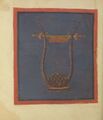
Note:[1] In some languages, the translation may be ambiguous but it is by no means a barrel organ. The lyre is a musical instrument used in Greek folk music, surrounded by an opulent mythology. According to legend, Hermes invented the instrument when he strung a turtle shell with strings. In original Greek depictions, the sound box of the heavenly lyre therefore has the shape of a turtle – e.g. on the globe of the Farnese Atlas.
Origin of Constellation
The myths surrounding the lyre contain numerous topoi from Greek culture:[1] Hermes is the son of one of the Pleiades, the seven daughters of Atlas. That is why his lyre has seven strings. Orpheus is the son of one of the nine Muses, which is why his lyre has nine strings. This alludes to a piece of music history, as the number of strings developed from three to as many as 18.
Orpheus' journey with his lyre into the underworld is topical for the characteristic of music to overcome the limits of mortality and attain immortality.
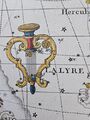
The name of the brightest star, Vega, is of Arabic origin. It comes from an-naṣr al-waqi, the Arabic expression for a ‘diving eagle’ on the hunt. This is a constellation that is probably of Arabic origin and differs from the Greek eagle. Knowledge of this origin of the star's name has been passed down to this day, which is why modern star charts sometimes depict an eagle holding a lyre in its beak. This representation has a heraldic effect. Joh. E. Bode also depicts the constellation in this way in his trilingual Uranographia (1801), but then writes in German ‘der Geyer mit der Leyer’ (the eagle with the lyre) or in Latin: Vulture et Lyra. It is quite possible that he renamed the constellation because of the amusing rhyme.
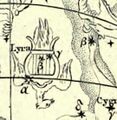
However, depictions of the Greek instrument vary greatly: sometimes the foot is at the top, sometimes at the bottom. In the drawings from Bode's two star charts – the Anleitung zur Kenntniß des gestirnten Himmels (Guide to the Knowledge of the Starry Sky) from 1782 and the Uranographia from 1801 – we find both variants even from the same author.
Babylonian
The constellation has no precursors in Babylon.[1] In Mesopotamia, the constellation of the Sumerian deity dGula was located at this point in the sky. She is one of the most important goddesses because, among other things, she is responsible for medicine. Since the 3rd millennium, depictions of Gula have been handed down in the form of reliefs and statues: she is often seated on a throne (or symbolically on a temple building). She is usually accompanied by her attribute animal, the dog, which occupies parts of the neighbouring constellation Hercules.
The star Vega is called ‘goat star’ in Babylonian and is of great importance in the cult of medicine. Recipes for medicines often state that a mixture should be irradiated by the goat star before being administered to the patient, i.e. it should be placed outside at night.
Greco-Roman
Aratus
The Tortoise too is small; when Hermes was actually still in his cradle, he hollowed out the shell and bade it be called a Lyre. [270] He set it down in front of the unknown figure, when he had brought it to the sky. The figure, as he crouches, comes near it with his left knee, while the Bird’s head at one extremity circles opposite it: the Lyre is set fast between the Bird’s head and the knee. (Kidd 1997)
Eratosthenes
Pamias and Zucker (2013,[2] 73-75)
Var. 1 (Περὶ τῆς Λύρας): It occupies the ninth position, and is the constellation of the Muses. It was originally fashioned by Hermes from a tortoise shell and Apollo’s oxen; it had seven strings, corresponding to the number of Atlas’s daughters. Apollo received it from him and, after composing a song on the lyre, presented it to Orpheus who, being the son of Calliope, one of the Muses, gave it nine strings, corresponding to the number of the Muses; Orpheus developed its potential and gained such fame among men that he was even credited with the power to charm wild beasts through his playing. After descending into Hades because of his wife, and having seen what went on there, he ceased to honour Dionysus, to whom he nevertheless owed his fame, and regarded Helios as the mightiest of the gods, invoking him also by the name of Apollo. He would wake at night, climb the mountain known as Pangaeus at dawn, and stand facing the east to be the first to see the sun. Dionysus was angered by this and sent the Bassarides against him, as the tragic poet Aeschylus relates; they tore him to pieces and scattered his limbs in all directions. The Muses gathered them up and buried them on the mountains called Leibethra. […] He consented to this, and so she was placed <in the heavens>. She signals a change of weather in what is commonly…
Var. 2 (Λύρας): It ranks ninth among the constellations, and is the constellation of the Muses. It was originally fashioned by Hermes from a tortoise and Apollo’s oxen; it was fitted with seven strings, corresponding to the number of Atlas’s daughters. Apollo received it from his hands and, after composing a song on the lyre, offered it to Orpheus who, being the son of Calliope, one of the Muses, gave it nine strings, corresponding to the number of the Muses; Orpheus developed its capabilities and gained such fame among men that he was even credited with the power to charm, through his playing, even stones and wild beasts. He refused to honour Dionysus, and regarded Helios, whom he also called Apollo, as the mightiest of the gods. He would wake at night, climb the mountain known as Pangaeus at dawn, and stand facing the east to be the first to see the sun. Dionysus was angered by this and sent the Bassarides against him, as the poet Aeschylus relates; they tore him to pieces and scattered his limbs in all directions. The Muses gathered them up and buried them on the mountains called Leibethra.
And as they did not know to whom to give the lyre, they asked Zeus to place it amongst the constellations, so that it might appear amongst the stars in memory of Orpheus and of themselves. Zeus agreed, and so it was placed in the heavens. It signals a change in the weather in connection with Orpheus’s misfortune, for it sets with each passing season.
It bears a star on each ear, one at the tip of each arm, one at one end, one on each shoulder, one on the crossbar, and one at its base—white and shining. Nine in all.
Eratosthenes's star catalogue can be reconstructed from the list of stars he mentions in the last section of each of the constelllation descriptions. Hoffmann (2017)[3] made such a catalogue and used it for computational comparison with Hipparchus's, Ptolemy's and Babylonian data; it is based on the edition and translation by Pamias and Geus (2007)[4] and presented here in English translation.
| erat.Cat.ID | constStarID | starName | ident.Bayer | ident.HIP | certainty |
|---|---|---|---|---|---|
| 391 | 1 | one star on each side of the crest | delta2 Lyr | 92791 | 2 |
| 392 | 2 | one star on each side of the crest | zeta1 Lyr | 91971 | 2 |
| 393 | 3 | one on each arm | eta Lyr | 94481 | 1 |
| 394 | 4 | one on each arm | beta Lyr | 92420 | 1 |
| 395 | 5 | similarly, one on the tip | eps Lyr | 91926 | 2 |
| 396 | 6 | one on each shoulder | gam Lyr | 93194 | 1 |
| 397 | 7 | one on each shoulder | theta Lyr | 94713 | 1 |
| 398 | 8 | one on the bridge | iota Lyr | 93903 | 1 |
| 399 | 9 | a white and bright one on the base | alpha Lyr | 91262 | 1 |
Ovid, Fasti
[1, 315] Should the Nones be at hand, showers discharged from sable clouds will be your sign, at the rising of the Lyre.
[1, 653] When the seventh sun, reckoned from that day, shall have set in the sea, the Lyre will shine no longer anywhere in the sky.
[1, 655] After the setting of that constellation (the Lyre), the fire that glitters in the middle of the Lion’s breast will be sunk below the horizon at nightfall. (James George Frazer 1931)
Hipparchus
Rising (Lib II Cap V §10)
The Rising of ...
| east | south | |||
|---|---|---|---|---|
| lam1 | lam2 | lam1 | lam2 | |
| Sco 8 1/2 | Sco 18 | Leo 12 1/2 | Leo 26 | |
| star | the one north of the bright one (eps) | the eastern one of the three on the jetty | ||
| duration | 4/5 hours = 48 min = 12 degree | |||
Setting (Lib II Cap VI §10)
| west | south | |||
|---|---|---|---|---|
| lam1 | lam2 | lam1 | lam2 | |
| Aqr 4 | Aqr 12 | Ari 12 1/2 | Tau 3 | |
| star | the front one of the two bright on the jetty (beta) | the one north of the bright one (eps) | ||
| duration | 2/3 hours = 40 min = 10° | |||
Hipparchus's "lost" star Catalogue
The star catalogue of Hipparchus is not preserved. Yet, several scholars have reconstructed it in the past century: Vogt (1925)[5], Grasshoff (1990)[6], Hoffmann (2017)[7] and Glover (2026)[8]. Grasshoff's catalogue and computations are not published digitally, Hoffmann published three versions of the Manitius+Hoffmann[9] star lists in the CDS VizieR "catalog of catalogs", and Glover printed the star lists constellationwise in his book.
| hipp.Cat.ID | constStarID | starName | ident.Bayer | ident.HIP | concordance |
|---|---|---|---|---|---|
| 388 | 1 | α Lyr | 91262 | CPAE | |
| 389 | 2 | β Lyr | 92420 | CPAE | |
| 390 | 3 | γ Lyr | 93194 | CPAE | |
| 391 | 4 | ε Lyr (ε1) | 91919 | CPAE | |
| 392 | 5 | 13 (R) Lyr | 92862 | CPAE | |
| 393 | 6 | μ Lyr | 90191 | non-CPAE |
Hyginus, Astronomica
The Lyre was put among the constellations for the following reason, as Eratosthenes says. Made at first by Mercury from a tortoise shell, it was given to Orpheus, son of Calliope and Oiagrus, who was passionately devoted to music. It is thought that by his skill he could charm even wild beasts to listen. When, grieving for his wife Eurydice, he descended to the Lower World, he praised the children of the gods in his song, all except Father Liber; him he overlooked and forgot, as Oineus did Diana in sacrifice. Afterwards, then, when Orpheus was taking delight in song, seated, as many say, on Mt. Olympus, which separates Macedonia from Thrace, or on Pangaion, as Eratosthenes says, Liber is said to have roused the Bacchanals against him. They slew him and dismembered his body. But others say that this happened because he had looked on the rites of Liber. The Muses gathered the scattered limbs and gave them burial, and as the greatest favour they could confer, they put as a memorial his lyre, pictured with stars, among the constellations. Apollo and Jove consented, for Orpheus had praised Apollo highly, and Jupiter granted this favour to his daughter.
Others say that when Mercury first made the lyre on Mount Cyllene in Arcadia, he made it with seven strings to correspond to the number of Atlantides, since Maia, his mother, was of their company. Later, when he had driven away the cattle of Apollo and had been caught in the act, to win pardon more easily, at Apollo's request he gave him permission to claim the invention of the lyre, and received from him a certain staff as reward. When Mercury, holding it in his hand, was journeying to Arcadia and saw two snakes with bodies intertwined, apparently fighting, he put down the staff between them. They separated then, and so he said that the staff had been appointed to bring peace. Some, in making caducei, put two snakes intertwined on the rod, because this seemed to Mercury a bringer of peace. Following his example, they use the staff in athletic contests and other contests of this kind.
But to return to the subject at hand. Apollo took the lyre, and is said to have taught Orpheus on it, and after he himself had invented the cithara, he gave the lyre to Orpheus.
Some also have said that Venus and Proserpina came to Jove for his decision, asking him to which of them he would grant Adonis. Calliope, the judge appointed by Jove, decided that each should posses him half of the year. But Venus, angry because she had not been granted what she thought was her right, stirred the women in Thrace by love, each to seek Orpheus for herself, so that they tore him limb from limb. His head, carried down from the mountain into the sea, was cast by the waves upon the island of Lesbos. It was taken up and buried by the people of Lesbos, and in return for this kindness, they have the reputation of being exceedingly skilled in the art of music. The lyre, as we have said, was put by the Muses among the stars.
Some say that because Orpheus first favored love for youths, he seemed to insult women, and for this reason they killed him. (Mary Ward 1960)
Geminos
Almagest Δύρα.
| id | Greek
(Heiberg 1898) |
English
(Toomer 1984) |
ident. |
|---|---|---|---|
| Λόρας ἀστερισμός. | Constellation of Lyra | ||
| 1 | ὁ λαμπρὸς ὁ ἐπὶ τοῦ ὀστράκου καλούμευος Δύρα. | The bright star on the shell, called Lyra | alf Lyr |
| 2 | τῶν παρακειμένων αὐτῷ β συνεχῶν ὁ βόρειος | The northernmost of the 2 stars lying near the latter, close together | eps Lyr |
| 3 | ὁ νοτιώτερος αὐτῶν. | The southernmost of them | zet Lyr |
| 4 | ὁ τούτοις ἐπόμενος καὶ μέσος τῆς ἐκφύσεως τῶν κεράτωυ | The one to the rear of these, in between the points where the horns [of the lyre] are attached | del Lyr |
| 5 | τῶν ἐν τῷ πρὸς ἀνατολὴν τοῦ ὀστράκου β συνεχῶν ὁ βόρειος. | The northernmost of the 2 stars close together in the region to the east of the shell | eta Lyr |
| 6 | ὁ νοτιώτερος αὐτῶν | The southernmost of them | tet Lyr |
| 7 | τῶν ἐν τῷ ξυγώματι προηγουμένων β ὁ βορειότερος. | The northernmost of the two advance stars in the bridge | bet Lyr |
| 8 | ὁ νοτιώτερος αὐτῶν | The southernmost of them | nu Lyr |
| 9 | τῶν ἐν τῷ ζυγώματι ἐπομένων β ὁ βορειότερος αὐτῶν. | The northernmost of the two rear stars in the bridge | gam Lyr |
| 10 | ὁ ροτιώτερος αὐτῶν. | The southernmost of them | lam Lyr |
| ἀστέρες ἱ, ὥρ α μεγέθους ἄ, γ’ β, δ’ ὅ | {10 stars, 1 of the first magnitude, 2 of the third, 7 of the fourth} |

Stars within the Constellation Area
| id | Label | IAU design. | description | Vmag |
|---|---|---|---|---|
| 1 | Vega | HIP 91262 | Constellation lines (Vertex) | 0.03 |
| 2 | Sulafat | HIP 93194 | Constellation lines | 3.25 |
| 3 | Sheliak | HIP 92420 | Constellation lines | 3.42 |
| 4 | NAME del Lyr Cluster | NAME del Lyr Cluster | Inside the hull | 3.8 |
| 5 | δ2 Lyrae | HIP 92791 | Constellation lines | 4.3 |
| 6 | ζ1 Lyrae | HIP 91971 | Constellation lines | 4.36 |
| 7 | θ Lyrae | HIP 94713 | Constellation lines (Vertex) | 4.38 |
| 8 | Aladfar | HIP 94481 | Constellation lines (Vertex) | 4.398 |
| 9 | λ Lyrae | HIP 93279 | Constellation lines | 4.93 |
| 10 | * eps1 Lyr A | HIP 91919 | Constellation lines (Vertex) | 4.991 |
| 11 | 17 Lyr | HIP 93917 | Constellation lines | 5.22 |
| 12 | ν2 Lyrae | HIP 92405 | Constellation lines | 5.226 |
| 13 | * eps2 Lyr A | HIP 91926 | Inside the hull | 5.23 |
| 14 | ι Lyrae | HIP 93903 | Constellation lines | 5.253 |
| 15 | - | HR 7162 | Inside the hull | 5.277 |
| 16 | - | HIP 91235 | Constellation lines (Vertex) | 5.41 |
| 17 | - | HIP 93718 | Inside the hull | 5.56 |
| 18 | δ1 Lyrae | HIP 92728 | Constellation lines | 5.573 |
| 19 | ζ2 Lyrae | HIP 91973 | Inside the hull | 5.585 |
| 20 | - | HIP 91883 | Constellation lines (Vertex) | 5.682 |
| 21 | V542 Lyr | HIP 93104 | Inside the hull | 5.883 |
| 22 | ν1 Lyrae | HIP 92398 | Inside the hull | 5.91 |
| 23 | - | HIP 92833 | Inside the hull | 6.03 |
| 24 | Xihe | HIP 91852 | Inside the hull | 6.037 |
| 25 | - | HIP 93354 | Inside the hull | 6.038 |
| 26 | - | HIP 92243 | Inside the hull | 6.054 |
| 27 | - | HIP 93720 | Constellation lines (Vertex) | 6.06 |
| 28 | - | HIP 92551 | Inside the hull | 6.082 |
| 29 | - | HIP 93437 | Inside the hull | 6.381 |
| 30 | - | HIP 93210 | Inside the hull | 6.403 |
| 31 | - | HIP 91820 | Inside the hull | 6.44 |
| 32 | - | HIP 91707 | Inside the hull | 6.473 |
| 33 | - | HIP 91552 | Inside the hull | 6.489 |
Mediaeval, Renaissance and Early Modern Source
Alfonsine Tables (1483)
In 1483 the printer Erhard Ratdolt, working in Venice, published Tabulae Alphonsinae or the Alphonsine Tables, a compilation of astronomical data tabulating the positions and movements of the planets.
Dürer (1515)
The pair of celestial maps created by Albrecht Dürer in 1515, one showing the Northern Hemisphere sky and the other the Southern Hemisphere sky, are generally regarded as the first printed star charts published in Europe.
Schickard wrote it ... .
Bayer and de Houtman (1603)
In his Uranometria, Bayer gives all the name alternatives mentioned above:
Rudolphine Tables (1627)

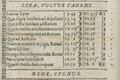
The Tabulae Rudolphinae were ordered and dedicated to Emperor Rudolph II of the Holy Roman Empire. The main purpose was to allow the computation of the positions of the five classically known planets, but the tables also consist of a star catalogue. They were published by Johannes Kepler (1627), including earlier work and observational data by Tycho Brahe. The original Latin title is "Tabulæ Rudolphinæ, Quibus Astronomicæ Scientiæ, Temporum longinquitate collapsæ Restauratio continetur".
Kepler uses classical Lyra as the primary designation but gives the name variant Vultur Cadens witnessing traces of the Arabic constellation of the "Eagle that rushes down" in this area of the sky.
Transfer and Transformation of the Constellation
-
 Lyr in Leiden Aratea (~840 CE)
 -
 Lyra in Bayer (1603)
 -
 Lyr = Vultur Cadens in Kepler (1627)
 -
 Lyra in Hugo-de-Groot: Syntagma Arateorum
 -
 Lyra in Hevelius (1690)
 -
 Lyra in Flamsteed (1776)
 -
 Lyra in Fortin's Atlas Céleste, 3rd edition (1795).
 -
 Lyra in Bode (1801)
 -
 Lyra in Young (1807): A Course of Lectures on Natural Philosophy and the Mechanical Arts.
 -
 Lyra in Hall (1825)
 -
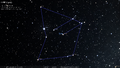 (1952) H.A. Rey's stick figure of Lyra
 -
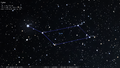 (1988) O. Hlad's stick figure of Lyra
 -
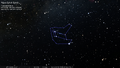 Reconstruction of Stickfigure based on the depiction of Almagest (100-170 CE). CC-BY Susanne Hoffmann in Stellarium.
 -
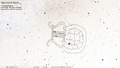 Image of the Farnese Globe (2nd century CE) taken by Susanne Hoffmann and imported into Stellarium.


.jpg)


Mythology[1]
The god Hermes tended Apollo's cattle – a rather idle occupation, during which a quick-witted fellow like him could easily come up with brilliant ideas. He strung seven strings across a turtle shell and coaxed sounds from it. Since he then stole Apollo's cattle, he gave Apollo the lyre as compensation. Apollo composed a song with it and then passed the lyre on to Orpheus. Orpheus added two strings and became a famous singer. He was reputed to be able to charm animals and even stones with his singing.
However, Orpheus' story is tragic: after his wife died, he descended into the underworld to bring her back. There are two versions of the story: In Plato's version, he fails because the gods only show him a shadow image of his wife; in Diodorus' version, he succeeds. Roman versions describe a near success, i.e. a meeting with his wife, but failure to bring her back at the last minute.
In any case, after his visit to the underworld, Orpheus is no longer the same, changes his way of life and worships other gods. After his death, the Muses ask Zeus to place his lyre in the sky. It stands there in memory of the Muses themselves and their offspring Orpheus. According to Eratosthenes, it is also a symbol of the singer's tragic death. For today's viewer, it is a symbol of the immortality of music and of excellent musicians, whose works live on after their death and are interpreted in new ways.
-
 Ainter of Agora 393 - ARV extra - standing boy with lyra and hare - Athens Agora Museum
 -
 Achilles Painter ARV 990 41 youth with lyra
 -
 Cartellino Painter - ARV 452 5 - youth with lyra - Athens NAM 12803
 -
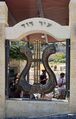 symbol of an ancient lyra
 -
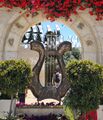 symbol of an ancient lyra
 -
 Kalymna - 560-540 BC - silver stater - head of warrior - lyra - Berlin MK BM 18200148
 -
 Statue of Erato (with lyre)

.jpg)


Weblinks
- Warburg Institute Iconographic Database – Lyra
- Warburg Institute Iconographic Database – Vultur Cadens
- Ian Ridpath's Star Tales – Lyra
References
- ↑ 1.0 1.1 1.2 1.3 Hoffmann, Susanne M. Wie der Löwe an den Himmel kam. Franckh Kosmos Verlag, Stuttgart 2021
- ↑ Pamìas, Jordi und Zucker, Arnaud (2013). Ératosthènes de Cyrène: Catastérrismes, Belles Lettres, Paris
- ↑ Hoffmann, S. M., <i>Hipparchs Himmelsglobus</i>. Springer Wiesbaden/ New York, 2017. doi:10.1007/978-3-658-18683-8.
- ↑ Eratosthenes: Sternsagen, übersetzt von Pamìas, Jordi und Geus, Klaus, Verlag Utopica, Oberhaid 2007
- ↑ Vogt, H., “Versuch einer Wiederherstellung von Hipparchs Fixsternver zeichnis”, <i>Astronomische Nachrichten</i>, vol. 224, no. 2, Wiley, p. 17, 1925. doi:10.1002/asna.19252240202.
- ↑ Graßhoff, G., <i>The History of Ptolemy's Star Catalogue</i>, Springer, New York, 1990
- ↑ Hoffmann, S. M., <i>Hipparchs Himmelsglobus</i>. Springer Wiesbaden/ New York, 2017. doi:10.1007/978-3-658-18683-8.
- ↑ Glover, E. (2026). The Astronomy of Hipparchus, Cambridge University Press
- ↑ Hipparchus's Lost Star Catalogue (1/2 reconstructed) (Hoffmann, 2017) in VizieR





