Caelum: Difference between revisions
IanRidpath (talk | contribs) →Weblinks: Added link |
|||
| (6 intermediate revisions by 3 users not shown) | |||
| Line 1: | Line 1: | ||
Authors: {{PAGEAUTHORS}} | |||
---- | |||
[[File:Caelum IAU.svg|alt=star chart|thumb|Caelum star chart (IAU and Sky & Telescope magazine, Roger Sinnott & Rick Fienberg)]] | [[File:Caelum IAU.svg|alt=star chart|thumb|Caelum star chart (IAU and Sky & Telescope magazine, Roger Sinnott & Rick Fienberg)]] | ||
One of the [[:Category:88_IAU-Constellations|88 IAU constellations]]. The constellation was invented by Lacaille in the 1750s. | One of the [[:Category:88_IAU-Constellations|88 IAU constellations]]. The constellation was invented by Lacaille in the 1750s. | ||
==Etymology and History== | ==Etymology and History== | ||
[[File:Lacaille text newConst1756 cae.JPG|alt=screenshot of text|thumb|Lacaille on Caelum (1752)]] | [[File:Lacaille text newConst1756 cae.JPG|alt=screenshot of text|thumb|Lacaille on Caelum (1752)]] | ||
===Origin of Constellation<ref>Hoffmann, Susanne M. Wie der Löwe an den Himmel kam. Franckh Kosmos Verlag, Stuttgart 2021</ref>=== | |||
This tiny constellation was introduced by Nicolas Louis de Lacaille when he measured the starry sky from South Africa. His stated goal was to fill in small gaps between the constellations and, in contrast to the ancient myths, to immortalise the technical devices of his time. However, it is not known why he felt compelled to combine a few faint stars next to the river Eridanus into a constellation of several bundled sculpting tools. He named the figure ‘Caelum Scalptorium’ or ‘Burin’ in French. The word is singular, but can refer to several different sculpting tools, in particular various chisels and gravers. On his star map, Lacaille depicts two crossed engraving tools, which, according to his description, are held together with a ribbon. A good century later, Joh. Elert Bode drew them like a bouquet of flowers. | |||
With regard to the constellation of the sculptor's workshop, also introduced by Lacaille, Caelum lies on the other side of the river Eridanus. There is no explanation for this. | |||
Elijah Burritt, an American mathematician and astronomer who was particularly popular for his textbooks with very simple explanations, attempted in the 19th century to trace the new constellations back to classical references. | |||
He named the constellation ‘Caelum Praxiteles’, meaning the chisel of Praxiteles, one of the most famous sculptors of ancient Athens in the 4th century BCE. Together with his rival Skopas, he was already considered the most important representative of the younger Attic school in ancient times. His works are characterised by their particular naturalness, and he is said to have introduced the youthful ideal images of some deities (Artemis, Apollo, Eros, etc.). These statues radiate a certain lightness and not as much pathos as earlier Greek art. It is therefore a revolutionary style. | |||
This name did not catch on; on the contrary, astronomers shortened the name ‘Caelum Scalptorium’ to ‘Caelum’ at the suggestion of John Herschel. | |||
===Transfer and Transformation of the Constellation=== | ===Transfer and Transformation of the Constellation=== | ||
<gallery> | <gallery> | ||
File:Lacaille-cae.jpg|Caelum in | File:Lacaille-cae.jpg|Caelum in Lacaille (1756) | ||
File:Cae Fortin1795.jpg|Caelum in Fortin's Atlas Céleste, 3rd edition (1795). | File:Cae Fortin1795.jpg|Caelum in Fortin's Atlas Céleste, 3rd edition (1795). | ||
File:H.A. Rey's stick figure stellarium-009.png|(1952) H.A. Rey's stick figure of Caelum | |||
File:O. Hlad's stick figure stellarium-009.png|(1988) O. Hlad's stick figure of Caelum | |||
</gallery> | </gallery> | ||
| Line 18: | Line 29: | ||
==Weblinks== | ==Weblinks== | ||
* | * Ian Ridpath's ''Star Tales'' [http://www.ianridpath.com/startales/caelum.html – Caelum] | ||
==References== | ==References== | ||
| Line 31: | Line 42: | ||
[[Category:Modern]] | [[Category:Modern]] | ||
[[Category:88 IAU-Constellations]] | [[Category:88 IAU-Constellations]] | ||
[[Category:European]] | [[Category:European]] [[Category:Cae]] | ||
[[Category: | |||
Latest revision as of 07:32, 22 July 2026
Authors: Susanne M Hoffmann, Youla Azkarrula, IanRidpath

One of the 88 IAU constellations. The constellation was invented by Lacaille in the 1750s.
Etymology and History

Origin of Constellation[1]
This tiny constellation was introduced by Nicolas Louis de Lacaille when he measured the starry sky from South Africa. His stated goal was to fill in small gaps between the constellations and, in contrast to the ancient myths, to immortalise the technical devices of his time. However, it is not known why he felt compelled to combine a few faint stars next to the river Eridanus into a constellation of several bundled sculpting tools. He named the figure ‘Caelum Scalptorium’ or ‘Burin’ in French. The word is singular, but can refer to several different sculpting tools, in particular various chisels and gravers. On his star map, Lacaille depicts two crossed engraving tools, which, according to his description, are held together with a ribbon. A good century later, Joh. Elert Bode drew them like a bouquet of flowers.
With regard to the constellation of the sculptor's workshop, also introduced by Lacaille, Caelum lies on the other side of the river Eridanus. There is no explanation for this.
Elijah Burritt, an American mathematician and astronomer who was particularly popular for his textbooks with very simple explanations, attempted in the 19th century to trace the new constellations back to classical references.
He named the constellation ‘Caelum Praxiteles’, meaning the chisel of Praxiteles, one of the most famous sculptors of ancient Athens in the 4th century BCE. Together with his rival Skopas, he was already considered the most important representative of the younger Attic school in ancient times. His works are characterised by their particular naturalness, and he is said to have introduced the youthful ideal images of some deities (Artemis, Apollo, Eros, etc.). These statues radiate a certain lightness and not as much pathos as earlier Greek art. It is therefore a revolutionary style.
This name did not catch on; on the contrary, astronomers shortened the name ‘Caelum Scalptorium’ to ‘Caelum’ at the suggestion of John Herschel.
Transfer and Transformation of the Constellation
-
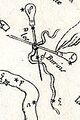 Caelum in Lacaille (1756)
 -
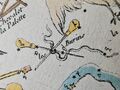 Caelum in Fortin's Atlas Céleste, 3rd edition (1795).
 -
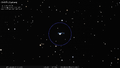 (1952) H.A. Rey's stick figure of Caelum
 -
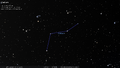 (1988) O. Hlad's stick figure of Caelum


Mythology
Weblinks
- Ian Ridpath's Star Tales – Caelum
References
- ↑ Hoffmann, Susanne M. Wie der Löwe an den Himmel kam. Franckh Kosmos Verlag, Stuttgart 2021