A-ḫa-ti: Difference between revisions
No edit summary |
No edit summary |
||
| (29 intermediate revisions by 4 users not shown) | |||
| Line 1: | Line 1: | ||
{{ | {{DISPLAYTITLE:''A-ḫa-ti''}} | ||
Authors: {{PAGEAUTHORS}} | |||
---- | |||
[[File:Pleiades and Venus in blue dawn 2020.jpg|alt=photograph|thumb|Pleiades and Venus in the morning sky.]] | |||
''A-ḫa-ti'' (𒀀𒄩𒋾) is a Mesopotamian term for the planet Venus, most likely meaning 'sister.' as Venus is the planet of the goddess Inanna = Ištar. the sister of the male Sun and Moon-gods in Ancient Mesopotamian tradition. | |||
== Visibility & Appearance == | |||
{{Template:Venus}} | |||
"[[Category:Mesopotamian]] | ==Concordance, Etymology, History<ref>[[Mesopotamian (All Terms)|Planetarium Babylonicum 2.0]], All Skies Encyclopaedia.</ref>== | ||
= <sup>mul</sup>''Aḫātu'' "Sister"; an epithet of Ištar as the planet Venus, who was considered the sister of the sun god Šamaš [Lambert 1987, 95; Tallqvist 1938, 332-333]. | |||
{| class="wikitable" | |||
|- | |||
! Sources !! Identifications | |||
|- | |||
| '''A Hittite Prayer to the Gods of the Night.''' | |||
* In the first place: <sup>mul</sup>''a-ḫa-ti'' [KUB IV, 47 r. 43; BPO 2, 2:1; Van der Toorn 1985, 129:43], see also (Kurtik a15) ''[[Aḫû]]'' | |||
In this source, there are five terms (''a-ha-ti, ga-ga, dumuzi, ninkizida, šulpae'') and there are five star-like planets. Lambert 1987 identifies them with (Venus, Mercury, Saturn, Mars, Jupiter). | |||
| | |||
|} | |||
''' ''' See also: [Lambert 1987, 95/96] | |||
=== Additional === | |||
''' ''' "Venus (Ištar) can only be the first: ''a-ha-ti''. This, we suggest, is ''aḫati'' "sister (of)", rather than ''ahatti'' "outside" etc., since Ištar was sister of Šamaš, the sun, the most conspicuous heavenly body. Identification of the other three is uncertain. Antagal G 309 (apud CAD ṣalbatānu) identified Simut, an Elamite god of the netherworld (= Nergal: AfK 2 72 16) as ''Ṣalbatānu'', Mars. So it could be argued that Ningišzida in this list, being a Sumerian god of the netherworld, is Mars. Then since ''Dumuzi''(''d'') would be ''māru kīnu'' in Akkadian translation, ''Kayamānu'' (Saturn), being linguistically a fuller form of '''<big>kfnu</big>''', '''what is that??''' '''note that there were several typos in this passage!''' might mean Dumuzi. | |||
''' ''' Then since Kakka under his aliases Ninšubur, Ilabrat and Papsukkal became a vizier or messenger of all the gods, he could be Mercury because the Greek god equivalent to Mercury, Hermes, was an errand boy for the other gods." | |||
== Historical Dictionaries == | |||
{| class="wikitable" | |||
|- | |||
! scope="col" style="width: 60%;" | Kurtik (2022, a14) | |||
! scope="col" style="width: 40%;" | Gössmann (1950) | |||
|- | |||
| = <sup>mul</sup>''Aḫātu'' «Сестра»(?); эпитет Иштар как планеты Венеры, которая считалась сестрой бога Солнца Шамаша [Lambert 1987, 95; Tallqvist 1938, 332–333]. | |||
I. Источники. | |||
Хеттская молитва ночным богам. На первом месте: mula-ḫa-ti [KUB IV, 47 r. 43; BPO 2, 2:1; Van der Toorn 1985, 129:43], см. также a15Aḫû. | |||
| Example | |||
|} | |||
== References == | |||
* [[References (Babylonian)|Kurtik's references]] | |||
[[Category:Mesopotamian]] [[Category:Constellation]] [[Category:West Asian]] [[Category:Asian]] [[Category:Eurasia]][[Category:Cuneiform]] [[Category:Asterism]] | |||
[[Category:Solar System]] | |||
[[Category:Planet]] | |||
[[Category:Venus]] | |||
Latest revision as of 01:48, 14 May 2026
Authors: Susanne M Hoffmann, Gennady E. Kurtik, Euin Choung Kim, David Hilder, Wayne Horowitz, Hermann Hunger, Youla Azkarrula

A-ḫa-ti (𒀀𒄩𒋾) is a Mesopotamian term for the planet Venus, most likely meaning 'sister.' as Venus is the planet of the goddess Inanna = Ištar. the sister of the male Sun and Moon-gods in Ancient Mesopotamian tradition.
Visibility & Appearance
Images of Venus (Naked Eye Appearance)
-
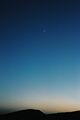 Venus above Sahara (Nov. 2005, Susanne M Hoffmann)
 -
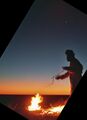 Venus above campfire (Sahara 2008, SMH)
 -
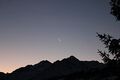 Moon and Venus in morning twilight above Austrian mountains (CC BY Susanne M Hoffmann 2016).
 -
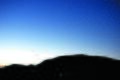 Venus and Pleiades above a mountain at Dawn in Europe (SMH 2020)
 -
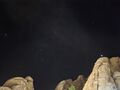 Venus above the rocks at Petra, Jordan (SMH 2023), it's already rather dark (not really dusk any more).
 -
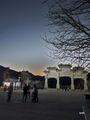 Venus above the Gate to the Shaolin Temple (China 2024, SMH)
 -
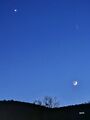 Venus and Moon at Dusk (Europe, SMH 2025)
 -
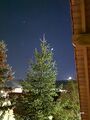 Saturn, Venus and Moon at Dusk (SMH 2025)
 -
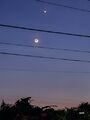 Moon and Venus in tropical dusk in Indonesia (Karimunjawa, SMH 2024).
 -
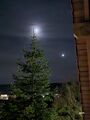 Moon and Venus at Dusk (SMH 2025).
 -
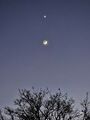 Venus and Moon at Dusk, 2025 (SMH)
 -
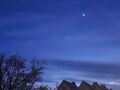 Venus above houses, evening star, (SMH 2025)
 -
 Venus and Pleiades at Dusk in Europe (SMH 2020), for comparison of brightness


Concordance, Etymology, History[1]
= mulAḫātu "Sister"; an epithet of Ištar as the planet Venus, who was considered the sister of the sun god Šamaš [Lambert 1987, 95; Tallqvist 1938, 332-333].
| Sources | Identifications |
|---|---|
A Hittite Prayer to the Gods of the Night.
In this source, there are five terms (a-ha-ti, ga-ga, dumuzi, ninkizida, šulpae) and there are five star-like planets. Lambert 1987 identifies them with (Venus, Mercury, Saturn, Mars, Jupiter). |
See also: [Lambert 1987, 95/96]
Additional
"Venus (Ištar) can only be the first: a-ha-ti. This, we suggest, is aḫati "sister (of)", rather than ahatti "outside" etc., since Ištar was sister of Šamaš, the sun, the most conspicuous heavenly body. Identification of the other three is uncertain. Antagal G 309 (apud CAD ṣalbatānu) identified Simut, an Elamite god of the netherworld (= Nergal: AfK 2 72 16) as Ṣalbatānu, Mars. So it could be argued that Ningišzida in this list, being a Sumerian god of the netherworld, is Mars. Then since Dumuzi(d) would be māru kīnu in Akkadian translation, Kayamānu (Saturn), being linguistically a fuller form of kfnu, what is that?? note that there were several typos in this passage! might mean Dumuzi.
Then since Kakka under his aliases Ninšubur, Ilabrat and Papsukkal became a vizier or messenger of all the gods, he could be Mercury because the Greek god equivalent to Mercury, Hermes, was an errand boy for the other gods."
Historical Dictionaries
| Kurtik (2022, a14) | Gössmann (1950) |
|---|---|
| = mulAḫātu «Сестра»(?); эпитет Иштар как планеты Венеры, которая считалась сестрой бога Солнца Шамаша [Lambert 1987, 95; Tallqvist 1938, 332–333].
I. Источники. Хеттская молитва ночным богам. На первом месте: mula-ḫa-ti [KUB IV, 47 r. 43; BPO 2, 2:1; Van der Toorn 1985, 129:43], см. также a15Aḫû. |
Example |
References
- ↑ Planetarium Babylonicum 2.0, All Skies Encyclopaedia.





