Template:Venus: Difference between revisions
From All Skies Encyclopaedia
No edit summary |
No edit summary |
||
| Line 12: | Line 12: | ||
File:20250201 175858.jpg |Venus and Moon at Dusk, 2025 (SMH) | File:20250201 175858.jpg |Venus and Moon at Dusk, 2025 (SMH) | ||
File:20250221 183039.jpg |Venus above houses, evening star, (SMH 2025) | File:20250221 183039.jpg |Venus above houses, evening star, (SMH 2025) | ||
File:Venus+Pleiades 2020.jpg|Venus and Pleiades at Dusk in Europe (SMH 2020), for comparison of brightness | |||
</gallery> | </gallery> | ||
[[Category:Solar System]] | [[Category:Solar System]] | ||
[[Category:Planet]] | [[Category:Planet]] | ||
Revision as of 20:13, 21 February 2025
Venus is a planet of our solar system and observable with the naked eye. It is the brightest one of the planets, but never separates more than 60° from the Sun. Thus, Venus is only visible short after sunset or short before sunrise - never in the middle of the night - and in temperate latitudes these hours are twilight while close to the equator, Venus at maximum elongation could be seen in darkness.
-
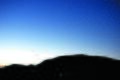 Venus and Pleiades above a mountain at Dawn in Europe (SMH 2020)
 -
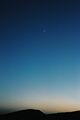 Venus above Sahara (Nov. 2005, Susanne M Hoffmann)
 -
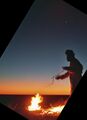 Venus above campfire (Sahara 2008, SMH)
 -
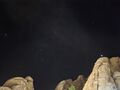 Venus above the rocks at Petra, Jordan (SMH 2023), it's already rather dark (not really dusk any more).
 -
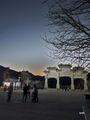 Venus a Gate to the Shaolin Temple (China 2024, SMH)
 -
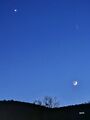 Venus and Moon at Dusk (Europe, SMH 2025)
 -
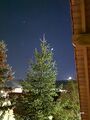 Saturn, Venus and Moon at Dusk (SMH 2025)
 -
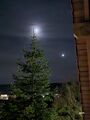 Moon and Venus at Dusk (SMH 2025).
 -
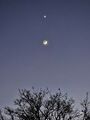 Venus and Moon at Dusk, 2025 (SMH)
 -
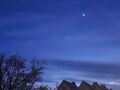 Venus above houses, evening star, (SMH 2025)
 -
 Venus and Pleiades at Dusk in Europe (SMH 2020), for comparison of brightness







