GENNA: Difference between revisions
A number of small but bothersome technical issues need to be addressed. |
|||
| Line 1: | Line 1: | ||
<sup>múl d</sup>GENNA = ''kayyamānu''(''m'') "Constant" is a common name for Saturn. It is the name that is used in the lists of 7 planets in the the | <sup>múl d</sup>GENNA = ''kayyamānu''(''m'') "Constant" is a common name for Saturn in cuneiform. It is the name that is used in the lists of 7 planets in the the Late Babylonian Uranology tablet MCL 1866 and contemporary Late Babylonian ritual texts. | ||
''Heading should be GENNA (TUR.DIŠ) = k.......'' | ''Heading should be GENNA (TUR.DIŠ) = k.......'' | ||
A''ll tur.dish should be read genna??? -- doesn<nowiki>''</nowiki>t exist'' | |||
A''ll tur.dish should be read genna???'' | |||
''Need to add Uranology Texts IMLC 1866 iv 8, Beaulieu et al. 38 D iv 8'' {{Template:Saturn}} | ''Need to add Uranology Texts IMLC 1866 iv 8, Beaulieu et al. 38 D iv 8'' {{Template:Saturn}} | ||
| Line 40: | Line 38: | ||
|'''Mathematical Astronomy.''' | |'''Mathematical Astronomy.''' | ||
<sup>(d)</sup>GENNA — the designation of Saturn in Seleucid ephemerides and horoscopes [ACT II, 474a; BH, 28]. Temple rituals. | <sup>(d)</sup>GENNA — the designation of Saturn in Seleucid ephemerides and horoscopes [ACT II, 474a; BH, 28]. Temple rituals. | ||
| | |||
|- | |||
* | |'''Uranology''' | ||
* ''IMLC 1866 iv 8, Beaulieu et al. 38 D iv 8'' | |||
| | | | ||
|- | |- | ||
| Line 48: | Line 47: | ||
* a) ''aš''<sub>2</sub>''-šu''<sub>2</sub> <sup>d</sup>TUR.DIŠ ''lu'' [...] ''ina'' KI SAL.MEŠ KI <sup>d</sup>''Sin'' DU''-zu'' UŠ U<sub>3</sub>.TU | * a) ''aš''<sub>2</sub>''-šu''<sub>2</sub> <sup>d</sup>TUR.DIŠ ''lu'' [...] ''ina'' KI SAL.MEŠ KI <sup>d</sup>''Sin'' DU''-zu'' UŠ U<sub>3</sub>.TU | ||
** "Since Saturn or [Mars], stands with the moon (or: in place of the Moon) within the boundaries of the female: a male child will be born." [LBAT, 1593:7′-8′; Reiner 2000]. | ** "Since Saturn or [Mars], stands with the moon (or: in place of the Moon) within the boundaries of the female: a male child will be born." [LBAT, 1593:7′-8′; Reiner 2000]. | ||
* b) ''aš''<sub>2</sub>-''šu''<sub>2</sub> <sup>d</sup>TUR.DIŠ ''u'' <sup>d</sup>''Ṣal-bat<sup>?</sup>-a<sup>?</sup>-nu<sup>?</sup>'' KI ''Sin'' / 2 UŠ<sup>(!)</sup>.MEŠ U<sub>3</sub>.TU | * b) ''aš''<sub>2</sub>-''šu''<sub>2</sub> <sup>d</sup>TUR.DIŠ ''u'' <sup>d</sup>''Ṣal-bat<sup>?</sup>-a<sup>?</sup>-nu<sup>?</sup>'' KI ''Sin'' / 2 UŠ<sup>(!)</sup>.MEŠ U<sub>3</sub>.TU | ||
** "As Saturn and Mars? with [or: in place of] the Moon (stands): 2 (male babies?) are born." [LBAT, 1593:9′-10′; Reiner 2000]. c) Mercury or Saturn with the Moon, see (Kurtik g34) [[GU4.UD|GU<sub>4</sub>.UD]]. | ** "As Saturn and Mars? with [or: in place of] the Moon (stands): 2 (male babies?) are born." [LBAT, 1593:9′-10′; Reiner 2000]. | ||
* c) Mercury or Saturn with the Moon, see (Kurtik g34) [[GU4.UD|GU<sub>4</sub>.UD]]. | |||
| | | | ||
|} | |} | ||
==== Ritual Texts/ Miscellenous ==== | |||
* (1) New Year ritual in Babylon: <sup>múl</sup>genna mul ''kit-tu''<sub>2</sub> ''u mi-šar'', "Saturn, the star of judgment and justice". [RAcc. 138:307; Linssen 2004, 220:307]. | |||
* (2) Ritual in Uruk, see (Kurtik u07) [[UDU.IDIM]]. | |||
==Historical Dictionaries== | ==Historical Dictionaries== | ||
Revision as of 16:05, 24 April 2025
múl dGENNA = kayyamānu(m) "Constant" is a common name for Saturn in cuneiform. It is the name that is used in the lists of 7 planets in the the Late Babylonian Uranology tablet MCL 1866 and contemporary Late Babylonian ritual texts.
Heading should be GENNA (TUR.DIŠ) = k.......
All tur.dish should be read genna??? -- doesn''t exist
Need to add Uranology Texts IMLC 1866 iv 8, Beaulieu et al. 38 D iv 8 === Images of Saturn ===
-
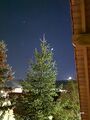 Saturn (uppest), Venus (next to the tree) and the Moon (at the horizon) at dusk in January 2025 (Susanne M Hoffmann).
 -
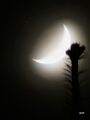 Saturn at the upper (dark) edge of the Moon on January 4, 2025, short before its occultation. It is obvious that Saturn is visible even with a slightly cloudy/ foggy sky.


Dictionary
Var. reading:
- dTUR.DIŠ; = kayyamānu(m) "Constant"; TUR.DISH is genna
- SAG.UŠ/UDU.IDIM.SAG.UŠ "The Planet, Saturn' (should this be here or underster SAG.UŠ with a reference - like - 'for other names for Saturn see the index etc.??? - do these need to be linked
A designation of Saturn in astronomical texts of the first millennium B.C. [G. 69].
The name apparently comes from the Akkadian word, ginâ, "constantly, normally" [AHw. [AHw, 289; CAD G, 78], close in meaning to kayyamānu, and apparently reflects the slow motion of Saturn relative to the stars in comparison to other planets.
The Sumerian equivalents of kayyamānu(m) mul/dSAG.UŠ and UDU.IDIM.SAG.UŠ (Kurtik s10, u09) are also commonly used in the first millennium B.C. [[do you like this statement??]]
Kurtik with Hilder, Hoffmann, Horowitz, Kim
| Sources | Identifications |
|---|---|
| Lexical texts.
Neo-Babylonian comments: GENNA = ka-a-a-nu [AHw, 420]. |
Example |
| EAE.
Only in later copies and commentaries, cf. [ABCD, 285, BM 47447 Rev. 29; SpTU I, 90:4-5, 7, 9; SpTU II, 42 r. 1, 6; SpTU III, 102 Rs. 8; SpTU IV, 162 r. 13]. |
|
| "Astronomical Diaries and Related Texts."
First in the diary for -567 as dGENNA [ADRT I, -567:9]; in the same diary we find dSAG.UŠ [ibid., -567:2]; in later texts the designation Saturn is always GENNA. |
|
| Mathematical Astronomy.
(d)GENNA — the designation of Saturn in Seleucid ephemerides and horoscopes [ACT II, 474a; BH, 28]. Temple rituals. |
|
Uranology
|
|
Late Astrology.Zodiacal Astrology.
|
Ritual Texts/ Miscellenous
- (1) New Year ritual in Babylon: múlgenna mul kit-tu2 u mi-šar, "Saturn, the star of judgment and justice". [RAcc. 138:307; Linssen 2004, 220:307].
- (2) Ritual in Uruk, see (Kurtik u07) UDU.IDIM.
Historical Dictionaries
| Kurtik (2022, g10) | Gössmann (1950) |
|---|---|
| вар. чтения: dTUR.DIŠ; = kayyamānu(m) «Постоянный»; обозначение Сатурна в астрономических текстах I тыс. до н.э. [G. 69]. Название происходит, по-видимому, от аккадского ginâ «постоянно, нормально» [AHw, 289; CAD G, 78], близкого по смыслу kayyamānu, и отражает, по-видимому, медленный характер движения Сатурна относительно звезд в сравнении с другими планетами. В астрологических текстах обычно употребляли названия SAG.UŠ, UDU.IDIM.SAG.UŠ (s10, u09).
I. Источники. Лексич. тексты. Нововавилонский комментарий: GENNA = ka-a-a-nu [AHw, 420]. ЕАЕ. Только в поздних копиях и комментариях, см. [ABCD, 285, BM 47447 Rev. 29; SpTU I, 90:4–5, 7, 9; SpTU II, 42 r. 1, 6; SpTU III, 102 Rs. 8; SpTU IV, 162 r. 13]. «Дневники наблюдений». Впервые в дневнике за -567 г. как dGENNA [ADRT I, -567:9]; в этом же дневнике встречаем dSAG.UŠ [ibid., -567:2], в более поздних текстах обозначение Сатурна всегда ― GENNA. Математическая астрономия. (d)GENNA ― обозначение Сатурна в эфемеридах селевкидского времени и гороскопах [ACT II, 474a; BH, 28]. Храмовые ритуалы. (1) Новогодний ритуал в Вавилоне: múlgenna mul kit-tu2 u mi-šar «Сатурн ― звезда суда и справедливости» [RAcc. 138:307; Linssen 2004, 220:307]. (2) Ритуал в Уруке, см. u07UDU.IDIM. Поздняя астрология. Зодиакальная астрология. a) aš2-šu2 dTUR.DIŠ lu […] ina KI SAL.MEŠ KI dSin DU-zu UŠ U3.TU «Поскольку Сатурн или [Марс] в области женщин стоит с Луной (или: на месте Луны): младенец мужского пола родится» [LBAT, 1593:7′–8′; Reiner 2000]. b) aš2-šu2 dTUR.DIŠ u dṢal-bat?-a?-nu? KI Sin / 2 UŠ(!).MEŠ U3.TU «Поскольку Сатурн и Марс? с [или: на месте] Луной (стоят): 2 (младенца мужского пола?) родятся» [LBAT, 1593:9′–10′; Reiner 2000]. с) Меркурий или Сатурн с Луной, см. g34GU4.UD. См. также mulGI6.NA (силлабическая запись GENNA?) [SpTU II, 42 r. 6]. См. также [SpTU V, 271:8ʹ]. |
Example |





