Hydra: Difference between revisions
From All Skies Encyclopaedia
Created page with "One of the 88 IAU constellations. ==Etymology and History== The Greek constellation of the Water Snake is a derivative of the Babylonian constellation of the MUŠ-Dragon, a dog-headed creature with the body of a gigantic snake with front legs and wings. ... === Origin of Constellation === === Transfer and Transformation of the Constellation === == Greek Mythology == == Weblinks == * == References == * References (gen..." Tag: Disambiguation links |
created the page (first draft) |
||
| Line 1: | Line 1: | ||
[[File:Hydra IAU.svg|alt=IAU Hydra chart|thumb|IAU Hydra chart]] | |||
One of the [[:Category:88_IAU-Constellations|88 IAU constellations]]. | One of the [[:Category:88_IAU-Constellations|88 IAU constellations]]. | ||
==Etymology and History== | ==Etymology and History== | ||
The Greek constellation of the Water Snake is a derivative of the Babylonian constellation of the MUŠ-Dragon, a dog-headed creature with the body of a gigantic snake with front legs and wings | The Greek constellation of the Water Snake is a derivative of the Babylonian constellation of the MUŠ-Dragon, a dog-headed creature with the body of a gigantic snake with front legs and wings. | ||
=== Origin of Constellation === | |||
=== Transfer and Transformation of the Constellation === | |||
<gallery> | |||
File:Hya+crt+crv stellarium mulapin.jpg|the Babylonian version of the "Hydra and Corvus" super-constellation does not contain a cup or jar. visualized in Stellarium (drawing by Jessica Gullberg) | |||
File:Cnc Hya KAKSISA stellarium.jpg|the lonely star in front of the dragon-head (Procyon) rised simultaneously with the faint stars of The Crab in ancient Babylon. Procyon and the head / foot of the dragon may serve as a replacement for Cancer | |||
File:Hya+crt+crv stellarium farnese.jpg|The Greeks introduced a Crater atop the snake. On the Farnese Globe, the body of the snake forms a vessel for Corvus and Crater. | |||
File:Sidney Hall - Urania's Mirror - Noctua, Corvus, Crater, Sextans Uraniæ, Hydra, Felis, Lupus, Centaurus, Antlia Pneumatica, Argo Navis, and Pyxis Nautica.jpg|In early modern time, some scholars extended the snake-body of Hydra beyond pi Hydrae and placed a second bird ([[Solitaire]] or [[Noctua]]) at this new end. | |||
</gallery> | |||
== | == Mythology == | ||
=== | === Greek/ Greco-Roman folklore === | ||
== | === Babylonian belief === | ||
== Weblinks == | == Weblinks == | ||
Revision as of 04:21, 30 October 2024

One of the 88 IAU constellations.
Etymology and History
The Greek constellation of the Water Snake is a derivative of the Babylonian constellation of the MUŠ-Dragon, a dog-headed creature with the body of a gigantic snake with front legs and wings.
Origin of Constellation
Transfer and Transformation of the Constellation
-
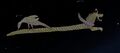 the Babylonian version of the "Hydra and Corvus" super-constellation does not contain a cup or jar. visualized in Stellarium (drawing by Jessica Gullberg)
 -
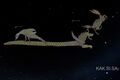 the lonely star in front of the dragon-head (Procyon) rised simultaneously with the faint stars of The Crab in ancient Babylon. Procyon and the head / foot of the dragon may serve as a replacement for Cancer
 -
 The Greeks introduced a Crater atop the snake. On the Farnese Globe, the body of the snake forms a vessel for Corvus and Crater.
 -







