Hydra: Difference between revisions
→Origin of Constellation: added double clay tablet |
No edit summary |
||
| Line 1: | Line 1: | ||
[[File:Hydra IAU.svg|alt=IAU Hydra chart|thumb|IAU Hydra chart]] | [[File:Hydra IAU.svg|alt=IAU Hydra chart|thumb|IAU Hydra chart]] | ||
One of the [[:Category:88_IAU-Constellations|88 IAU constellations]]. | One of the [[:Category:88_IAU-Constellations|88 IAU constellations]]. The name "Hydra" refers to a watersnake from Greek mythology, but the underlying constellation originally referred to a Babylonian creature that consisted of a dog-headed snake with wings, the [[MUŠ]]. | ||
==Etymology and History== | ==Etymology and History== | ||
Revision as of 16:35, 4 March 2025

One of the 88 IAU constellations. The name "Hydra" refers to a watersnake from Greek mythology, but the underlying constellation originally referred to a Babylonian creature that consisted of a dog-headed snake with wings, the mul (d)MUŠ.
Etymology and History
The Greek constellation of the Water Snake is a derivative of the Babylonian constellation of the MUŠ-Dragon, a dog-headed creature with the body of a gigantic snake with front legs and wings.
Origin of Constellation
The Babylonian constellation is mentioned ...
Aratus
Hipparchus mentions the constellation rising and setting. The first star rising is , the last star rising is the oneat the tip of the tail (ὁ ἐν ἄκρᾳ τῇ οὐρᾷ)
Almagest
Transfer and Transformation of the Constellation
-
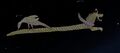 the Babylonian version of the "Hydra and Corvus" super-constellation does not contain a cup or jar. visualized in Stellarium (drawing by Jessica Gullberg)
 -
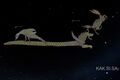 the lonely star in front of the dragon-head (Procyon) rised simultaneously with the faint stars of The Crab in ancient Babylon. Procyon and the head / foot of the dragon may serve as a replacement for Cancer
 -
 Leo and Virgo above the MUŠ-Dragon, two claytablet drawings from the Seleucid era (roughly 2nd century BCE), CC BY SMH based upon the drawings by E. Weidner (1967) and Thureau-Dangin (1922).
 -
 The Greeks introduced a Crater atop the snake. On the Farnese Globe, the body of the snake forms a vessel for Corvus and Crater.
 -


Mythology
Greek/ Greco-Roman folklore
Babylonian belief
IAU WGSN
The star pi Hydrae is very important in history as it is one of the keywitnesses for transfer from Hipparchus to Ptolemy.
- name in Hipparchus: ὁ ἐν ἄκρᾳ τῇ οὐρᾷ (the one at the farthest point of the tail)
- name in the Almagest: ὁ ἐπ᾽ἄκρας τῆς οὐρᾶς (the one at the end of the tail)
The Greek term ἄκρᾳ can be translated as "at the farthest point" or "at the end" (or "hightest" which doesn't apply here).





