Ashlesha: Difference between revisions
No edit summary |
No edit summary |
||
| Line 1: | Line 1: | ||
{{DISPLAYTITLE:Ashlesha (आश्लेषः)}} | {{DISPLAYTITLE:Ashlesha (आश्लेषः)}} | ||
[[File:9 Ashlesha stellarium.gif|thumb|The 9th Nakshatra, Ashlesha, consists of five stars and is identified with the head of Hydra (WGSN 2025).]] | [[File:9 Ashlesha stellarium.gif|thumb|The 9th Nakshatra, Ashlesha, consists of five stars and is identified with the head of Hydra (WGSN 2025).]] | ||
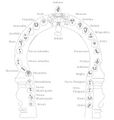
[[File:Ashlesha nakshatras in Temple draw+lbl 4ase.jpg|thumb|The 9th Nakshatra, Ashelesha nakshatra in Tirupperunthurai (Athmanathaswamy temple) near Aranthangi, India, 10th century CE. (SMH 2025).]] | |||
Āśleṣā (आश्लेषा), "The Embrace", is the Sanskrit name for an asterism in [[Hydra]], the head of the Watersnake (δ, ε , η, ρ, and σ Hydrae). It is considered the ninth of the traditional Nakṣatras (lunar stations) in the Vedic culture that predates Hinduism but was taken over by it. | Āśleṣā (आश्लेषा), "The Embrace", is the Sanskrit name for an asterism in [[Hydra]], the head of the Watersnake (δ, ε , η, ρ, and σ Hydrae). It is considered the ninth of the traditional Nakṣatras (lunar stations) in the Vedic culture that predates Hinduism but was taken over by it. | ||
| Line 7: | Line 7: | ||
==Etymology and History== | ==Etymology and History== | ||
'''Name Variants:''' | '''Name Variants:''' | ||
| Line 21: | Line 19: | ||
==== Identification ==== | ==== Identification ==== | ||
Normally, five stars are drawn and they are identified with the stars in Hydra; δ, ε , η, ρ, and σ Hydrae. | Normally, five stars are drawn and they are identified with the stars in Hydra; δ, ε , η, ρ, and σ Hydrae. | ||
The Yogatara (the main star) of the Vedic nakshatra is ε Hya. It was historically considered representative for the nakshatra and, thus, named after it by the IAU WGSN.[[File:Naga ashlesha bali pooja.jpg|thumb|Naga ashlesha bali pooja]] | The Yogatara (the main star) of the Vedic nakshatra is ε Hya. It was historically considered representative for the nakshatra and, thus, named after it by the IAU WGSN. | ||
=== Transfer and Transformation === | |||
<gallery> | |||
File:Ashlesha nakshatras in Temple draw+lbl 4ase.jpg|Ashlesha nakshatra in Tirupperunthurai (Athmanathaswamy temple) near Aranthangi, India, 10th century CE. (SMH 2025). | |||
File:Tibet nakshatra 07.png|Ashlesha in Tibetian | |||
File:柳宿(仏像図彙).png|Ashlesha in Chinese | |||
File:Naga ashlesha bali pooja.jpg|Bali naga "Ashlesha" | |||
File:9 Ashlesha draw.png|Ashlesha as reconstructed by Jones (1720, WGSN 2025). | |||
File:Nakshatras in Temple draw+lbl 4ase.jpg | |||
File:Nakshatra temple magDraw lbl.jpg | |||
</gallery>[[File:Naga ashlesha bali pooja.jpg|thumb|Naga ashlesha bali pooja]] | |||
==Mythology== | ==Mythology== | ||
Revision as of 09:37, 30 October 2025


Āśleṣā (आश्लेषा), "The Embrace", is the Sanskrit name for an asterism in Hydra, the head of the Watersnake (δ, ε , η, ρ, and σ Hydrae). It is considered the ninth of the traditional Nakṣatras (lunar stations) in the Vedic culture that predates Hinduism but was taken over by it.
Ashlesha is also a modern star name adopted by the International Astronomical Union in the IAU-Catalog of Star Names (IAU-CSN). Its origin is Indian. It is the name of HIP 43109 (ε Hya, HR 3482) in the constellation Hya.
Etymology and History
Name Variants:
- Āshleshā,
- Ashlesha,
- Ahya,
- Phanibha,
- Sarpa
Origin
Identification
Normally, five stars are drawn and they are identified with the stars in Hydra; δ, ε , η, ρ, and σ Hydrae. The Yogatara (the main star) of the Vedic nakshatra is ε Hya. It was historically considered representative for the nakshatra and, thus, named after it by the IAU WGSN.
Transfer and Transformation
-
 Ashlesha nakshatra in Tirupperunthurai (Athmanathaswamy temple) near Aranthangi, India, 10th century CE. (SMH 2025).
 -
 Ashlesha in Tibetian
 -
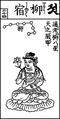 Ashlesha in Chinese
 -
 Bali naga "Ashlesha"
 -
 Ashlesha as reconstructed by Jones (1720, WGSN 2025).
 -

-


Mythology
IAU Working Group on Star Names
The name was adopted by the IAU WGSN on 2018/06/01.
Weblinks
- Website of the IAU WGSN: https://exopla.net/