Punarvasu: Difference between revisions
From All Skies Encyclopaedia
Punarvasu
No edit summary |
No edit summary |
||
| Line 1: | Line 1: | ||
{{DISPLAYTITLE:Punarvasu (पुनर्वसु)}} | {{DISPLAYTITLE:Punarvasu (पुनर्वसु)}} | ||
[[File:Punarvasu nakshatras in Temple draw+lbl 4ase.jpg|thumb|Punarvasu, in Tirupperunthurai (Athmanathaswamy temple) near Aranthangi, India, 10th century CE. (SMH 2025).]] | |||
[[File: | |||
[[File:7 Punarvasu stellarium.gif|thumb|Punarvasu, 7th Nakshatra, mapped to the Stellarium star chart.]] | [[File:7 Punarvasu stellarium.gif|thumb|Punarvasu, 7th Nakshatra, mapped to the Stellarium star chart.]] | ||
Punarvasu (पुनर्वसु), "the twin-restorers of goods", is an Indian name, used by the Indian Vedic tradition. Most of these names are roughly 3000 years old. They pre-date Hinduism but were taken over by it. It is an asterism consisting of four stars, the brightest ones being alpha and beta Geminorum | |||
==Etymology and History== | ==Etymology and History== | ||
'''Name Variants''' | '''Name Variants''' | ||
| Line 20: | Line 19: | ||
=== Transfer and Transformation of the Constellation === | === Transfer and Transformation of the Constellation === | ||
<gallery> | |||
File:Punarvasu nakshatras in Temple draw+lbl 4ase.jpg|Punarvasu, 10th century CE | |||
File:Nakshatra temple magDraw lbl.jpg|Display of all 28th nakshatras in silver arch with candles in Tirupperunthurai (Athmanathaswamy temple) near Aranthangi, India, 10th century CE. (SMH 2025). | |||
File:Nakshatras in Temple draw+lbl 4ase.jpg|Display of all 28th nakshatras in a door frame in Tirupperunthurai (Athmanathaswamy temple) near Aranthangi, India, 10th century CE. (SMH 2025). | |||
File:Tibet nakshatra 05.png|Punarvasu, Tibetean | |||
File:井宿(仏像図彙).png|Punarvasu, Chinese | |||
File:चरकसंहिता of चरक. (IA dli.granth.16014).pdf | |||
File:7 Punarvasu draw.png|Punarvasu as reconstructed by Jones (1720). | |||
</gallery> | |||
== Mythology == | == Mythology == | ||
Revision as of 16:42, 30 October 2025


Punarvasu (पुनर्वसु), "the twin-restorers of goods", is an Indian name, used by the Indian Vedic tradition. Most of these names are roughly 3000 years old. They pre-date Hinduism but were taken over by it. It is an asterism consisting of four stars, the brightest ones being alpha and beta Geminorum
Etymology and History
Name Variants
- Punarvasu (the two restorers),
- Yamakau ("the two chariots")
- Aditerbha

Origin of Constellation
The name of the constellations is grammatically a dual, so it points to two similar stars/ asterisms. This way, it equals the idea of the Greco-Roman and Mesopotamian Twin-constellation where two bright stars head two similar, parallel chains of stars.
4 stars: α, β Geminorum are certain; the other two might be ε, ζ Gem
Transfer and Transformation of the Constellation
-
 Punarvasu, 10th century CE
 -
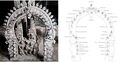 Display of all 28th nakshatras in silver arch with candles in Tirupperunthurai (Athmanathaswamy temple) near Aranthangi, India, 10th century CE. (SMH 2025).
 -
 Display of all 28th nakshatras in a door frame in Tirupperunthurai (Athmanathaswamy temple) near Aranthangi, India, 10th century CE. (SMH 2025).
 -
 Punarvasu, Tibetean
 -
 Punarvasu, Chinese
 -

-
 Punarvasu as reconstructed by Jones (1720).


Mythology
mnemonic tales and cultural significance
Weblinks
References
- References (general)





