Ashvini: Difference between revisions
From All Skies Encyclopaedia
Ashvini
No edit summary |
No edit summary |
||
| Line 17: | Line 17: | ||
(perhaps also α Ari in some variants, as sometimes three stars are drawn) | (perhaps also α Ari in some variants, as sometimes three stars are drawn) | ||
{| class="wikitable" | |||
|+ | |||
! | |||
!Ashvini in | |||
Tirupperunthurai | |||
!Ashvini | |||
Chinese | |||
!Ashvini | |||
(Jones 1790) | |||
|- | |||
| | |||
|6 stars | |||
|3 stars | |||
|3 stars | |||
|} | |||
===Transfer and Transformation of the Constellation=== | ===Transfer and Transformation of the Constellation=== | ||
Revision as of 17:42, 16 November 2025


Aśvini is the name of an Indian twin deity that is asscoiated with the first nakshatra. As gods they initially represent physicians; as asterism they are associated with the star β and γ Arietis in Aries. However, the oldest reconstruction of the image shows a horse head with three stars, suggesting that α Arietis might also have belonged to the asterism.
Etymology and History
Name Variant:
- Dasra

Origin of Constellation
Asvini is mythologically associated with twin physicians of the Gods. It is represented by the face of a horse, the word asva means a horse.
Identification
β, γ Arietis are certain,
(perhaps also α Ari in some variants, as sometimes three stars are drawn)
| Ashvini in
Tirupperunthurai |
Ashvini
Chinese |
Ashvini
(Jones 1790) | |
|---|---|---|---|
| 6 stars | 3 stars | 3 stars |
Transfer and Transformation of the Constellation
-
 Ashvini 10th century CE
 -
 Ashvini Tibetean
 -
 Ashvini (Chinese)
 -
 Ashvini reconstructed by Jones (1720).
 -
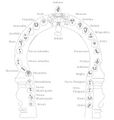 Display of all 28th nakshatra in silver arch with candles in Tirupperunthurai (Athmanathaswamy temple) near Aranthangi, India, 10th century CE. (SMH 2025).
 -
 Display of all 28th nakshatra in a door frame in Tirupperunthurai (Athmanathaswamy temple) near Aranthangi, India, 10th century CE. (SMH 2025).


Mythology
mnemonic tales and cultural significance
Weblinks
References
- References (general)