Hasta: Difference between revisions
From All Skies Encyclopaedia
Hasta
No edit summary |
No edit summary |
||
| Line 1: | Line 1: | ||
{{DISPLAYTITLE:Hasta (हस्त)}} | {{DISPLAYTITLE:Hasta (हस्त)}} | ||
[[File: | [[File:Hasta nakshatras in Temple draw+lbl 4ase.jpg|thumb|Hasta , the 13th nakshatra, in Tirupperunthurai (Athmanathaswamy temple) near Aranthangi, India, 10th century CE. (SMH 2025).]] | ||
[[File:13+14 stellarium.gif|thumb|Nakshatras 13 and 14, Hasta and Citra, marked on the Stellarium map (WGSN 2025).]] | [[File:13+14 stellarium.gif|thumb|Nakshatras 13 and 14, Hasta and Citra, marked on the Stellarium map (WGSN 2025).]] | ||
Hasta (हस्त) is an Indian name, used by the Indian Vedic tradition. Most of these names are roughly 3000 years old. They pre-date Hinduism but were taken over by it. | Hasta (हस्त) is an Indian name, used by the Indian Vedic tradition. Most of these names are roughly 3000 years old. They pre-date Hinduism but were taken over by it. | ||
Revision as of 16:08, 30 October 2025


Hasta (हस्त) is an Indian name, used by the Indian Vedic tradition. Most of these names are roughly 3000 years old. They pre-date Hinduism but were taken over by it.
Etymology and History
Name Variants
- Hasta
- Kara,
- Ravibha
The term "Hasta" means "hand". Temple depictions show it with five stars, and it is identified with the five stars (β, α, ε, γ, and δ Corvi) of modern Corvus that form a remarkable and easily recognizable pattern in the night sky.
Origin of Constellation
Transfer and Transformation of the Constellation
-
 Hasta 10th century CE
 -
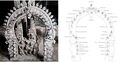 Display of all 28th nakshatras in silver arch with candles in Tirupperunthurai (Athmanathaswamy temple) near Aranthangi, India, 10th century CE. (SMH 2025).
 -
 Display of all 28th nakshatras in a door frame in Tirupperunthurai (Athmanathaswamy temple) near Aranthangi, India, 10th century CE. (SMH 2025).
 -
 Hasta Chinese
 -
 Hasta as reconstructed by Jones (1720)


Mythology
mnemonic tales and cultural significance
Weblinks
References
- References (general)





