Antlia: Difference between revisions
No edit summary |
No edit summary |
||
| Line 7: | Line 7: | ||
[[File:Lacaille text newConst1752 Ant.JPG|alt=screenshot(s) of text|thumb|Lacaille on Antlia 1752]] | [[File:Lacaille text newConst1752 Ant.JPG|alt=screenshot(s) of text|thumb|Lacaille on Antlia 1752]] | ||
The constellation was invented in the 18th century. At that time, science was flourishing in Europe. Academies and scientific societies were founded – following the English Royal Society in 1660, similar foundations were established throughout Europe. International cooperation was strengthened as scientists exchanged ideas, organised joint observation campaigns such as the measurement of the transits of Venus in 1661 and 1669, and collected data in one place (Paris). Scientists also collaborated in societies across national and linguistic boundaries, so that new discoveries spread rapidly. Experiments laid the foundations for modern thermodynamics. | |||
Among the numerous technical inventions of the time was the vacuum pump. In 1654, Otto von Guericke demonstrated to an impressed audience in Magdeburg the power of air pressure holding two hemispheres together. They had previously been pumped free of air using a vacuum pump. | |||
This invention in turn inspired experiments with steam. The boiling process under high pressure was investigated, leading to the invention of the precursor to the pressure cooker. | |||
Both the vacuum pump for pumping out air and the pump for letting air into submarines or diving helmets may have been inspired by this idea. | |||
The fact is that the constellation was defined by Nicolas Louis de la Caille. Between 1750 and 1754, he worked at the Cape of Good Hope, where he surveyed the land as a geodesist and the sky as an astronomer. In the Mémoires de l'Académie Royale des Sciences, he wrote in 1756 that the device known as the ‘pneumatic machine’ was symbolic of experimental physics. | |||
It is therefore a celestial monument to a subject. | |||
=== Origin of Constellation === | === Origin of Constellation === | ||
Revision as of 10:07, 18 February 2026
Authors: Susanne M Hoffmann, Youla Azkarrula

One of the 88 IAU constellations. The constellation was invented by Lacaille in the 1750s.
Etymology and History

The constellation was invented in the 18th century. At that time, science was flourishing in Europe. Academies and scientific societies were founded – following the English Royal Society in 1660, similar foundations were established throughout Europe. International cooperation was strengthened as scientists exchanged ideas, organised joint observation campaigns such as the measurement of the transits of Venus in 1661 and 1669, and collected data in one place (Paris). Scientists also collaborated in societies across national and linguistic boundaries, so that new discoveries spread rapidly. Experiments laid the foundations for modern thermodynamics.
Among the numerous technical inventions of the time was the vacuum pump. In 1654, Otto von Guericke demonstrated to an impressed audience in Magdeburg the power of air pressure holding two hemispheres together. They had previously been pumped free of air using a vacuum pump.
This invention in turn inspired experiments with steam. The boiling process under high pressure was investigated, leading to the invention of the precursor to the pressure cooker.
Both the vacuum pump for pumping out air and the pump for letting air into submarines or diving helmets may have been inspired by this idea.
The fact is that the constellation was defined by Nicolas Louis de la Caille. Between 1750 and 1754, he worked at the Cape of Good Hope, where he surveyed the land as a geodesist and the sky as an astronomer. In the Mémoires de l'Académie Royale des Sciences, he wrote in 1756 that the device known as the ‘pneumatic machine’ was symbolic of experimental physics.
It is therefore a celestial monument to a subject.
Origin of Constellation
Various types of historical air pumps
-
 The air-pump of Otto von Guericke (1654). (This file is from Wikimedia Commons and may be used by other projects. Wellcome Trust, UK)
 -
 Boyle's first air pump (1660s). (This file is from Wikimedia Commons and may be used by other projects: Wellcome Trust UK)
 -
 Vacuum Pump, ~1700 Dresden, Germany (Thomas Quine 2010). (This file is from Wikimedia Commons and may be used by other projects.)


.jpg)
Transfer and Transformation of the Constellation
-
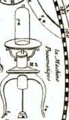 Antlia (Lacaille (1756).
 -
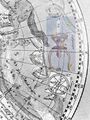 Antlia in Bode (1782)
 -
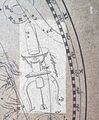 Antlia in Goldbach (1799)
 -
 Antlia in Bode (1801), This file is from Wikimedia Commons and may be used by other projects.


Mythology
There is no mythology.
Weblinks
All HIP Stars within this constellation
| test | |||
|---|---|---|---|
| 1 | RA | DEC | mag |
| 2 | |||
| 3 |
HIP 53502,HIP 46515,HIP 51172,HIP 46515,HIP 47039,HIP 47627,HIP 48587,HIP 47919,HIP 49264,HIP 49434,HIP 49165,HIP 49428,HIP 48926,HIP 49418,HIP 50030,HIP 50075,HIP 49670,HIP 49769,HIP 49943,HIP 49950,HIP 50234,HIP 50641,HIP 50525,HIP 51937,HIP 51530,HIP 52022,HIP 52273,HIP 52151,HIP 52324,HIP 52550





