Canes Venatici: Difference between revisions
No edit summary |
No edit summary |
||
| Line 6: | Line 6: | ||
==Etymology and History== | ==Etymology and History== | ||
[[File:CVn Johannes-Hevelii-Prodromus-astronomiae.jpg|alt=historical map|thumb|CVn depicted in Hevelius (1687).]] | [[File:CVn Johannes-Hevelii-Prodromus-astronomiae.jpg|alt=historical map|thumb|CVn depicted in Hevelius (1687).]] | ||
[[File:CVn Hevelius.JPG|alt=screenshot of text|thumb|Canes Venatici as desctibed in Hevelius (1687).]] | |||
=== Origin of Constellation === | |||
In English star charts from the 1670s, it had already become customary to name the brightest nameless star in this area in memory of the beheaded king: Francis Lamb (1673) and Edward Sherburne (1675) drew a human heart with a crown around this star. They named it Cor Caroli Regis Martyris in memory of Charles I. The name for the lonely star was shortened by subsequent astronomers to [[Cor Caroli|Cor Caroli,]] Heart of Charles. | |||
The constellation of the Dogs is also a fictional character. In 1687, Hevelius drew the figure of two slender dogs held on a leash by Bootes. The southern one contains two bright stars, while the northern one contains only stars at the limit of visibility. A century later, Bode wrote the names of the dogs, Asterion (the starry one) and Chara (joy), on the animals' collars. | |||
Many Babylonian stars in this region of the sky cannot be identified with certainty, as there are no coordinates or data available. The designation “star of abundance” can refer to a single star or a group of stars, and Cor Caroli is one of the possible identification suggestions – but it could also be Arcturus in Bootes. The name is usually interpreted as a reference to a conspicuous bright single star, but this is not documented anywhere. Arcturus is much brighter and calendrically significant, and Cor Caroli had no other name in ancient times. If this is the Babylonian “star of abundance,” the name was not translated into Greek. | |||
Ptolemy lists the brightest stars of the hunting dogs in his star catalog, but for him they do not belong to any constellation. They appear in an intermediate section of the catalog under the heading “Great Bear” as the “stars outside the figure, around it.” These stars do not have proper names, but are referred to as “the star south of the tail [of the Bear] at some distance” and “the weaker of the two.”<gallery> | |||
<gallery> | |||
File:Cvn Bode1782.jpg|Canes Venatici in Bode (1782, 1805): The constellation has boundary line and the southern one of the dogs has the "Heart of Charles II" on the leash (sic! must be Charles I). | File:Cvn Bode1782.jpg|Canes Venatici in Bode (1782, 1805): The constellation has boundary line and the southern one of the dogs has the "Heart of Charles II" on the leash (sic! must be Charles I). | ||
</gallery> | </gallery> | ||
Revision as of 18:47, 24 February 2026
Authors: Susanne M Hoffmann, Youla Azkarrula, Ian Ridpath

One of the 88 IAU constellations. The constellation was invented by Hevelius (1687) in it's present shape but with predecessors in other cultures and atlases.
Etymology and History


Origin of Constellation
In English star charts from the 1670s, it had already become customary to name the brightest nameless star in this area in memory of the beheaded king: Francis Lamb (1673) and Edward Sherburne (1675) drew a human heart with a crown around this star. They named it Cor Caroli Regis Martyris in memory of Charles I. The name for the lonely star was shortened by subsequent astronomers to Cor Caroli, Heart of Charles.
The constellation of the Dogs is also a fictional character. In 1687, Hevelius drew the figure of two slender dogs held on a leash by Bootes. The southern one contains two bright stars, while the northern one contains only stars at the limit of visibility. A century later, Bode wrote the names of the dogs, Asterion (the starry one) and Chara (joy), on the animals' collars.
Many Babylonian stars in this region of the sky cannot be identified with certainty, as there are no coordinates or data available. The designation “star of abundance” can refer to a single star or a group of stars, and Cor Caroli is one of the possible identification suggestions – but it could also be Arcturus in Bootes. The name is usually interpreted as a reference to a conspicuous bright single star, but this is not documented anywhere. Arcturus is much brighter and calendrically significant, and Cor Caroli had no other name in ancient times. If this is the Babylonian “star of abundance,” the name was not translated into Greek.
Ptolemy lists the brightest stars of the hunting dogs in his star catalog, but for him they do not belong to any constellation. They appear in an intermediate section of the catalog under the heading “Great Bear” as the “stars outside the figure, around it.” These stars do not have proper names, but are referred to as “the star south of the tail [of the Bear] at some distance” and “the weaker of the two.”
-
 Canes Venatici in Bode (1782, 1805): The constellation has boundary line and the southern one of the dogs has the "Heart of Charles II" on the leash (sic! must be Charles I).

Transfer and Transformation of the Constellation
-
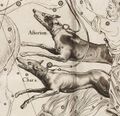 CVn in Hevelius (1687)
 -
 Canes Venatici in Flamsteed (1729)
 -
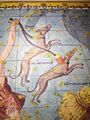 CVn in Bode (1782,1805) with the "Heart of Charles II"







