Libra: Difference between revisions
No edit summary |
|||
| Line 2: | Line 2: | ||
---- | ---- | ||
[[File:Libra (lib).tiff|alt=star chart|thumb|Lib star chart (IAU and Sky & Telescope magazine, Roger Sinnott & Rick Fienberg).]] | [[File:Libra (lib).tiff|alt=star chart|thumb|Lib star chart (IAU and Sky & Telescope magazine, Roger Sinnott & Rick Fienberg).]] | ||
One of the [[:Category:88_IAU-Constellations|88 IAU constellations]]. | One of the [[:Category:88_IAU-Constellations|88 IAU constellations]]. The constellation Libra is Babylonian—like all constellations of the zodiac. What is special about this constellation is that it was initially lost in Greek times and returned in Roman times. The fact that Libra is the only instrument in the zodiac today is rather coincidental: we could just as well count the sextant in the zodiac in addition to [[Orion]]'s club, because stars in this constellation are sometimes covered by the moon, and then we would have another inanimate object. So it is rather coincidental that Libra ended up in the zodiac and other instruments did not. | ||
==Etymology and History== | ==Etymology and History== | ||
The Greek constellation ... | ===Origin of Constellation=== | ||
The constellation name is attested at least since MUL.APIN (around 1000 BCE). However the shape of the image and the exact identification with stars was occasionally varied over time. | |||
If you draw the Babylonian equivalent of the constellation [[Virgo]], [[Spica]] is the easternmost star. Between this and the stars at the tips of the Scorpion's claws (α and β Lib), there is about 20° of space where you can draw a set of scales. The scales then lie towards [[Virgo]] and not towards [[Scorpius]] as in today's/Greek image. Perhaps this was the original image, which first had to give way to the enlarged Greek Virgo before the Babylonian roots were revisited in Roman times. In the 1st century, Libra appears in astrological literature, for example in Geminos and Manilius, and is thus drawn again – but then in the scissors of Scorpio: on the Farnese Globe, Scorpius “holds” Libra with the tips of its scissors, so that the scales dangle in its face. | |||
==== Greek Absence ==== | |||
Aratos, Eratosthenes, Hipparchus, and Ptolemy did not know the constellation Libra: for them, this area was named the scorpion's claws. The reason for this is probably a change in the constellation Virgo: in Mesopotamia, there were two variants of the constellation Virgo (the Virgin), both of which occupy a small space of about 30° along the ecliptic. However, today's constellation Virgo is approximately 43° long along the ecliptic, and today's constellation is based on the Greek one. | |||
If you draw the Greek Virgo on a star map and next to it a giant scorpion, for which the tips of the claws are marked by the stars α and β Librae, then there is no room left in between for another figure, e.g., a scale. On the globe of the Farnese Atlas, the scorpion holds the scales in its claws, i.e., anyone who wanted to imagine a set of scales in Greek superimposed them on the claws of the scorpion. | |||
==== Roman Renaissance ==== | |||
Manilius passed down the mnemonic rule that day and night “keep the scales balanced” in the constellation. He cannot have meant that the sun is in Libra at the equinox, because that was no longer the case in his era. The equinox was located next to α Lib around 1250 BC, which fits the date of MUL.APIN. Heliocentric risings of the Libra stars α and β Lib in the morning sky thus took place in the 2nd millennium at the equinox and no longer in Roman times. Manilius can therefore only have referred to heliocentric settings in the evening, i.e., observations at a time when people could comfortably observe the sky and could use this as a farmer's rule. In his time, the stars of Libra were just visible in the evening sky around the equinox and set quickly after the sun. | |||
Manilius was best known for his astrology and was not read in mathematical astronomy. Astronomy in the Arabic and Latin Middle Ages refers primarily to Aratus and Ptolemy, neither of whom knew the constellation Libra. That is why the two brightest stars in Libra are still called by their Arabic names “northern scissors” and “southern scissors” today; they are direct translations from the Almagest. In modern star charts, Libra is consistently depicted again – at least since it was drawn in the Uranometria in 1603, it has become an integral part of uraniumography. | |||
Modern authors sometimes wonder why Libra is the only inanimate object in the zodiac. This was by no means always the case: the Mesopotamian precursor to the zodiac was the moon's path. The “path of the moon” is the area in which the moon can cover stars. Today, as in MUL.APIN, it consists of 17 constellations. Among them are several “devices”; for example, the stars of Auriga once formed a throwing stick, i.e., a weapon—a kind of Babylonian boomerang. Orion holds up a club (or, in modern terms, sometimes a sword) or, in Babylonian terms, a shepherd's crook. Whatever he holds in his northward-facing hand is an object whose tip lies in the zodiac. This is also already mentioned in MUL.APIN. | |||
==== Babylonian ==== | ==== Babylonian ==== | ||
| Line 446: | Line 458: | ||
==Mythology== | ==Mythology== | ||
For the Babylonians, Libra was located next to Spica, the ear of corn, and was therefore probably an instrument for weighing the harvest. The Babylonian equivalent of the constellation Virgo was associated with the goddess Shala. Although there was no constellation called Shala, this goddess is sometimes depicted holding the ear of corn in her hand instead of lying in a furrow. This pragmatic proximity of the ear of corn and the scales is thus documented from the 2nd millennium BCE to Greek times. There is no story behind it; rather, it seems to be a mnemonic device for the farmers' calendar. | |||
When the Romans reintroduced the constellation Libra, however, it was an instrument or symbol of justice for them. It is said to be the scales of the goddess Justicia (Greek Dike), which is one of the possible interpretations of the Greek Virgin. | |||
There is therefore no specific myth associated with Libra, only various ideas in ancient religions or as a farmer's rule for determining the calendar: day and night are in balance, the world experiences justice, or the harvest is weighed. | |||
==Weblinks== | ==Weblinks== | ||
Revision as of 19:21, 24 February 2026
Authors: Susanne M Hoffmann, Youla Azkarrula, Ian Ridpath

One of the 88 IAU constellations. The constellation Libra is Babylonian—like all constellations of the zodiac. What is special about this constellation is that it was initially lost in Greek times and returned in Roman times. The fact that Libra is the only instrument in the zodiac today is rather coincidental: we could just as well count the sextant in the zodiac in addition to Orion's club, because stars in this constellation are sometimes covered by the moon, and then we would have another inanimate object. So it is rather coincidental that Libra ended up in the zodiac and other instruments did not.
Etymology and History
Origin of Constellation
The constellation name is attested at least since MUL.APIN (around 1000 BCE). However the shape of the image and the exact identification with stars was occasionally varied over time.
If you draw the Babylonian equivalent of the constellation Virgo, Spica is the easternmost star. Between this and the stars at the tips of the Scorpion's claws (α and β Lib), there is about 20° of space where you can draw a set of scales. The scales then lie towards Virgo and not towards Scorpius as in today's/Greek image. Perhaps this was the original image, which first had to give way to the enlarged Greek Virgo before the Babylonian roots were revisited in Roman times. In the 1st century, Libra appears in astrological literature, for example in Geminos and Manilius, and is thus drawn again – but then in the scissors of Scorpio: on the Farnese Globe, Scorpius “holds” Libra with the tips of its scissors, so that the scales dangle in its face.
Greek Absence
Aratos, Eratosthenes, Hipparchus, and Ptolemy did not know the constellation Libra: for them, this area was named the scorpion's claws. The reason for this is probably a change in the constellation Virgo: in Mesopotamia, there were two variants of the constellation Virgo (the Virgin), both of which occupy a small space of about 30° along the ecliptic. However, today's constellation Virgo is approximately 43° long along the ecliptic, and today's constellation is based on the Greek one.
If you draw the Greek Virgo on a star map and next to it a giant scorpion, for which the tips of the claws are marked by the stars α and β Librae, then there is no room left in between for another figure, e.g., a scale. On the globe of the Farnese Atlas, the scorpion holds the scales in its claws, i.e., anyone who wanted to imagine a set of scales in Greek superimposed them on the claws of the scorpion.
Roman Renaissance
Manilius passed down the mnemonic rule that day and night “keep the scales balanced” in the constellation. He cannot have meant that the sun is in Libra at the equinox, because that was no longer the case in his era. The equinox was located next to α Lib around 1250 BC, which fits the date of MUL.APIN. Heliocentric risings of the Libra stars α and β Lib in the morning sky thus took place in the 2nd millennium at the equinox and no longer in Roman times. Manilius can therefore only have referred to heliocentric settings in the evening, i.e., observations at a time when people could comfortably observe the sky and could use this as a farmer's rule. In his time, the stars of Libra were just visible in the evening sky around the equinox and set quickly after the sun.
Manilius was best known for his astrology and was not read in mathematical astronomy. Astronomy in the Arabic and Latin Middle Ages refers primarily to Aratus and Ptolemy, neither of whom knew the constellation Libra. That is why the two brightest stars in Libra are still called by their Arabic names “northern scissors” and “southern scissors” today; they are direct translations from the Almagest. In modern star charts, Libra is consistently depicted again – at least since it was drawn in the Uranometria in 1603, it has become an integral part of uraniumography.
Modern authors sometimes wonder why Libra is the only inanimate object in the zodiac. This was by no means always the case: the Mesopotamian precursor to the zodiac was the moon's path. The “path of the moon” is the area in which the moon can cover stars. Today, as in MUL.APIN, it consists of 17 constellations. Among them are several “devices”; for example, the stars of Auriga once formed a throwing stick, i.e., a weapon—a kind of Babylonian boomerang. Orion holds up a club (or, in modern terms, sometimes a sword) or, in Babylonian terms, a shepherd's crook. Whatever he holds in his northward-facing hand is an object whose tip lies in the zodiac. This is also already mentioned in MUL.APIN.
Babylonian
Greco-Roman
Aratos
Eratosthenes
Hipparchus
Rising (Lib II Cap V §10)
The Rising of ...
| east | south | |||
|---|---|---|---|---|
| lam1 | lam2 | lam1 | lam2 | |
| star | ||||
| duration | 2 1/8 hours = 127.5 min = 31 7/8 degree | |||
Setting (Lib II Cap VI §10)
| west | south | |||
|---|---|---|---|---|
| lam1 | lam2 | lam1 | lam2 | |
| star | ||||
| duration | 2 2/3 hours = 160 min = 40° | |||
Stars Mentioned
| Greek | German | English | ident. | src | lam_culm | ||
|---|---|---|---|---|---|---|---|
| Lib II Cap V §10 | rising, east, first | ||||||
| Lib II Cap V §10 | rising, east, last | ||||||
| Lib II Cap VI §2 | setting CrB, south, last | Psc 13.5 | |||||
| Lib II Cap VI §13 | setting Aql, south, first | Ari 2 | |||||
| Lib III Cap I §9 | rising Ori, south, last | Psc 13 |
Geminos
Almagest Χηλαί.
| id | Greek
(Heiberg 1898) |
English
(Toomer 1984) |
ident. |
|---|---|---|---|
| Χηλῶν ἀστερισμός. | Constellation of The Claws | ||
| 1 | τῶν ἐπ’ ἄκρας τῆς νοτίου χηλῆς ὁ λαμπρός | Stars on the tip of the southern claw: the bright one | alf Lib |
| 2 | ὁ βορειότερος αὐτοῦ καὶ ἀμαυρότερος; | Stars on the tip of the southern claw: the star to the north of this and fainter than it | mu Lib |
| 3 | τῶν ἐπ’ ἄκρας τῆς βορείου χηλῆς ὁ λαμπρός | Stars an the tip of the northern claw: the bright one | bet Lib |
| 4 | ὁ προηγούμενος αὐτοῦ καὶ ἀμαυρός. | Stars an the tip of the northern claw: the faint star in a,dvance of this | del Lib |
| 5 | ὁ ἐν μέσῃ τῇ νοτόῳ χηλῇ | The star in the middle of the southern claw | iot Lib |
| 6 | ὁ τούτου προηγούμενος ἐπὶ τῆς αὐτῆς χηλῆς | The one in advance of this an the same claw | nu Lib |
| 7 | ὁ ἐν μέσῃ τῇ βορεύῳ χηλῇ. | The star in the middle of the northern claw | gam Lib |
| 9 | ὁ ἑπόμενος αὐτῷ ἐπὶ τῆς αὐτῆς χηλῆς | The one to the rear of this on the same daw | tet Lib |
| ἀστέρερ ἡ, ὥν β’ μεγέθους β, δ’ ὅ, ε’ β. | {8 stars, 2 of the second magnitude, 4 of the fourth, 2 of tl;le fifth} | ||
| Οἱ περὶ τὰς χηλὰς ἀμόρφωτοι | Stars araund Libra outside the constellation | ||
| 10 | τῶν βορειοτέρων τῆς βορείου χηλῆς β' ὁ προηγούμενος | The most advanced of the 3 stars north of the northern claw | 37 Lib |
| 11 | τῶν ἐπομένων β ὁ νοτιώτερος | The southernmost of the rearmost 2 [ of these] | 48 Lib |
| 12 | ὁ βόρειος αὐτῶν | The northernmost of them | xi Lib |
| 13 | τῶν μεταξὺ τῶν χηλῶν » ὁ ἐπόμευος | The rearmost of the 3 stars between the claws | lam Lib |
| 14 | τῶν λοιπῶν β καὶ προηγουμένων ὁ βόρειος. | The northernmost of the other 2 in advance f of the lauer 1 | 41 Lib |
| 15 | ὁ νότιος αὐτῶν | The southernmost of them | HR 5810 |
| 16 | τῶν νοτιωτέρου τῆς νοτίου χηλῆς 7 ὁ προηγούμενος. | The most advanced of the 3 stars south of the southern claw | 20 Lib |
| 17 | τῶν λοιπῶν καὶ ἐπομένωυ β ὁ βορειότερος. | The northernmost of the other, rear 2 | 39 Lib |
| 18 | ὁ νοτιώτερος αὐτῶν | The southernmost of them | 40 Lib |
| ἀστέρες 9, ὧν γ’ μεγέθουρ ἄ, δ’ ἓ, ε β, ς ἂ. | 9 stars, I of the third magnitude, 5 of the fourth, 2 of the fifth, 1 of the sixth |

Stars within the Constellation Area
| id | Label | IAU design. | description | Vmag |
|---|---|---|---|---|
| 1 | Zubeneschamali | HIP 74785 | Constellation lines (Vertex) | 2.62 |
| 2 | Zubenelgenubi | HIP 72622 | Constellation lines (Vertex) | 2.75 |
| 3 | Zubenelhakrabi | HIP 76333 | Constellation lines | 3.91 |
| 4 | θ Librae | HIP 77853 | Constellation lines (Vertex) | 4.16 |
| 5 | ι 1 Librae | HIP 74392 | Constellation lines (Vertex) | 4.54 |
| 6 | δ Librae | HIP 73473 | Constellation lines (Vertex) | 4.93 |
| 7 | ν Librae | HIP 73945 | Constellation lines | 5.2 |
| 8 | μ Librae | HIP 72489 | Constellation lines (Vertex) | 5.31 |
| 9 | η Librae | HIP 77060 | Inside the hull | 5.412 |
| 10 | ξ 2 Librae | HIP 73133 | Inside the hull | 5.45 |
| 11 | ζ 4 Librae | HIP 76126 | Inside the hull | 5.499 |
| 12 | ζ 1 Librae | HIP 75730 | Inside the hull | 5.626 |
| 13 | - | HIP 75352 | Inside the hull | 5.716 |
| 14 | ξ 1 Librae | HIP 72934 | Inside the hull | 5.788 |
| 15 | ζ 3 Librae | HIP 75944 | Inside the hull | 5.806 |
| 16 | 18 Lib | HIP 73310 | Inside the hull | 5.857 |
| 17 | ι 2 Librae | HIP 74493 | Inside the hull | 6.066 |
| 18 | ο Librae | HIP 75118 | Inside the hull | 6.143 |
| 19 | 28 Lib | HIP 75110 | Inside the hull | 6.17 |
| 20 | 26 Lib | HIP 74600 | Inside the hull | 6.172 |
| 21 | - | HIP 77007 | Inside the hull | 6.295 |
| 22 | 22 Lib | HIP 73953 | Inside the hull | 6.404 |
| 23 | 30 Lib | HIP 75294 | Inside the hull | 6.48 |
| 24 | - | HIP 74391 | Inside the hull | 6.49 |
Transfer and Transformation of the Constellation
-
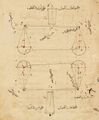 Libra (two versions) in as-Sufi, Kitāb Ṣuwar al-kawākib al-thābitah, Mosul 1170, Bodleian Libraries, University of Oxford,
 -
 Libra in Bayer (1603).
 -
 Libra in Flamsteed (1776)
 -
 Libra in Bode (1782,1805)
 -
 Libra in Jamieson (1822)
 -
 Libra zodiac sign, Jantar Mantar, Jaipur, India


.jpg)


Mythology
For the Babylonians, Libra was located next to Spica, the ear of corn, and was therefore probably an instrument for weighing the harvest. The Babylonian equivalent of the constellation Virgo was associated with the goddess Shala. Although there was no constellation called Shala, this goddess is sometimes depicted holding the ear of corn in her hand instead of lying in a furrow. This pragmatic proximity of the ear of corn and the scales is thus documented from the 2nd millennium BCE to Greek times. There is no story behind it; rather, it seems to be a mnemonic device for the farmers' calendar.
When the Romans reintroduced the constellation Libra, however, it was an instrument or symbol of justice for them. It is said to be the scales of the goddess Justicia (Greek Dike), which is one of the possible interpretations of the Greek Virgin.
There is therefore no specific myth associated with Libra, only various ideas in ancient religions or as a farmer's rule for determining the calendar: day and night are in balance, the world experiences justice, or the harvest is weighed.





