Phoenix: Difference between revisions
No edit summary |
No edit summary |
||
| Line 7: | Line 7: | ||
[[File:DeHoutman denVoghelFenicx all.JPG|alt=screenshot of text|thumb|de Houtman (1603) "den Voghel Fenicx", Phoenix, the Phenix. screenshot of star catalogue.]] | [[File:DeHoutman denVoghelFenicx all.JPG|alt=screenshot of text|thumb|de Houtman (1603) "den Voghel Fenicx", Phoenix, the Phenix. screenshot of star catalogue.]] | ||
===Origin of Constellation=== | ===Origin of Constellation=== | ||
The constellation dates back to the early modern period. However, the myth of the bird rising from its own ashes is ancient. It is already mentioned in Herodotus' Histories and seems to be an embellishment of Egyptian myths, according to which a certain bird dies at sunset and is reborn at sunrise. However, this does not appear to have been a constellation or celestial body anywhere, neither in Egypt nor in Greece. | <ref>Hoffmann, Susanne M. Wie der Löwe an den Himmel kam. Franckh Kosmos Verlag, Stuttgart 2021</ref>The constellation dates back to the early modern period. However, the myth of the bird rising from its own ashes is ancient. It is already mentioned in Herodotus' Histories and seems to be an embellishment of Egyptian myths, according to which a certain bird dies at sunset and is reborn at sunrise. However, this does not appear to have been a constellation or celestial body anywhere, neither in Egypt nor in Greece. | ||
Ovid takes up the phoenix myth in Metamorphoses, recounting its death not in flames, but as falling asleep in a nest and its rebirth from itself. The phoenix was also a well-known motif in Christianity. Symbolically, it can easily be associated with resurrection and is therefore sometimes depicted alongside Jesus. | Ovid takes up the phoenix myth in Metamorphoses, recounting its death not in flames, but as falling asleep in a nest and its rebirth from itself. The phoenix was also a well-known motif in Christianity. Symbolically, it can easily be associated with resurrection and is therefore sometimes depicted alongside Jesus. | ||
Revision as of 12:37, 27 February 2026
Authors: Susanne M Hoffmann, Youla Azkarrula, Ian Ridpath

One of the 88 IAU constellations. The constellation was invented by Dutch sailors in the 1590s.
Etymology and History

Origin of Constellation
[1]The constellation dates back to the early modern period. However, the myth of the bird rising from its own ashes is ancient. It is already mentioned in Herodotus' Histories and seems to be an embellishment of Egyptian myths, according to which a certain bird dies at sunset and is reborn at sunrise. However, this does not appear to have been a constellation or celestial body anywhere, neither in Egypt nor in Greece.
Ovid takes up the phoenix myth in Metamorphoses, recounting its death not in flames, but as falling asleep in a nest and its rebirth from itself. The phoenix was also a well-known motif in Christianity. Symbolically, it can easily be associated with resurrection and is therefore sometimes depicted alongside Jesus.
The star catalogue based on the measurements of Pieter Keyser and Frederick de Houtman and the celestial globe by Petrus Plancius (1598) contain five birds near the celestial South Pole: While four of these ‘southern birds’ depict real animals native to Papua New Guinea, Indonesia and India, the phoenix is the only bird that is not real. The death of Pieter Keyser during the voyage and the symbolism of the phoenix suggest a metaphorical memorial to a valued companion.
Transfer and Transformation of the Constellation
-
 Phonix on Blaeu's (1603) globe, based on de Houtman's data. RMG
 -
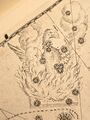 Phoenix in Bayer (1603)
 -
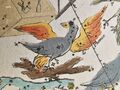 Phoenix in Fortin's Atlas Céleste, 3rd edition (1795).


Mythology
The original legend, which Herodotus recounts from Egypt and considers implausible, is that the phoenix only comes to Egypt every 500 years to bury its father. The father bird dies in Arabia and the son bird buries him at an Egyptian temple. The bird's plumage is said to have been depicted in red and gold in illustrations. Ovid reports that the young bird springs from the corpse of the old one.
Weblinks
References
- ↑ Hoffmann, Susanne M. Wie der Löwe an den Himmel kam. Franckh Kosmos Verlag, Stuttgart 2021






