Centaurus: Difference between revisions
accent |
IanRidpath (talk | contribs) →Weblinks: Added web link |
||
| Line 22: | Line 22: | ||
==Weblinks== | ==Weblinks== | ||
* Ridpath, Ian, “[http://www.ianridpath.com/startales/centaurus.html Star Tales: online edition]”. | |||
* | |||
==References== | ==References== | ||
Revision as of 09:40, 25 September 2024

One of the 88 IAU constellations. The ancient Greek constellation of the Centaur forms a super-constellation with Lupus and Ara. It is unknown whether or not Centaurus had a Babylonian predecessor: The Mesopotamian uranologies in this area mention a god (Numushda) whose appearance and exact location in the sky are not preserved, and the constellation UR.IDIM which is commonly translated as "Mad Dog" (or rabid dog) but also associated with a benevolent door keeper daemon who is a lion-man. Such a lion-man may possibly be depicted in seal imprints and mythologically named Urmahlullu.
Etymology and History
The Greek constellation is possibly derived from a Babylonian one. There were several centaur-like creatures and other mixed man-animal beings in Mesopotamian culture; seal imprints and reliefs witness them.
Origin of Constellation
Transfer and Transformation of the Constellation
-
 Centaurus et Lupus on the ancient Greek Kugel Globe, drawing by SMH 2021.
 -
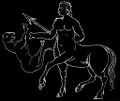 Centaurus et Lupus on the ancient Greco-Roman Farnese Globe, drawing by SMH 2017.
 -
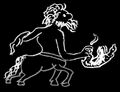 Centaurus et Lupus on the ancient Roman Mainz Globe, drawing by SMH 2021.
 -
 Centaurus and Lupus constellations from the Mercator celestial globe 1551 (CC0).
 -
 Centaurus as drawn by Joh. Bayer (1603) and Lupus drawn by the user of this exemplar of the atlas (extra map for Bayer).
 -
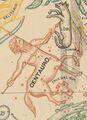 Centaurus et Lupus at Planisferio celeste (Carlos Simón 1894)


Greek Mythology
Weblinks
- Ridpath, Ian, “Star Tales: online edition”.