Aquila: Difference between revisions
| Line 9: | Line 9: | ||
The confusion of the Eagle and the Vulture can be traced throughout all epochs. In medieval manuscripts Aquilae was also commonly known as "vultur volans", see [https://www.thesaxlproject.com/assets/Uploads/00-Aquila-Master-0-R-6-October-2023.pdf Saxl-Project] while similarly, the (originally Arabian) eagle in [[Lyra]] also got the Latin name "vultur cadens". These names are preserved in late-medieval European astrolabes, star catalogues and from the sixteenth-century onwards on celestial globes. See for example the celestial globe [https://nla.gov.au/nla.obj-233257345/view (1551) of Gerard Mercator]. The term "lucida vulturis" for Altair remained popular until far into the 17th century, and Bode's celestial atlas uses the German rhyme "der Geyer mit der Leyer" (the vulture with the lyre) for [[Lyra]]. | The confusion of the Eagle and the Vulture can be traced throughout all epochs. In medieval manuscripts Aquilae was also commonly known as "vultur volans", see [https://www.thesaxlproject.com/assets/Uploads/00-Aquila-Master-0-R-6-October-2023.pdf Saxl-Project] while similarly, the (originally Arabian) eagle in [[Lyra]] also got the Latin name "vultur cadens". These names are preserved in late-medieval European astrolabes, star catalogues and from the sixteenth-century onwards on celestial globes. See for example the celestial globe [https://nla.gov.au/nla.obj-233257345/view (1551) of Gerard Mercator]. The term "lucida vulturis" for Altair remained popular until far into the 17th century, and Bode's celestial atlas uses the German rhyme "der Geyer mit der Leyer" (the vulture with the lyre) for [[Lyra]]. | ||
However, the arrow is not depicted on the Farnese Globe, as some of the smaller constellations are missing there. There is also no room for it because the eagle is hanging upside down, its head resting on the brightest star and its feet pointing towards the swan: it looks as if the swan is pecking at the eagle's talons. Compared to the image we can draw using the Almagest star catalogue, this Greek eagle is rotated by 180°. | |||
In fact, the constellation of the eagle can also be found in this position in the sky in Mesopotamian astronomy of the 2nd millennium BC. This suggests that the constellation was adopted into Greek culture from Babylon: although it does not belong to the zodiac, it is close to it and mythologically intertwined with Aquarius in the zodiac. | |||
Interestingly, near the Babylonian eagle is the Babylonian constellation ‘Dead Man’ or ‘Corpse,’ which has no analogue in Greek. It may have been located in the area east of the star Atair in Aquila, but it is impossible to say for sure. It is possible that Babylonian uranography referred to the constellation Delphinus as the corpse. Alternatively, the corpse could also have been located further south, i.e. ‘below’ the eagle. Calculations of Babylonian constellations do not allow for an exact position in declination, but only an estimate of the area in right ascension. | |||
One argument in favour of the southern variant is that Ptolemy simply renamed a group of stars in Aquila in his Almagest, calling them ‘Antinous’. This young man was a favourite of the contemporary Emperor Hadrian and could be stylised in modern terms as the constellation of homosexual love – although pederasty in ancient times had a different, more initiatory and educational character. All that is known about Antinous is that he drowned in the Nile in 130 AD for unknown reasons, whereupon a new cult was established throughout the Roman Empire: festivals were invented, temples built and other things done in his honour, so that his death by the astronomer in Alexandria comes as no surprise. However, he depicts him as a dead man carried by the (established) constellation Aquila. The figure of the double constellation ‘Aquila with Antinous’ in Ptolemy can be reconstructed from the star names and coordinates, and this eagle does not have outstretched wings, but flies from west to east. He is depicted in profile. | |||
Since Ptolemy makes numerous references to direct Babylonian sources, for example by using data on solar and lunar eclipses from there, it cannot be ruled out that his Antinous corresponds to the Babylonian constellation of the corpse. | |||
Incidentally, the interpretation of the bird as an eagle is unclear for the Babylonian constellation: the language does not allow for a distinction between eagles and vultures. A vulture as a scavenger would suggest a very old interpretation of the constellation, which could perhaps even be related to the hygienic and medically advisable burial of the dead. A vulture next to a corpse makes more sense in this respect. However, when it comes to ideas about life after death, the eagle is more appropriate: in Sumerian and Babylonian culture, it is a symbol of life, which is best illustrated in the ancient myth of Etana. The constellation is also located in the Milky Way, which is interpreted in numerous cultures as a road to the afterlife, so that a connection to the cult of the dead is virtually inevitable. | |||
Regardless of whether it was an eagle or a vulture, this constellation of a bird of prey has been found in Mesopotamian culture at that point in the sky since at least MUL.APIN. | |||
=== Origin of constellation === | === Origin of constellation === | ||
| Line 16: | Line 30: | ||
===== Aratos ===== | ===== Aratos ===== | ||
<blockquote>[311] Ahead of the Archer is another Arrow lying all by itself without a bow. The Bird is outstretched beside it, nearer to the north. Close to it another bird is wafted, inferior in size, but stormy when it rises from the sea at the departure of night; and men call it the Eagle. (Kidd 1997)</blockquote> | <blockquote>[311] Ahead of the Archer is another Arrow lying all by itself without a bow. The Bird is outstretched beside it, nearer to the north. Close to it another bird is wafted, inferior in size, but stormy when it rises from the sea at the departure of night; and men call it the Eagle. (Kidd 1997)</blockquote>The popular didactic poem by Aratos describes this bird as ‘dangerous when it emerges from the sea’ and calls it ‘the blown away’. Etymologically, this may be correct, but eagles do not emerge from the sea. The sentence therefore does not refer to the animal, but to the astronomy of the sunrise.<ref name=":0">Hoffmann, Susanne M. Wie der Löwe an den Himmel kam. Franckh Kosmos Verlag, Stuttgart 2021</ref> | ||
===== Eratosthenes ===== | ===== Eratosthenes ===== | ||
Eratosthenes believes that the eagle is the only bird that flies towards the sun without ducking away from its rays. He explicitly mentions that the eagle is depicted with outstretched wings, as if it were swooping down. Its head is therefore facing south towards Aquarius and its tail feathers point north towards Lyra and Cygnus. Germanicus in Roman times supports this idea with his description of the eagle guarding the arrow of Eros, which makes humans and even Zeus fall in love. On the Carolingian Aratea, the eagle is therefore depicted holding the arrow in its talons.<ref name=":0" /> | |||
===== Hipparchus ===== | ===== Hipparchus ===== | ||
| Line 778: | Line 793: | ||
== Greek Mythology == | == Greek Mythology == | ||
=== Greek === | |||
Hyginus, librarian to the Roman emperor Augustus, tells a story of an eagle and a swan: when Zeus fell in love with Nemesis, goddess of righteous wrath, he had to resort to trickery to seduce her. He transformed himself into a swan and had his eagle pursue him. Taking pity on the pursued, Nemesis gave the swan refuge in her lap, and Zeus, satisfied, placed his eagle in the sky. | |||
According to another legend, the eagle was Zeus's attribute animal, accompanying him since his campaign against the Titans. Eratosthenes leaves no doubt that it was the eagle who brought Ganymede to Zeus. Referring to the youth of Zeus, who was raised on Naxos and then fought against the Titans, Eratosthenes reports that an eagle joined Zeus and accompanied him. Because he saw this as a good omen, Zeus later declared the animal sacred. When the gods divided the birds among themselves, Zeus received the eagle, as it ruled over all birds. | |||
=== Babylonian === | |||
The eagle probably originates from the Sumerian myth of Etana. According to the royal lists, Etana is said to have been the first Sumerian king after the Flood. Since the neighbouring constellation of Aquarius is associated with this flood, the placement of the eagle in its immediate vicinity makes perfect sense in Mesopotamian thinking. Since the Etana myth dates back to at least the 24th century BC and may even be older, this connection could also suggest that the constellation Aquila is much older than the invention of writing. The myth already attests to the eagle's symbolism of life. | |||
According to legend, Etana was childless, which saddened him greatly. A helpful eagle carried him on its back to the sky, where he wanted to fetch the life-giving ‘herb of childbirth’. The myth tells how Etana climbs higher and higher on the eagle's back, sees the earth from above and describes what he sees. Shortly before reaching the herb, the eagle and its rider fall. The story provides interesting insights into the imagination of people who were already able to picture what the earth might look like from above. | |||
== Weblinks == | == Weblinks == | ||
Revision as of 10:47, 18 February 2026
Authors: Susanne M Hoffmann, Youla Azkarrula, Doris Vickers, ASE Tech Team, Ian Ridpath


Aquila, The Eagle, is one of the official IAU-constellations. Its history goes back to a Sumerian constellations (TI8mušen, The Eagle or The Vulture) in the same area of the sky. In Babylonian uranography, the neighboring constellation is a corpse and in Ptolemy's Almagest, the asterism of Antinous (a recently past away and deified favourit of the Roman emperor) is split off.
Etymology and History
"Aquila" is the Latin translation of the Ancient Greek term which is the translation of an Akkadian term which is the translation of a Sumerian term. It is unknown whether the Sumerians distinguished betwen eagles and vultures. The Greek term and mythology clearly refer to an eagle as a symbol of divine power. Still, the original Sumerian constellation might have had a different context: as it was placed next to the Sumerian constellation of The Corpse, the bird might have been considered a vulture.
The confusion of the Eagle and the Vulture can be traced throughout all epochs. In medieval manuscripts Aquilae was also commonly known as "vultur volans", see Saxl-Project while similarly, the (originally Arabian) eagle in Lyra also got the Latin name "vultur cadens". These names are preserved in late-medieval European astrolabes, star catalogues and from the sixteenth-century onwards on celestial globes. See for example the celestial globe (1551) of Gerard Mercator. The term "lucida vulturis" for Altair remained popular until far into the 17th century, and Bode's celestial atlas uses the German rhyme "der Geyer mit der Leyer" (the vulture with the lyre) for Lyra.
However, the arrow is not depicted on the Farnese Globe, as some of the smaller constellations are missing there. There is also no room for it because the eagle is hanging upside down, its head resting on the brightest star and its feet pointing towards the swan: it looks as if the swan is pecking at the eagle's talons. Compared to the image we can draw using the Almagest star catalogue, this Greek eagle is rotated by 180°.
In fact, the constellation of the eagle can also be found in this position in the sky in Mesopotamian astronomy of the 2nd millennium BC. This suggests that the constellation was adopted into Greek culture from Babylon: although it does not belong to the zodiac, it is close to it and mythologically intertwined with Aquarius in the zodiac.
Interestingly, near the Babylonian eagle is the Babylonian constellation ‘Dead Man’ or ‘Corpse,’ which has no analogue in Greek. It may have been located in the area east of the star Atair in Aquila, but it is impossible to say for sure. It is possible that Babylonian uranography referred to the constellation Delphinus as the corpse. Alternatively, the corpse could also have been located further south, i.e. ‘below’ the eagle. Calculations of Babylonian constellations do not allow for an exact position in declination, but only an estimate of the area in right ascension.
One argument in favour of the southern variant is that Ptolemy simply renamed a group of stars in Aquila in his Almagest, calling them ‘Antinous’. This young man was a favourite of the contemporary Emperor Hadrian and could be stylised in modern terms as the constellation of homosexual love – although pederasty in ancient times had a different, more initiatory and educational character. All that is known about Antinous is that he drowned in the Nile in 130 AD for unknown reasons, whereupon a new cult was established throughout the Roman Empire: festivals were invented, temples built and other things done in his honour, so that his death by the astronomer in Alexandria comes as no surprise. However, he depicts him as a dead man carried by the (established) constellation Aquila. The figure of the double constellation ‘Aquila with Antinous’ in Ptolemy can be reconstructed from the star names and coordinates, and this eagle does not have outstretched wings, but flies from west to east. He is depicted in profile.
Since Ptolemy makes numerous references to direct Babylonian sources, for example by using data on solar and lunar eclipses from there, it cannot be ruled out that his Antinous corresponds to the Babylonian constellation of the corpse.
Incidentally, the interpretation of the bird as an eagle is unclear for the Babylonian constellation: the language does not allow for a distinction between eagles and vultures. A vulture as a scavenger would suggest a very old interpretation of the constellation, which could perhaps even be related to the hygienic and medically advisable burial of the dead. A vulture next to a corpse makes more sense in this respect. However, when it comes to ideas about life after death, the eagle is more appropriate: in Sumerian and Babylonian culture, it is a symbol of life, which is best illustrated in the ancient myth of Etana. The constellation is also located in the Milky Way, which is interpreted in numerous cultures as a road to the afterlife, so that a connection to the cult of the dead is virtually inevitable.
Regardless of whether it was an eagle or a vulture, this constellation of a bird of prey has been found in Mesopotamian culture at that point in the sky since at least MUL.APIN.
Origin of constellation
The constellation of The Eagle mulTE8 is listed in the Mesopotamian creation myth "Enuma Anu Enlil", in Astrolab P and Astrolab B, and in MUL.APIN's first list, all dating to the 2nd millennium BCE.
Graeco-Roman constellation
Aratos
[311] Ahead of the Archer is another Arrow lying all by itself without a bow. The Bird is outstretched beside it, nearer to the north. Close to it another bird is wafted, inferior in size, but stormy when it rises from the sea at the departure of night; and men call it the Eagle. (Kidd 1997)
The popular didactic poem by Aratos describes this bird as ‘dangerous when it emerges from the sea’ and calls it ‘the blown away’. Etymologically, this may be correct, but eagles do not emerge from the sea. The sentence therefore does not refer to the animal, but to the astronomy of the sunrise.[1]
Eratosthenes
Eratosthenes believes that the eagle is the only bird that flies towards the sun without ducking away from its rays. He explicitly mentions that the eagle is depicted with outstretched wings, as if it were swooping down. Its head is therefore facing south towards Aquarius and its tail feathers point north towards Lyra and Cygnus. Germanicus in Roman times supports this idea with his description of the eagle guarding the arrow of Eros, which makes humans and even Zeus fall in love. On the Carolingian Aratea, the eagle is therefore depicted holding the arrow in its talons.[1]
Hipparchus
Geminos

Ptolemy's Almagest Αετός.
| Greek
(Heiberg 1898) |
English
(Toomer 1984) |
ident. | |
|---|---|---|---|
| Αετοῦ ἀστερισμός | |||
| ὁ ἐῃ μέσῃ τῇ κεφαλῇ | The star in the middle of the head | τ Aql | |
| ὁ τούτου προηγούμενος καὶ ἐπὶ τοῦ τραχήλου. | The one in advance of this, on the neck | β Aql | |
| ὁ ἐπὶ τοῦ μεταφρένου λαμπρὸς καλούμενος Ἀετός | The bright star on the place between the shoulders, called Aquila | αAql | |
| ὁ τούτου σύνεγγυς ἀπ’ ἄρκτων | The one close to this towards the north | ο Aql | |
| τῶν ἐν τῷ ἀριστερῷ ὤμῳ β ὁ προηγούμενος. | The more advanced of the 2 in the left shoulder | γ Aql | |
| ὁ ἐπόμενος αὐτῶν | The rearmost of them | φ Aql | |
| ὁ τῶν ἐν τῷ δεξιῷ ὤμῳ δύο ὁ προηγούμενος | The more advanced of the two in the right shoulder | μ Aql | |
| ὁ ἑπόμευος αὐτῶν | The rearmost of them | σ Aql | |
| ὁ ὑπὸ τὴν οὐρὰν τοῦ Ἀετοῦ ἀπωτέρω ἀπτόμενος τοῦ γαλαξίου. | The star some distance under the tail of Aquila, touching the Milky Way | ζ Aql | |
| all | ἀστέρες ὅ, ὥν β’ μεγέθους ἄ, γ’ ὅ, δ’ α, ε' γ' | 9 stars, 1 of the second magnitude, 4ofthe third, 1 of the fourth, 3 of the fifth | |
| Οἱ περὶ τὸν άετόν, ἐφ’ ὧν ὁ Ἀντίνοος | The stars araund Aquila, to which the name 'Antinous' is given | ||
| Τὸ τῶν ἀπὸ φότου τῆς κεφαλῆς τοῦ Ἀετοῦ β ὁ προηγούμενος, | The more advanced of the 2 stars south of the head of Aquila | η Aql | |
| ὁ ἐπόμερος αὐτῶν | The rearmost of them | θ Aql | |
| ὁ ἀπὸ νότου καὶ λιβὸς τοῦ δεξιοῦ ὤμου τοῦ Ἀετοῦ. | The star to the south and west of the right shoulder of Aquila | δ Aql | |
| ὁ τούτου ἀπὸ μεσημβρίας | The one to the south of this | ι Aql | |
| ὁ ἔτι τούτου φοτιώτερος | The one to the south again of the latter | κ Aql | |
| ὁ πάντου προηφούμευος. | The star most in adVance of ali | λ Aql | |
| all | ἀστέρες ξ, ὥν γ’ μεγέθους ὅ, δ’ ἄ, | 6 stars, 4 of the third magnitude, 1 of the fourth, 1 of the fifth |

Stars within the Constellation Area
| id | Label | IAU design. | description | Vmag |
|---|---|---|---|---|
| 1 | Altair | HIP 97649 | Inside the hull | 0.76 |
| 2 | Tarazed | HIP 97278 | Constellation lines | 2.72 |
| 3 | Okab | HIP 93747 | Constellation lines | 2.99 |
| 4 | Antinous | HIP 99473 | Inside the hull | 3.22 |
| 5 | δ Aquilae | HIP 95501 | Constellation lines | 3.36 |
| 6 | λ Aquilae | HIP 93805 | Constellation lines (Vertex) | 3.43 |
| 7 | Alshain | HIP 98036 | Constellation lines | 3.71 |
| 8 | η Aquilae | HIP 97804 | Inside the hull | 3.8 |
| 9 | ϵ Aquilae | HIP 93244 | Constellation lines (Vertex) | 4.02 |
| 10 | ι Aquilae | HIP 96468 | Constellation lines | 4.36 |
| 11 | μ Aquilae | HIP 96229 | Constellation lines | 4.45 |
| 12 | Libertas | HIP 97938 | Inside the hull | 4.707 |
| 13 | ν Aquilae | HIP 95585 | Constellation lines | 4.72 |
| 14 | κ Aquilae | HIP 96483 | Constellation lines (Vertex) | 4.96 |
| 15 | 26 Aql | HIP 95066 | Inside the hull | 4.99 |
| 16 | 36 Aql | HIP 95937 | Inside the hull | 5.03 |
| 17 | 18 Aql | HIP 93867 | Inside the hull | 5.086 |
| 18 | ο Aquilae | HIP 97675 | Inside the hull | 5.1 |
| 19 | 21 Aql | HIP 94477 | Inside the hull | 5.15 |
| 20 | - | HIP 95447 | Inside the hull | 5.15 |
| 21 | σ Aquilae | HIP 96665 | Constellation lines | 5.17 |
| 22 | 19 Aql | HIP 94068 | Constellation lines | 5.23 |
| 23 | 11 Aql | HIP 93203 | Constellation lines (Vertex) | 5.258 |
| 24 | ϕ Aquilae | HIP 98103 | Constellation lines | 5.278 |
| 25 | 23 Aql | HIP 94885 | Inside the hull | 5.28 |
| 26 | ω 1 Aquilae | HIP 94834 | Inside the hull | 5.283 |
| 27 | 132 G. Aql | HIP 100541 | Constellation lines (Vertex) | 5.301 |
| 28 | χ Aquilae | HIP 96957 | Inside the hull | 5.31 |
| 29 | 27 Aql | HIP 95073 | Inside the hull | 5.451 |
| 30 | 66 Aql | HIP 99631 | Constellation lines (Vertex) | 5.47 |
| 31 | Tianfu | HIP 98823 | Inside the hull | 5.508 |
| 32 | 28 Aql | HIP 94982 | Inside the hull | 5.518 |
| 33 | 64 Ser | HIP 93051 | Constellation lines (Vertex) | 5.551 |
| 34 | - | HIP 95822 | Inside the hull | 5.564 |
| 35 | 22 Aql | HIP 94727 | Inside the hull | 5.569 |
| 36 | - | HIP 94624 | Constellation lines | 5.571 |
| 37 | V1291 Aql | HIP 97871 | Constellation lines | 5.619 |
| 38 | - | HIP 94720 | Inside the hull | 5.63 |
| 39 | 58 Aql | HIP 97980 | Inside the hull | 5.631 |
| 40 | 45 Aql | HIP 96807 | Inside the hull | 5.637 |
| 41 | ϵ Sagittae | HIP 96516 | Constellation lines (Vertex) | 5.659 |
| 42 | 42 Aql | HIP 96556 | Constellation lines | 5.68 |
| 43 | 62 Aql | HIP 98844 | Inside the hull | 5.68 |
| 44 | π Aquilae | HIP 97473 | Inside the hull | 5.74 |
| 45 | - | HIP 95572 | Inside the hull | 5.754 |
| 46 | 35 Aql | HIP 95793 | Inside the hull | 5.783 |
| 47 | 42 G. Aql | HIP 95222 | Inside the hull | 5.811 |
| 48 | 13 G. Aql | HIP 93580 | Inside the hull | 5.815 |
| 49 | 49 G. Aql | HIP 95732 | Inside the hull | 5.839 |
| 50 | 103 G. Aql | HIP 98526 | Constellation lines | 5.91 |
| 51 | υ Aquilae | HIP 97229 | Inside the hull | 5.91 |
| 52 | 64 Aql | HIP 99171 | Inside the hull | 5.968 |
| 53 | - | HIP 96481 | Inside the hull | 5.975 |
| 54 | QS Aql | HIP 96840 | Inside the hull | 5.99 |
| 55 | ω 2 Aquilae | HIP 95002 | Inside the hull | 6.012 |
| 56 | - | HIP 95898 | Inside the hull | 6.042 |
| 57 | V923 Aql | HIP 95929 | Inside the hull | 6.082 |
| 58 | R Aql | HIP 93820 | Inside the hull | 6.09 |
| 59 | - | HIP 97970 | Inside the hull | 6.127 |
| 60 | 85 G. Aql | HIP 97687 | Constellation lines | 6.13 |
| 61 | - | HIP 97767 | Inside the hull | 6.15 |
| 62 | 34 G. Aql | HIP 94833 | Inside the hull | 6.174 |
| 63 | 101 G. Aql | HIP 98385 | Inside the hull | 6.18 |
| 64 | 7 G. Aql | HIP 93138 | Inside the hull | 6.207 |
| 65 | 88 G. Aql | HIP 97697 | Inside the hull | 6.233 |
| 66 | ψ Aquilae | HIP 97139 | Inside the hull | 6.243 |
| 67 | 52 G. Aql | HIP 95812 | Inside the hull | 6.245 |
| 68 | STF 2644AB | HIP 99585 | Constellation lines | 6.27 |
| 69 | 12 G. Aql | HIP 93488 | Inside the hull | 6.271 |
| 70 | - | HIP 95664 | Constellation lines | 6.303 |
| 71 | 37 G. Aql | HIP 94916 | Inside the hull | 6.311 |
| 72 | 25 G. Aql | HIP 94149 | Inside the hull | 6.321 |
| 73 | 46 Aql | HIP 96931 | Inside the hull | 6.321 |
| 74 | 44 G. Aql | HIP 95253 | Inside the hull | 6.346 |
| 75 | 67 G. Aql | HIP 96630 | Inside the hull | 6.358 |
| 76 | - | HIP 96428 | Inside the hull | 6.364 |
| 77 | 61 G. Aql | HIP 96351 | Inside the hull | 6.368 |
| 78 | 24 Aql | HIP 94913 | Inside the hull | 6.404 |
| 79 | 75 G. Aql | HIP 97144 | Inside the hull | 6.428 |
| 80 | Chechia | HIP 99894 | Inside the hull | 6.446 |
| 81 | - | HIP 97454 | Inside the hull | 6.457 |
| 82 | V1339 Aql | HIP 97607 | Inside the hull | 6.478 |
| 83 | V450 Aql | HIP 96204 | Inside the hull | 6.48 |
| 84 | 77 G. Aql | HIP 97244 | Inside the hull | 6.48 |
| 85 | - | HIP 94478 | Inside the hull | 6.49 |
| 86 | - | HIP 95453 | Inside the hull | 6.499 |
| 87 | - | HIP 93990 | Inside the hull | 6.5 |
| 88 | - | HIP 98922 | Constellation lines | 6.755 |
| 89 | - | HIP 97384 | Constellation lines | 6.77 |
| 90 | - | HIP 98314 | Constellation lines | 6.77 |
| 91 | - | HIP 98313 | Constellation lines (Vertex) | 6.83 |
| 92 | - | HIP 97762 | Constellation lines | 7.51 |
| 93 | - | HIP 97662 | Constellation lines | 7.64 |
| 94 | - | HIP 98348 | Constellation lines | 8.17 |
Hyginus, Astronomica
This is the eagle which is said to have snatched Ganymede up and given him to his lover, Jove. This bird, too, Jupiter is thought first to have singled out from the tribe of birds, because it alone, men say, strives to fly straight into the rays of the rising sun. And so it seems to fly above Aquarius, who, as many imagine, is Ganymede.
Some, too, have said that the bird was a certain Meropes, who ruled the island of Cos, and who called the island Cos from the name of his daughter, and the inhabitants Meropians from his own name. He had a wife, Ethemea, of the race of nymphs, who was stuck with the arrows of Diana when she ceased worshipping her. At last she was snatched away alive by Proserpina to the Land of the Dead. Meropes, moved by longing for his wife, would have committed suicide, but Juno, pitying him, changed him into an eagle and put him among the constellations, for, if she had put him there in human form, since he would have a man's memory, he would still be moved with longing for his wife.
Aglaosthenes, who wrote the Naxica, says that Jove was taken secretly from Crete, brought to Naxos, and there nourished. After he came to man's estate and wished to attack the Titans in war, he sighted an eagle as he was sacrificing, and considering this an omen, he placed it among the stars.
Some, too, have said that Mercury (though others say Anaplades) stirred by Venus's beauty, fell in love with her, and when she permitted no favours, became greatly downcast, as if in disgrace. Jove pitied him, and when Venus was bathing in the river Achelous he sent and eagle to take her sandal to Amythaonia of the Egyptians and give it to Mercury. Venus, in seeking for it, came to him who loved her, and so he, on attaining his desire, as a reward put the eagle in the sky. (Mary Ward 1960)
Ovid, Fasti, III, 793ff.
stella Lycaoniam vergit declinis ad Arcton
Miluus: haec illa nocte videnda venit.
quid dederit volucri, si vis cognoscere, caelum, 795
Saturnus regnis a Iove pulsus erat;
concitat iratus validos Titanas in arma,
quaeque fuit fatis debita temptat opem.
matre satus Terra, monstrum mirabile, taurus
parte sui serpens posteriore fuit: 800
hunc triplici muro lucis incluserat atris
Parcarum monitu Styx violenta trium.
viscera qui tauri flammis adolenda dedisset,
sors erat aeternos vincere posse deos.
immolat hunc Briareus facta ex adamante securi, 805
et iamiam flammis exta daturus erat:
Iuppiter alitibus rapere imperat: attulit illi
miluus, et meritis venit in astra suis.
The star of the Kite slopes downwards towards the Lycaonian Bear: on that night it becomes visible. If you would know what raised the bird to heaven. Saturn had been dethroned by Jupiter. In his wrath he stirred up the strong Titans to take arms and sought the help the Fates allowed him. There was a bull born of its mother Earth, a wondrous monster, the hinder part whereof was a serpent: him, at the warning of the three Fates, grim Styx had shut up in gloomy woods enclosed by a triple wall. There was an oracle that he who should burn the inwards of the bull in the flames would be able to conquer the eternal gods. Briareus sacrificed him with an axe made of adamant, and was just about to put the entrails on the fire: Jupiter commanded the birds to snatch them away; the kite brought them to him and was promoted to the stars for his services.
Medieval Epoch
Early Modern Epoch
Transfer and Transformation of the constellation
-
 Aquila with Sagitta, Leiden Aratea, Fol. 54v and 55r, between circa 830 and circa 840
 -
 Aquila et Antinous (Bayer 1603)
 -
 "Aquila et Antinous" in Hevelius (1690) in "Firmamentum Sobiescianum, sive uranographia" in volume "Prodromus Astronomia"
 -
 "Delphinus, Sagitta, Aquila, and Antinous", plate 13 in Urania's Mirror, a set of celestial cards accompanied by A familiar treatise on astronomy ... by Jehoshaphat Aspin (1825). London. Astronomical chart, 1 print on layered paper board : etching, hand-colored.
 -
 Aquila et Antinous, 1776 - Jean Fortin/ John Flamsteed - L'Aigle, Antinous, La Fleche, Le Renard, Le Dauphin (Aquila, Sagitta, Vulpecula & Anser Delphinus, source)
 -
 The constellation of Aquila (Eagle) and the constellation of Antinous, portrayed as Zeus and Ganymede, from the Uranographia, by Johann Elert Bode (1782).
 -
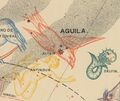 Aquila et Antinous at Planisferio celeste (Carlos Simón 1894)


.jpg)


Greek Mythology
Greek
Hyginus, librarian to the Roman emperor Augustus, tells a story of an eagle and a swan: when Zeus fell in love with Nemesis, goddess of righteous wrath, he had to resort to trickery to seduce her. He transformed himself into a swan and had his eagle pursue him. Taking pity on the pursued, Nemesis gave the swan refuge in her lap, and Zeus, satisfied, placed his eagle in the sky.
According to another legend, the eagle was Zeus's attribute animal, accompanying him since his campaign against the Titans. Eratosthenes leaves no doubt that it was the eagle who brought Ganymede to Zeus. Referring to the youth of Zeus, who was raised on Naxos and then fought against the Titans, Eratosthenes reports that an eagle joined Zeus and accompanied him. Because he saw this as a good omen, Zeus later declared the animal sacred. When the gods divided the birds among themselves, Zeus received the eagle, as it ruled over all birds.
Babylonian
The eagle probably originates from the Sumerian myth of Etana. According to the royal lists, Etana is said to have been the first Sumerian king after the Flood. Since the neighbouring constellation of Aquarius is associated with this flood, the placement of the eagle in its immediate vicinity makes perfect sense in Mesopotamian thinking. Since the Etana myth dates back to at least the 24th century BC and may even be older, this connection could also suggest that the constellation Aquila is much older than the invention of writing. The myth already attests to the eagle's symbolism of life.
According to legend, Etana was childless, which saddened him greatly. A helpful eagle carried him on its back to the sky, where he wanted to fetch the life-giving ‘herb of childbirth’. The myth tells how Etana climbs higher and higher on the eagle's back, sees the earth from above and describes what he sees. Shortly before reaching the herb, the eagle and its rider fall. The story provides interesting insights into the imagination of people who were already able to picture what the earth might look like from above.
Weblinks
- Ridpath, Ian, “Star Tales: online edition”.
All HIP Stars within this constellation
HIP 93429,HIP 93244,HIP 97278,HIP 97649,HIP 99473,HIP 93551,HIP 93526,HIP 93716,HIP 93717,HIP 93805,HIP 95236,HIP 95937,HIP 93743,HIP 93836,HIP 94149,HIP 94053,HIP 95055,HIP 95073,HIP 95126,HIP 95222,HIP 95886,HIP 96007,HIP 96807,HIP 96468,HIP 96392,HIP 96851,HIP 97207,HIP 98844,HIP 99171,HIP 93417,HIP 93589,HIP 93385,HIP 93580,HIP 93557,HIP 93892,HIP 93990,HIP 94331,HIP 94833,HIP 94883,HIP 94885,HIP 94477,HIP 94913,HIP 95697,HIP 95793,HIP 95585,HIP 95812,HIP 95987,HIP 96603,HIP 96403,HIP 97804,HIP 98336,HIP 98385,HIP 98191,HIP 97980,HIP 98945,HIP 93647,HIP 94250,HIP 94247,HIP 94727,HIP 94873,HIP 95045,HIP 95121,HIP 95680,HIP 95501,HIP 95732,HIP 95898,HIP 95929,HIP 96159,HIP 96630,HIP 96351,HIP 96196,HIP 97255,HIP 97709,HIP 97877,HIP 98474,HIP 93833,HIP 93920,HIP 93937,HIP 94068,HIP 94512,HIP 94733,HIP 94478,HIP 94564,HIP 96071,HIP 96047,HIP 96229,HIP 96745,HIP 96423,HIP 96204,HIP 96665,HIP 97398,HIP 98036,HIP 93732,HIP 93488,HIP 93820,HIP 94103,HIP 94220,HIP 94612,HIP 94486,HIP 94916,HIP 95253,HIP 95325,HIP 96092,HIP 96241,HIP 96979,HIP 97101,HIP 97144,HIP 97607,HIP 97229,HIP 97779,HIP 93438,HIP 93867,HIP 93273,HIP 94009,HIP 94064,HIP 94098,HIP 94120,HIP 94452,HIP 94524,HIP 94834,HIP 94982,HIP 95002,HIP 95406,HIP 95586,HIP 95620,HIP 96024,HIP 96282,HIP 96416,HIP 96481,HIP 93747





