Pavo: Difference between revisions
No edit summary |
No edit summary |
||
| Line 2: | Line 2: | ||
---- | ---- | ||
[[File:Pavo IAU.svg|alt=star chart|thumb|Pavo star chart (IAU and Sky & Telescope magazine, Roger Sinnott & Rick Fienberg).]] | [[File:Pavo IAU.svg|alt=star chart|thumb|Pavo star chart (IAU and Sky & Telescope magazine, Roger Sinnott & Rick Fienberg).]] | ||
Pavo, The Peacock, one of the [[:Category:88_IAU-Constellations|88 IAU constellations]]. The brightest star is named "[[Peacock]]" in modern astronomy. | |||
==Etymology and History== | ==Etymology and History== | ||
[[File:DePauw Houtman1603.jpg|alt=screenshot of text|thumb|de Pauw in de Houtman (1603), star catalogue as appendix to a dictionary.]] | [[File:DePauw Houtman1603.jpg|alt=screenshot of text|thumb|de Pauw in de Houtman (1603), star catalogue as appendix to a dictionary.]] | ||
[[File:Blaeu1603 Ind+Pav.JPG|thumb|Pavo and Indus on the Blaeu (1603) Globe, based on de Houtman's data. [https://collections.rmg.co.uk/mediaLib/398/media-398216/large.jpg RMG]: ]] | |||
===Origin of Constellation === | |||
The Peacock is one of the first constellations that Europeans defined in the southern sky. This constellation was invented during the Dutch's first expedition to the East Indies. The star catalogue was published under the name of navigator Pieter Keyser and the brother of Captain Frederick de Houtman, who assisted him in surveying the sky and completed the catalogue after their return. Perhaps it was de Houtman alone who conceived this constellation, as Keyser fell ill during the voyage and had to be buried in Java. | |||
The peacock's native habitat is primarily India, where the Dutch did not travel until later. However, the fact that trade brought peacocks to Europe in ancient times does not rule out the possibility that sailors had already seen such an animal in a park or stuffed in one of the Baroque cabinets of curiosities (collections of exotic objects). | |||
Via Plancius' globe from 1598, the constellation Pavo found its way into Bayer's Uranometria (1603) and thus became a standard figure in the starry sky. | |||
===Transfer and Transformation of the Constellation === | ===Transfer and Transformation of the Constellation === | ||
Revision as of 18:43, 26 February 2026
Authors: Susanne M Hoffmann, Youla Azkarrula, IanRidpath

Pavo, The Peacock, one of the 88 IAU constellations. The brightest star is named "Peacock" in modern astronomy.
Etymology and History


Origin of Constellation
The Peacock is one of the first constellations that Europeans defined in the southern sky. This constellation was invented during the Dutch's first expedition to the East Indies. The star catalogue was published under the name of navigator Pieter Keyser and the brother of Captain Frederick de Houtman, who assisted him in surveying the sky and completed the catalogue after their return. Perhaps it was de Houtman alone who conceived this constellation, as Keyser fell ill during the voyage and had to be buried in Java.
The peacock's native habitat is primarily India, where the Dutch did not travel until later. However, the fact that trade brought peacocks to Europe in ancient times does not rule out the possibility that sailors had already seen such an animal in a park or stuffed in one of the Baroque cabinets of curiosities (collections of exotic objects).
Via Plancius' globe from 1598, the constellation Pavo found its way into Bayer's Uranometria (1603) and thus became a standard figure in the starry sky.
Transfer and Transformation of the Constellation
-
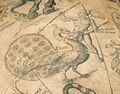 Pavo and Indus on Blaeu's first globe that copies from Plancius/ Hondius (1598). RMG
 -
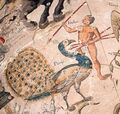 Pavo and Indus on the Blaeu (1603) Globe, based on de Houtman's data. RMG:
 -
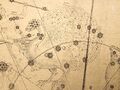 Pavo in Bayer (1603).
 -
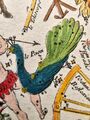 Pavo in Fortin's Atlas Céleste, 3rd edition (1795).