Vulpecula: Difference between revisions
No edit summary |
No edit summary |
||
| Line 7: | Line 7: | ||
[[File:Vul Hevelius.JPG|alt=screenshot(s) of text|thumb|Vulpecula cum Ansere as decribed by Hevelius (1687).]] | [[File:Vul Hevelius.JPG|alt=screenshot(s) of text|thumb|Vulpecula cum Ansere as decribed by Hevelius (1687).]] | ||
[[File:Vul Hevelii-Prodromus-astronomiae-4.jpg|alt=star chart|thumb|Vulpecula cum Ansere as depicted in mapping by Hevelius (1687).]] | [[File:Vul Hevelii-Prodromus-astronomiae-4.jpg|alt=star chart|thumb|Vulpecula cum Ansere as depicted in mapping by Hevelius (1687).]] | ||
===Origin of Constellation=== | |||
The constellation was originally called ''Vulpecula cum Anser'', ‘little fox with goose,’ and was squeezed into the middle of the Summer Triangle by Hevelius in 1687. It lies between the classical constellations [[Cygnus]], [[Lyra]], [[Sagitta]] and [[Aquila]]. On later star charts, it was recorded as a fox carrying a dead goose in its mouth. However, when the constellations were standardised in the 1920s, the goose was omitted. | |||
The fact that some astronomers do have a sense of humour is reflected in the fact that the star α Vul was christened ‘Anser’ by the IAU in 2017. The IAU's aim is to restore outdated constellations to the sky. The star α Vul is the brightest star in the constellation Vulpecula and is located in the body of the fox. The goose ([[Anser]]) has now been eaten by the fox (after 330 years). | |||
The Hevelius couple themselves did not give the individual stars any names. They probably saw an elongated animal and associated it with a small fox galloping with its tail stretched out behind it. At least, that is how the figure is drawn on modern star charts. | |||
===Transfer and Transformation of the Constellation=== | ===Transfer and Transformation of the Constellation=== | ||
Revision as of 19:18, 26 February 2026
Authors: Susanne M Hoffmann, Youla Azkarrula, Ian Ridpath

The constellation was invented by Hevelius (1687) and is one of the 88 IAU constellations.
Etymology and History


Origin of Constellation
The constellation was originally called Vulpecula cum Anser, ‘little fox with goose,’ and was squeezed into the middle of the Summer Triangle by Hevelius in 1687. It lies between the classical constellations Cygnus, Lyra, Sagitta and Aquila. On later star charts, it was recorded as a fox carrying a dead goose in its mouth. However, when the constellations were standardised in the 1920s, the goose was omitted.
The fact that some astronomers do have a sense of humour is reflected in the fact that the star α Vul was christened ‘Anser’ by the IAU in 2017. The IAU's aim is to restore outdated constellations to the sky. The star α Vul is the brightest star in the constellation Vulpecula and is located in the body of the fox. The goose (Anser) has now been eaten by the fox (after 330 years).
The Hevelius couple themselves did not give the individual stars any names. They probably saw an elongated animal and associated it with a small fox galloping with its tail stretched out behind it. At least, that is how the figure is drawn on modern star charts.
Transfer and Transformation of the Constellation
-
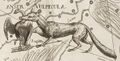 Vulpecula cum Ansere in Hevelius (1687)
 -
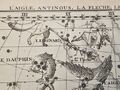 Vul depicted in Fortin's Atlas Céleste, 1st edition (1776)
 -
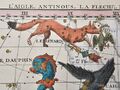 Vulpecula et Anser depicted in Fortin's Atlas Céleste, 3rd edition (1795)







