Fornax: Difference between revisions
No edit summary |
No edit summary |
||
| Line 5: | Line 5: | ||
==Etymology and History== | ==Etymology and History== | ||
[[File:Lacaille text newConst1756 for.JPG|alt=screenshot of text|thumb|Lacaille on Fornax (1752)]] | [[File:Lacaille text newConst1756 for.JPG|alt=screenshot of text|thumb|Lacaille on Fornax (1752)]] | ||
===Origin of Constellation=== | |||
<ref>Hoffmann, Susanne M. Wie der Löwe an den Himmel kam. Franckh Kosmos Verlag, Stuttgart 2021</ref>The Chemical Furnace (Fornax Chimiae) is one of the 14 constellations introduced by Lacaille when he observed the southern sky. After his stay in South Africa for surveying purposes from 1750 to 1754, he had compiled a catalogue of about 10,000 stars and numerous ‘nebulous’ objects, and also defined new constellations. The Chemical Furnace found its place in a bend of the ancient river, and it is not known why Lacaille introduced it. The only thing he says about it is a list entry: ‘Chemical furnace with its distillation apparatus and a collecting vessel’. | |||
Even if we consider the historical context, it is not clear whether Lacaille wanted to refer to a specific experiment or a specific apparatus here. In any case, it certainly has nothing to do with Lavoisier: Lavoisier (1743-1794) is considered one of the most important fathers of modern chemistry. He introduced qualitative measurement methods and discovered the important role of oxygen in combustion processes. As an official of the former royal administrative apparatus, Lavoisier fell victim to the aftermath of the French Revolution. Bode (around 1801) drew the constellation of chemistry based on an illustration in Lavoisier's publication. However, when Lacaille invented the constellation in the early 1750s, he was not in Paris but in Cape Town, and Lavoisier was just over ten years old. The two certainly did not know each other, and the constellation has nothing to do with any specific person, but honours chemistry in general as a craft and academic discipline. | |||
===Transfer and Transformation of the Constellation=== | ===Transfer and Transformation of the Constellation=== | ||
Revision as of 19:38, 26 February 2026
Authors: Susanne M Hoffmann, Youla Azkarrula, Ian Ridpath

One of the 88 IAU constellations. The constellation was invented by Lacaille in the 1750s.
Etymology and History

Origin of Constellation
[1]The Chemical Furnace (Fornax Chimiae) is one of the 14 constellations introduced by Lacaille when he observed the southern sky. After his stay in South Africa for surveying purposes from 1750 to 1754, he had compiled a catalogue of about 10,000 stars and numerous ‘nebulous’ objects, and also defined new constellations. The Chemical Furnace found its place in a bend of the ancient river, and it is not known why Lacaille introduced it. The only thing he says about it is a list entry: ‘Chemical furnace with its distillation apparatus and a collecting vessel’.
Even if we consider the historical context, it is not clear whether Lacaille wanted to refer to a specific experiment or a specific apparatus here. In any case, it certainly has nothing to do with Lavoisier: Lavoisier (1743-1794) is considered one of the most important fathers of modern chemistry. He introduced qualitative measurement methods and discovered the important role of oxygen in combustion processes. As an official of the former royal administrative apparatus, Lavoisier fell victim to the aftermath of the French Revolution. Bode (around 1801) drew the constellation of chemistry based on an illustration in Lavoisier's publication. However, when Lacaille invented the constellation in the early 1750s, he was not in Paris but in Cape Town, and Lavoisier was just over ten years old. The two certainly did not know each other, and the constellation has nothing to do with any specific person, but honours chemistry in general as a craft and academic discipline.
Transfer and Transformation of the Constellation
-
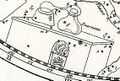 Fornax in Lacaille (1756).
 -
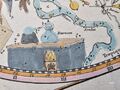 Fornax in Fortin's Atlas Céleste, 3rd edition (1795).
 -
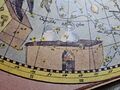 Fornax in Bode (1782, 1805).


Mythology
Weblinks
References
- ↑ Hoffmann, Susanne M. Wie der Löwe an den Himmel kam. Franckh Kosmos Verlag, Stuttgart 2021





