Bixiu: Difference between revisions
HaochengLyu (talk | contribs) Delete duplicate content |
HaochengLyu (talk | contribs) Added pictures |
||
| Line 2: | Line 2: | ||
Authors: {{PAGEAUTHORS}} | Authors: {{PAGEAUTHORS}} | ||
---- | ---- | ||
[[File:Bixiu in Stellarium.jpg|alt=Bixiu in Stellarium|thumb|'''Bixiu in Stellarium''']] | |||
Bixiu (毕宿), or Bi (毕), one of the Twenty-Eight Mansions, is the fifth mansion of the White Tiger of the West. It represents a long-handled hunting tool with a small mesh, used for catching hares or birds. It corresponds to eight stars in the constellation Taurus. | Bixiu (毕宿), or Bi (毕), one of the Twenty-Eight Mansions, is the fifth mansion of the White Tiger of the West. It represents a long-handled hunting tool with a small mesh, used for catching hares or birds. It corresponds to eight stars in the constellation Taurus. | ||
| Line 81: | Line 82: | ||
| lambda Tau | | lambda Tau | ||
|} | |} | ||
=== Maps (Gallery) === | |||
<gallery widths="200" heights="200" perrow="6" caption="Bixiu (Bi)"> | |||
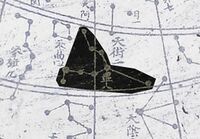
File:Bixiu in Cheonsang Yeolcha Bunyajido.jpg|'''Bixiu in Cheonsang Yeolcha Bunyajido''' | |||
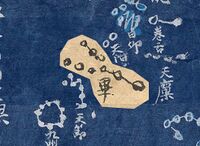
File:Bixiu in Dunhuang Star Map.jpg|'''Bixiu in Dunhuang Star Map''' | |||
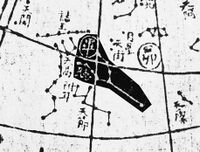
File:Bixiu in Suzhou Star Map.jpg|'''Bixiu in Suzhou Star Map''' | |||
</gallery> | |||
== References== | == References== | ||
Revision as of 11:09, 4 March 2026
Authors: Lyu Haocheng, Boshun YANG, Susanne M Hoffmann, Youla Azkarrula

Bixiu (毕宿), or Bi (毕), one of the Twenty-Eight Mansions, is the fifth mansion of the White Tiger of the West. It represents a long-handled hunting tool with a small mesh, used for catching hares or birds. It corresponds to eight stars in the constellation Taurus.
Concordance, Etymology, History
The shape of Bi was envisioned by ancient Chinese as a hare-catching net with a small mesh and a long handle. In astrology, it is used to govern matters like hunting rabbits or warfare in border regions.
Bi and its surrounding celestial region were viewed as a battlefield on the frontier, with the Mao (昴, Pleiades) as the opposing force, and the border lying at the Tianjie (天街). Bi itself is seen as a war chariot, used for hunting or warfare. Its brightest star, α Tau, is regarded as the Border General. Next to it is a star named Fuer (附耳, σ2 Tau), meaning "whispering close to the ear" or secret plotting.
Identification of stars
| Star Names or Orders(Traditional/Qing) | Yi Shitong[1]
Based on catalogue in 18th century |
Pan Nai[2]
based on Xinyixiangfayao Star Map |
Pan Nai[3]
based on catalogues in Yuan dynasty |
Boshun Yang[4]
before Tang dynasty |
Boshun Yang[4]
Song Jingyou(1034) |
|---|---|---|---|---|---|
| 1st/8th | epsilon Tau | epsilon Tau | epsilon Tau | epsilon Tau | epsilon Tau |
| 2nd/7th | delta3 Tau | delta3 Tau | delta3 Tau | delta3 Tau | delta3 Tau |
| 3rd/6th | delta1 Tau | delta1 Tau | delta1 Tau | delta1 Tau | delta1 Tau |
| 4th/5th | gamma Tau | gamma Tau | gamma Tau | gamma Tau | gamma Tau |
| 5th/4th | alf Tau | alf Tau | alf Tau | alf Tau | alf Tau |
| 6th/3th | theta1 Tau | theta2 Tau | theta1 Tau | theta2 Tau | theta2 Tau |
| 7th/2nd | 71 Tau | 71 Tau | 71 Tau | 71 Tau | 71 Tau |
| 8th/1st | lambda Tau | lambda Tau | lambda Tau | lambda Tau | lambda Tau |
Maps (Gallery)
- Bixiu (Bi)
-
 Bixiu in Cheonsang Yeolcha Bunyajido
 -
 Bixiu in Dunhuang Star Map
 -
 Bixiu in Suzhou Star Map


References
- ↑ Yi Shitong伊世同. Zhongxi Duizhao Hengxing Tubiao中西对照恒星图表1950. Beijing: Science Press.1981: 56.
- ↑ Pan Nai潘鼐. Zhongguo Hengxing Guance shi中国恒星观测史[M]. Shanghai: Xuelin Pree. 1989. p226.
- ↑ Pan Nai潘鼐. Zhongguo Hengxing Guance shi中国恒星观测史[M]. Shanghai: Xuelin Pree. 2009. p443.
- ↑ 4.0 4.1 B.-S. Yang杨伯顺, Zhongguo Chuantong Hengxing Guance Jingdu ji Xingguan Yanbian Yanjiu 中国传统恒星观测精度及星官演变研究 (A Research on the Accuracy of Chinese Traditional Star Observation and the Evolution of Constellations), PhD thesis, (Hefei: University of Science and Technology of China, 2023). 261.