A-ḫa-ti: Difference between revisions
No edit summary |
|||
| Line 9: | Line 9: | ||
==Concordance, Etymology, History<ref>[[Mesopotamian (All Terms)|Planetarium Babylonicum 2.0]], All Skies Encyclopaedia.</ref>== | ==Concordance, Etymology, History<ref>[[Mesopotamian (All Terms)|Planetarium Babylonicum 2.0]], All Skies Encyclopaedia.</ref>== | ||
= <sup>mul</sup>''Aḫātu'' "Sister"; an epithet of | = <sup>mul</sup>''Aḫātu'' "Sister"; an epithet of Ištar as the planet Venus, who was considered the sister of the sun god Šamaš [Lambert 1987, 95; Tallqvist 1938, 332-333]. | ||
{| class="wikitable" | {| class="wikitable" | ||
|- | |- | ||
| Line 16: | Line 16: | ||
| '''A Hittite Prayer to the Gods of the Night.''' | | '''A Hittite Prayer to the Gods of the Night.''' | ||
* In the first place: <sup>mul</sup>''a-ḫa-ti'' [KUB IV, 47 r. 43; BPO 2, 2:1; Van der Toorn 1985, 129:43], see also (Kurtik a15) ''[[Aḫû]]'' | * In the first place: <sup>mul</sup>''a-ḫa-ti'' [KUB IV, 47 r. 43; BPO 2, 2:1; Van der Toorn 1985, 129:43], see also (Kurtik a15) ''[[Aḫû]]'' | ||
In this source, there are five terms (''a-ha-ti, ga-ga, dumuzi, ninkizida, | In this source, there are five terms (''a-ha-ti, ga-ga, dumuzi, ninkizida, šulpae'') and there are five star-like planets. Lambert 1987 equals them to (Venus, Mercury, Saturn, Mars, Jupiter). | ||
| | | | ||
|} | |} | ||
| Line 22: | Line 22: | ||
=== Additional === | === Additional === | ||
''' ''' "Venus ( | ''' ''' "Venus (Ištar) can only be the first: ''a-ha-ti''. This, we suggest, is ''aḫati'' "sister (of)", rather than ''ahatti'' "outside" etc., since Ištar was sister of Šamaš, the sun, the most conspicuous heavenly body. Identification of the other three is uncertain. Antagal G 309 (apud CAD ṣalbatānu) identified Simut, an Elamite god of the netherworld (= Nergal: AfK 2 72 16) as ''Ṣalbatānu'', Mars. So it could be argued that Ningišzida in this list, being a Sumerian god of the netherworld, is Mars. Then since ''Dumuzi''(''d'') would be ''māru kīnu'' in Akkadian translation, ''Kayamānu'' (Saturn), being linguistically a fuller form of kfnu, might mean Dumuzi. | ||
''' ''' Then since Kakka under his aliases | ''' ''' Then since Kakka under his aliases Ninšubur, Ilabrat and Papsukkal became a vizier or messenger of all the gods, he could be Mercury because the Greek god equivalent to Mercury, Hermes, was an errand boy for the other gods." | ||
'''''This whole passage makes little sense to me''''' | |||
== Historical Dictionaries == | == Historical Dictionaries == | ||
Revision as of 10:08, 31 March 2026
Authors: Susanne M Hoffmann, Gennady E. Kurtik, Euin Choung Kim, David Hilder, Wayne Horowitz, Hermann Hunger, Youla Azkarrula

A-ḫa-ti (𒀀𒄩𒋾) is a Mesopotamian term for the planet Venus.
Visibility & Appearance
Images of Venus (Naked Eye Appearance)
-
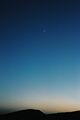 Venus above Sahara (Nov. 2005, Susanne M Hoffmann)
 -
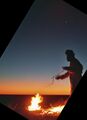 Venus above campfire (Sahara 2008, SMH)
 -
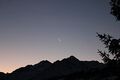 Moon and Venus in morning twilight above Austrian mountains (CC BY Susanne M Hoffmann 2016).
 -
 Venus and Pleiades above a mountain at Dawn in Europe (SMH 2020)
 -
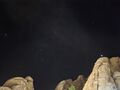 Venus above the rocks at Petra, Jordan (SMH 2023), it's already rather dark (not really dusk any more).
 -
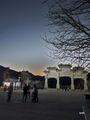 Venus above the Gate to the Shaolin Temple (China 2024, SMH)
 -
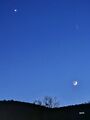 Venus and Moon at Dusk (Europe, SMH 2025)
 -
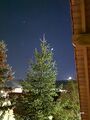 Saturn, Venus and Moon at Dusk (SMH 2025)
 -
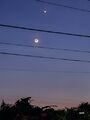 Moon and Venus in tropical dusk in Indonesia (Karimunjawa, SMH 2024).
 -
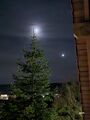 Moon and Venus at Dusk (SMH 2025).
 -
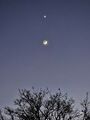 Venus and Moon at Dusk, 2025 (SMH)
 -
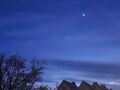 Venus above houses, evening star, (SMH 2025)
 -
 Venus and Pleiades at Dusk in Europe (SMH 2020), for comparison of brightness


Concordance, Etymology, History[1]
= mulAḫātu "Sister"; an epithet of Ištar as the planet Venus, who was considered the sister of the sun god Šamaš [Lambert 1987, 95; Tallqvist 1938, 332-333].
| Sources | Identifications |
|---|---|
A Hittite Prayer to the Gods of the Night.
In this source, there are five terms (a-ha-ti, ga-ga, dumuzi, ninkizida, šulpae) and there are five star-like planets. Lambert 1987 equals them to (Venus, Mercury, Saturn, Mars, Jupiter). |
See also: [Lambert 1987, 95/96]
Additional
"Venus (Ištar) can only be the first: a-ha-ti. This, we suggest, is aḫati "sister (of)", rather than ahatti "outside" etc., since Ištar was sister of Šamaš, the sun, the most conspicuous heavenly body. Identification of the other three is uncertain. Antagal G 309 (apud CAD ṣalbatānu) identified Simut, an Elamite god of the netherworld (= Nergal: AfK 2 72 16) as Ṣalbatānu, Mars. So it could be argued that Ningišzida in this list, being a Sumerian god of the netherworld, is Mars. Then since Dumuzi(d) would be māru kīnu in Akkadian translation, Kayamānu (Saturn), being linguistically a fuller form of kfnu, might mean Dumuzi.
Then since Kakka under his aliases Ninšubur, Ilabrat and Papsukkal became a vizier or messenger of all the gods, he could be Mercury because the Greek god equivalent to Mercury, Hermes, was an errand boy for the other gods."
This whole passage makes little sense to me
Historical Dictionaries
| Kurtik (2022, a14) | Gössmann (1950) |
|---|---|
| = mulAḫātu «Сестра»(?); эпитет Иштар как планеты Венеры, которая считалась сестрой бога Солнца Шамаша [Lambert 1987, 95; Tallqvist 1938, 332–333].
I. Источники. Хеттская молитва ночным богам. На первом месте: mula-ḫa-ti [KUB IV, 47 r. 43; BPO 2, 2:1; Van der Toorn 1985, 129:43], см. также a15Aḫû. |
Example |
References
- ↑ Planetarium Babylonicum 2.0, All Skies Encyclopaedia.