Quadrans Muralis: Difference between revisions
No edit summary |
No edit summary |
||
| Line 8: | Line 8: | ||
The constellation was originally invented by the French astronomer Joseph Jérôme Lalande in 1795. <ref>Ian Ridpath, Star Tales, Lalande's Quadrans Muralis ([http://www.ianridpath.com/startales/quadranslalande.html Online Edition])</ref> | The constellation was originally invented by the French astronomer Joseph Jérôme Lalande in 1795. <ref>Ian Ridpath, Star Tales, Lalande's Quadrans Muralis ([http://www.ianridpath.com/startales/quadranslalande.html Online Edition])</ref> | ||
In the same year, the other French astronomer Jean Fortin published the 3rd edition of his Atlas Céleste and a star catalogue in which he mentions ten stars in the constellation "Le Mural" (in French). Fortin's atlas started in 1776 as a French edition of Flamsteed's 1729 Atlas Coelestis written in English (maps labelled in Latin).<ref>Die Große Flamsteed Edition. | In the same year, the other French astronomer Jean Fortin published the 3rd edition of his Atlas Céleste and a star catalogue in which he mentions ten stars in the constellation "Le Mural" (in French). Fortin's atlas started in 1776 as a French edition of Flamsteed's 1729 Atlas Coelestis written in English (maps labelled in Latin).<ref>Die Große Flamsteed Edition (Faksimiles of Flamsteed, Fortin, Bode). Begleitbuch Latußeck, A. and Hoffmann, S: Ein nützliches Unternehmen, Albireo-Verlag, Köln, 2017 ([https://albireo-verlag.org/product/die-grosse-flamsteed-edition/ online])</ref> This book (1st and 2nd edition) of the Atlas Céleste<ref>Flamsteed (1729). Atlas Coelestis, [https://gallica.bnf.fr/ark:/12148/btv1b53096741t# Online: Gallica]</ref> does not show Quadrans, neither in the Bootes map nor in the Draco map. His 3rd edition, published in 1795 (with participation of others, e.g. Lalande) show the new constellation Quadrans in the [[Draco]] map, but not in the map of [[Bootes]]. | ||
Latußeck, A. and Hoffmann, S: Ein nützliches Unternehmen, | |||
The German astronomer Johann E. Bode had included a German edition of Flamsteed's atlas in his popular book "Anleitung zur Kennntniß des gestirnten Himmels" (1782). In the 2nd edition of this book in 1805, he depicted the new constellation Quadrans in the map of [[Bootes]], but not in the map [[Draco]] (so he did not copy from Fortin directly). It is clearly visible that he had used the same copper plates for the print as in 1782 because he did not erase the boundary lines between the constellations that he had invented. (There are no boundaries drawn in Flamsteed or Fortin.) The image of the constellation Quadrans is at the place where the boundaries of the three constellations [[Bootes]], [[Hercules]] and [[Draco]] meet. <gallery> | The German astronomer Johann E. Bode had included a German edition of Flamsteed's atlas in his popular book "Anleitung zur Kennntniß des gestirnten Himmels" (1782). In the 2nd edition of this book in 1805, he depicted the new constellation Quadrans in the map of [[Bootes]], but not in the map [[Draco]] (so he did not copy from Fortin directly). It is clearly visible that he had used the same copper plates for the print as in 1782 because he did not erase the boundary lines between the constellations that he had invented. (There are no boundaries drawn in Flamsteed or Fortin.) The image of the constellation Quadrans is at the place where the boundaries of the three constellations [[Bootes]], [[Hercules]] and [[Draco]] meet. <gallery> | ||
Revision as of 14:03, 26 January 2025

This is one of the obsolete constellations from Early Modern Europe. The term is Latin and means "wall-mounted quadrant", a large instrument attached to a wall. The constellation is still in common memory of astronomers as a rich meteor shower that peaks in the first days of January is named The Quadrantids; their apparent point of origin, the radiant, is in the area where historically this constellation used to be defined.
Etymology and History


Origin of Constellation
The constellation was originally invented by the French astronomer Joseph Jérôme Lalande in 1795. [1]
In the same year, the other French astronomer Jean Fortin published the 3rd edition of his Atlas Céleste and a star catalogue in which he mentions ten stars in the constellation "Le Mural" (in French). Fortin's atlas started in 1776 as a French edition of Flamsteed's 1729 Atlas Coelestis written in English (maps labelled in Latin).[2] This book (1st and 2nd edition) of the Atlas Céleste[3] does not show Quadrans, neither in the Bootes map nor in the Draco map. His 3rd edition, published in 1795 (with participation of others, e.g. Lalande) show the new constellation Quadrans in the Draco map, but not in the map of Boötes.
The German astronomer Johann E. Bode had included a German edition of Flamsteed's atlas in his popular book "Anleitung zur Kennntniß des gestirnten Himmels" (1782). In the 2nd edition of this book in 1805, he depicted the new constellation Quadrans in the map of Boötes, but not in the map Draco (so he did not copy from Fortin directly). It is clearly visible that he had used the same copper plates for the print as in 1782 because he did not erase the boundary lines between the constellations that he had invented. (There are no boundaries drawn in Flamsteed or Fortin.) The image of the constellation Quadrans is at the place where the boundaries of the three constellations Boötes, Hercules and Draco meet.
-
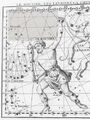 Fortin's 1776 (2nd edition) of the Atlas Céleste without Quadrans (Boo).
 -
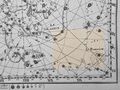 Fortin's 1776 (2nd edition) of the Atlas Céleste without Quadrans (Dra).
 -
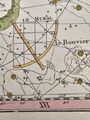 Fortin's 1795 (3rd edition) of the Atlas Céleste with Quadrans in the map of Draco.
 -
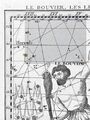 Fortin's 1795 (3rd edition) of the Atlas Céleste still without Quadrans in the map Bootes.
 -
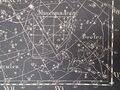 Goldbach's 1799 atlas with Quadrans between Draco, Hercules and Bootes.
 -
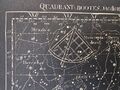 Goldbach's 1799 atlas with Quadrans north of Bootes.
 -
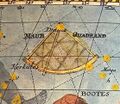 Bode's 1805 edition of his Bootes-star chart in "Anleitung zur Kenntniß des gestirnten Himmels" (labelling in German).
 -
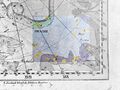 Bode's 1805 edition of "Anleitung zur Kenntniß des gestirnten Himmels" with the star chart of Draco still without Quadrans.


In his 1801 trilingual magnus opus "Uranographia"[4] (with text in German and French, and constellation maps labelled in Latin), Bode took up the idea of this constellation and incorporated it in the map of Bootes.[5] This map is not anymore based on Flamsteed's drawings, but a completely new celestial map with deviating shapes of constellations and many more objects (stars, star clusters and other nebulae) registered.
Alexander Jamieson and Sidney Hall in the subsequent decades also depicted Quadrans together with Bootes.
Transfer and Transformation of the Constellation
-
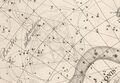 Bode 1801 Uranographia, Quadrans as a neighbouring detail next to Draco
 -
 Bode's (1801), Quadrans Muralis in Uranographia, Johann E. Bode. This file is from Wikimedia Commons and may be used by other projects
 -
 Quadrans in Alexander Jamieson (1822), Plate 7 from A celestial atlas comprising a systematic display of the heavens in a series of thirty maps illustrated by scientific description of their contents and accompanied by catalogues of the stars and astronomical exercises
 -
 Sidney Hall, Urania's Mirror (1825): "Bootes, Canes Venatici, Coma Berenices, and Quadrans Muralis", plate 10, a set of celestial cards accompanied by A familiar treatise on astronomy ... by Jehoshaphat Aspin. London. Astronomical chart, 1 print on layered paper board : etching, hand-colored.
 -
 Map of the ancient constellation Quadrans Muralis. Created by CWitte with PP3 (PP3's homepage) byTorsten Bronger. This file is from Wikimedia Commons and may be used by other projects.


Mythology
no mythology
IAU WGSN name discussion
In 2023 and 2025, it was suggested to use a name related to this obsolete historical constellation. The terms "Quadrans" or "Muralis" could be used to name a star in the area of this historical constellation; the first term makes more sense with regard to its reminiscence in the name of the meteor shower.
WGSN chose to ...
Weblinks
References
- ↑ Ian Ridpath, Star Tales, Lalande's Quadrans Muralis (Online Edition)
- ↑ Die Große Flamsteed Edition (Faksimiles of Flamsteed, Fortin, Bode). Begleitbuch Latußeck, A. and Hoffmann, S: Ein nützliches Unternehmen, Albireo-Verlag, Köln, 2017 (online)
- ↑ Flamsteed (1729). Atlas Coelestis, Online: Gallica
- ↑ Bode (1801) Uranographia. Online: maps not available, but star catalogue by MDZ (Munich Library)
- ↑ Ian Ridpath, Star Tales, Quadrans Muralis (Online Edition)





