Chamaeleon
Authors: Susanne M Hoffmann, Youla Azkarrula, IanRidpath

One of the 88 IAU constellations. The constellation was invented by Dutch sailors in the 1590s, published in de Houtman (1603) and Plancius' globe 1594.
Etymology and History

Origin of Constellation
The Chameleon is one of the constellations introduced by Dutch sailors. It is so close to the South Celestial Pole that its stars could not be seen by any of the ancient cultures.
It was brought back in the star catalog from the South Seas: during the first Dutch East India expedition, navigator Pieter Keyser was tasked with observing the stars. He was assisted by the captain's brother, Frederick de Houtman, who had also been trained in astronavigation by Petrus Plancius. At that time, sea voyages were dangerous due to often inadequate positioning at sea and poor food supplies. Keyser died on the island of Java and the work was continued by de Houtman. The star positions they measured were already mapped on a celestial globe by Plancius a year after de Houtman's return, but were not published as a star catalog until 1603. In the same year, the German lawyer Johann Bayer published his atlas Uranometria, for which Plancius' globe was one of the sources.
Since Uranometria represents a new standard in the nomenclature of stars that is still valid today, the new constellations of Keyser and de Houtman have been preserved to this day.
Transfer and Transformation of the Constellation
-
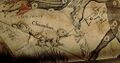 Musca, Chamaeleon and Crux on Blaeu's first globe (1602) that is a copy of Plancius/ Hondius (1598). RMG
 -
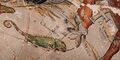 Musca, Chamaeleon and Crux on Blaeu (1603), the globe that is based on de Houtman's data. RMG
 -
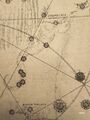 Chamaeleon in Bayer (1603)
 -
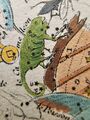 Chamaeleon in Fortin's Atlas Céleste, 3rd edition (1795).


Mythology
Where on their journey the two travelers transported the chameleon to the sky, and why, is not known. Chameleons are widespread in the Mediterranean region and on the Arabian Peninsula and have therefore been known since ancient times. However, they also exist in Madagascar, where the Dutch expedition made its first stop and, due to illness, already had to bury 70 men from the crew.