Patrem
Authors: Youla Azkarrula, Susanne M Hoffmann


Patrěm is an Oceanic name from Bali (Indonesia). The lintang of patrěm is found in intersection of Rědite (Sunday, in saptawara) and Pon (in pancawara) in a series of palelintangan. Lintang patrěm means an indigenous dagger from Indonesia.[1]
Etymology and History
Patrěm (IPA: /ˈpatrəˈm/) is derived from Javanese "Panggane Ingkang Damel Tentrem" means "a peaceful place". This also refers to any heirloom objects that are believed to have spiritual powers to provide benefits and peace.
Spelling Variants
- keris
- kris
Origin of Constellation
Patrěm is a type of keris-shaped (dagger) weapon that is smaller than a keris in general. In Nusantara era (before being Indonesia, which still ruled by kings from various kingdom), this tool was usually owned by women and knights who usually served as "telik sandi" or spies (now intelligence or investigators).
For Balinese people, the keris is considered sacred. Keris is a symbol of Linggayoni, as a Shiva shrine, Sang Hyang Tiga Sakti. Keris can be used as a tool of worship, preceded by a sacred ceremony called the Pasupati Ceremony. The Balinese people consider keris tayuhan (pajenengan) as a sacred heritage because most of the religious rituals are conducted involving Keris as the medium.
Keris is symbol of the power of ancestors and the universe that must be maintained and conserved. Irol, steel and parmor are the basic material of keris pajenengan symbolizing Tri Sakti, with wijaksara AUM. The black steel is the stana of Hyang Wisnu with wijaksara U. The red steel is the stana of Brahma with wijaksara A, white nickel is the stana of Hyang Iswara with wijaksara M.
Keris is believed to have three blades. The right blade of Keris is a symbol of Brahma’s power, who has the power of Sidha (talent). The left side of the blade is Wisnu’s power, who has the power of Sidhi (blessing/prosperity). The top blade of Keris is a symbol of Iswara’s strength that has a Sadu power (the eternal truth).
Keris was viewed as the ultimate weapon on the battlefield. The dagger symbolized resistance to evil spirits through the protection of the gods. Keris was often associated with the mystical power of the Balinese in ancient times. Among others, there is a belief that the keris has its own spirit. Historically, keris bali is a legacy of the Majapahit Kingdom. It is said that the cultural influence of the Majapahit Kingdom was so strong that war tools such as the dagger were adopted by Bali’s governments.
The existence of keris has been proved by the founding of inscriptions during the seventh to ninth centuries, namely: Humanding inscription (Krapyak, Yogyakarta, Central Java, 797 Saka / 875 CE), Tukmas inscription (Lebak Village, Magelang, Central Java, 748 Saka / 842 CE), Rukam inscription (Petarongan Village, Temanggung, Central Java, 829 Saka / 907 CE), Sukawana inscription (Sukawana village, Kintamani District, Bangli Regency, Bali, 804 Saka / 882 CE), and Bulian A inscription (Bulian village, 1130 Saka / 1181 CE)
Philosophically, the Balinese dagger is seen as emblematic of the values of the life of the Hindu religion. In fact, they had a special day of prayer when they would keep the purity of their heirloom dagger. Keris is also regarded as an object of aesthetic value in the lives of the people there. Until now, the dagger is still regarded as a symbol of power and a symbol of power. Usually, Hindus who keep the Balinese heirloom decide to cleanse based on the lunar rotation of the Earth. While the day’s ritual of purification is in keeping the ancient Balinese Hindu tradition. Even the treatment of the dagger is sacred. Understandably, the keris is considered to have magical power. They believe that the dagger is a manifestation of the spirit of the ancestors. Usually, such a dagger is called Tay Tayuhuan, whose making is more important than its beauty, its choice of iron, and its prestige. Such crystals are usually wingit, haunted, radiant, and sometimes scary. Because of this, some Balinese people are willing to work and to earn a lucky dagger.
Many people think that Javanese keris and Balinese keris are the same. However, Javanese keris tend to have a smaller shape than Balinese keris. In addition, the handle on Balinese keris is designed more complexly than Javanese keris.
General information

The astronomical identification of the constellation is taken from Maaß (1929)[1] who explains in general that these constellations and the according ritual practice
"sind seit alten Zeiten in einem Werk "wariga" niedergelegt, in dem wir zwei Kulturschichten, nämlich indische und malaio-polynesische Bestandteile wiederfinden."
English: "are written down in a work called "wariga" since old times; there we recognise two cultural layers, i.e. the Indian and the Malayo-Polynesian."
He also quotes other scholars[2][3][4][5] and his earlier work[6][7] reporting that this work dates back to the 9th century CE when Bali was part of a Hindu empire on the neighbouring island of Java.[1] Neubronner van der Tuuk even uses the Old Javanese spelling.
Identification
The identifications, Maaß (1929) gives according to the aforementioned and his own studies during visits of the country and in European and Batavian libraries (p.150).[1]
Maaß (1929), p. 141:
ein Kriss (der landesübliche Dolch).
English: a kriss (the traditional dagger of the country).
UPTD Museum Bali mentioned this lintang is in the area of Grus. The longer stars order is where the sharp material.[8]
Transfer and Transformation of the Constellation
Mythology / Religion
There are various stories about the origin of the keris circulating in society. One popular story is that the keris was first created by the gods or great kings who had supernatural powers. In some myths, the keris is considered a gift or blessing from the gods, who have magical powers and can provide protection or even control nature.
The keris is believed to have a living soul or spirit, which can respond to requests or commands from its owner. Some keris are even seen as having the ability to cure diseases, bring good luck, or give extraordinary powers to its owner.
In many areas in Indonesia, the keris can be passed down from generation to generation, and each keris carries the legacy of the spirit or soul of its previous owner. The inherited keris is believed to have greater power because it has gone through various events and experiences from its previous owner. It is said that a keris that has been used for a long time can "live" and have the power to protect the owner's family or descendants.
The keris is considered to be able to "speak" or give instructions to its owner through dreams or certain signs. In some beliefs, there are also those who say that keris can be used to communicate with spirits or supernatural beings. Many people perform certain rituals or ceremonies to summon these spirits to provide strength or guidance through keris.
So that, each keris has a different origin that is believed by the indigenous local.
Keris Ki Pencok Sahang
Keris Ki Pencok Sahang or Fangs of the Dragon Basuki is an heirloom from Puri Blahbatuh, Gianyar Regency. This keris originated from the story of Ni Gusti Ayu Kalner, the wife of a warlord from the Bedahulu Kingdom named I Gusti Ngurah Jelantik Bogol, who found a piece of wood while bathing in the river. The wood was taken home and split to be used as firewood.
However, his wife found a keris as soon as the wood was split. At that time, a word was heard from the sky, that the keris was a gift from Bhatara Toh Langkir which was the fang of the Dragon Basuki. This keris was then named Ki Pencok Sahang because it was in the middle of the wood (sahang).
This keris was used to kill a powerful and powerful person from Nusa Penida named Ki Dalem Bungkut. He could only be killed by the fangs of the Dragon Basuki, which was none other than the Keris Ki Pencok Sahang.
Keris Ki Baru Gajah
The Ki Baru Gajah Keris was a gift from Dang Hyang Dwijendra to the bendesa (village head) of Beraban Village in Kediri District, Tabanan Regency. This keris was once used as a weapon to kill Ki Bhuta Babahung. Because Ki Bhuta Babahung had an elephant's head, this keris was named Ki Baru Gajah. This keris is now placed in the Kediri Palace.
The Ki Baru Gajah Keris is closely related to the Ngerebeg Tradition which is held on Kuningan Day. In the Ngerebeg Tradition procession, the Ki Baru Gajah Keris will be carried by residents from
the Kediri Palace to the Pakendungan Luhur Temple by walking 11 kilometers.
This keris is believed to have the power to ward off various kinds of pests and diseases. Therefore, the Ngerebeg Tradition must be carried out so that the Kediri area is free from pests and its residents live prosperously.
Image Variants
-
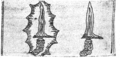 Lintang Patrem (CC-BY Alfred Maaß, (1929), Astrologische Kalender der Balinesen)
 -
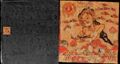 Lintang Patrem in the cloth (CC-BY UPTD Museum Bali Inventary no. 09.746)
 -
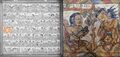 Lintang Patrem in the cloth (CC-BY UPTD Museum Bali Inventary no. 09.752)
 -
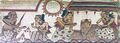 Lintang Patrem (CC-BY Youla Azkarrula taken in the ceiling of Taman Gili Klungkung Palace Bali)


Cultural Beliefs
Numerology (Neptu/Urip)
Rědite (Sunday, in saptawara) has a value of 5 and Pon (in pancawara) has a value of 7. Thus, the total urip on this lintang is 12.[8]
Astrological Characteristics
Be careful if you take work in the rice fields, because disasters come from the fields. Don't be an advisor (it's dangerous) you can die quickly. If you are born as a woman, you often torture yourself, you like to indulge in luxury, you like to show off your wealth.[8]
Matching Gemstones
Rudirarnawa (blood lake) (garnet).[8]
Weblinks
All HIP Stars within this constellation
Stars within the Constellation Area
| id | Label | IAU design. | description | Vmag |
|---|---|---|---|---|
| 1 | Alnair | HIP 109268 | within constellation lines | 1.71 |
| 2 | Tiaki | HIP 112122 | within constellation lines | 2.11 |
| 3 | Aldhanab | HIP 108085 | within constellation lines | 3.01 |
| 4 | ϵ Gruis | HIP 112623 | within constellation lines | 3.466 |
| 5 | ι Gruis | HIP 114421 | within constellation lines | 3.877 |
| 6 | δ 1 Gruis | HIP 110997 | within constellation lines | 3.97 |
| 7 | δ 2 Gruis | HIP 111043 | Inside the Hull | 4.11 |
| 8 | λ Gruis | HIP 109111 | Inside the Hull | 4.458 |
| 9 | μ 1 Gruis | HIP 109908 | Inside the Hull | 4.798 |
| 10 | μ 2 Gruis | HIP 109973 | Inside the Hull | 5.117 |
| 11 | - | HIP 108543 | Inside the Hull | 5.495 |
| 12 | - | HIP 112381 | Inside the Hull | 5.51 |
| 13 | π 2 Gruis | HIP 110506 | Inside the Hull | 5.62 |
| 14 | τ 3 Gruis | HIP 113307 | Inside the Hull | 5.714 |
| 15 | S Gru | HIP 110736 | Inside the Hull | 6 |
| 16 | τ 1 Gruis | HIP 113044 | Inside the Hull | 6.04 |
| 17 | - | HIP 112117 | Inside the Hull | 6.06 |
| 18 | - | HIP 112127 | Inside the Hull | 6.067 |
| 19 | - | HIP 109902 | Inside the Hull | 6.089 |
| 20 | BZ Gru | HIP 108347 | Inside the Hull | 6.168 |
| 21 | - | HIP 109821 | Inside the Hull | 6.23 |
| 22 | - | HIP 112432 | Inside the Hull | 6.48 |
IAU Working Group on Star Names
In November 2025, it has been proposed to use the name "Patrem" for a star in the area to preserve the Balinese heritage. The star eps Gru or HIP 112623 is in the handle of the dagger which was selected because this is the identity of the dagger. In Bali, the shape of the handle can indicate the region of origin (North Bali, South Bali, Karangasem, Buleleng, etc.), the status of the owner (warrior, priest, nobleman, artist) and the function of the keris (ceremonial, family heirloom, daily keris, dance keris). Constellation Patrem is mentioned in Palelintangan Prasi, dating roughly 700 CE, and is still used in Bali.
References
- References (general)
- ↑ 1.0 1.1 1.2 1.3 Maass, Alfred, “Astrologische Kalender der Balinesen,” in Koninklijk Bataviaasch Genootschap van Kunsten en Wetenschappen, Feestbundel bij gelegenheid van zijn 150 jarig bestaan 1778-1928, 2 vols. (Weltevreden, 1929), Vol. 2, 126-157.
- ↑ Friedrich, R. (1849). Voorloopig verslag van het eiland Bali, Batavia, Verb. Bat Gen. Deel 23, Nr. 13
- ↑ HINLOOPEN LABBERT0N, D. VAN (1910). Geillustreerd handboek van Insulinde. Amsterdam: "Vivat"
- ↑ PIGEAUD, TH. (1925). Een stuk over sterrenkunde uit het Anggastyaparwwa ...... Weltevreden: Albrecht. Tijdsch. v. lnd, T.-, L.- en Vk. deel LXV
- ↑ Nieuwenkamp, W. O. J. (1905), Schetsen van Bali en Lombok. (Eigen Haard)
- ↑ MAASS, ALFRED (1920). Sterne und Sternbilder im malaiischen Archipel. Berlin. Zeitschrift für Ethnologie Jg. 1920/21, H. 1
- ↑ MAASS, ALFRED (1924). Sternkunde und Sterndeuterei im malaiischen Archipel. Batavia, den Haag. Tijdsch. v. T.-, L.-en Vk. deel LX IV
- ↑ 8.0 8.1 8.2 8.3 Tim Kajian Palelintangan, “Gabungan Kajian Palelintangan,” Museum Bali (2021), 1-149.





