Atiwa-tiwa
Authors: Youla Azkarrula, Susanne M Hoffmann


Atiwa-tiwa is an Oceanic name from Bali (Indonesia). The lintang of atiwa-tiwa is found in intersection of Buda (Wednesday, in saptawara) and Kliwon (in pancawara) in a series of palelintangan. Lintang atiwa-tiwa means cleansing corpse (in cremation ceremony) constellation.[1]
Etymology and History
Atiwa-tiwa derived from the words "ati" meaning willingness and "awa" meaning bright or clear or clean. The full meaning is the desire to carry out the cleaning and purification of the corpse and the power of the Panca Maha Butha. In balinese ritual, ngaben (cremation), atiwa-tiwa ceremony is the first step of Pitra Yadnya ceremony. The word "atiwa-tiwa" possibly originating from the native language of Austronesian, considering in Indonesia, there is also this kind of ceremony in Dayak tribe, in Kalimantan, which they call "tiwah". Likewise in Batak tribe, they call "tibal" to mention ceremony after death.
Spelling Variants
- hatitiwa
- titiwa
- tětiwah
- tiwa-tiwa
Origin of Constellation
Atiwa-tiwa has the root word “tiwa” which means purification. In Balinese Hindu tradition, according to the Yama Purwana Tattwa lontar, every dead person (pitra) must perform a sacred offering (yadnya). This yadnya is a ritual carried out to return the ancestral spirits to their place of origin. The sequence of pitra yadnya in brief is atiwa-tiwa, ngaben, pemukuran and nilapati.
Atiwa-tiwa is an initial stage of purification. There are two different treatments for corpses related to atiwa-tiwa. If the corpse has passed the atiwa-tiwa stage, then the body can be carried up (digotong) to the paga, or wadah, or bade, or container. While a corpse who buried without the atiwa-tiwa stage and, the body should not be carried up (digotong), but carried by hand (dijinjing) because the corpse has the status of Petra (unclean, unpurified).
In Indonesia, gotong and jinjing mean carry, but in different ways. Gotong means to carry something heavy that requires two or more people to lift and transport it. In English, it translates to "carry together" or "to haul". While Jinjing refers to carrying something with one hand, usually by holding it from the top, like a bag or a small object. In English, it translates to "to tote" or "to carry by hand".
General information

The astronomical identification of the constellation is taken from Maaß (1929)[1] who explains in general that these constellations and the according ritual practice
"sind seit alten Zeiten in einem Werk ,,wariga" niedergelegt, in dem wir zwei Kulturschichten, nämlich indische und malaio-polynesische Bestandteile wiederfinden."
English: "are written down in a work called "wariga" since old times; there we recognise two cultural layers, i.e. the Indian and the Malayo-Polynesian."
He also quotes other scholars[2][3][4][5] and his earlier work[6][7] reporting that this work dates back to the 9th century CE when Bali was part of a Hindu empire on the neighbouring island of Java.[1] Neubronner van der Tuuk even uses the Old Javanese spelling.
Identification
The identifications, Maaß (1929) gives according to the aforementioned and his own studies during visits of the country and in European and Batavian libraries (p.150).[1]
Maaß (1929), p. 143:
hatitiwa; - titiwa, das Wegtragen von Leichen .oder Bestattung von Toten auf dem Kirchhof; -.ein Mann, der ganz nackend ist.
English: hatitiwa; - titiwa, the carrying away of corpses or burial of the dead in the churchyard; -a man who is completely naked.
UPTD Museum Bali mentioned the area of lintang Atiwa-tiwa is within the Serpentis constellation.
Transfer and Transformation of the Constellation
Mythology / Religion
In Putru Pasaji Lontar, verse 17:
“Kancit liwat kiterika, kapanggih tang gunung suktiman kahananing anak bajang, padamangku lawak, tan papramana kwehnika, maglar ing tegal, pada turwaking balung lawan kulit, makaraket wetengnya ya wetning lapanya, sukunya buh, matanya clong, rambutnya bang murinding. Hana ta waneh, maputih ragas kayunya tuha, ngaranya ring sungsang ragas, papupulaning kabeh, angadang pitara mulih kang huwus inentasaken, sira sang mulih ring swarga. Pinaka lakwanulih-ulih, sungakena sekul sakepel, lawanbubur sakalanci, wartta kabeh Tanana iri, ndatan pinanganya juga, dinelen ya tainangisan, kabeh deni luhnya, imuyupnya ta ya arah, dening lawasnya tan tumoning sekul, mati tan ginawe ayu, hetunya menangis malara, kunang yan hilangeng papa, tulisaken ring pustaka, ring papan, pada Madhya pan mulaksara, pakenanya.”[8]
Translation:
Suddenly you pass from there and arrive at Mount Suktiman which is filled with young people, all holding their bodies, spread out in the field, both emaciated, only bones and skin, their stomachs sticky from hunger, their legs are big, their eyes are far ahead, their hair is standing red. There is another thing, there is a white tree with no leaves left, it is old, it is called sungsang ragas. There many people gathered to block the pitara, who was about to go home after doing ceremony. He went home to heaven. As a means of going home, he was served one lump of rice and one lump of kalanci porridge, divided evenly until it was finished (?), but he didn't eat it, he just looked at it accompanied by tears, full of tears, then he wiped away the tears, because he hadn't seen rice for a long time, he didn't have a ceremony to die, that's why he was sad and crying. So that the papa disappears then it is written in the pustaka, on a board in the mulaksara. That is its use.
From the verse quote above, it is explained that the suffering of the soul that has not been given the Atiwa-tiwa ceremony (ngaben), they can only see the soul that has been given the ceremony (dientas) by bringing sufficient provisions that are distributed to them but they cannot enjoy it, they can only look at it while shedding tears.
Image Variants
-
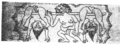 Lintang Hatitiwa (CC-BY Alfred Maaß, (1929), Astrologische Kalender der Balinesen)
 -
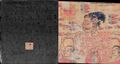 Lintang Titiwa in the cloth (CC-BY UPTD Museum Bali Inventary no. 09.746)
 -
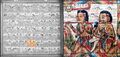 Lintang Titiwa in the cloth (CC-BY UPTD Museum Bali Inventary no. 09.752)
 -
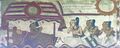 Lintang Atitiwa (CC-BY Youla Azkarrula taken in the ceiling of Taman Gili Klungkung Palace Bali)


Cultural Beliefs
Numerology (Neptu/Urip)
Buda (Wednesday, in saptawara) has a value of 7 and Kliwon (in pancawara) has a value of 8. Thus, the total urip on this lintang is 15.[9]
Astrological Characteristics
pain from childhood and even tend to die young. In family, always behave childishly. They are friendly to people, good at choosing words that please the heart. But unfortunately they are very easy and quick to be offended.[9]
Matching Gemstones
mirah (ruby), kalimaya (opal).[9]
Weblinks
All HIP Stars within this constellation
Stars within the Constellation Area
| id | Label | IAU design. | description | Vmag |
|---|---|---|---|---|
| 1 | Unukalhai | HIP 77070 | within constellation lines | 2.63 |
| 2 | Yed Prior | HIP 79593 | within constellation lines | 2.75 |
| 3 | μ Serpentis | HIP 77516 | within constellation lines | 3.53 |
| 4 | ϵ Serpentis | HIP 77622 | Inside the Hull | 3.693 |
| 5 | * del Ser A | HIP 76276 | within constellation lines | 4.14 |
| 6 | b Ser | HIP 77660 | Inside the Hull | 5.1 |
| 7 | ω Serpentis | HIP 77578 | Inside the Hull | 5.217 |
| 8 | 43 G. Ser Cap | HIP 79195 | Inside the Hull | 5.378 |
| 9 | 22 G. Ser Cap | HIP 77163 | Inside the Hull | 5.58 |
| 10 | ψ Serpentis | HIP 77052 | Inside the Hull | 5.86 |
| 11 | 23 G. Ser Cap | HIP 77186 | Inside the Hull | 6.337 |
IAU Working Group on Star Names
In November 2025, it has been proposed to use the name "Atiwa-tiwa" for a star in the area to preserve the Balinese heritage. The star mu Ser or HIP 77516 is in the stick of the funeral stick. Constellation Atiwa-tiwa is mentioned in Palelintangan Prasi, dating roughly 700 CE, and is still used in Bali.
References
- References (general)
- ↑ 1.0 1.1 1.2 1.3 Maass, Alfred, “Astrologische Kalender der Balinesen,” in Koninklijk Bataviaasch Genootschap van Kunsten en Wetenschappen, Feestbundel bij gelegenheid van zijn 150 jarig bestaan 1778-1928, 2 vols. (Weltevreden, 1929), Vol. 2, 126-157.
- ↑ Friedrich, R. (1849). Voorloopig verslag van het eiland Bali, Batavia, Verb. Bat Gen. Deel 23, Nr. 13
- ↑ HINLOOPEN LABBERT0N, D. VAN (1910). Geillustreerd handboek van Insulinde. Amsterdam: "Vivat"
- ↑ PIGEAUD, TH. (1925). Een stuk over sterrenkunde uit het Anggastyaparwwa ...... Weltevreden: Albrecht. Tijdsch. v. lnd, T.-, L.- en Vk. deel LXV
- ↑ Nieuwenkamp, W. O. J. (1905), Schetsen van Bali en Lombok. (Eigen Haard)
- ↑ MAASS, ALFRED (1920). Sterne und Sternbilder im malaiischen Archipel. Berlin. Zeitschrift für Ethnologie Jg. 1920/21, H. 1
- ↑ MAASS, ALFRED (1924). Sternkunde und Sterndeuterei im malaiischen Archipel. Batavia, den Haag. Tijdsch. v. T.-, L.-en Vk. deel LX IV
- ↑ Putru Pasaji Lontar verse 17
- ↑ 9.0 9.1 9.2 Tim Kajian Palelintangan, “Gabungan Kajian Palelintangan,” Museum Bali (2021), 1-149.





