Guansuo (贯索)
Guansuo
Authors: Lyu Haocheng, Susanne M Hoffmann, Youla Azkarrula

Guàn Suǒ (Coiled Thong, 贯索), a Chinese constellation located within the Corona Borealis. Consists of 9 stars in front of Qigong (七公) (Seven Excellencies, 七公). This constellation is named for its shape, which resembles a string threaded through a series of copper coins. It is also regarded as the "Prison of Mean People". It belongs to the Shi school (石氏) and is located in the Heavenly Market Enclosure (天市垣) of the Three Enclosures.
Concordance, Etymology, History
In ancient China, coins were known as "square-hole coins" — made of bronze, circular in shape, with a square hole in the center. People would thread a string through the square holes to string coins together into a string, thereby organizing the money and making it easier to store and carry. This string was called Guansuo. In monetary measurement, a bundle of a thousand copper coins tied together with such a string was called a guàn (贯).

_in_Stellarium.jpg)

The Guansuo constellation is an ancient Chinese constellation. The Records of the Grand Historian (史记, Shǐjì), Treatise on the Celestial Officials (天官书), written around 100 BCE, states:
There are fifteen stars arranged in a hook-like circle (句圜, 勾圜, Gōu Huán); they are called the Prison of Mean People. When the stars inside the prison are numerous, it means many prisoners; when they are sparse, it means prisoners have been released.
The "hook-like circle" (句圜) is the precursor of Guansuo, regarded as the Prison of Mean People, also known as the "Heavenly Prison". One theory holds that the 9 stars of Guansuo and the 7 stars of Qigong (七公) together originated from the 15 stars of the hook-like circle. The Book of Jin (晋书, Jìn Shū), Treatise on Astronomy, similarly records it as:
Guansuo, the Prison of Mean People, governing laws and restraining violence and the strong.
In astrological practice, the number of visible stars within Guansuo was often used to divine the number of prisoners in jail. This may be due to the considerable number of variable stars near Guàn Suǒ, such as R CrB, T CrB, and others.
Identification of stars
The shape of Guansuo is a complete ring. In many depictions it has an opening on the north side (considered a gate). The identification of its 9 stars is fairly certain, with the only point of disagreement being the location of the opening. Its determinative star was originally the "star to the right of the gate" (门右星), which, depending on the opening position, could be either θ CrB or π CrB. In observational records from the Huangyou era of the Northern Song Dynasty (1052 CE), the determinative star was changed to the brightest star, α CrB.
| Star Names or Orders(Traditional/Qing) | Ho PENG YOKE[1] | Yi Shitong[2]
Based on catalogue in 18th century |
Pan Nai[3]
based on Xinyixiangfayao Star Map |
SUN X. & J. Kistemaker[4]
Han Dynasty |
Boshun Yang[5]
before Tang dynasty |
Boshun Yang[5]
Song Jingyou(1034) |
|---|---|---|---|---|---|---|
| 1st | π CrB | π CrB | θ CrB | π CrB | θ CrB
(Determinative) |
θ CrB
(Determinative) |
| 2nd | θ CrB | θ CrB | β CrB | θ CrB | β CrB | β CrB |
| 3rd | β CrB | β CrB | α CrB (Determinative) | β CrB | α CrB | α CrB |
| 4th | α CrB | α CrB | γ CrB | α CrB | γ CrB | γ CrB |
| 5th | γ CrB | γ CrB | δ CrB | γ CrB | δ CrB | δ CrB |
| 6th | δ CrB | δ CrB | ε CrB | δ CrB | ε CrB | ε CrB |
| 7th | ε CrB | ε CrB | ι CrB | ε CrB | ι CrB | ι CrB |
| 8th | ι CrB | ι CrB | ρ CrB | ι CrB | ρ CrB | ρ CrB |
| 9th | ρ CrB | ρ CrB | κ CrB | ρ CrB | π CrB | π CrB |
Maps (Gallery)
- Guansuo
-
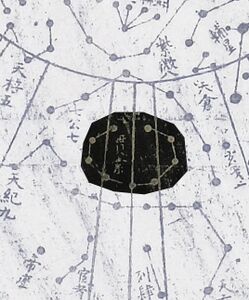 Guansuo on Cheonsang Yeolcha Bunyajido
 -
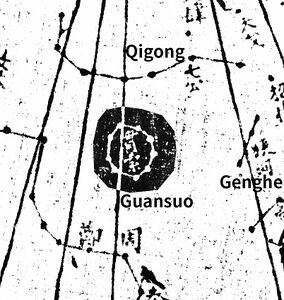 Guansuo on Suzhou Star Map
 -
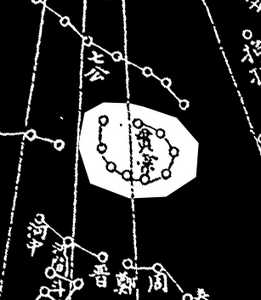 Guansuo on 18th century star map

.jpg)

IAU Working Group on Star Names
In 202x, the name of the historical constellation "xxx" was suggested to be used for one of the stars in this constellation. ...
Decision: ...
References
- ↑ P.-Y. Ho, “Ancient And Mediaeval Observations of Comets and Novae in Chinese Sources,” Vistas in Astronomy, 5(1962), 127-225.
- ↑ Yi Shitong伊世同. Zhongxi Duizhao Hengxing Tubiao中西对照恒星图表1950. Beijing: Science Press.1981: 56.
- ↑ Pan Nai潘鼐. Zhongguo Hengxing Guance shi中国恒星观测史[M]. Shanghai: Xuelin Pree. 1989. p226.
- ↑ Sun Xiaochun. & Kistemaker J. The Chinese sky during the Han. Leiden: Brill. 1997, Pp241-6.
- ↑ 5.0 5.1 B.-S. Yang杨伯顺, Zhongguo Chuantong Hengxing Guance Jingdu ji Xingguan Yanbian Yanjiu 中国传统恒星观测精度及星官演变研究 (A Research on the Accuracy of Chinese Traditional Star Observation and the Evolution of Constellations), PhD thesis, (Hefei: University of Science and Technology of China, 2023). 261.





