Psalterium Georgianum
Authors: Doris Vickers, Susanne M Hoffmann, IanRidpath

Psalterium Georgianum, George's Harp, is an early modern constellation introduced by Maximilian Hell in 1789.
Concordance, Etymology, History
Variants
- Psalterium Georgianum
- Psaltriem Georgii
- Harpa Georgii
Origin of Constellation
Ian Ridpath:[1]
Maximilian Hell (1720–92), the Hungarian-born director of the Vienna observatory, introduced this constellation in 1789 under the name Psalterium Georgianum, i.e. George’s Psaltery, a psaltery being an ancient form of harp. It was intended to honour King George III of England, patron of William Herschel who had discovered the planet Uranus in 1781. Hell depicted the harp dangling from a ribbon beneath the hooves of Taurus on a chart in Monumenta, Aere Perenniora, Inter Astra Ponenda, a special publication issued to announce this constellation and two others he invented that commemorated William Herschel’s telescopes.
Johann Bode adopted Hell’s new constellation on his Uranographia atlas of 1801 but simplified its name to Harpa Georgii. Bode depicted it as a more modern form of harp, dispensed with the suspending ribbon, and angled the harp to fit better between the surrounding constellations (below). This was the representation that became best-known, before it faded from the sky over the following decades.
Source
Identifications
The exact area covered by this image differs between the historical atlases, but it in the area where Taurus, Cetus and Eridanus meet.
Transfer and Transformation of the Constellation
Here we give a list of all sources where the name is attested.
-
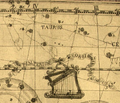 Hell (1789).
 -
 Harpa Georgii in the Uranographia of Johann Bode (1801).
 -
 Sidney Hall (1825), plate 28 in Urania's Mirror
 -
 Alexander Jamieson (1822). Orion, Psaltriem Georgii, Sceptrum Brandenburgium, Lepus and Columba Noachi
 -


Mythology
mnemonic tales and cultural significance
Weblinks
References
- References (general)
- ↑ Ian Ridpath, Star Tales, Online Edition