Prau Pegat
Authors: Youla Azkarrula, Susanne M Hoffmann

Prau Pěgat is an Oceanic name from Bali (Indonesia). The lintang of prau pěgat is found in intersection of Sukra (Friday, in saptawara) and Pon (in pancawara) in a series of palelintangan. Lintang prau pěgat means broken ship constellation.[1]
Etymology and History
Prau Pegat (IPA: [ˈpra.u ˈpə.ɡat])
Spelling Variants
- Banawah pasaj
- Prawu p’gat
- Pěrahu pěgat
- Pěrahu pěcah
Origin of Constellation
This lintang depicts a boat that has broken or split in two.
General information

The astronomical identification of the constellation is taken from Maaß (1929)[2] who explains in general that these constellations and the according ritual practice
"sind seit alten Zeiten in einem Werk ,,wariga" niedergelegt, in dem wir zwei Kulturschichten, nämlich indische und malaio-polynesische Bestandteile wiederfinden."
English: "are written down in a work called "wariga" since old times; there we recognise two cultural layers, i.e. the Indian and the Malayo-Polynesian."
He also quotes other scholars[3][4][5][6] and his earlier work[7][8] reporting that this work dates back to the 9th century CE when Bali was part of a Hindu empire on the neighbouring island of Java.[2] Neubronner van der Tuuk even uses the Old Javanese spelling.
Identification
The identifications, Maaß (1929) gives according to the aforementioned and his own studies during visits of the country and in European and Batavian libraries (p.150).[2]
Maaß (1929), p. 142:
banawallpasah; - prawu p'gat; ein leckgewordenes Schiff.
English: banawallpasah; - prawu p'gat; a ship that has sprung a leak.
Transfer and Transformation of the Constellation
Mythology / Religion
In the depiction of the Kerta Gosa, perahu pegat is depicted as a foreign (Japanese) ship that was split in two after being damaged by a water creature seen as an astral being whose purpose was to protect the Balinese people.
Image Variants
-
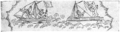 Lintang banawahpasah (CC-BY Alfred Maaß, (1929), Astrologische Kalender der Balinesen)
 -
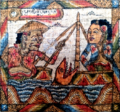 Lintang Praha Pgat in the cloth (CC-BY UPTD Museum Bali)
 -
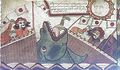 Lintang Parahu Pgat (CC-BY Youla Azkarrula taken in the ceiling of Taman Gili Klungkung Palace Bali)


Cultural Beliefs
Numerology (Neptu/Urip)
Sukra (Friday, in saptawara) has a value of 6 and Pon (in pancawara) has a value of 7. Thus, the total urip on this lintang is 13.[9]
Astrological Characteristics
Left by husband or wife, widowed or widowed, their mind is always confused, gamblers, like to chase delicious foods. At first, they get pleasure but in the end they will suffer. They like to socialize and have a compassionate heart. Unfortunately, they often get caught up in praise so that it is difficult in the future.[9]
Matching Gemstones
Cempaka (yellow sapphire).[9]
Weblinks
All HIP Stars within this constellation
Stars within the Constellation Area
| id | Label | IAU design. | description | Vmag |
|---|---|---|---|---|
| 1 | Nunki | HIP 92855 | within constellation lines | 2.067 |
| 2 | Ascella | HIP 93506 | within constellation lines | 2.59 |
References
- References (general)
- ↑ Maass, Alfred, “Astrologische Kalender der Balinesen,” in Koninklijk Bataviaasch Genootschap van Kunsten en Wetenschappen, Feestbundel bij gelegenheid van zijn 150 jarig bestaan 1778-1928, 2 vols. (Weltevreden, 1929), Vol. 2, 126-157.
- ↑ 2.0 2.1 2.2 Cite error: Invalid
<ref>tag; no text was provided for refs named:1 - ↑ Friedrich, R. (1849). Voorloopig verslag van het eiland Bali, Batavia, Verb. Bat Gen. Deel 23, Nr. 13
- ↑ HINLOOPEN LABBERT0N, D. VAN (1910). Geillustreerd handboek van Insulinde. Amsterdam: "Vivat"
- ↑ PIGEAUD, TH. (1925). Een stuk over sterrenkunde uit het Anggastyaparwwa ...... Weltevreden: Albrecht. Tijdsch. v. lnd, T.-, L.- en Vk. deel LXV
- ↑ Nieuwenkamp, W. O. J. (1905), Schetsen van Bali en Lombok. (Eigen Haard)
- ↑ MAASS, ALFRED (1920). Sterne und Sternbilder im malaiischen Archipel. Berlin. Zeitschrift für Ethnologie Jg. 1920/21, H. 1
- ↑ MAASS, ALFRED (1924). Sternkunde und Sterndeuterei im malaiischen Archipel. Batavia, den Haag. Tijdsch. v. T.-, L.-en Vk. deel LX IV
- ↑ 9.0 9.1 9.2 Tim Kajian Palelintangan, “Gabungan Kajian Palelintangan,” Museum Bali (2021), 1-149.





